Saturday, January 19, 2019
January is in with a roar!
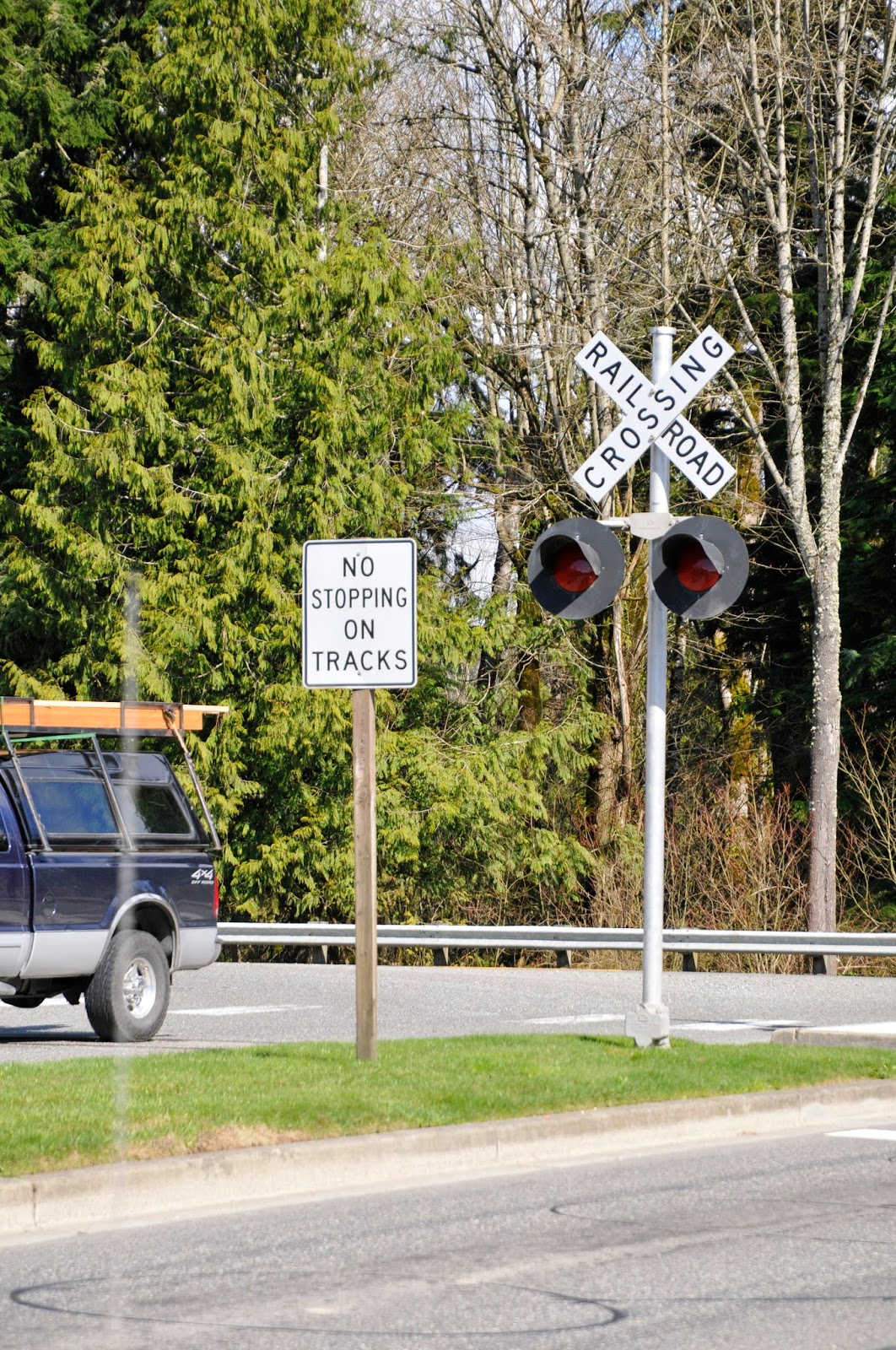
In addition to being one of the warmest Januaries on record, there have been some powerful wind storms. Trees have been blown down, power out, and traffic detoured. Wind storms have also destroyed a total of three railroad crossing gates on the Museum's railroad in North Bend.
Crossing gates are designed to withstand wind gusts of more than 70 miles per hour, but despite official records indicating gusts of "just" 50 mph, three gates - made of extruded aluminum - folded up over the wind guards. Of course, despite the unexpected expense and effort, they will be repaired in time for the coming season, which begins at 11 AM on Saturday, April 6, 2019.
Sunday, July 8, 2018
Crossing art?
Completion of this crossing work represents two more summer projects the Museum can check off the list, and another task completed in time for Day Out With Thomas 2018.
Saturday, June 30, 2018
Crossing Northern
Friday, April 18, 2014
Crossing gate retired
The Museum recently retired a railroad crossing gate mechanism that was placed in service in 1953, reportedly on either the Great Northern or Northern Pacific Railway here in Washington State. It was received in a donation from the Burlington Northern in 1977 and installed on Meadowbrook Way SE in Snoqualmie.
The Griswold-built device was manufactured in Minneapolis by the precursor to today's Siemens Rail Automation. This device is known in the industry simply as a model EM gate, and was replaced with a much newer device of the same design that was rebuilt by the Museum's signal maintainer Jon B. Rebuilding included new wire, a new relay, repainting, new lights, new cross bucks and more. Total financial investment was modest but an estimated 175 person hours were invested in the project.
The original device served the Museum well but the mechanism was badly worn; replacement was the only practicable option. The newly rebuilt device will easily serve for twenty or more years thanks to the efforts of Jon and others at the Museum.
Come and see it in operation for yourself - trains operate weekends through the end of October. Check out schedules and fares on the Museum's web site at www.trainmuseum.org
Saturday, March 22, 2014
A signal indication
Monday, February 25, 2013
Main Street crossing reconstruction
Railroad crossings represent one of the bigger funding challenges for the Northwest Railway Museum. With a total of 18 roadway crossings, the Museum devotes significant resources towards maintenance and reconstruction. This latest project cost was in excess of $51,000 and replaced a double track crossing in downtown North Bend, which was required to continued operating trains into the North Bend Depot.
Concrete panels arrive and await
installation on Main Street as an
excavator sets the grade.
|
The Museum learned about a small track removal project in the City of Redmond, about 20 miles from the Museum. There, two concrete tub crossings that were installed in 1997 were being removed to allow installation of a new sewer. Often, used tub crossings are scrapped because they are difficult to remove without damage. So with little commercial value, the City of Redmond was able to donate the panels to the Museum. In the end, of the 70 panels removed, 40 were reclaimed, repaired and reused. This “saved” the Museum over $35,000 versus the cost of new crossing tubs.
The new crossing takes shape on Main
Street in North Bend. Concrete tubs
eliminate the use of railroad ties in the
crossing.
|
Other important project support came from the City of North Bend, which provided all the traffic control required to close the road and detour traffic, and forgave three years of user fees for the North Bend Depot for a combined benefit of over $11,000.
The crossing has been completed; it opened as soon as the
asphalt cooled.
|
And the Museum was able to secure some relay rail for the side track (new rail was used on the main). As well, the Museum's dedicated volunteers were able to perform the required repairs on the used crossing panels.
The project allowed for six days of construction but it was completed in less than five. RailWorks Track Systems, Asphalt by George, and Snoqualmie's Imhoff Contractor Crane Service performed the balance of the work.
Wednesday, October 31, 2012
Crossing repairs
Center of crossing is re-
paired on North Bend Way.
|
Asphalt By George's crew compacts
new asphalt on Stone Quarry Road.
|
| George's crew poses at Northern Street
along with locomotive 4024.
|
Friday, July 15, 2011
Reconstructing a railroad crossing
Crossings are the interface between a railroad and a roadway or trail. The Northwest Railway Museum has 23 crossings; 13 of those are public crossings of local streets, arterials, or major thoroughfares including a State highway. All of these crossings require ongoing maintenance; the majority of the wear and tear is caused by truck and automobile traffic. To meet the needs of today's heavier trucks and increased traffic, when it is opportune crossings are being rebuilt to withstand greater weight and use.Among the busiest of the public crossings in Snoqualmie is Meadowbrook Way SE, a road that opened in the 1920s. It was last reconstructed after the great flood of 1996 using asphalt. The roadway was heavily impacted by flooding in 2007 and again in 2009, and is scheduled for repaving (overlay) in late summer 2011. The Museum has been working with the City of Snoqualmie for more than four years to secure funding that would allow reconstruction of the crossing along with the overlay. Fortunately, a portion of funding from the Snoqualmie Tribe’s Snoqualmie Casino designated for area road improvements has allowed the project to proceed.
The Museum has rebuilt nearly 1/2 of its public crossings in the last 15 years. All of the recent projects have been reconstructed using concrete panels similar to those used on railroads throughout the Northwest. These panels last longer and take the weight of today's trucks better than older-style asphalt or timber crossings. But the concrete panels are only the most obvious element of a crossing reconstruction. Reconstructions also often involve upgrading the size of the rail and improving the subgrade conditions by excavating out the native soil to a depth of 41 inches and replacing it with railroad ballast. (This makes the crossing more resistant to settlement caused by the passage of trucks and busses.) It also involves the use of longer railroad crossties to improve stability and to support concrete panels. All these improvements together allow reconstructed crossings to last at least 25 years.
RailWorks of Chehalis, WA was awarded a contract and began work on July 5. The existing crossing was removed and the subgrade was excavated to a depth of 41 inches. Larger replacement rail (115 RE, which means it is 115 pounds per yard, as opposed to the existing 90 RB rail, which is 90 pounds to the yard) was welded together using the thermite process to eliminate rail joints from the crossing. Geofabric was placed as a new base at the bottom of the excavation. New railroad ballast was placed as subgrade and new oak crossties were placed on 18 inch centers. The welded rail was double spiked in the crossing and rail anchors to resist creep were installed.
Concrete panels manufactured by Omega Industries of Vancouver, WA were installed on the new ties, and Asphalt by George patched the space between the new panels and the existing roadway. The City of Snoqualmie provided additional project support by assuming responsibility for the temporary closure of Meadowbrook Way SE. Project value was $38,000 and work was completed in 3 days.
Photos/Video:
(video) Scenes from the Meadowbrook Way SE crossing reconstruction project
(top photo) Completed crossing on July 8, 2011
(upper middle photo) New concrete crossing panel is lowered into place. Large lag screws driven into the white oak cross ties will hold them in place.
(lower middle photo) A jig is used to align two lengths of rail prior to thermite welding.
(bottom photo) Special compromise joint bars transition between the new welded rail and the existing rail. (Note the different height.)