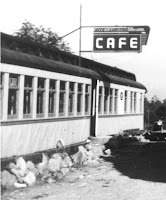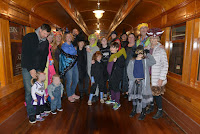
The Northwest Railway Museum is delighted to announce appointment of Ms. Peggy Barchi as the new School Train Coordinator. Peggy brings a wealth of museum interpretive experience, and previously worked as the Marketing Manager of the Museum before retiring in 2018. She is a veteran of Fort Nisqually, and is a former Scouting leader, too.
School Trains are Museum programs developed specifically for school-age children, but also for preschoolers. They operate in April and May, and this year are expected to serve 2,000 children. School Trains have operated at the Northwest Railway Museum for more than 40 years.
More information is available on the web or by emailing info@TrainMuseum.org
Monday, January 27, 2020
Friday, January 17, 2020
Take this box and shelve it!
| The Railway Education Center in January. |
| Rolling carriages are the heart of a SpaceSaver shelving system. |
| Registrar Cristy L. demos how the rolling shelving moves along the black tracks set into the floor. |
Thanks to a major grant from the King County 4Culture cultural equipment program, and additional support from individual donors, a new 32 inch shelving carriage has been added to the vault. SpaceSaver made this rolling unit with attached shelving and completed the installation through their representatives at Southwest Solutions.
| Cristy L. shows off the library's new set of wheels: 10' high, 11' long, 32" wide |
The SpaceSaver shelving arrived in large crates and assembled much like a giant Erector or Meccano set. It was ready to load with boxes after just four or five hours of effort by the Southwest Solutions crew. Already many important documents including all the chapel car 5 research, and exciting tomes published by the Association of American Railroads have found a new home on this brand new mobile storage structure.
The Northwest Railway Museum staff, trustees and patrons send a huge "Thank You" to King County 4Culture, and the more than dozen individual donors who made this new shelving financially possible.
Friday, December 13, 2019
Steam locomotive 924 updates
Steam locomotive 924 is an 0-6-0 constructed in 1899 by the Rogers Locomotive Works. By 1901 it was owned by the Northern Pacific Railway and had been shipped west to Seattle. It served a distinguished career in the Seattle region switching docks along Elliot Bay, building passenger trains to originate at King Street Station, and even switching industry in Everett, Tacoma and Auburn. While all the plumbing has been happening, other members of the crew have been working on mechanical components including driving boxes, connecting rods, and the main rods. So progress is evident on more than one front, and Spike will produce another update in a few weeks to show you even more progress.
The 924 project is one of the largest rehabilitation projects the Museum has undertaken, and work is in the final phases. Your support can help bring this project to completion, and really does make a difference! Your donation in any amount may be made on the Museum's web site here and is tax deductible to the extent provided by law.
Labels:
injector,
locomotive 924,
Northern Pacific Railway,
steam
Monday, November 25, 2019
Upgrading coach 213
![]() |
| Sister coach 214 as delivered in 1912. |
![]() |
| Michelle F. cleaning open car 213 in 1995. |
![]() |
| 213 windows are now fully operational. |
![]() |
| The natural canvas color is white; bronze tacks fasten the edges. |
![]() |
| Veneers are quarter-sawn, which exhibits this striking pattern. |
![]() |
| The traditional restroom is becoming an electrical locker. |
Coach 213 is an historically valuable object in the Museum's educational collection. It is slowly but methodically being returned to its former glory as a first class passenger coach. Meaningful progress is being made, thanks in no small part to contributions from 4Culture, the Schwab Fund, and almost 100 individuals.
Please consider an end-of-year contribution to help allow this work to continue in the new year. Giving Tuesday is on December 3, but you can make a Giving Tuesday contribution anytime from now through the end of the year: donate now!
Friday, November 15, 2019
Wheels for an interurban car
Puget Sound Electric Railway car 523 operated between Seattle and Tacoma from 1908 until 1928. This early mass transit allowed commuters on "Limited" trains to travel from downtown to downtown in just 1 hour and 15 minutes. The 523 is the sole surviving car from this once proud fleet and is the newest Snoqualmie property listed on the King County and City of Snoqualmie Landmarks Register.
523 was first preserved in 1963 when it was purchased by preservationist Paul Class. It had been repurposed as a home in Federal Way sometime prior to WW II, and the property owner was ready to build a larger house. So Mr. Class purchased the car and moved it to Oregon where he had started what today is known as the Oregon Electric Railway Historical Society. There were several ill-fated restoration attempts on the 523, but only when the car was donated to the Northwest Railway Museum was a formal plan prepared.
When 523 was adaptively reused first as an outbuilding and then as a home, the wheels and motors were no longer needed; they were sold for scrap circa 1930. So replacements of at least similar vintage were needed. This month new trucks (wheels and motors) for the 523 arrived in Snoqualmie. This was the result of a culmination of more than a year of effort and is being made possible with support from the Schwab Fund for Charitable Giving and 4Culture's Building for Equity program.
The "new" trucks are actually from an electric car order built for the Chicago Elevated and delivered in the early 1920s. The trucks were built by Baldwin (same builder of the Museum's locomotives 4012 & 4024), but are a decade newer than the trucks that would have been found under the 523 circa 1914. The front truck is powered with two GE traction motors and the rear truck is unpowered.
The Streetcar Investment Company purchased the trucks from a scrap car some years ago and the components had been in storage at their California yard. An industrial motor shop in the Bay Area overhauled the two GE 243 traction motors, and the Streetcar Investment folks reassembled everything. They arrived on a Gerlock Heavy Haul tow truck, the same rig that delivered 523 to the Museum more than two years ago.
The trucks are not ready for installation. It was important to acquire and move the trucks so that all the variables between the carbody and the trucks were correctly defined. Until they are installed, the trucks will remain in storage inside the Museum in Snoqualmie.
The "new" trucks are actually from an electric car order built for the Chicago Elevated and delivered in the early 1920s. The trucks were built by Baldwin (same builder of the Museum's locomotives 4012 & 4024), but are a decade newer than the trucks that would have been found under the 523 circa 1914. The front truck is powered with two GE traction motors and the rear truck is unpowered.
The Streetcar Investment Company purchased the trucks from a scrap car some years ago and the components had been in storage at their California yard. An industrial motor shop in the Bay Area overhauled the two GE 243 traction motors, and the Streetcar Investment folks reassembled everything. They arrived on a Gerlock Heavy Haul tow truck, the same rig that delivered 523 to the Museum more than two years ago.
The trucks are not ready for installation. It was important to acquire and move the trucks so that all the variables between the carbody and the trucks were correctly defined. Until they are installed, the trucks will remain in storage inside the Museum in Snoqualmie.
Labels:
4culture,
PSER 523,
Puget Sound Electric Railway,
Schwab Fund
Thursday, October 31, 2019
Giving thanks for the chapel car

Arthur lovingly cared for the chapel car, maintaining its unique Terne metal roof, and keeping fresh paint on the car's exposed exterior. The car was a part of family gatherings and events for more than 30 years, and became important to them, too. Sadly, Mr. Hodgins passed away in October 2005 at the age of 95.
In 2007 the Hodgins Family donated the chapel car to the Northwest Railway Museum. It was moved from near the town of Grayland on the Pacific coast to Snoqualmie that same year. It was successfully nominated to the National Register of Historic Places in 2009, and secured a Save America's Treasures grant later that year. Major rehabilitation work began in 2011 and the substantially complete car is now on exhibit in the Train Shed exhibit building in Snoqualmie.
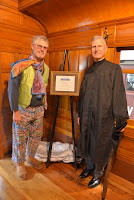
The Trustees and Staff of the Northwest Railway Museum gratefully
acknowledge the tireless dedication of
Arthur H. Hodgins
(24
June1910 – 15 October 2005)
preserving
Chapel car 5 Messenger
of Peace
His foresight is allowing new
generations to appreciate its magnificence as a mobile church, understand its
role in community development, and view it as a grand example of the lost art
of wooden railway car construction.
_______________________
With gratitude, the Northwest
Railway Museum, 27 October 2019
Thursday, October 10, 2019
Inside a caboose
Notably, 001 was built during the war at Enumclaw. This was because the war time ration board denied White River permission to purchase a new caboose. Yet a caboose was required on log trains with ten or more cars. So the logging company managers tasked their workers with building a caboose. It is not a prime example of the fine art of car building, but it is an example of the thoughtful and utilitarian improvisation that was common in logging camps throughout the Northwest.
Come and visit caboose 001 Thursday - Sunday from 11:00 am - 4:00 pm through the end of October. Members are free. Admission is included with all regular train tickets; trains depart Snoqualmie on Saturdays and Sundays 11:00 am, 12:30 pm, and 3 pm. A la carte visitation is $10 for adults and $5 for children.
Labels:
caboose 001,
Exhibits,
Train Shed,
White River Lumber Company
Subscribe to:
Posts (Atom)