Showing posts with label signals. Show all posts

Friday, April 18, 2014

Crossing gate retired

One of the aspects of railroads that Spike finds particularly interesting is the longevity of many fixed assets.  Bridges, depots, and even rails are frequently in service for many decades, and in some instances for more than 100 years.  Electrical apparatus, however, are not things you often see with long service lives, but there are exceptions. 

The Museum recently retired a railroad crossing gate mechanism that was placed in service in 1953, reportedly on either the Great Northern or Northern Pacific Railway here in Washington State. It was received in a donation from the Burlington Northern in 1977 and installed on Meadowbrook Way SE in Snoqualmie.

The Griswold-built device was manufactured in Minneapolis by the precursor to today's Siemens Rail Automation.  This device is known in the industry simply as a model EM gate, and was replaced with a much newer device of the same design that was rebuilt by the Museum's signal maintainer Jon B.  Rebuilding included new wire, a new relay, repainting, new lights, new cross bucks and more.  Total financial investment was modest but an estimated 175 person hours were invested in the project.

The original device served the Museum well but the mechanism was badly worn; replacement was the only practicable option.  The newly rebuilt device will easily serve for twenty or more years thanks to the efforts of Jon and others at the Museum.

Come and see it in operation for yourself - trains operate weekends through the end of October.  Check out schedules and fares on the Museum's web site at www.trainmuseum.org

Saturday, March 22, 2014

A signal indication

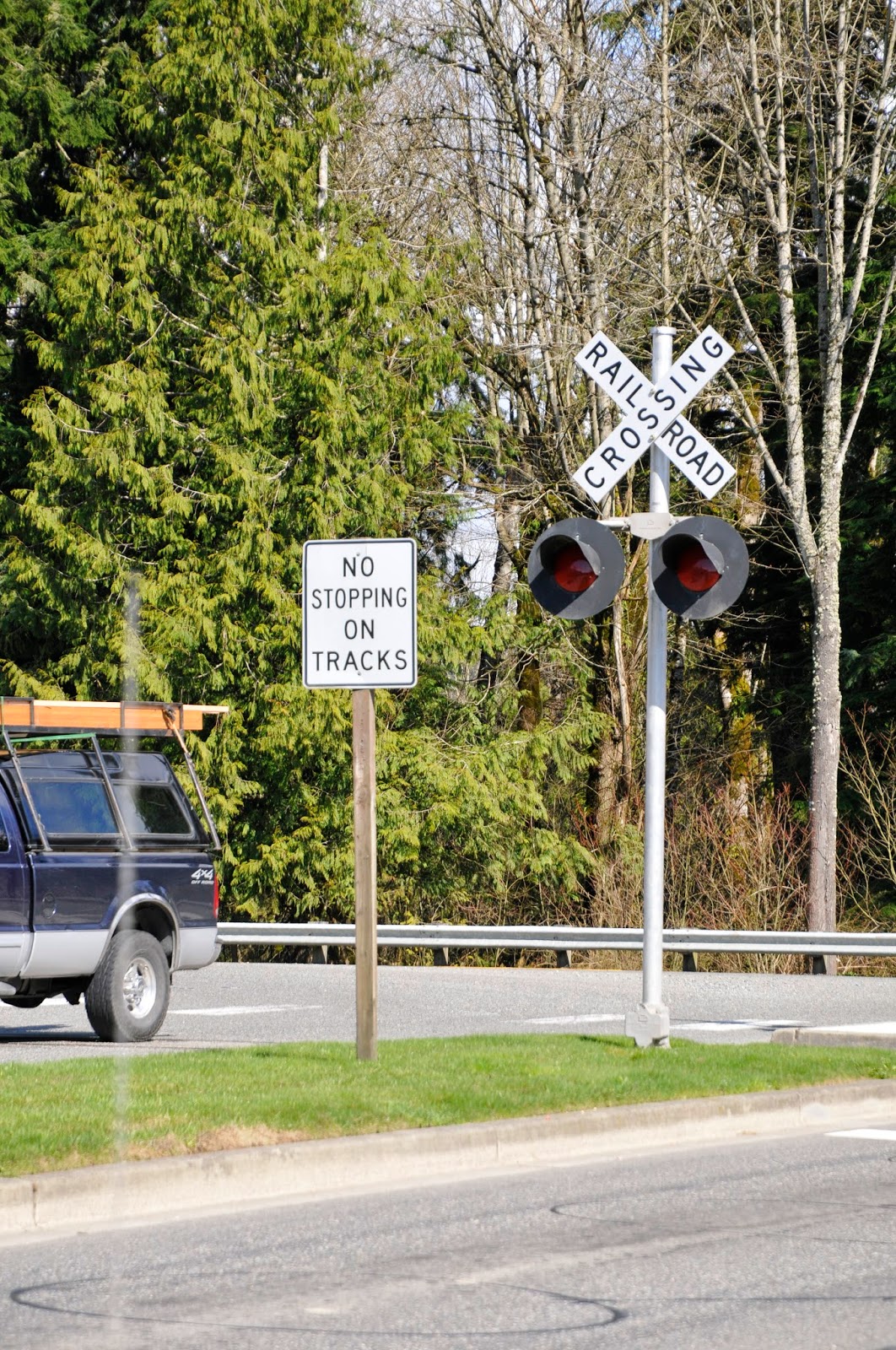
Winter weather often brings challenging driving conditions, and with that comes the inevitable opportunity for mishap. And so was the outcome of a recent winter driving incident at the Snoqualmie Parkway railway crossing.  The incident did not involve a train or engine, and there were no serious injuries.  However, the multiple vehicle accident resulted in the loss of a mast and signals in the center median when a deflected vehicle struck the mast, broke it off at the base, and the resulting impact with the local terrain damaged nearly every component.  Fortunately, no one was seriously injured, and the vehicle owner was appropriately insured.

The Northwest Railway Museum is responsible for five railroad crossing signal systems. With limited project work and just occasional component failures, the Museum only rarely purchases replacement parts.  So it came as quite a surprise to learn how much consolidation and change in the railroad signal industry has taken place in the last few years: now many signal components are supplied by Siemens Rail Automation, and nearly everything is made to order. So instead of purchasing parts "off the self," a new assembly was ordered.  About six weeks later, it arrived on a truck ready for installation.
The installation was completed in a few hours and the system was tested.  Costs totaled more than $6,000 and were fully reimbursed by the vehicle's insurance carrier.  Now the Snoqualmie Parkway signals are back in service and ready for the upcoming operating season!

Friday, April 24, 2009

Signal repairs

North Bend's Bendigo Street railroad crossing is fully repaired following efforts led by signal maintainer Jon B. and assisted by Steve P., Issac F., and Dan C. A beautiful April 24 saw temperatures soar to 66 degrees and the crew of four made quick work of the assignment. Completing this work will allow trains to operate through this crossing without restriction beginning Saturday, 25 April 2009. (Click here for current schedules.)

Technically, a new Safetran model S-40 gate mechanism was installed in the west quadrant. Heavy rains that precipitated the January 7 & 8 flooding infiltrated and damaged this crossing gate mechanism on Bendigo Street. Temporary repairs allowed the crossing signals to function normally up until now, but complete replacement for "permanent" repair was required because it was not practical to fully repair this 30 year-old model S gate. The old gate mechanism was disconnected and lifted off with the Museum's Pettibone Speedswing; then a new one was hoisted into place. The entire procedure took 5 hours and replacement parts cost over $6,000; this in another in a series of flood-related repairs that when completed will total $116,000.