Wednesday, July 18, 2012

Thomas thrills thousands

Thomas the Tank Engine steams into
Snoqualmie.
Thomas the Tank Engine is visiting Snoqualmie and the Northwest Railway Museum for the 12thannual Day Out With Thomas event. The first three days of the six day event have concluded and thousands came to see the really useful engine.

In all, more than 16,400 visitors are expected at this sold-out event before it closes July 22. Motor car rides, temporary tattoos, live steam model trains, train tables, live music and models of Thomas the Tank engine were just some of the activities.  Proceeds support Museum programs including rehabilitation of Chapel Car 5 Messenger of Peace and operation of the Snoqualmie Depot.


Sir Topham Hatt is an
honored guest.
Genii Blue Clown adds
exitement to the event!
Casper Baby Pants
performs live.
Day Out With Thomas is
a rewarding event to
witness!


A photo with Thomas!
 

A happy visitor takes a
motor car ride

Friday, June 29, 2012

Improving collections care

Stewardship of a massive collection like the Northwest Railway Museum’s can be daunting.  A trained curator can quickly see there are issues with storage conditions, damaged artifacts, and security. Heat, light, humidity and too few restrictions on collections access are the usual culprits, but they do have to be identified and assessed before they can be mitigated. So what to do?
Cristy L. highlights one of the
new dehumidifiers in the
periodical and drawing
storage area.
For starters, solving collections challenges is a long term process – there are no quick fixes in this field.  In 2006 the Museum hired Randy Silverman, preservation librarian at the University of Utah’s Marriot Library in Salt Lake City, to conduct an assessment and write a preservation needs report.  That project, funded with a grant from the National Endowment for the Humanities, has helped guide a long term strategy to improve collections care, primarily through improved collections storage.

The latest implementations of the Silverman report's recommendations - thanks to a 4Culture Collections Care Grant - are the acquisition of three dehumidifiers and a special museum vacuum.
Environmental monitoring devices were installed in collections areas in 2010 and 2011.  With nearly a year of data, collections staff were able to identify areas where environmental conditions were presenting the greatest threats to the collection.  Three areas were found to have humidity that was unacceptably high on a consistent basis.  The collections care grant has allowed the purchase of three modest-size dehumidifiers that are being used to reduce humidity and improve the storage environment where small objects, periodicals and drawings are stored.
Cristy L. demonstrates the Nilfisk HEPA
variable speed vacuum on a wood crate.
Cleanliness is next to . . . well, you know the saying, and it may as well have been written for museum curators.  “Dirt” threatens museum collections, whether it be in the form of mold, dust, rodent droppings, or just plain sand.  Long term preservation needs demand that artifacts be clean and the environment that they are stored in be just as clean.
A museum vacuum has variable speed to allow control over the amount of suction, and a HEPA filtration system so that hazardous substances – such as mold or Hantavirus – are not sucked up and transmitted around the room.  So a Nilfisk model GM 80 vacuum with a museum kit has been purchased with the collections care grant proceeds.  The museum kit provides a HEPA filter, variable speed to control suction, and special attachments to get into unusual spaces.
So thanks to a 4Culture collections care grant, the Northwest Railway Museum is able to make additional improvements in collections storage conditions.  This is helping ensure the Museum’s collections will survive long into the future.

Wednesday, June 27, 2012

Aarrgh!

Avast me hearties:  the Snoqualmie Railroad Days committee is proud to announce the return of the SeaFair Pirates! They’re back, matey!

The SeaFair Pirates will sail inland to grace our town with their piratical presence at our community festival, Snoqualmie Railroad Days. Watch for them on Saturday in the Grand Parade. And you better watch out for those rascally pirates all afternoon too! See you at Snoqualmie Railroad Days.


Come join in the fun in Snoqualmie, Washington, August 17-19, 2012! www.railroaddays.com

Tuesday, June 5, 2012

Terne over a new roof

The original Terne roof was applied in
1898.  Pin holes, loss of coating and
breaches in the membrane left few
options for the rehabilitation.
The roof on a century-old railcar is more than just something to keep the rain out; it is a distinguishing feature.  On chapel car 5 Messenger of Peace, the roof is particularly important for what it was made of: Terne metal.  The vast majority of 19th and early 20th Century rail passenger cars had a canvas roof supported by a wooden deck.  The chapel car was built with a 28 gauge Terne sheet metal roof supported by a wooden deck.  It debuted in its natural state and over a short period of time oxidized to a pleasant pewter-like appearance.  In later years as the roof began to show its age, it was coated with paint and other materials to seal leaks.
Orignal Terne sheet metal produced by
Piqua in 1898.  The pewter-like
appearance is oxidation accelerated
by air pollution.  The seams were
sealed with lead solder.
Terne metal has been around for more than 200 years and in its earliest form was sheets of wrought iron coated with an alloy of tin and lead.  Thomas Jefferson’s Monticello was roofed with Terne metal at his request, and other important 19th Century structures that were built to last also received the same treatment.  As technology improved, Terne roofing was offered as light sheet metal with its corrosion-resistant coating on both sides.  Light-weight Terne roofing could be used in a variety of lighter constructs – such as a railcar roof.

Original sheet metal roof was carefully
torn up to  allow depair of the deck.
The "holes" behind Gary were for the
kerosene lamp chimneys.
Chapel car 5 was built with a traditional Terne-coated 28 gauge carbon steel roof.  The light gauge sheets performed for more than 100 years but by the time the car arrived at the Museum, the sheets were heavily compromised with pin holes.  Complicating how this would be mitigated was the unknown condition of the underlying decking: the only way to inspect and repair was to remove the metal sheets.  It was not practicable to remove the original sheets and reuse them.  And the Museum's concern was justified: several areas of previously undetected deterioration were discovered as the original Terne metal was removed.  The ends hoods in particular had issues and new "green" white oak lath was steamed and applied to the damaged areas to rehabilitate them as new. 
New panels on the upper deck.  Metal will be kept in its natural
state in keeping with the original treatment.
A team of two sheet metal specialists
applied the new Terne II sheets.  The
center panel of the upper deck slid
over the two side panels.
So what is the Terne coating?  Originally it was an alloy of approximately 79% lead and 19% tin.  So why tin?  Tin allows the molten lead to ”stick” to the carbon steel, which it ordinarily would not.  The other 2% of the alloy is additives such as antimony to adjust characteristics such as melting point.  Today, a concern over lead in the environment has evolved the product into an alloy of zinc and tin, which is now known as Terne II and is manufactured by Follansbee. Seams of Terne II sealed with tin solder. 
The hoods on the ends of the roof
were particularly challenging.
The new Terne II metal was available to the Museum in a coil steel format.  So large coils were purchased, sheared by sheet metal specialists, and each edge bent to 90 degrees.  Individual sections of roofing are connected to each adjacent panel by folding the edge of the panel over the edge of the next panel and rolling it smooth.  The seam was soldered with tin to complete the seal; work was performed by Trinity Sheet Metal of Granite Falls, WA.  In all, more than 1,800 linear feet of soldering was required to complete the roof.  The new roof – as with the original – will be left uncoated and untreated.  Over time it will oxidize to a pewter-like patina, though ironically because of cleaner air today this process will take considerably longer than it would have in 1898.
The completed roof is striking and a is
an appearance not seen for generations.
Work was completed in May and substantially completed the roof area of the chapel car.  Special thanks to major funders including the National Trust for Historic Preservation's Partners in Preservation (funding by the American Express Foundation), Save America's Treasures, 4Culture, and the Washington State Heritage Capital Projects Fund administered by the Washington State Historical Society. 

Monday, May 28, 2012

Studio Snoqualmie

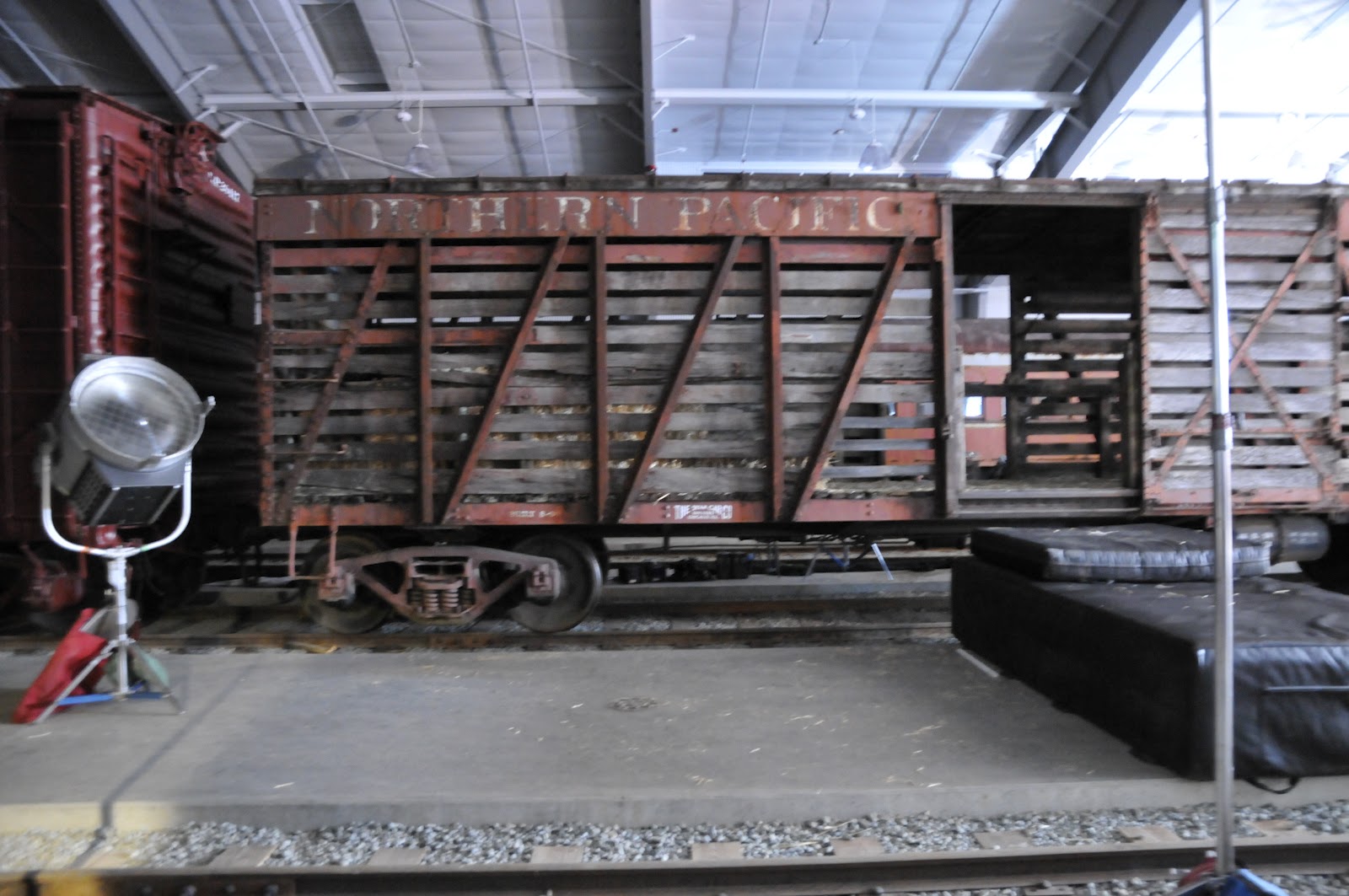
Former NP stock car is positioned for
filming inside the Train Shed exhibit
building.
Lights!  Camera!  Work Extra 4024, take it ahead!  Not quite what you were expecting?  The Northwest Railway Museum was briefly transformed into a movie studio for the production of You Can’t Win, a screen play adapted from the literary work of the same name.  Filming at the Museum of this independent production took place on May 16 and 17, 2012; other scenes were filmed in the Snoqualmie Valley in the following week.
Costume specialists make last minute
 preparations to a jacket for a young
 Jack Black as extras prepare for their
 entry into the scene.
You Can’t Win is a novel published in 1926 and is the autobiography of Jack Black, a hobo and thief for more than 30 years who in later life reformed himself and became a librarian.  Black is portrayed by Michael Pitt, an American actor best known for his role as Jimmy Darmody in HBO’s Boardwalk Empire.  The film is directed by Robinson Devor, a Seattle-based director.
Inside the stock car, the film crew
prepares to shoot as the train operates
between Snoqualmie Falls and Bridge
35.  Director Devor is seen in the
center looking toward the camera. Pitt
is seen at the other end of the car in
character.
The production team had a variety of “riding the rails” scenes they wanted to recreate, many dating from the late 19th Century.  A train station scene was filmed in the Snoqualmie Depot ladies’ waiting room with locomotive 11 visible through the windows.  Several more scenes were filmed with representative freight cars from the Museum’s collection including a stock car, two former Northern Pacific Railway boxcars and a former Great Northern auto boxcar as they operated between Snoqualmie Falls and Bridge 35.
The former Great Northern automobile
boxcar is prepared for an action scene
with lighting and a blue screen.  The
car was rocked back and forth while
filming took place.

Later, the Museum’s Train Shed exhibit building proved to be a workable studio where a number of important scenes could be filmed inside the cars while they were stationary.  A“blue screen” was placed in the background and will be used to insert motion scenes later.  A crew of more than 70 specialists was involved in the production, which is expected to debut at a film festival in 2013.

Former NP boxcar was
the site of a "staged" ac-
cident.  
The Museum only rarely participates in movie production - it is very disruptive to operations and is distracting to volunteers and staff.  You Can't Win is different: it has thematic content consistent with the Museum's mission.  And license fees the Museum charged were sufficient to fund work on Bridge 35 earlier this year.  Overall, the project progressed without incident thanks in part to the Museum's great team of volunteers (more than 20 participated!), staff, and a great and respectful movie production company.


Wednesday, May 23, 2012

Salute!

In honor of Memorial Day, the Northwest Railway Museum is offering reduced fare train rides for members of the military: active duty, guard, reserve, retired, and their dependent families. See the splendid scenery of the Cascade Foothills through the windows of a vintage railcar.

Your current military id and $5 are all you need for a ride on the Museum’s train Saturday, May 26 – Monday, May 28, 2012.

What a great deal, and fun for the whole family, too. All are welcome of course. Check the schedule on www.trainmuseum.org. The first train departs the Snoqualmie Depot at 11:01 AM and the North Bend Depot at 11:31 AM.

Show your current military id at the ticket window of either the Snoqualmie or North Bend Depots. The Ticket Agent will issue a special ticket to you for only $5.

Tuesday, May 8, 2012

Clerestory windows for the chapel car

Let there be light, and some fresh air too!  One of the distinguishing features of most traditional clerestory-roofed railroad cars is the clerestory window.  Designed to provide both light and ventilation, the windows are typically elongated and have hinges that allow the windows to “roll” into the car.

Chapel car 5 - built in 1898 in an era before air conditioning - was built with 45 clerestory windows.  These windows were constructed of white oak and were glazed with double glue chip glass.  Fortunately, these windows were in comparatively good condition and 38 original windows arrived in Snoqualmie with the car.  Unfortunately, nearly all the bottom rails were badly deteriorated and some of the glazing was broken, or had been replaced with other types of glass.
Old shellac was removed with the
infrared stripper and then alcohol.
Glass and stop material was carefully
removed and saved. 
Work began in February 2011 with the removal, cataloging, and condition assessment of all the windows.  Over a period of months hardware was recovered, glazing was removed, paint and shellac was stripped, and new stiles and rails were made and exchanged as required.  Seven completely new window frames were made, and a new weather stripping reveal to hold a rubber strip against the bottom swivel face was made for all 45 windows.  The window frames were cleaned and sanded, and then set aside until the car body was completed.  The hardware and glass were carefully cleaned and set aside for reuse.
Hardware consists of a
spring-loaded latch and a
radius with detents to hold
the window in a given
position.
Hardware is easily taken for granted but without it the windows never would have performed their function.  The hinges and pivots were assemblies originally produced by the Dayton Manufacturing Company, the hardware company owned by Barney and Smith.  Some windows had slightly more modern assemblies made by Adams and Westlake, a company still in business today as Adlake!  Regardless of origin, all hardware was "cooked" overnight in a dilute soap solution.  Each item was then lightly brushed to remove varnish, paint and rust.  The hardware was coated with a gun-metal paint color.  Many of the mounting screws were replaced in kind with steel flathead slot screws each individually painted black to match.
Shellac immediately changes the
appearance of the windows.
In winter 2011, “varnishing” of the windows began.  Traditional shellac (flakes dissolved in alcohol) was applied in successive 3 lb/gallon coats until a smooth and uniform finish was achieved - typically that required eight coats with light sanding between each coat.  Shellac dries quickly and recoating is typically after 8 hours, but it is dry to the touch in 15 minutes or less.

The exterior was painted with a dark
green urethane matched to paint
samples found under the end
platform hood.

After the varnish process was completed, the outside of the frame received primer.  Then the windows were glazed and the final coats of dark green were applied to the exterior. 
Window installation was tricky: care had to be used to set the hinges in exactly the right location so the windows are neither too tight nor too loose.  Evidence that this had been a problem in the past was a serious of metal clips that had been fashioned and installed over the clerestory hinges to prevent the windows from quite literally bouncing out on rough track!  This problem was exacerbated when windows were removed for servicing (typically a fresh coat of varnish) and were not reinstalled in the same openings they came out of.  With careful installation in the openings that match the numbers on the window, the Museum expects a more precision fit and does not plan to reinstall the “aftermarket” clips.
Lead restoration worker Kevin P.
highlights the first clerestory
windows to be reinstalled.
So many hundreds of hours later, chapel car 5 Messenger of Peace has 45 rehabilitated or restored clerestory windows installed.  The car had one of its distinguishing features returned to its former glory and another category of work is completed.