Showing posts with label Barney and Smith Car Co. Show all posts

Tuesday, October 2, 2018

There is a pew in the chapel car

The odor of the day was . . . ethanol, which was used to dissolve shellac flake.  Specifically, a 2.5 pound cut, which is 2.5 pounds gossamer shellac flake per gallon of ethanol.  This was the finish that historically was applied to the white oak surfaces in chapel car 5 Messenger of Peace, and this year was mixed and applied to new pews for the sanctuary.

Shellac is an ancient technology that has been used for hundreds of years, and was widely used until the 1930s when it was replaced by nitrocellulose lacquers. Today, even the lacquers have been supplanted by newer and more forgiving finishes.  However, shellac is easy to mix, straight-forward to apply, and it dries very quickly.  To mix workable amounts of shellac, Spike began with 22 ounces of thin flake shellac.  The flake was place in a jar and mixed with 99% ethanol to bring the total volume to 64 fluid ounces.  The resulting solution was filtered to remove contaminants and was applied to the pews with a premium bristle brush.  A total of seven coats were applied to the new pews.

Chapel car 5 Messenger of Peace is a rare surviving example of a 19th Century Barney and Smith all-wood passenger car, and a fine example of a mobile church built for the American Baptist Publication Society. It was donated to the Northwest Railway Museum by the Hodgins Family in 2007, and by 2009 it was listed on the National Register of Historic Places as a Nationally-significant property.  Much of the rehabilitation was conducted between 2011 and 2013 by a team of shipwrights and other artisans, but a selection of accurate replica pews could not be fully completed until now.  

Before the chapel car was adaptively reused as a road side diner, and then a cottage, the Messenger of Peace had special Barney and Smith-built railroad car pews. Unfortunately, they were removed and disposed of back in 1948, but an identical pew from a sister car made it into the collections of the American Baptist Historical Society. The fine staff of their archives allowed Spike to take measurements, make drawings, and create templates, which were used by a mill work firm to make accurate replicas.  In June, Spike gave you a glimpse of the pew components as they were completed in the shops of architectural mill work specialist OB Williams in Seattle.  Next week Spike will publish an inside look at the finishing project.

The project was made possible with the generous support of many partners including the Nysether Family Foundation, the American Baptist Home Missions Societies, the American Baptist Historical Society, The National Society of the Colonial Dames of America in the State of Washington, and contributions from dozens of individuals.  The Northwest Railway Museum and its Volunteers, Trustees and Staff are exceptionally grateful for this support.

Monday, June 4, 2018

Chapel car pews

Chapel car 5 Messenger of Peace is a signature exhibit in the Museum's Train Shed exhibit hall. Constructed in 1898 by the Barney and Smith Car Company, the Messenger of Peace is a wooden railway car that functioned as a mobile church for the American Baptist Publication Society, and later for the American Baptist Home Missions Society too.  Major rehabilitation work on this National Register-listed object was completed in 2013, but the sanctuary has been lacking pews, at least until now.


Unfortunately the Museum has not had the capacity to produce replica pews while the Conservation and Restoration Center has been hosting rehabilitation of NP locomotive 924 and SP&S coach 213.  So beginning last winter, journeymen cabinetmakers at OB Williams in Seattle - and their very well-equipped shop - were contracted to produce pew components, which would later be finished and assembled at the Museum.  Construction is based on designs copied from an original two-seat pew held in the collection of the American Baptist Historical Society at Mercer University in Atlanta.  The pews were originally installed in a 3 & 2 configuration, and the replica components will allow five full rows.


Much work remains: the pew components need to be finished with at least seven coats of shellac, and then they need to be assembled.  And to keep costs down, the project (assembly and finishing) is being completed between tasks on NP locomotive 924 and SP&S coach 213.  However, work is expected to wrap up early this summer.


The Northwest Railway Museum is grateful for the support that is making this project possible, including contributions from the Nysether Family Foundation, American Baptist Home Missions Society, American Baptist Historical Society, and dozens of generous individuals.  Thank you also to Ms. Terry Wick at OB Williams for agreeing to take on this surprisingly complicated fabrication, especially with the attention to detail that is making each replica almost distinguishable from the original.

Monday, June 16, 2014

Color for 218


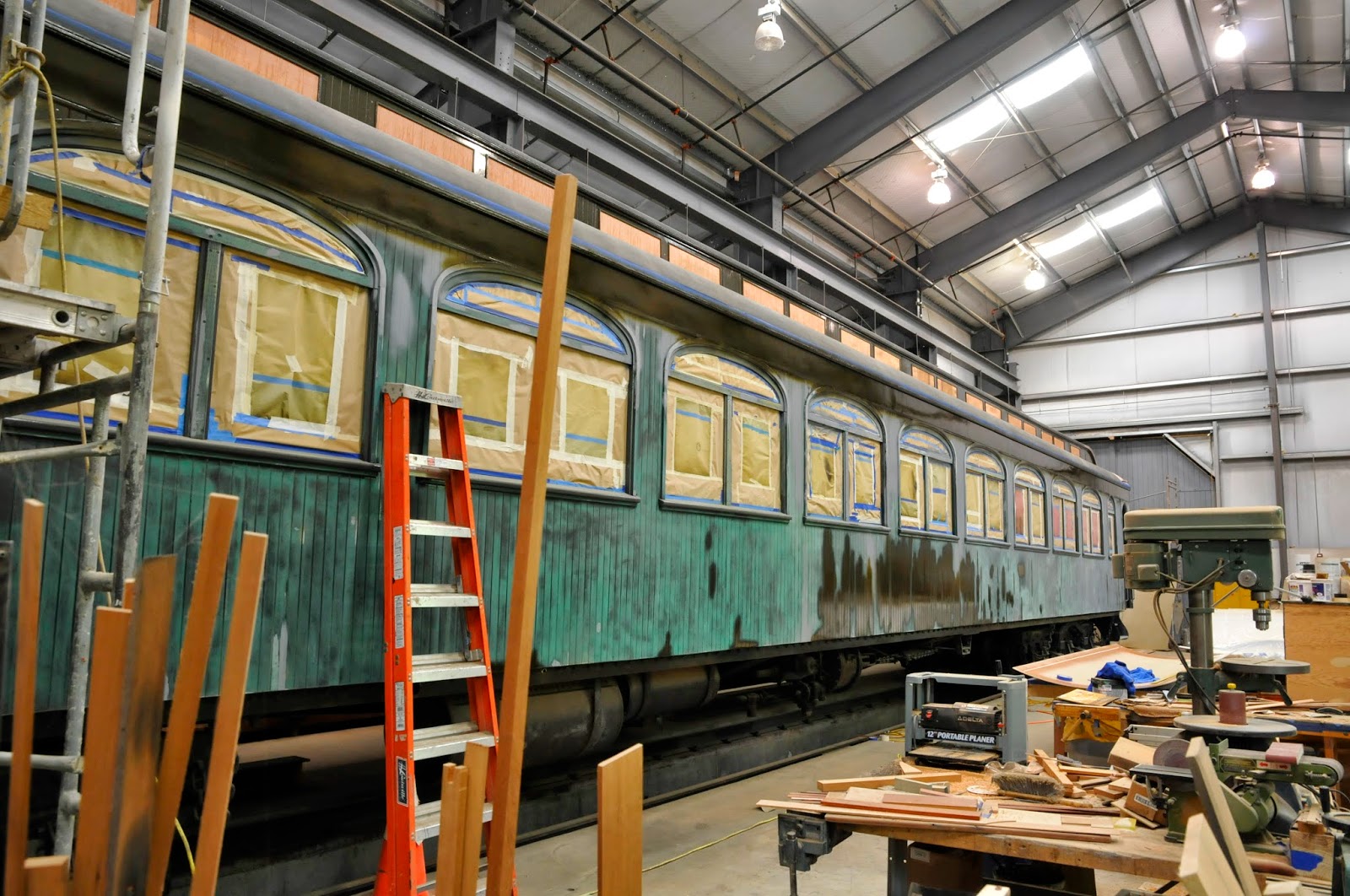
Coach 218 will be 102 years old this summer.  This Barney and Smith coach is one of the last wood coaches built for service on an American railroad.  It served the Spokane, Portland and Seattle Railway as a first class coach from 1912 through the late 1940s.

Over the last several years, coach 218 has received considerable attention from skilled volunteers and employees.  The most recent effort applied the "original" color to one side of the car.   The other side of the car will be completed in the coming weeks, but this latest effort was completed in time to debut on the annual Father's Day trains.

So what is "original" color?  It is a color matched to samples found under moldings in the vestibule. They were scanned by the paint manufacturer to create a formula for modern paint that can be mixed locally.  This dark green color was common on railroad coaches of the era and perhaps was best known as the color of most Pullman company sleeping cars.  Paint used on early 20th Century railroad coaches generally had a flat sheen and the gloss was added by applying a spirit varnish over the color coat, but that had to be re-applied each year.  The modern paint used on 218 is a two-component gloss urethane formulated for wood boats that should provide years of trouble-free service.

What is next?  Lettering.  218 was lettered "Spokane Portland and Seattle," originally in gold leaf, and later in imitation gold.  The number 218 appeared in four places, over each of the bolsters on each side of the car.

Rehabilitation of SP&S coach 218 is nearing completion after a multi-year effort incorporating 15,000 person hours and an investment of more than $250,000.  The project has been made possible in part with the generous support of 4Culture, The Snoqualmie Tribe, and the Nysether Family Foundation.

Monday, April 14, 2014

Coach 218 interior paneling

Wall paneling is cut and fit inside
coach 218.  Veneers have at least nine
coats of shellac.
Spokane, Portland and Seattle Railway coach 218 has been undergoing rehabilitation and restoration in the Museum's Conservation and Restoration Center.  Reports detailing this work have appeared in this blog for several years; the last report detailed the new floor.  Recently, crews began fitting interior paneling into the car, a tedious component of work that will take many weeks to complete. 

New and recovered mahogany veneers have been pressed onto new plywood cores using the Museum's vacuum veneer press.  Some veneers were removed from original but damaged solid core plywood.  Replacement veneers were acquired from Edensaw, a specialty hardwood supplier.  The flitches were carefully laid out and trimmed to match along each edge.  Special veneer tape was used to maintain indexing while glue and pressure was applied.
There are 43 windows in coach 218 so
there are a number of window panels.

After curing the adhesive, the veneer was colored using a 2% solution of potassium dichromate, an old but effective technique for darkening the wood and drawing out the figure.  Following a drying period, "varnish" was applied, which consists of nine or more coats of shellac. 

Shellac is a natural finish made by dissolving buttons of shellac in alcohol, and is available with semi-transparent color that ranges from clear to black.  (The buttons are made by melting the secretions of the lac bug collected from trees in India and Indonesia.)  It is the traditional interior finish used by the Barney and Smith Car Company on coach 218, but also chapel car 5 Messenger of Peace.

Coach 218 is using  a shellac variety called "ruby." which not coincidentally possesses a reddish hue.  However there can be considerable variation in the appearance of wood so the coach 218 crew has used other varieties of shellac when panels are too light or too dark.

There are many hours of effort remaining to fit all the panels but this stage represents an important and long-awaited milestone.

Sunday, June 9, 2013

Coach 218 windows, part 2

Clerestory windows are a distinguishing feature of early 20th Century coaches.  Obviously, these windows let light in but their primary function was - and is - to provide ventilation in an era before air conditioning, not to mention daily showers! 

Coach 218 was built in 1912 and has 41 of these attractive windows.  Rehabilitation and reinstallation of these windows is an important part of the coach's rehabilitation so that museum visitors traveling in the car will experience it like travelers did in the 1920s. 

Dedicated volunteers repaired, rebuilt or recreated all the color glass glazing, which is set in zinc came and soldered together.  In May and early June 2013 all 41 windows were reinstalled into coach 218.  Rehabilitation and reinstallation took nearly 800 person hours of labor, a significant amount of it performed by volunteers!

The clerestory window hinges are unusual; the design dates from the 19th Century.  They were produced by Dayton Manufacturing, the hardware manufacturer owned by the Barney and Smith Car Company in Dayton, Ohio.  Later, similar hinges were produced by Adams and Westlake, a company that remains in business today.  A few of those "replacement" hinges are in the car and were likely installed as a result of a broken hinge.

So another milestone is achieved.  Rehabilitation of coach 218 is moving towards completion when it will enter service on the Museum's interpretive railway. Remaining work includes rehabilitation or repair of lower window sashes, exterior painting and lettering, metal work on end roof hoods, interior floor (maple) installation, interior paneling (mahogany) panel rehabilitation or replacement and installation, lighting and seating.
 
Clerestory windows
separate the lower and
upper clerestory.
Clerestory windows swing into the car.
Windows fit snuggly in the openings.

These windows have
unusual hinges made by
Dayton Manufacturing.
Each is custom fit for an
opening.


Flashing is formed and soldered under
and around each window opening to
keep the water out.  Note the window
hinges, a segment that looks like part
of a wagon wheel, and a spring
housing.

Tuesday, April 30, 2013

Coach 218 windows, part 1

Bob McNall begins a
window installation
Coach 218 was built in 1912 and is now being prepared for its second century of service. Historic rehabilitation of this former Spokane, Portland and Seattle Railway coach has been underway for several years, but is now moving at a rapid pace with both a dedicated crew of volunteers and a full time crew advancing the agenda. Priorities for one of the last wooden coaches built for service on an American railroad include completion of the roof, installation of a new floor, and installation of exterior upper window sashes on.


Closeup of colored glass lights.
The exterior upper sashes are one of the distinguishing features of the car and include colored glass panels mounted in zinc came. Volunteers have been rebuilding the zinc and glass panels and they are now being installed in the carbody. Volunteers Tom Powell and Larry Fischer are responsible for the excellent job of rebuilding the panels and mounting them in wood frames. Each glass panel is individually soldered in place and sealed with glazing compound.


Bob drives in large wood screws just
like the original car builders, except he
uses and electric drill and impact 
screw driver.
Windows are attached to the carbody with large wood screws - #14 slotted screws just like the original Barney and Smith car builders used in 1912.  One change from the original installation is the use of acrylic latex calking around the perimeter of the window sash to improve water resistance and keep the sash from rattling.

Rehabilitation of the 218 is now underway in the Museum's Conservation and Restoration Center.  The project is being supported in part by King County 4Culture and the Nysether Foundation.  Substantial completion is planned for later in 2013.


Wednesday, March 27, 2013

Organ donor

Well, not quite, but at a price that felt like a donation! 
A "new" Estey organ arrived at the
Conservation and Restoration Center
on a warm March 27, 2013.

"One (1) Estey reed organ, cottage or school house model, mahogany, circa 1885.  Fully functional but missing one knob.  $125."  This is "pretty close" to the reed organ from the chapel car Messenger of Peace that the Estey Organ Company donated to the car in 1898, though the original was likely made from white oak. 
 
Mr. Dennis Shadduck offered his family's Estey Organ for sale through Craig's List; supporters Jay S. and Brian T. helped keep the Museum informed of available organs on that service and elsewhere. So locating a suitable organ has been another important milestone towards completion of the Chapel Car 5 Messenger of Peace rehabilitation.  Thank you Mr. Shadduck!

Tuesday, December 11, 2012

Something old, something new

6 wheel wood, steel reinforced
passenger truck
Something old, something new, something borrowed, something . . . carbon black!

Later this month inside the Conservation and Restoration Center, the chapel car 5 Messenger of Peace will be married to its new trucks, which are special frames with wheels, bearings, and brakes.  The trucks (we think, based on castings and other details) date from circa 1901 and will get some new parts, are in a sense borrowed, and will be carbon black.  So how appropriate to now look at the origins of those trucks and how they compare to the originals.
Messenger of Peace was built by Barney and Smith of Dayton, Ohio in 1898.  The car was one of the longest cars built to that date and incorporated all the latest design advances.  It included 6 wheel trucks reinforced with steel flatbars on either side of the oak frame members.  Sadly, those original trucks were (we believe) scrapped in 1948 when the car was repurposed as a roadside diner.
The Museum has several railroad cars it has been holding to provide parts for others.  While most were originally acquired for the Collection, they were later removed either because they were redundant or because they were in very poor condition. They provide couplers, brakes, hardware, and even wood moldings to make objects in the Collection more complete.
Imhoff Crane lifts the X-127 while the
Museum's Pettibone exchanged the
trucks.

 A late nineteenth Century car called the X-127 was one such car.  It was outfitted with trucks of the same design that the chapel car was built with and they are in great shape.  They received some structural upgrades circa 1927, but are visually nearly identical to the originals.  Earlier this month, Snoqualmie’s own Imhoff Crane set up at the CRC and made quick work of the truck exchange.  They lifted the car one end at a time and replaced the original trucks with a set of shop trucks the Museum uses to move projects around.
So something old (the chapel car), something new (new center plates), something borrowed and something carbon black (black trucks from another car) will be in the marriage of chapel car 5 and its trucks.  Later, Spike will post some marriage photos along with the circa 1902 photo taken at Novinger, MO that has been used to rehabilitate the car.
Perhaps only to a curator's eye, this is a classic wood-era
passenger car truck

Wednesday, September 12, 2012

Platform to preach

Chapel car 5 Messenger of Peace with
its distinctive open vestibules or plat-
forms.
A distinguishing feature of many 19thCentury railroad cars is an open platform or vestibule on one or both ends.  For chapel car 5 Messenger of Peace, this platform was the ingress and egress to the car.  So the preacher, his wife, and all the parishioners used the open end platform to enter and leave the car.  Clearly, restoration of this missing feature was vital for a successful project, and was fully supported by the major funders including Save Americas Treasures, the National Trust for Historic Preservation's Partners in Preservation (Seattle) and the  Washington State Heritage Capital Projects Fund administered by the Washington State Historical Society. And it was one of the most challenging aspects of the project because most of the work had to be performed in a specific sequence between March 2011 and April 2012 to avoid conflict with other work divisions such as carbody rehabilitation, floor repairs, and even the Terne roof installation. 
"Badly deteriorated"was the entry made
in the intial survey.  Little remained
in place from the original platform.
 
Vestibules in general are highly susceptible to deterioration.  Open platforms are even worse off.  Every rain storm, passing insect, or even passing thief has open access.  For instance, when the car was just a few years old, the pastor woke up one morning to learn that his milk can had been stolen from the end platform.  Apparently that Sunday’s sermon reminded parishioners that “thou shall not steal!”
The only surviving section of the
original platform end beam (top) is com-
pared with the new end beam (bottom).
The Messenger of Peace had very little to offer about the platform to researchers and rehabilitation specialists as they put their work plan together.  Fortunately, a portion of the original end beam had been recovered from the seaside where the car was used as a cabin; it confirmed the basic dimensions.  One end of the car had nearly complete platform and draft sills and those were used to make copies.
"B" end of car 5 at Novinger, MO. 
Image courtesty of Adair County
Historical Society.
Other resources played an important role too.  Researcher's visited other Barney and Smith-built cars from the era looking for clues, but most other cars had been retrofitted with more modern accessories from the early 20th Century. The Adair County Historical Society had a wonderful photo of the end platform taken in circa 1903 at Novinger, MO and this proved to be the most valuable guide. 
New platform and draft sills are at-
tached to the car with new fasteners.
Once basic dimensions were established, the rehabilitation team’s next challenge was to find large dimension white oak timbers, the species originally used for the chapel car platform and draft sills, and platform end beam.  Oak is an unusual wood for its density, resistance to decay, its hardness, and for the challenges in drying green wood.  A phenomenon called cell collapse often occurs when forcing large oak timbers to dry and severely reduces strength.  Air drying of green oak timbers is effective but takes years.  So what to do?  Recycled oak beams from an Amish barn in Ohio!
A platform end beam is milled on
the Northfield chain mortiser.
The timbers arrived in mid winter and the team found they had been stored outside.  The timber was cleaned off and any remaining fasteners were removed.  Holes or other minor defects were filled with epoxy or wood plugs were glued in.  Then the process of preparing the timbers began. 
A large slick was used to clean up the
initial cuts made by the mortise machine
There is always a need for good hand
tools when rehabilitating old wood cars!
Four large men were required to guide the 500 pound timbers through the Oliver planer.  During this process, several pockets of insect damage were discovered which had to be treated and repaired.  But in the end, some really great looking timbers were produced for the chapel car. 
Just a sample of the steel hardware that
is unseen inside and beneath the plat-
forms.

Was there more to it? Well, yes.  One of the unsung heros of the project was Ray M.  who repaired or made new the steel tension and tie rods that hold everything together.  Original steel was used wherever possible and was connected to new material with a turnbuckle.  Ray spent many hours custom machining hardware to fit in tight places where it would not be noticed.
There were also new castings required to make it all work.  Fortunately there was at least one copy of everything so the team was able to work with Mackenzie Castings in Arlington, WA to have copies made in ductile iron.  And they did fabulous work too!

The end railing is missing from the car and will have to be fabricated.  Fortunately, the great folks at Prairie Village in South Dakota have allowed the Messenger of Peace researchers to photograph and measure the railings on their chapel car Emmanuel.  These railings appear to be identical to the Messenger of Peace but surprisingly a number of other details including the platform end beam design and layout are not exactly the same even though the cars were built to the same plan.  The railings will be fabricated when additional project funding is secured.
The lead rehabilitation specialist Kevin P.
guides the mounting bolts for the plat-
form end beam into the matching holes.

Platform and draft sills are approximately 16 feet long.  The platform end beam is the width of the car and weighs over 200 pounds.  So a lot of special handling was required to maneuver the timbers around to the other woodworking machines.  And in the end - or at least as of May 2012 -  the Messenger of Peace has regained its platform to preach! 


The completed open vestibule needs one more
detail: an end railing. When more rehabilitation
funding is secured, a replacement railing will be
fabricated


Tuesday, July 31, 2012

Drawing the chapel car

Randy Miller describes his drawing to
the project lead rehabilitation
specialist Kevin Palo.
Documenting an historic structure is an essential element in any rehabilitation, and is a concomitant of the Secretary of the Interior Standards for the Treatment of Historic Structures.  This allows future curators to know what was done, and what the underlying structure lookd like without having to take it apart again.  The potential value of this information was clear early in the chapel car project when certain parts of the car had to be dismantled to inspect and document because there was no information about the interior structure.
Details are important.  Every window,
beam and stud are shown.  This is an
elevation view of the left side of the car.

For the chapel car, the entire structure has been measured.  Sketches and photographs have supplemented these dimensions and were used to create a complete set of drawings.  AutoCadd is the most popular program used in the architecture and engineering professions and Randy Miller has been creating this thorough documentation that records not only how the car was originally built but what has been repaired or modified during this rehabilitation.
Shaded components indicate new
material added to replace damaged
or missing structure.  The area depicted
in this image is in the center of the car
on the left hand side where two doors
were cut in the side.  The car saw
adaptive reuse as a roadside diner,
then as a cabana, and finally as a
cottage on a Pacific Ocean beach. 

Documenting the work is really important.  Replacement wood is shown shaded.  Notes capture other details such as supplemental supports that may have been installed, or where replacement steel or iron was incorporated.  Missing features discovered during research are also added and identified on the drawing as restoration.  The final product stands as a record not just of the chapel car but of wood cars produced by Barney and Smith circa 1898.  Good work Randy, and thanks to Save America's Treasures for funding this important part of the project!

Tuesday, May 8, 2012

Clerestory windows for the chapel car

Let there be light, and some fresh air too!  One of the distinguishing features of most traditional clerestory-roofed railroad cars is the clerestory window.  Designed to provide both light and ventilation, the windows are typically elongated and have hinges that allow the windows to “roll” into the car.

Chapel car 5 - built in 1898 in an era before air conditioning - was built with 45 clerestory windows.  These windows were constructed of white oak and were glazed with double glue chip glass.  Fortunately, these windows were in comparatively good condition and 38 original windows arrived in Snoqualmie with the car.  Unfortunately, nearly all the bottom rails were badly deteriorated and some of the glazing was broken, or had been replaced with other types of glass.
Old shellac was removed with the
infrared stripper and then alcohol.
Glass and stop material was carefully
removed and saved. 
Work began in February 2011 with the removal, cataloging, and condition assessment of all the windows.  Over a period of months hardware was recovered, glazing was removed, paint and shellac was stripped, and new stiles and rails were made and exchanged as required.  Seven completely new window frames were made, and a new weather stripping reveal to hold a rubber strip against the bottom swivel face was made for all 45 windows.  The window frames were cleaned and sanded, and then set aside until the car body was completed.  The hardware and glass were carefully cleaned and set aside for reuse.
Hardware consists of a
spring-loaded latch and a
radius with detents to hold
the window in a given
position.
Hardware is easily taken for granted but without it the windows never would have performed their function.  The hinges and pivots were assemblies originally produced by the Dayton Manufacturing Company, the hardware company owned by Barney and Smith.  Some windows had slightly more modern assemblies made by Adams and Westlake, a company still in business today as Adlake!  Regardless of origin, all hardware was "cooked" overnight in a dilute soap solution.  Each item was then lightly brushed to remove varnish, paint and rust.  The hardware was coated with a gun-metal paint color.  Many of the mounting screws were replaced in kind with steel flathead slot screws each individually painted black to match.
Shellac immediately changes the
appearance of the windows.
In winter 2011, “varnishing” of the windows began.  Traditional shellac (flakes dissolved in alcohol) was applied in successive 3 lb/gallon coats until a smooth and uniform finish was achieved - typically that required eight coats with light sanding between each coat.  Shellac dries quickly and recoating is typically after 8 hours, but it is dry to the touch in 15 minutes or less.

The exterior was painted with a dark
green urethane matched to paint
samples found under the end
platform hood.

After the varnish process was completed, the outside of the frame received primer.  Then the windows were glazed and the final coats of dark green were applied to the exterior. 
Window installation was tricky: care had to be used to set the hinges in exactly the right location so the windows are neither too tight nor too loose.  Evidence that this had been a problem in the past was a serious of metal clips that had been fashioned and installed over the clerestory hinges to prevent the windows from quite literally bouncing out on rough track!  This problem was exacerbated when windows were removed for servicing (typically a fresh coat of varnish) and were not reinstalled in the same openings they came out of.  With careful installation in the openings that match the numbers on the window, the Museum expects a more precision fit and does not plan to reinstall the “aftermarket” clips.
Lead restoration worker Kevin P.
highlights the first clerestory
windows to be reinstalled.
So many hundreds of hours later, chapel car 5 Messenger of Peace has 45 rehabilitated or restored clerestory windows installed.  The car had one of its distinguishing features returned to its former glory and another category of work is completed.


Friday, May 4, 2012

Chapel car secrets Pt 2

Part 1 was published on February 27 and described a business card for H. J. Geisler's tasting room that was discovered hidden in the roof structure of chapel car 5 Messenger of Peace.  The car was built at Dayton, Ohio's Barney and Smith Car Company in 1898.  So who was H.J. Giesler?  Thanks to some clever research by volunteer Doris A., his identity is much clearer.

H.J. Geisler was Henry J. Geisler of Dayton, Ohio.  He was born in Ohio in August, 1869.  In 1893 he married Clara and by 1894 appeared in the Dayton, Ohio city directory as the proprietor of "choice wines, Liquors and Cigars." In 1895 his business was identified as the "Sample Room," which continued to share his home address.  Business must have been good because he was able to afford cutting-edge technology - by 1899 he listed a telephone number!

The Henry J. Geisler Family was listed in the 1900 US Census, which revealed a daughter, Florence, born September 1894.  Henry's occupation was listed as "Saloon Keeper."

Henry J. Geisler continued to appear in the city directory until 1905.  Sadly, in 1906, the city directory listed Mrs. Henry J. Geisler as the Sample Room proprietor.  The 1910 US Census confirmed that Clara was a widow and head of household with daughter Florence, 15 years of age, not in school.

So a small business card found in the roof of chapel car Messenger of Peace reveals a few secrets from Dayton, Ohio at the turn of the 20th Century.


Monday, February 27, 2012

Chapel car secrets Pt 1

Rehabilitation of a landmark property invites many opportunities to learn from the object.  The chapel car rehabilitation is no exception  - the structure has been largely untouched since it was built at Dayton, Ohio in 1898 and there is much to learn from it.

Work on the car's roof began in January 2012 and in late February an unusual discovery was made: a business card for H. J. Geisler at a Dayton, Ohio saloon was found in the car's roof sandwiched between the soffit, blocking, and roof decking.  The Sample Room advertised "fine wine, liquor, and cigars," and claimed "Kentucky whiskey a specialty."

The American Baptist Publication Society ordered Messenger of Peace from the Barney and Smith Car Company in early 1898. Eugene Barney was a lay Baptist minister and supported the church - his company built all seven Baptist cars. Baptists strongly advocated temperance and it is easy to believe the placement of the saloon's card in the roof was both intentional and in spite of the church's values, yet "why" cannot be proved with the evidence at hand. As wood railcar experts, however, Team Chapel Car has strong evidence to suggest that the placement of the card in the roof was intentional.

So when, who and how did the saloon calling card find its way into the roof of a Baptist chapel car?  Here is what Spike knows:
  1. This area of the car has been inaccessible since 1898.  The decking was covered with Terne roofing material that was nailed to the deck with all the seams soldered in situ.  There was only one set of nail holes in the roof decking and they match the nails protruding from the bottom of the Terne metal. 
  2. The card is about the same width as the soffit so it had to be carefully placed parallel with the outer edge as the roof deck was fastened in place.  It was located along the edge of the upper roof deck and was accessible to Barney and Smith's car builders.
  3. Messenger of Peace served in at least 11 States but car records assembled by Wilma Taylor in This Train is Bound for Glory do not show a return visit to Dayton after the car departed for its dedication in May 1898.
1898's Dayton, Ohio was a bustling industrial center.  Mary and Robert Steele wrote Early Dayton : with important facts and incidents from the founding of the city of Dayton, Ohio, to the hundredth anniversary, 1796-1896.  It mentions anachronistic milestones such as the the birth of the first white male baby, the many churches, numerous railroads and traction companies, and the successful railcar building enterprise of the Barney and Smith Car Company.  The statistical index lists 81 churches by denomination and admits to 399 saloons; the text does not describe any of the latter or their locations.

So what do you think is the story of the wine, liquor and cigar ad in the roof of the chapel car?  Write us a story about how the card got in the roof and send it to us; the Museum would be delighted to publish any interesting theories!

Monday, November 7, 2011

Pew with a view: seats for the chapel car

Chapel car 5 Messenger of Peace was built with a full complement of pews. Unfortunately changes in use and 113 years of history resulted in the loss of all the originals. But the Messenger of Peace had four “siblings” - they were other chapel cars built to the same plan by the Barney and Smith Car Company. And as fate would have it, a pew from Herald of Hope was donated to the American Baptist Historical Society (“ABHS”) and is held in their collection at Mercer University in Atlanta, GA. So after a recent effort to measure, photograph, and make cardboard templates, there is a “herald of hope” that Messenger of Peace may soon again have pews.

Herald of Hope was the chapel car built two years after Messenger of Peace, and in 1900 was also the last such wooden car constructed. It was called the “Young Men’s Car” because it was funded as a project of the young men of the Woodward Avenue Church in Detroit, MI. Even though early Twentieth Century Detroit was a very prosperous industrial center, fundraising to purchase an entire railroad car was a remarkable achievement. This stands in contrast to the Messenger of Peace, which was known as the “ladies’ car” because it was funded by subscriptions purchased by ladies from across the entire country.

Herald of Hope served the Baptist Publication Society and Home Mission Society for 31years. In 1931 it was moved off the rail to continue as a church, but finished out its days as an office at a coal mine in West Virginia. Fortunately, its final days as a chapel car were attended by its last parson’s widow. Mrs. Newton gave away many of the car’s furnishings including two portable organs and at least one pew. Later, one of the organs and a pew were donated to the ABHS and are today held in their archives at Mercer University.

Examining a 111-year-old pew so that construction plans can be created is a delicate operation. Gloves are worn to protect the object from the acidic affects of bare hands. It cannot be disassembled - this is so the object may continue to serve the needs of researchers - and this makes it challenging to discover the type of joinery and the true profile of hardware. Photography occurs with available light only. Pencils are used to sketch and take notes. Calipers, a measuring tape and protractor are carefully applied to the artifact to take measurements. Acid free card stock is carefully cut to make templates of the curves and shapes. Five pages of sketches and notes, 100 photographs and 11 cardstock templates are now available to support construction of replica pews.

Perhaps it is a coincidence that the “young men’s car” would help the “ladies car.” Notwithstanding, the helpful staff at the ABHS allowed the pew to be examined, dimensioned and photographed so that replica pews can be created for the Messenger of Peace. Special thanks to Archivist Jan Ballard and Associate Archivist Clarence Brown Jr. for their assistance with the rehabilitation of chapel car 5 Messenger of Peace.

Photos (top to bottom)

Messenger of Peace interior with pews, May 1898. Image courtesy of the Adair County (MO) Historical Society.

American Baptist Historical Society archives at Mercer University, Atlanta, GA.


Hinge and seat support for chapel car pew. There are a few challenges in reverse engineering something that cannot be taken apart but these have been overcome.


American Baptist Historical Society Archivist Jan Ballard and Associate Archivist Clarence Brown Jr. pose with chapel car Herald of Hope pew held in their collection.