
The Museum's annual visit from Thomas the Tank Engine® is upon us!
Today, Thursday, June 30, 2011, Thomas arrived in North Bend, WA. He traveled on a special truck from an event in Oregon and was unloaded in downtown North Bend by a team of the Museum's running trades volunteers. Bob L., Jeanette M., Jim H., Shawn M., Vern S., Dan C., Ken L., and Chuck S. all contributed to a successful move.
Check out this short video illustrating the process of switching Thomas the Tank Engine off his special truck in this behind-the-scenes look at the Museum:
Day Out With Thomas® will be held July 8, 9, 10 & 15, 16, 17 at the Snoqualmie Depot. Tickets are $19 and are available in the Snoqualmie Depot at 38625 SE King Street, or on line via the Museum's web site. Proceeds support operation of the Northwest Railway Museum and the new Railway History Center construction.
Thomas the Tank Engine and Day Out With Thomas are registered trademarks of Gullane (Thomas) Ltd.
Thursday, June 30, 2011


Monday, June 27, 2011
Monitoring the environment
 Museum collections are expected to last for a really long time. To preserve objects in a collection for a really long time, museums attempt to control the environmental factors that affect preservation. Too much light, humidity, heat and improper handling all contribute to deterioration. So with a conditioned building and good collections management practices, the likelihood of an object surviving for hundreds of years improves. Improving the microenvironment inside a building or storage room can even further increase the life expectancy.
Some situations do not require a lot of analysis. Many of the Northwest Railway Museum’s large objects have been stored outside for years. Getting those large objects into a building and keeping them dry has extended their life expectancy by many years.
Other situations - for instance the conditions inside the building - require more information before improvements can be identified and implemented. The best compromise of conditions would be 45% relative humidity and a temperature of 60 degrees Fahrenheit. However these conditions are difficult – or impossible – to achieve most of the year unless special air handling equipment is installed. A related factor affecting preservation is the rate of change for temperature and humidity. Simplistically, it is preferable to have constant higher humidity and/or temperature than optimal conditions that cannot be held constant resulting in daily fluctuations. Environmental monitoring allows a museum to determine what is occurring so that the best compromise can be reached, and to plan for long term improvements such as the installation of supplementary dehumidification.
A collections grant from 4Culture has funded the purchase of 10 environmental monitoring units. The solid state devices record temperature and humidity readings every 30 minutes and retain up to 10 years of data. The PEM-2 units are manufactured by the Image Permanence Institute at the Rochester Institute of Technology and are among the most trusted devices in the museum field.
The PEM-2 monitoring units have been placed inside the Museum’s buildings, and in storage areas where the most vulnerable objects – including photographs, paintings, and books –are stored. The data will be used to help establish priorities for environmental improvements by identifying obvious problems and trends that lead to problems.
Thanks to 4Culture’s support, the Museum is able to study the environment that collections are stored in. The data will be used to optimize the settings of the existing environmental controls, and to plan for future investment that will further improve preservation.
Photo: A PEM-2 device displaying 74% RH - much too humid for preservation.
Wednesday, June 15, 2011
GiveBIG to make giving history June 23
How would you like to be part of what promises to be the biggest community-wide, charitable giving day in King County history?
GiveBIG is an online giving challenge benefiting King County nonprofit organizations. Any donation you make to the Northwest Railway Museum through The Seattle Foundation's online Giving Center between 7:00 AM and midnight, Thursday, June 23, will be stretched further, thanks to The Seattle Foundation and GiveBIG sponsors.
 The Museum values The Seattle Foundation as a supporter and funder. The Foundation currently supports a “complex fabric of issues” through a countywide philanthropic agenda called A Healthy Community. We’re deeply moved by the importance A Healthy Community places on arts and culture as well as basic needs, education, economy, environment, health and other issues.
Over the years, The Seattle Foundation has given the Museum several generous grants in support of general operating expenses and the Railway History Center Train Shed capital campaign. Now The Seattle Foundation and GiveBIG sponsors have arranged to stretch donations made by you and other involved community members next week during one special day of giving. Funds received by the Museum will support collection care, including our interpretive railway, and help complete the track leading into the Train Shed exhibit building.
Here's how GiveBIG works:
1) Please visit our page in The Seattle Foundation Giving Center on Thursday, June 23.
2) On that day, the Donate Now button will reveal a link for making credit card donations. Click and enter your donation and Visa or MasterCard information. That’s it!
The Museum will receive your gift plus a prorated portion of The Seattle Foundation's $500,000 stretch pool based on the total value of donations the Museum receives during the day.
In addition, if you're randomly selected to win a Golden Ticket some time during the day, you'll earn an additional $1,000 for the Northwest Railway Museum!
What can you do to get ready?
1) Mark your calendar today so you'll remember to make a gift Thursday, June 23, between 7:00 AM and midnight.
2) “Attend” the Museum’s GiveBIG event on Facebook.
3) Check out The Seattle Foundation’s GiveBIG event page.
4) Rally your friends through Facebook, Twitter ((#GiveBIG)), email, phone and good old face-to-face. Every donation made to the Museum through The Seattle Foundation Giving Center between 7:00 AM and midnight on June 23 will increase the Museum's share of the $500,000 stretch pool!
We know the power of one when acting in sync with other committed individuals. Exactly one year ago today, we learned that Chapel Car 5 Messenger of Peace had been awarded a generous grant from Partners in Preservation because of your ardent response to an online voting campaign. Thank you for being part of such a wonderful, active community of friends and supporters! We hope you’ll join us on June 23 for The Seattle Foundation’s GiveBIG event.
GiveBIG is an online giving challenge benefiting King County nonprofit organizations. Any donation you make to the Northwest Railway Museum through The Seattle Foundation's online Giving Center between 7:00 AM and midnight, Thursday, June 23, will be stretched further, thanks to The Seattle Foundation and GiveBIG sponsors.
 The Museum values The Seattle Foundation as a supporter and funder. The Foundation currently supports a “complex fabric of issues” through a countywide philanthropic agenda called A Healthy Community. We’re deeply moved by the importance A Healthy Community places on arts and culture as well as basic needs, education, economy, environment, health and other issues.
Over the years, The Seattle Foundation has given the Museum several generous grants in support of general operating expenses and the Railway History Center Train Shed capital campaign. Now The Seattle Foundation and GiveBIG sponsors have arranged to stretch donations made by you and other involved community members next week during one special day of giving. Funds received by the Museum will support collection care, including our interpretive railway, and help complete the track leading into the Train Shed exhibit building.
Here's how GiveBIG works:
1) Please visit our page in The Seattle Foundation Giving Center on Thursday, June 23.
2) On that day, the Donate Now button will reveal a link for making credit card donations. Click and enter your donation and Visa or MasterCard information. That’s it!
The Museum will receive your gift plus a prorated portion of The Seattle Foundation's $500,000 stretch pool based on the total value of donations the Museum receives during the day.
In addition, if you're randomly selected to win a Golden Ticket some time during the day, you'll earn an additional $1,000 for the Northwest Railway Museum!
What can you do to get ready?
1) Mark your calendar today so you'll remember to make a gift Thursday, June 23, between 7:00 AM and midnight.
2) “Attend” the Museum’s GiveBIG event on Facebook.
3) Check out The Seattle Foundation’s GiveBIG event page.
4) Rally your friends through Facebook, Twitter ((#GiveBIG)), email, phone and good old face-to-face. Every donation made to the Museum through The Seattle Foundation Giving Center between 7:00 AM and midnight on June 23 will increase the Museum's share of the $500,000 stretch pool!
We know the power of one when acting in sync with other committed individuals. Exactly one year ago today, we learned that Chapel Car 5 Messenger of Peace had been awarded a generous grant from Partners in Preservation because of your ardent response to an online voting campaign. Thank you for being part of such a wonderful, active community of friends and supporters! We hope you’ll join us on June 23 for The Seattle Foundation’s GiveBIG event.
Monday, May 16, 2011
Chapel car windows
Chapel car 5 rehabilitation continues in the Conservation and Restoration Center and with a recent delay in the arrival of heavy timbers work shifted to another important element: windows.
Windows are among the most distinctive features of a 19th Century railroad car. There was an almost unimaginably wide array of different window designs from the simple and functional to the elaborate. For a Baptist car, simple and functional were the expectations of the day yet by 21st Century standards, they are exceptional.
There were three main types of windows in the car: clerestory (operating) sash, upper sash and lower (operating) sash. The upper and lower sashes had one light (glass piece) each.
The clerestory sashes had three lights and were probably originally built with double glue chip glazing but over time several lights received single glue chip glazing. The clerestory windows adorned the car from end to end and provided light – and ventilation – throughout the car.
The car had nearly all the clerestory windows, although many of the bottom rails were damaged or missing. Six windows were missing altogether. Six new windows and a supply of replacement bottom rails were produced in the Conservation and Restoration Center.
The upper and lower sashes were located along the sides of the car and also provided light and ventilation (remember, air conditioning was an invention of the twentieth century.) There were 41 pairs in all but just one survived until 2011 when rehabilitation began. Fortunately, the one remaining sash combination was nearly complete allowing a very accurate restoration of the missing windows.
With just one window, dozens of questions were answered: type of wood – white oak; joinery – mortise and tenon; interior finish – shellac; window latch location – right side; thickness – one inch; and glass type – double strength. Additional details were inferred from old hardware mounting holes, paint shadows on the carbody, and a few remaining window stops.
While it would be more cost effective to use modern window joinery, the chapel car is a national treasure and the Secretary of the Interior Standards prescribe a greater attention to detail and authenticity. Traditional mortise and tenon joinery was used to make all replacement windows, along with the same cut and species of wood - 1/4 sawn white oak. In fact, there were only a few modern materials used: glue and brads. A modern paint will also be used on the exterior. Windows were produced over a two week period by Kevin P., Meg G., and Clark M. They will receive their shellac and color coats this summer.
Major funding for the chapel car window project has been provided by 4Culture - Landmark Rehabilitation Program, Partners In Preservation Seattle (National Trust For Historic Preservation and American Express Foundation), Save America's Treasures and the Washington State Historical Society - Capital Projects for Washington's Heritage.
Photos:
(Top) Chapel car window assembly as seen through the eye of a camera with Meg G. and Kevin P. performing.
Thursday, May 5, 2011
Destination heritage
King County has a rich heritage. Agriculture, maritime and industry themes along with its people shaped the County into what it is today. A new website entitled Destination Heritage highlights some of the preserved buildings and heritage resources located within the County, and includes descriptions and informational links. There are print versions in each category; click on each name to download a copy: agriculture, maritime and industry. The industry theme includes the Northwest Railway Museum and Wellington too.
King County is one of the largest counties in all of America. Home to dozens of cities including Seattle, the County's population is nearly 2 million. Three transcontinental railroads - the Northern Pacific, Great Northern and Milwaukee Road - functionally terminated here, and today the largest private employers include Microsoft, Paccar, Boeing, American Seafoods, and Amazon. Today's King County has a rich and colorful history. Carnation and Weyerhaeuser are just two household names that are inextricably linked to King County's history.
Destination Heritage was created by 4Culture with additional support from the King County Historic Preservation Program, the National Trust for Historic Preservation and Preserve America, a program of the National Park Service. Holly T.'s Past Forward Inc assisted in the creation of content. One of the most comprehensive features is the interactive map that can zoom and pan. And with King County's long and close relationship with railroads, there are plenty of resources to interest a railway historian.
Destination Heritage is an outstanding effort. It has received an award of merit (2010) from the American Association for State and Local History, and Outstanding Achievement in Media (2010) from the Washington State Historic Preservation Officer. Congratulations to 4Culture and their dedicated staff!
King County is one of the largest counties in all of America. Home to dozens of cities including Seattle, the County's population is nearly 2 million. Three transcontinental railroads - the Northern Pacific, Great Northern and Milwaukee Road - functionally terminated here, and today the largest private employers include Microsoft, Paccar, Boeing, American Seafoods, and Amazon. Today's King County has a rich and colorful history. Carnation and Weyerhaeuser are just two household names that are inextricably linked to King County's history.
Destination Heritage was created by 4Culture with additional support from the King County Historic Preservation Program, the National Trust for Historic Preservation and Preserve America, a program of the National Park Service. Holly T.'s Past Forward Inc assisted in the creation of content. One of the most comprehensive features is the interactive map that can zoom and pan. And with King County's long and close relationship with railroads, there are plenty of resources to interest a railway historian.
Destination Heritage is an outstanding effort. It has received an award of merit (2010) from the American Association for State and Local History, and Outstanding Achievement in Media (2010) from the Washington State Historic Preservation Officer. Congratulations to 4Culture and their dedicated staff!
Thursday, April 28, 2011
Wellington Remembered receives accolades
The Northwest Railway Museum has received an award for its Wellington Remembered exhibit. The Association of King County Historical Organizations (“AKCHO”) has recognized Wellington Remembered with its 2011 Exhibit Award. The Exhibit Award is presented annually to an organization for an outstanding permanent, traveling, outreach, or temporary display or exhibit of any size that uses historical collections as the educational source material.
Wellington Rem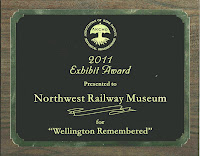 embered is an exhibit and web site launched in February 2010 commemorating the town of Wellington (1892 – 1929) and the Wellington Disaster (1910). This broad-based effort included the Museum’s Oberg Collection of Wellington images and resources from a variety of other regional institutions including the Wenatchee Valley Museum and Cultural Center, Skykomish Historical Society, Everett Public Library, University of Washington Special Collections, and the Washington State Historical Society. In the first year, over 100,000 people visited the exhibit or web site. Volunteers assisted in assembling a half scale section of snow shed used as the exhibit venue. The project was curated by the Museum’s educator Jessie C., and was funded by 4Culture and the Museum's general fund.
The award was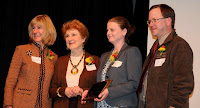 presented on April 26 at AKCHO’s annual awards reception held at the Museum of History and Industry. King County Councilmember Jane Hague was the MC. Other recipients include the Museum of Flight for the Boeing B-29 restoration, a 19 year effort; Dr. Quintard Taylor for BlackPast.org; and Preserving the Stories of Fall City, a memory book project of the Fall City Historical Society.
AKCHO is a professional association that exists to encourage cooperation among historical organizations and to promote and encourage the study and preservation of the history and heritage of King County through member organizations, individual members, and the community they serve, and to support such preservation efforts through public awareness and understanding of legislative issues. Meetings are held monthly and are open to the public.
Wellington Rem
embered is an exhibit and web site launched in February 2010 commemorating the town of Wellington (1892 – 1929) and the Wellington Disaster (1910). This broad-based effort included the Museum’s Oberg Collection of Wellington images and resources from a variety of other regional institutions including the Wenatchee Valley Museum and Cultural Center, Skykomish Historical Society, Everett Public Library, University of Washington Special Collections, and the Washington State Historical Society. In the first year, over 100,000 people visited the exhibit or web site. Volunteers assisted in assembling a half scale section of snow shed used as the exhibit venue. The project was curated by the Museum’s educator Jessie C., and was funded by 4Culture and the Museum's general fund.The award was
 presented on April 26 at AKCHO’s annual awards reception held at the Museum of History and Industry. King County Councilmember Jane Hague was the MC. Other recipients include the Museum of Flight for the Boeing B-29 restoration, a 19 year effort; Dr. Quintard Taylor for BlackPast.org; and Preserving the Stories of Fall City, a memory book project of the Fall City Historical Society.
AKCHO is a professional association that exists to encourage cooperation among historical organizations and to promote and encourage the study and preservation of the history and heritage of King County through member organizations, individual members, and the community they serve, and to support such preservation efforts through public awareness and understanding of legislative issues. Meetings are held monthly and are open to the public.
Photo (top): The award plaque presented to Jessie C. and Richard A. at the awards ceremony.
Photo (bottom): Councilmember Jane Hague and Jo Ann E. ~ the 2010 exhibit award winner from Kenmore Heritage Society ~ presented the award to Jessie C. and Richard A.
Thursday, March 31, 2011
Rehabilitating track at Snoqualmie Falls
 The world's first underground power generating station is located at Snoqualmie Falls. It was opened in 1898 by Charles Baker, who just a few years earlier was a civil engineer for the Seattle, Lake Shore and Eastern Railway. Fast forward to 2010. Puget Sound Energy owns the Snoqualmie Generating station and began a major reconstruction of the 112 year old plant. Scope of work includes new penstocks and replacement of a 1910 era generator. (The original 1898-built generators will return to service after project completion.)
 In August 2010, efforts to construct a retaining wall above the water intake did not go as planned. Soil conditions and other factors caused movement of the hillside. Unfortunately the hillside also supports the Northwest Railway Museum’s railway, the former Seattle, Lake Shore and Eastern. Train service was immediately suspended and additional geotechnical investigation began. Changes in construction techniques, longer soil anchors, some clean ballast for the railroad, and two years of monitoring are among the mitigation measures that have been adopted.
In late March 2011 rehabilitation of the railway began. Railworks of Centralia, WA was the successful bidder and are reconstructing over 400 feet of track in a difficult location. Their crews are dismantling track, excavating old ballast and installing new, and rebuilding the track. Work is expected to take two weeks and will allow regular trains to operate on April 2, 2011.
Please enjoy this two minute video illustrating the work:
Photos:
(Top) Railworks hyrail excavator at Snoqualmie Falls spreading new ballast; Salish Lodge and Spa is across the river in the distance.
(Bottom) Video shot at Snoqualmie Falls illustrating track reconstruction.
Subscribe to:
Comments (Atom)

