Wednesday, March 20, 2019

Day Out With Thomas 2019


The Steam Team Tour stops at the Northwest Railway Museum!Toot, toot, toot!   The Northwest Railway Museum is pleased to welcome Thomas the Tank Engine back to Snoqualmie, Washington this summer.  Day Out With Thomas will steam into the Snoqualmie Valley July 12 - 14 and July 19 - 21, 2019.


Thomas the Tank Engine makes a stop near Snoqualmie Falls.Thomas the Tank Engine is a popular children's storybook character that first appeared in print in 1945.  Today, he has a world-wide following, and we are so happy to welcome him back to the Snoqualmie Depot for his 17th annual visit. 

Day Out With Thomas is a fun-filled family event that includes not just a ride with Thomas the Tank Engine, but live music, train tables, story time, Thomas and Friends videos, a Thomas bouncy castle, motor car rides, and more.  Your ticket includes everything except food and merchandise.

Thomas the Tank Engine makes a stop at the Snoqualmie Falls Depot.This year there are two sensory-friendly trains offered for families with special needs.  One train will be on Friday, July 19 and the other on Sunday, July 21.  If this is an option that will best-serve your family, please email the Museum at info@TrainMuseum.org to request ticketing.

Tickets for this popular event are available through TicketWeb, but may also be purchased in the Depot Bookstore in the Snoqualmie Depot, daily between 10 AM and 5 PM.

Friday, March 8, 2019

Coaching an old coach

The end platforms on coach 213 were recently rebuilt with new windows, doors, and cladding.
Coach 213 platform "B"
The Northwest Railway Museum has operated an interpretive railway since 1967.  Since then, millions of people have ridden the train, and coaches have traveled thousands of miles.  One of the longest-serving cars is coach 213, a former Spokane, Portland and Seattle Railway coach built by Barney and Smith in 1912.  It is a sister to coach 218 - which was extensively rehabilitated and restored earlier this decade - and is built predominantly of wood. These two cars represent typical intercity passenger coaches used throughout Washington in the period prior to WW II.

Now it is coach 213's turn: it is being completely rehabilitated, but unlike the 218 this work is being performed in phases so the car may remain in service during peak periods.  With support from King County 4Culture's Heritage Capital program, major work has already been performed.

Clerestory windows renewed with replacement zinc came and original colored glass.  Broken or missing glass was replaced inkind.
A renewed clerestory window
Over the last two years, all the 213's clerestory windows have been removed for rehabilitation.  The zinc came that retains the individual pieces of glass has been renewed, and any broken or missing colored glass has been replaced. The mahogany frames have been stripped of old finishes, repaired as necessary, and refinished with varnish on the interior and an epoxy primer on the exterior.  These windows will be installed as soon as a new canvas roof is applied.

New zinc came and colored glass panels in upper sashes.
Upper window sashes after re-installation
Meanwhile, the upper "elliptical"  sashes have been removed, rehabilitated and reinstalled.  These window sashes required a little more work that the clerestory windows because all but one were missing their colored glass panels.  The Museum's incredible team of volunteers and staff restored the original zinc came and produced the missing glass.  The effect is stunning, particularly when the sun passes directly through the milky green glass.

New platform traps were installed in coach 213
New platform trap
The platforms on the end of a wood coach are particularly susceptible to deterioration.  Mechanical wear and exposure to the elements are the chief factors, and improving the weather-resistance of the structure is key to its preservation.  The platforms were taken apart, deteriorated steel components were replaced, and missing or deteriorated wood was replaced.  Platform traps were patterned, manufactured, and installed.  Meanwhile, the hand brake stand was rebuilt and a new brake handle installed. 

New platform doors and windows have been installed on coach 213.
New door and windows
The platforms have many components and are one of the more complicated areas of the car to work on.  Included in the scope work was replacement of four windows with elliptical tops, four platform doors also with elliptical tops, and even the platform ceilings where new LED platform lamps have now been installed. For now, this work will mostly appear in gray primer, but as the work advances everything will be colored SP&S coach green to match coach 218.

Car body siding has been addressed too.  Extensive reworking of the cladding is sealing it from the weather and preparing it for the final color coats. And the next step will be rehabilitating the roof deck and re-applying a canvas roof.  Exciting days are ahead for coach 213!
The exterior cladding on coach 213 has been reworked to make it more weather resistant.
213 with reworked cladding appearing in gray primer

Monday, March 4, 2019

Looking to the Future

Site layout for the Railway History Center
Railway History Center Master Site Plan schematic
The Northwest Railway Museum has been developing the Railway History Center in Snoqualmie for more than ten years.  Today, it consists of three buildings - CRC, Train Shed, and REC - but the Master Site Plan includes a fourth structure that is intended to provide expanded exhibits and public programming.  The Roundhouse structure has been envisioned as a modern building with design motifs peculiar to railroad locomotive roundhouses of the 19th and early 20th Centuries.

Stone roundhouse on the Northern Pacific Railway at Lester circa 1910
NPR roundhouse at Lester, circa 1910


After an investment of more than $10 million, the Railway History Center is already a facility that provides for collection care, exhibits, excellent programming, a research library, administration, and even a classroom.  The next step is a space to expand the depth and breadth of interpretation, which will help fulfill the Mission and expand the audience. 

At the annual Northwest Railway Museum Volunteer Banquet held on March 2, 2019 the Museum announced to its volunteers that the fourth building concept is going to be studied.  The Master Site Plan approval includes environmental clearance and has a finite life.  In the next few years, the Museum has to decide if it will be built, and if so what it will include. Features, design elements, or considerations being studied and already provided for in the current city approvals include provisions to,
  • Prominently feature operating models to illustrate interpretive themes and provide context for featured exhibits
  • Provide permanent homes in fully conditioned space for King County and City of Snoqualmie Landmarks including Puget Sound Electric Railway 523, Northern Pacific Railway rotary snow plow 10, Chapel car 5 Messenger of Peace, and Northern Pacific Railway steam locomotive 924
  • Provide for off peak train operations, possibly featuring Puget Sound Electric Railway car 523
  • Include adaptive space that may be used for large groups including banquets
  • Provide additional support facilities for programs and events including laundry, kitchen and locker rooms
  • Allow for additional visitor and volunteer parking
The Museum is merely in the study phase right now, but the possibilities this final phase of the Railway History Center presents makes this a truly exciting time for railway history in Western Washington.  The parameters of the study were still being formed at the time of this writing, but consultant will be hired this spring.  The Museum hopes to announce the results of the planning exercise later this year.

Tuesday, February 12, 2019

February continues to scream!

Northern Pacific Railway Rotary 10
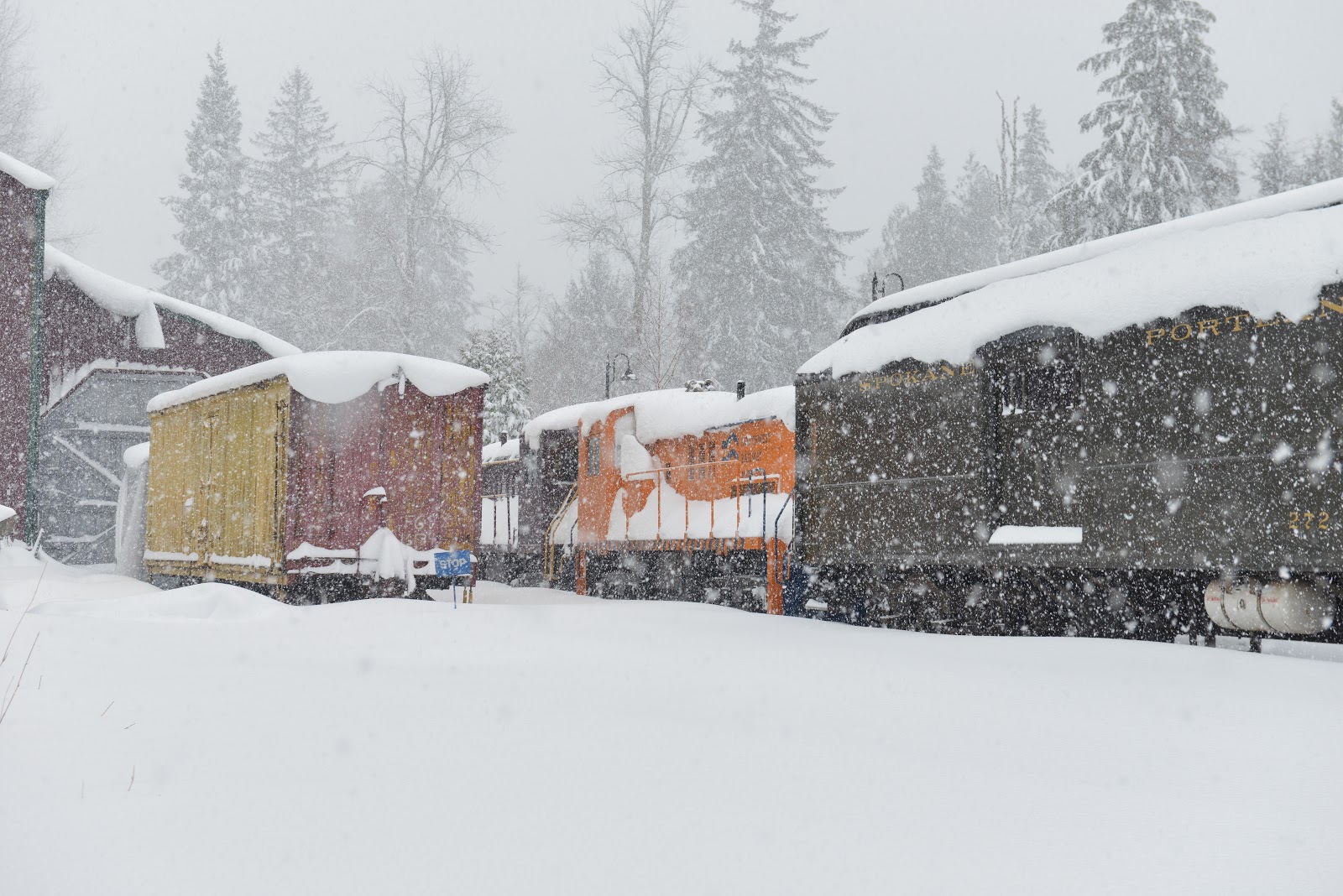
More snow.  Incredibly, it has continued to snow in Snoqualmie and North Bend.  It is difficult to accurately measure accumulations because of the high winds, so let's stipulate, "a whole bunch of snow."  And this was not just any snow, it was Cascade Concrete, a really wet snow that is incredibly slippery and has very high density.  


Snoqualmie Depot
Cascade Concrete was the frozen slurry that descended on Wellington in the infamous avalanche of 1910, and made it particularly difficult to extricate survivors. It is snow that has a particularly high water ratio.  Today's snow had a 3:1 ratio.  So three inches of snow would equal one inch of rain.  Snow in other parts of the country might normally have a water ratio of 10:1.  So ten inches of snow would equal one inch of rain.  Notwithstanding, check out today's snowy views of the Northwest Railway Museum in Snoqualmie, Washington.  And, as always, click on the image to see it in high resolution.

Bridge 35 in North Bend

Railway Education Center

Train Shed foyer

Cars and locomotives outside the CRC

Rear side of Train Shed

East end of Train Shed foyer

Monday, February 11, 2019

January roared but February screams!

Railway Education Center
Western Washington and the Northwest Railway Museum are experiencing a severe bout of winter weather.  Schools are closed, as are many businesses, several Amtrak trains have been canceled, and even the State Legislature has shut down.  Already, February has seen more snow in the Puget Sound lowlands than any time since records have been kept, and the Museum has been in the thick of it.  
Locomotive 4024

Nearly two feet of snow has fallen at the Museum in the space of just eight days.  While some has melted, most has not. And the winds have been howling: drifting snow is almost four feet deep in places.  The Museum is in a region where snow plows and sanding trucks are rare; this is a weather event experienced only once every 25 years or so.  Check out a few of today's seemingly unworldly photos, all from an elevation that rarely sees snow for more than a day or two. (Click on the photos to see full resolution!)


Locomotive 7

Cars and locomotives outside the CRC

Pettibone

West end of Train Shed

Coach 213

Snoqualmie Depot

Army ambulance kitchen car


Saturday, January 19, 2019

January is in with a roar!

January is traditionally the slowest month of the year for the Northwest Railway Museum.  It is a time to reflect on the prior year, plan for the coming year, and to conduct annual inventories.  This month, however, has not been typical.

In addition to being one of the warmest Januaries on record, there have been some powerful wind storms.  Trees have been blown down, power out, and traffic detoured.  Wind storms have also destroyed a total of three railroad crossing gates on the Museum's railroad in North Bend.  

Crossing gates are designed to withstand wind gusts of more than 70 miles per hour, but despite official records indicating gusts of "just" 50 mph, three gates - made of extruded aluminum - folded up over the wind guards.  Of course, despite the unexpected expense and effort, they will be repaired in time for the coming season, which begins at 11 AM on Saturday, April 6, 2019.  


Tuesday, December 25, 2018

Season's Greetings

Happy holidays from the Northwest Railway Museum!  

2018 has been another successful year for the Museum.  Thousands of guests were served and several project milestones were met.

Important achievements included acquisition of a Pullman-built parlor car, substantial progress on the steam locomotive 924 rehabilitation, successful nomination of interurban car 523 to the Landmarks Register, and the fabrication and installation of five rows of pews in chapel car 5.  However the really noteworthy achievement was again serving more than 120,000 guests (combined paid & unpaid) with at least one program, including more than 12,000 at the most-attended Santa Train ever. 

All of our regular staff - Elizabeth (volunteer coordinator), Bob (collection assistant), Cristy (registrar), Gary (collection technician), Jessie (deputy director), Traci (bookstore clerk), Lara (visitor services), and Jennifer (bookkeeper) join me in thanking you for your patronage and support, and in wishing you and your families the happiest of holidays and the very best in the New Year.

Richard R. Anderson
Executive Director