Showing posts with label cold weather. Show all posts

Tuesday, February 12, 2019

February continues to scream!

Northern Pacific Railway Rotary 10
More snow.  Incredibly, it has continued to snow in Snoqualmie and North Bend.  It is difficult to accurately measure accumulations because of the high winds, so let's stipulate, "a whole bunch of snow."  And this was not just any snow, it was Cascade Concrete, a really wet snow that is incredibly slippery and has very high density.  


Snoqualmie Depot
Cascade Concrete was the frozen slurry that descended on Wellington in the infamous avalanche of 1910, and made it particularly difficult to extricate survivors. It is snow that has a particularly high water ratio.  Today's snow had a 3:1 ratio.  So three inches of snow would equal one inch of rain.  Snow in other parts of the country might normally have a water ratio of 10:1.  So ten inches of snow would equal one inch of rain.  Notwithstanding, check out today's snowy views of the Northwest Railway Museum in Snoqualmie, Washington.  And, as always, click on the image to see it in high resolution.

Bridge 35 in North Bend

Railway Education Center

Train Shed foyer
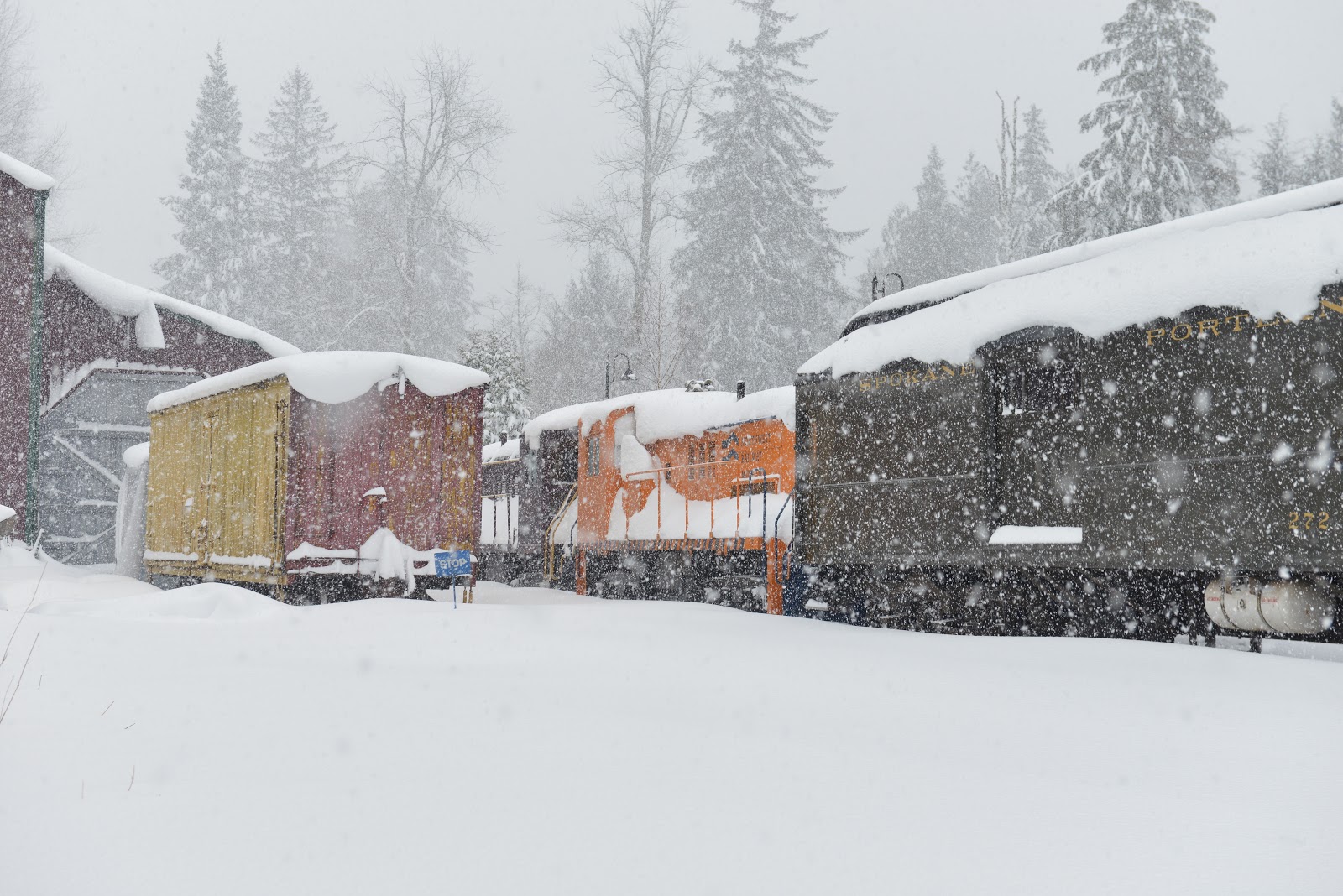
Cars and locomotives outside the CRC

Rear side of Train Shed

East end of Train Shed foyer

Monday, February 11, 2019

January roared but February screams!

Railway Education Center
Western Washington and the Northwest Railway Museum are experiencing a severe bout of winter weather.  Schools are closed, as are many businesses, several Amtrak trains have been canceled, and even the State Legislature has shut down.  Already, February has seen more snow in the Puget Sound lowlands than any time since records have been kept, and the Museum has been in the thick of it.  
Locomotive 4024

Nearly two feet of snow has fallen at the Museum in the space of just eight days.  While some has melted, most has not. And the winds have been howling: drifting snow is almost four feet deep in places.  The Museum is in a region where snow plows and sanding trucks are rare; this is a weather event experienced only once every 25 years or so.  Check out a few of today's seemingly unworldly photos, all from an elevation that rarely sees snow for more than a day or two. (Click on the photos to see full resolution!)


Locomotive 7

Cars and locomotives outside the CRC

Pettibone

West end of Train Shed

Coach 213

Snoqualmie Depot

Army ambulance kitchen car


Sunday, December 28, 2008

More on rotaries

Apparently many of you are interested in rotary snowplows. Here are some additional links to information and videos about rotaries.

Exhibit one: Rotary 1 on the White Pass and Yukon

Exhibit two: Union Pacific rotary 900082

Exhibit three: Although a little out of date, here is a list of remaining rotaries

Exhibit four: HistoryLink's entry for the Museum's rotary 10

Exhibit five: Garden railway rotary snowplow model in action

Exhibit six: Rotary snowplow demo at Portola, CA

Exhibit seven: Sample footage of 1952 Southern Pacific rotary action

Wednesday, December 24, 2008

Rotary snowplow

This week’s snowy weather in Western Washington reminds me how all-weather travel is really a modern convenience. In the early days of the transcontinental railroads, winter line closures were a frequent occurrence. The introduction of the rotary snowplow improved winter operating conditions for railroads, particularly in mountain passes here in Washington, but also notably in California and British Columbia.

In this region, the Great Northern Railway, Northern Pacific Railway, and the Canadian Pacific Railway relied on rotaries to clear heavy snow. Accounts of the 1910 Wellington Disaster frequently mention the efforts of rotaries to keep Stevens Pass open, and it was only a shortage of coal that prevented them from continuing to clear snow. (X808 was one of those rotaries and is pictured here circa 1913.) Considered the “big guns” of snow clearing, rotaries continued to play a prominent role in winter railroading until well into modern times.

So what is a rotary snowplow? It is a giant wheel of cutting blades that spins into the snow, shaves off a layer of snow and then expels it to the side of the tracks. The plow itself is not self-propelled – one or more locomotives push it. Traditionally, blades were steam powered. Today the few rotaries remaining in service are diesel-electric.

Toronto, Canada Dentist J.W. Elliot invented the rotary snowplow in 1869 but a practical application was not tested until Leslie Bros. built Orange Jull’s design in 1883. Other manufacturers including Cooke soon manufactured variations on the concept.

The Northwest Railway Museum owns former Northern Pacific Railway steam rotary snowplow #10. Built in 1907, the plow was used extensively on Stampede Pass, a mountain pass used by the Northern Pacific just east of Auburn and a little south of the better-known Snoqualmie Pass. Retired in 1964 and donated to the Museum, rotary 10 can be viewed at the Snoqualmie Depot. Through the magic of QuickTime VR, you can view the inside of the cab here.

Saturday, December 20, 2008

Oh the weather outside is frightful...

Day 7 of Santa Train. All trains are sold out and we are receiving calls asking if the train is still running today. It is of course (only one weekend in 40 years has been canceled) and a generator has been borrowed along other precautions to help ensure a happy experience for all. Certainly some people are concerned about driving on compact ice and snow – this is Western Washington after all – but many more seem happy to be here. The real concern is an approaching windstorm with projected gusts of 80 mph, but it isn’t expected to have a significant impact until after the last Santa Train has returned to North Bend.

So far Santa Train is running smoothly and it is beautiful to ride over the hill and through the snow to see Santa. And the hot cocoa tastes so much sweeter in the cold, at least to me. Radiant heaters are located in several areas to help keep the chill off, but some people are not dressed for freezing weather. Unfortunately that makes the experience less pleasant for them yet it is authentic. Imagine just a few short decades ago when the only practical intercity transportation choice was the train. If the weather changed while you were on a trip and you hadn’t made room to pack extra clothing, you had to make do. Today most of us are fortunate to have personal vehicles that allow us the freedom to move on our own schedule and to easily carry extra provisions. That’s one of the big changes the automobile has brought our society. It did mean giving up some all weather reliability though: Santa Train is running on schedule today yet nearly everyone spent a lot of extra time on the roads getting to North Bend.

P.S. Santa Trains all ran on 20 December without incident, although a few hundred people did not show up to use their tickets. On 21 December, Amtrak canceled nearly all their Pacific Northwest service. Why? Historically, the railroads had thousands of employees and therefore had the resources to clear snow and ice from turnouts, the arrangement of rails that allows a train to move from one track to another. In the mountains today, this work is done by impressively powerful automatic propane heaters. In the lowlands, snow is so infrequent that there are no automatic heaters. So frozen turnouts means very significant delays that make most passenger trains completely impracticable.