Showing posts with label Northern Pacific. Show all posts

Wednesday, March 31, 2021

Coal trains from Snoqualmie?

There is coal in the Snoqualmie Valley! 

"Soon there will be scores of rail cars full of sequestered carbon headed from Snoqualmie to power Seattle, and dozens of new local jobs mining the ore, too." 

Well, not quite, but almost a century ago an enthusiastic Mr. R.T. Warwick, Agent of the Northern Pacific Railway in Snoqualmie could easily have said such a thing. 

In 1925 the California Alaska Corporation was operating the Niblock Mine, which was extracting coal from two seams located near today's I-90 exit 27, just outside Snoqualmie city limits.  In a common move both then and now, Mr. Newenham of that venture had offered a glowing report light on evidence and advised that, 

"they have opened up number three vein and found it (to be) twelve feet thick, and a very high grade of coal."  

Agent Warwick dutifully reported this information to the railway company's traffic manager.  Statements like this were difficult to verify over distance, so these glowing reports usually went unverified, causing the value of mining company stock to rise, and sometimes even tricked railway companies into building rail lines that would never see enough traffic to recover the cost of construction, let alone operation.  The promise of coal and iron mines in the Snoqualmie Valley was part of what led to the construction of the Seattle, Lake Shore and Eastern Railway into the area.  Yet when the valley was connected by rail, it was its vast timber resources that dominated the local economy.

So a colliery was operated on and off by a series of three successive operators over a period of almost 40 years, but it never achieved any of the success found to the west in the mines of Issaquah, Newcastle, and Renton.  So there will not be any coal trains in Snoqualmie at any time in the foreseeable future.

Thursday, March 26, 2020

Locomotive 924 gets rods and more

The  worldwide pandemic is causing significant disruption in nearly everyone's lives throughout the Puget Sound Region, but a core group of dedicated specialists is continuing to work on locomotive 924.  They are practicing social distancing, and limiting the number of workers in the shop at once, but still achieving success.  Until this week, that meant not more than ten people at a time.  However, now the Governor has ordered non-essential workers (and pretty much all volunteers) to stay at home for at least the next two weeks.  So this seems like a great opportunity to reflect on and highlight recent progress, and what all the public donations have supported.

Packing - Mechanical packing seals the gap around the piston rod where it penetrates the steam cylinder.  The packing has to be installed before the rod is inserted into the cross head.  So Jay was busy assembling this puzzle on a Saturday morning earlier this month as everyone else was preparing to install the rods.  There is more to this than meets the eye - the packing gland has to be able to resist 185 lbs of saturated steam without leaking.

Radius rods - Meanwhile, Paul and Larry were cleaning up the radius rods for the valve gear, which with Stephenson motion are located between the lead and main drivers.  It is an awkward place to reach, but the Museum's Conservation and Restoration Center has pits 60 inches deep, providing ample room to work from below.

Eccentric straps - Over on the work bench, David and Vic were cleaning and preparing the eccentric rods or straps in advance of their reinstallation.  These rods fasten around the main driver axle on an eccentric (offset center) and as the axle turns they convert rotary motion into a longitudinal oscillating displacement (back and forth motion) to move valves that control steam entering and exiting the cylinders.

Cross head - After Jay completed tightening of the packing, the piston rods were inserted into the cross heads.  The cross head is the assembly that most observers will recognize on a steam locomotive.  It is the component that moves back and forth with each rotation of the main driver, and at high speeds might appear to some to be just a blur.  The rod has a taper and fits just about perfectly into the cross head - so there is no movement between the two parts.  Then a tapered key or keeper fits through the cross head and the end of the piston rod to ensure they remain tightly in position.

Main rod - Installing the main rod is a delicate dance.  This forged assembly is - even on a light locomotive such as the 924 - amazingly heavy.  Fingers or toes that are in the wrong place will be effortlessly and mercilessly removed.  So with the aid of a wheeled hydraulic table to adjust the height and position of the rod, the work was performed with just three workers.  The first milestone was installation of the little end into the cross head.  It is attached with a pin just behind the piston rod end.

The next step was to raise the big end of the rod into position ahead of the main rod crank pin.  This involved another form of dance as the entire cross head, piston and rod assembly was gently moved forth and back until it was in just the right place.  And yes, there was a great deal of careful measurement and calculation, too.  Otherwise when the bearing brasses were installed and wedges tightened to hold them in place, the rod would be either too long or too short, causing catastrophic failure.  

With the rod in the correct position, the bearing brasses, wedge, and a large fitted bolt were applied to hold everything in the correct position. Lyle was careful to apply anti seize coatings on all the components prior to assembly.

The resurrection of Northern Pacific locomotive 924 is continuing to take shape at the Northwest Railway Museum.  Support from 4Culture, Washington Heritage Capital , Schwab Fund, Microsoft, Osberg Family Foundation, Boeing, Emery Rail Heritage Trust, more than hundred individual donors, several awesomely skilled employees, and dozens of dedicated volunteers is making this work possible.  Additional progress will be described in another article that will appear in early April.

Project 924 continues to welcome your support!  To make a donation online, please visit the Northwest Railway Museum donation portal and select "steam locomotive."

Wednesday, July 27, 2011

I've been working on the railroad as an engineer

“The engineer is in charge of and responsible for the locomotive as well as the mechanical operation of the train, train speed, and all train handling.” In other words, the engineer controls the locomotive. Historically people apprenticed for the position of engineer by being the fireman.

A steam locomotive fireman spent most of his time maintaining pressure in the boiler -- shoveling coal into the firebox of a coal-fired steam locomotive or adjusting the fire in an oil-burning locomotive. It was a hard, dirty job. Hours and hours spent shoveling coal – it was hot in the summer and drafty in the winter.

Besides lighting and tending the fire, the fireman was also responsible for cleaning out the boiler and firebox, and adding water and fueling the locomotive before departure. Besides the fire and other duties, the fireman was also learning the job of engineer - incentive enough to shovel all that coal!

George William Longworth was born in Connecticut on February 16, 1879. He was the first of five children born to Peter and Kate Longworth. Soon after his birth the family moved west. In 1900 they were living in Lester, WA, where Peter was a shopkeeper.

Longworth hired out on the Northern Pacific Railway (NP) in September 1898, at 19 years old. He listed his occupation as locomotive fireman in the 1900 U.S. Census and locomotive engineer in the 1910 census. So somewhere within that 10 year span he was promoted to engineer from fireman.

Longworth married Josephine Devershire and the couple lived in Seattle, WA. They had two children, daughter Melrene and son Thomas. Melrene was born in 1911, Thomas in 1917. Longworth worked for the NP until his death, at age 52, in 1931.

The executor of Melrene’s estate donated her photo collection to the Northwest Railway Museum. The collection consisted of some of George Longworth’s photos and correspondence from his time as an engineer, as well as the passes Melrene used to ride on the train when her dad worked for the NP.

If you are interested in seeing more photos, as well as several artifacts, visit the ladies waiting room at the Snoqualmie Depot. "I've been working on the railroad" is a rotating exhibit showcasing railroad jobs and and the people who performed them. Approximately every six months a new job will premiere.

Photos
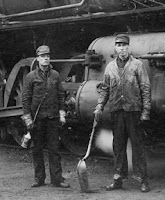
Which one is the fireman and which one is the engineer? Here is a hint: the fireman was responsible for shoveling coal as well as cleaning out the boiler, jobs he probably would have used a coal scoop for. Meanwhile, the engineer was responsible for oiling bearings and sliding surfaces before departure. George Longworth is on the left and is the engineer (holding his tool of the trade, an oil can), his fireman is on the right holding his shovel. Sometimes the fireman can be spotted simply because his clothes are noticeably dirtier from coming into contact with all that coal dust! Northwest Railway Museum Collection

George Longworth, date unknown. Northwest Railway Museum Collection


Trainmen were responsible for filing all kinds of paperwork, especially if there was a problem with their run. Here, engineer Longworth receives kudos from his superior: “George - Atta Boy, I knew you could do it, keep it up.” Circa 1930. Northwest Railway Museum Collection

Sunday, April 19, 2009

Boxcar completed

Volunteers lead by Rich W. have completed a modest effort to rehabilitate a 1932-built Northern Pacific Railway boxcar. Working inside the Conservation and Restoration Center over a three month period, the car is presented as it appeared in July 1953 after being shopped in Duluth, MN. (Click here to view an earlier post described the importance of boxcars.)

Work performed this year focused on preservation (stopping deterioration) and rehabilitation (reversing damage). At the beginning of the process, workers searched the carbody for evidence of lettering both for font style and location. Traces of nearly all lettering from the last shopping were found. Also noteworthy were the wide variety of mineral red samples found on the car.

Now damaged wood has been stabilized with epoxy, the entire wood carbody has been primed with an epoxy primer, the nailer/fascia board has been replaced, minor tears in the sheet metal roof have been patched, the hand brake has been repaired, the air valves have been serviced, all other surfaces have been cleaned and repaired as needed, and the car has been lettered using a paint mask. Color coats were applied with conventional alkyd enamels and are expected to fade on exposure to sunlight just as the original railway-applied mineral red did. Total cost of materials was nearly $2,000; over 400 hours were donated to the effort.

Friday, January 23, 2009

Boxcars for almost everything

Once upon a time, nearly everything moved in a boxcar. Grain, finished lumber, automobiles and parts, tools, house wares, clothing, aircraft parts, and nearly everything else imaginable could be found moving in a boxcar. Today, containers have replaced boxcars in most applications but a few remain in service for special applications such as newsprint and pulp. A few of the classic boxcars survive in museums including the Northwest Railway Museum.

The Museum has several great examples of typical boxcars and one of them is in the Conservation and Restoration Center for some rehabilitation work. Skilled workers of the Northern Pacific Railway built boxcar 14794 in September 1932 at their Brainerd, Minnesota shops. It has 80,000 pounds capacity and is 40 feet long; it was part of an order of 500 cars. It features composite wood and steel construction, and has a classic rolling corrugated steel door. The t & g roof is clad with interlocking sheet metal to keep the inside dry; this was a relatively new innovation in 1932. Much of the design and construction is simple but robust, which allowed it to serve the Northern Pacific Railway for an astoundingly long period - nearly 50 years!

Rehabilitation work is replacing the fascia board along the top of the car side (see old and new comparison photo to the left), and is injecting all other deteriorated wood with epoxy. Wood and steel surfaces are being prepared and coated with appropriate primer (gray Awlgrip for the wood) and top coated with an appropriately tinted boxcar red.

Thanks to Rich W. for historical data used in this post.

Wednesday, December 24, 2008

Rotary snowplow

This week’s snowy weather in Western Washington reminds me how all-weather travel is really a modern convenience. In the early days of the transcontinental railroads, winter line closures were a frequent occurrence. The introduction of the rotary snowplow improved winter operating conditions for railroads, particularly in mountain passes here in Washington, but also notably in California and British Columbia.

In this region, the Great Northern Railway, Northern Pacific Railway, and the Canadian Pacific Railway relied on rotaries to clear heavy snow. Accounts of the 1910 Wellington Disaster frequently mention the efforts of rotaries to keep Stevens Pass open, and it was only a shortage of coal that prevented them from continuing to clear snow. (X808 was one of those rotaries and is pictured here circa 1913.) Considered the “big guns” of snow clearing, rotaries continued to play a prominent role in winter railroading until well into modern times.

So what is a rotary snowplow? It is a giant wheel of cutting blades that spins into the snow, shaves off a layer of snow and then expels it to the side of the tracks. The plow itself is not self-propelled – one or more locomotives push it. Traditionally, blades were steam powered. Today the few rotaries remaining in service are diesel-electric.

Toronto, Canada Dentist J.W. Elliot invented the rotary snowplow in 1869 but a practical application was not tested until Leslie Bros. built Orange Jull’s design in 1883. Other manufacturers including Cooke soon manufactured variations on the concept.

The Northwest Railway Museum owns former Northern Pacific Railway steam rotary snowplow #10. Built in 1907, the plow was used extensively on Stampede Pass, a mountain pass used by the Northern Pacific just east of Auburn and a little south of the better-known Snoqualmie Pass. Retired in 1964 and donated to the Museum, rotary 10 can be viewed at the Snoqualmie Depot. Through the magic of QuickTime VR, you can view the inside of the cab here.