 s in charge of and responsible for the locomotive as well as the mechanical operation of the train, train speed, and all train handling.” In other words, the engineer controls the locomotive. Historically people apprenticed for the position of engineer by being the fireman.
A steam locomotive fireman spent most of his time maintaining pressure in the boiler -- shoveling coal into the firebox of a coal-fired steam locomotive or adjusting the fire in an oil-burning locomotive. It was a hard, dirty job. Hours and hours spent shoveling coal – it was hot in the summer and drafty in the winter.
Besides lighting and tending the fire, the fireman was also responsible for cleaning out the boiler and firebox, and adding water and fueling the locomotive before departure. Besides the fire and other duties, the fireman was also learning the job of engineer - incentive enough to shovel all that coal!
George William
 Longworth was born in Connecticut on February 16, 1879. He was the first of five children born to Peter and Kate Longworth. Soon after his birth the family moved west. In 1900 they were living in Lester, WA, where Peter was a shopkeeper.
Longworth hired out on the Northern Pacific Railway (NP) in September 1898, at 19 years old. He listed his occupation as locomotive fireman in the 1900 U.S. Census and locomotive engineer in the 1910 census. So somewhere within that 10 year span he was promoted to engineer from fireman.
Longworth married Josephine Devershire and the couple lived in Seattle, WA. They had two children, daughter Melrene and son Thomas. Melrene was born in 1911, Thomas in 1917. Longworth worked for the NP until his death, at age 52, in 1931.
The executor
 of Melrene’s estate donated her photo collection to the Northwest Railway Museum. The collection consisted of some of George Longworth’s photos and correspondence from his time as an engineer, as well as the passes Melrene used to ride on the train when her dad worked for the NP.
If you are interested in seeing more photos, as well as several artifacts, visit the ladies waiting room at the Snoqualmie Depot. "I've been working on the railroad" is a rotating exhibit showcasing railroad jobs and and the people who performed them. Approximately every six months a new job will premiere.
Photos
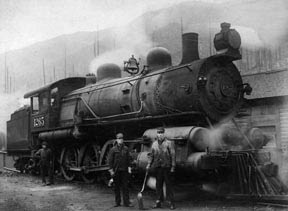
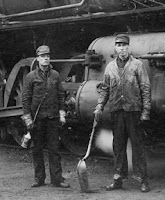
Which one is the fireman and which one is the engineer? Here is a hint: the fireman was responsible for shoveling coal as well as cleaning out the boiler, jobs he probably would have used a coal scoop for. Meanwhile, the engineer was responsible for oiling bearings and sliding surfaces before departure. George Longworth is on the left and is the engineer (holding his tool of the trade, an oil can), his fireman is on the right holding his shovel. Sometimes the fireman can be spotted simply because his clothes are noticeably dirtier from coming into contact with all that coal dust! Northwest Railway Museum Collection
George Longworth, date unknown. Northwest Railway Museum Collection
Trainmen were responsible for filing all kinds of paperwork, especially if there was a problem with their run. Here, engineer Longworth receives kudos from his superior: “George - Atta Boy, I knew you could do it, keep it up.” Circa 1930. Northwest Railway Museum Collection