Showing posts with label Education. Show all posts

Tuesday, May 22, 2018

New exhibit panels installed in Train Shed

Sign on the Northern Pacific bunk car.
New exhibit panels have been installed on or near eight objects in the Train Shed Exhibit Building. The panels were developed and purchased with a 2017 4Culture Heritage Special Projects grant and are now on display for the visiting public. Fossil Industries fabricated the panels. The Museum has used Fossil, based in New England, for several projects – the company is a leader in High Pressure Laminate (HPL) signage. HPL is a popular exhibit material because it is fade resistant and anti-graffiti.

Eight artifacts now sport a new panel that will help interpret the type of railroad car (general history) as well as the individual history of the car. The panels also include information on northern transcontinental lines including the Northern Pacific (NP), the Great Northern (GN), and Canadian Pacific (CP). Included are the GN X-101 and NP 1203 cabooses, the chapel car Messenger of Peace, the NP bunk car, the NP refrigerator car, a NP box car, a Polson Logging side dump car, and the CP 25 (formerly known as "Earnscliffe"). Four signs are 32” x 32” and are displayed on a sign stand next to their object. The other four panels are 24” x 24” and are affixed directly to the object in some way.

With these eight new signs added to the four signs already in the building, it means most of the large objects on display have their own interpretive sign. This is a major milestone for the education/exhibit department!

A 4Culture Heritage Special Projects Grant funded this exhibit. 4Culture is the cultural funding agency for King County, Washington. Using Lodging Tax and 1% for Art funds, 4Culture has four program areas to serve the county: arts, heritage, historic preservation, and public art. For more info on 4Culture, visit their website at www.4Culture.org


A big thank you to 4Culture for continuing to support exhibits at the Northwest Railway Museum.

Sign on one of the NP box cars in the Train Shed.

Large sign for the dump car - sign is affixed to
sign stands donated by Washington
State Historical Society.


Wednesday, April 27, 2016

Humanizing Railway History

Connecting history to modern lives is a challenge for museums.  Museum interpreters carefully look for ways to engage and interact with visitors' wide-range of interests, backgrounds and cultures. For some it’s the love of railroads and machinery that draws them here, especially when they can “talk train” with knowledgeable people. Then there are others (the majority of visitors) who are looking for a family experience, and the Museum is simply a “neat place to take an old-fashioned train excursion and see the top of Snoqualmie Falls with the kids.”  And others fall between these two groups. So how does the Museum address all of the varied interests and ages?
 
 
One common denominator lies in the “humanization” of history. All of us can relate to being a real person. And when that side of railway history is presented, it leads to learning fun without knowing that learning is happening! Recent exhibits include historic photos with people in them.  What the people of the past wore, their expressions, their stance all let visitors connect to the fact that these were real people who lived the railroading experience in one way or another. Giving visitors something they’re familiar with, even though different, allows them to make a connection to the past while making comparisons with their current lives.  The new Northern Pacific Railway Stewardess exhibit, along with firsthand looks inside the Chapel Car and Bunk car offer a glimpse of how railroading isn’t just about the technology, but about real people and how the railroad impacted their lives.
 
Periodically, we bring real humans into the humanization experience through living history programs where visitors speak with, listen to, watch and engage re-enactors portraying passengers of earlier times. For instance, a living history piece has been added during School train.  Students are greeted by an actor in Edwardian-era clothing. During the presentation, they learn about the passengers of that era – their clothing, luggage and “quiet” toys that children riding the trains may have had. A highlight is dressing a girl and boy from each class in period clothing. Afterwards, the students are invited to handle the clothing and try the historic toys themselves. When the light goes on about how early 20th century train travel is different from their modern lives, it’s magical.  They never considered how those everyday items tied into railroad history! And now those simple ordinary items opened up a new understanding of how the railroad changed everything.
 
GiveBig2016!
All of these techniques engage Northwest Railway Museum visitors in different ways to keep the history alive, but none of these are possible without the Museum’s members and donors who allow funding of new programs and exhibits to occur along with running and restoring the artifacts. So as we move closer to the Seattle Foundation’s GiveBIG date on Tuesday May 3, please consider scheduling your GiveBIG donation to ensure more programming growth at the Northwest Railway! Remember, every little bit helps. And if you’re curious to see some of this firsthand, ride the May 1, 11 am train for the Groundbreaking of the Railway Education Center and you never know who you might run into on the train…

-Guest blog by Marketing Manager Peggy Barchi


Sunday, May 25, 2014

Preschool and school train programs in 2014

May 20 marked the final day of School Train for 2014. This year the Museum hosted two full days of Preschool Train on April 29 and 30, and four days of School Train in April and May. The Preschool Train program is designed for children age 3-5. The School Train program is designed for grade 4, with a separate program for younger students and mixed-aged groups.

In 2014, 605 preschool children and adults attended the two day Preschool Train program. 631 children and adults attended the School Train program. So a total of 1236 people participated in the 6 days of educational programming this spring. In 2014 a large number of School Train participants were from small private schools, although there were attendees from the Federal Way, Renton, Lake Washington school districts. School Train is also popular with families that home school and this year was no exception.

School Train activities included a history intense grade 4 program, where students study primary source documents (census data and historic photographs) to learn about Valley life in 1890 and how the railroad changed everything here in the Pacific Northwest. Younger students and mixed-age groups were rotated thru three short activities that included Signs and Signals (all about ways we communicate with trains), a docent-led Depot tour, and a fun craft (decorate your own bandana) that doubled as a take-home. Students enjoyed coloring the bandanas while the educator enjoyed making the students first explain the historic role of bandanas on the railway. The program concluded with a 60 minute journey upon the Snoqualmie Valley Railroad, wherein students follow in the footprints of history, riding the same rails as those who traveled by train to the Snoqualmie Valley in the 1890s.

The Preschool Train program is similar, in that it includes rotation thru short age-appropriate activities followed by a 35 minute long train ride. (Preschool train is a 90 minute program whereas School Train is a 2 hour program.)
A special thanks to all the volunteer docents who helped with this educational programming, and to the running trades volunteers who operated the train!

Wednesday, December 25, 2013

Merry Christmas!

Deputy director Jessie C., Visitor services 
James S., Volunteer coordinator Cristy L., 
Bookkeeper Jennifer Y. and Director 
Richard A.
Christmas and the railroad

In their roles as museum educators, staff work hard to remain truthful and accurate in creating interpretive programming. However, they must also use today's conventions to help people understand yesterday's.  Identifying the year-end holiday season as "Christmas" considers a recent Angus Reid Global poll that found 80% of people in the United States, Britain and Canada prefer to call the holiday season "Christmas." That is a pretty convincing majority!

So what do a refer car, box car, brakeman, coach car, express car, locomotive, conductor, railroad bridge, depot, and chapel car all have to do with "Christmas?"  Everything!

While examining the impact of railroads on the Northwest it is nearly impossible to ignore the role of significant cultural practices, including the celebration of Christmas. Why? Christmas and other major holidays have had - and continue to have - a tremendous impact on railway transportation including express, freight and passenger service.  Railroads brought (bring) families together, letters and packages to family members, and goods to retailers. Railroads even transport many Christmas trees from farms to your local communities.  So Christmas might not be very merry without the railroad!

Thank you to everyone! 

As another successful Santa Train program is completed and 2013 draws to a close, I am delighted to reflect upon another great year at the Northwest Railway Museum. In doing so, what is clearly evident are all of the generous contributions of time, talent and funding that have helped make the Northwest Railway Museum and its programs possible.  By the numbers, the human side of the Museum's success was a handful of management and other key staff, a dozen trustees and advisers, a gaggle of special contractors, more than 125 volunteers, and hundreds of donors. They all worked together to serve more than 90,000 guests who got to see and understand the role railroads played in the development and settlement of the Northwest.  

From all of us to all of you, have a Merry Christmas!

--Spike

Wednesday, July 27, 2011

I've been working on the railroad as an engineer

“The engineer is in charge of and responsible for the locomotive as well as the mechanical operation of the train, train speed, and all train handling.” In other words, the engineer controls the locomotive. Historically people apprenticed for the position of engineer by being the fireman.

A steam locomotive fireman spent most of his time maintaining pressure in the boiler -- shoveling coal into the firebox of a coal-fired steam locomotive or adjusting the fire in an oil-burning locomotive. It was a hard, dirty job. Hours and hours spent shoveling coal – it was hot in the summer and drafty in the winter.

Besides lighting and tending the fire, the fireman was also responsible for cleaning out the boiler and firebox, and adding water and fueling the locomotive before departure. Besides the fire and other duties, the fireman was also learning the job of engineer - incentive enough to shovel all that coal!

George William Longworth was born in Connecticut on February 16, 1879. He was the first of five children born to Peter and Kate Longworth. Soon after his birth the family moved west. In 1900 they were living in Lester, WA, where Peter was a shopkeeper.
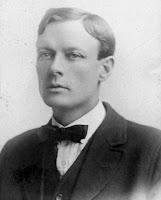
Longworth hired out on the Northern Pacific Railway (NP) in September 1898, at 19 years old. He listed his occupation as locomotive fireman in the 1900 U.S. Census and locomotive engineer in the 1910 census. So somewhere within that 10 year span he was promoted to engineer from fireman.

Longworth married Josephine Devershire and the couple lived in Seattle, WA. They had two children, daughter Melrene and son Thomas. Melrene was born in 1911, Thomas in 1917. Longworth worked for the NP until his death, at age 52, in 1931.

The executor of Melrene’s estate donated her photo collection to the Northwest Railway Museum. The collection consisted of some of George Longworth’s photos and correspondence from his time as an engineer, as well as the passes Melrene used to ride on the train when her dad worked for the NP.
If you are interested in seeing more photos, as well as several artifacts, visit the ladies waiting room at the Snoqualmie Depot. "I've been working on the railroad" is a rotating exhibit showcasing railroad jobs and and the people who performed them. Approximately every six months a new job will premiere.

Photos
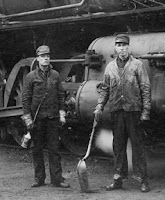
Which one is the fireman and which one is the engineer? Here is a hint: the fireman was responsible for shoveling coal as well as cleaning out the boiler, jobs he probably would have used a coal scoop for. Meanwhile, the engineer was responsible for oiling bearings and sliding surfaces before departure. George Longworth is on the left and is the engineer (holding his tool of the trade, an oil can), his fireman is on the right holding his shovel. Sometimes the fireman can be spotted simply because his clothes are noticeably dirtier from coming into contact with all that coal dust! Northwest Railway Museum Collection

George Longworth, date unknown. Northwest Railway Museum Collection


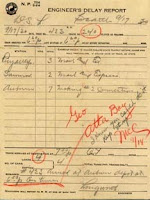
Trainmen were responsible for filing all kinds of paperwork, especially if there was a problem with their run. Here, engineer Longworth receives kudos from his superior: “George - Atta Boy, I knew you could do it, keep it up.” Circa 1930. Northwest Railway Museum Collection

Thursday, March 10, 2011

Research and the process of education

Education at the Northwest Railway Museum has many levels. It is interpretation – whether a small or large exhibit or even a sign found around the site. It is education programs like Pre-School Train and School Train. It is educational tours of the Depot or the CRC. It is also the train rides which begin again in April. Education has many levels, all of which require background knowledge of the subject matter to be presented, and background knowledge comes from research.

Sometimes the research has already been done and all one needs to do is read and absorb the information so they can present it in a coherent manner (whether in verbal or written form). Often times, though, research is required. So where to begin? Once you have your topic, the easiest first step is searching our archives. What does the Museum have that relates to the subject? Once we have established what we have, then we need to determine what we need. This could be written material to build our content, photos to add visual depth to the presentation, or archival documents to connect people and events across time.

There are some great online resources to help with this type of research, among them is the University of Washington’s digital collections, Washington State Archives, and the Library of Congress digital collections. There are many additional sites that can be very helpful, but these three are a great place to start looking for information and resources.

On a recent online trip we found multiple images and maps that could work well in a tentative Train Shed exhibit, along with interesting primary documents pertaining to the need – in Washington Territory – for a railroad. This research is how we begin to build exhibits and interpretation (= education) here at the Museum. And while it can sometimes be difficult locating the information you need – when you finally find, or stumble, upon the missing piece – it can be very rewarding. It is much like completing a puzzle when you don't have the box and picture to help guide your work!


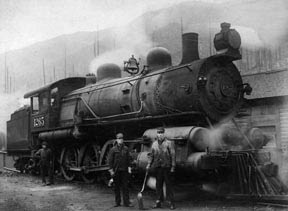
Photograph: Locomotive #1265 at Lester, WA. Longworth Collection, Northwest Railway Museum.

Certificate: Certificate of marriage, Colville, WA circa 1915. Washington State Archives.