Showing posts with label interpretation. Show all posts

Tuesday, May 22, 2018

New exhibit panels installed in Train Shed

Sign on the Northern Pacific bunk car.
New exhibit panels have been installed on or near eight objects in the Train Shed Exhibit Building. The panels were developed and purchased with a 2017 4Culture Heritage Special Projects grant and are now on display for the visiting public. Fossil Industries fabricated the panels. The Museum has used Fossil, based in New England, for several projects – the company is a leader in High Pressure Laminate (HPL) signage. HPL is a popular exhibit material because it is fade resistant and anti-graffiti.

Eight artifacts now sport a new panel that will help interpret the type of railroad car (general history) as well as the individual history of the car. The panels also include information on northern transcontinental lines including the Northern Pacific (NP), the Great Northern (GN), and Canadian Pacific (CP). Included are the GN X-101 and NP 1203 cabooses, the chapel car Messenger of Peace, the NP bunk car, the NP refrigerator car, a NP box car, a Polson Logging side dump car, and the CP 25 (formerly known as "Earnscliffe"). Four signs are 32” x 32” and are displayed on a sign stand next to their object. The other four panels are 24” x 24” and are affixed directly to the object in some way.

With these eight new signs added to the four signs already in the building, it means most of the large objects on display have their own interpretive sign. This is a major milestone for the education/exhibit department!

A 4Culture Heritage Special Projects Grant funded this exhibit. 4Culture is the cultural funding agency for King County, Washington. Using Lodging Tax and 1% for Art funds, 4Culture has four program areas to serve the county: arts, heritage, historic preservation, and public art. For more info on 4Culture, visit their website at www.4Culture.org


A big thank you to 4Culture for continuing to support exhibits at the Northwest Railway Museum.

Sign on one of the NP box cars in the Train Shed.

Large sign for the dump car - sign is affixed to
sign stands donated by Washington
State Historical Society.


Wednesday, February 15, 2012

New interpretive signs at the Depot

Thanks to a recent donation from the 4th Division/Pacific Northwest Region/National Model Railroad Association specifically marked for education, the Museum has designed and produced three new interpretive signs for large objects at the Snoqualmie Depot. The signs were fabricated by Fossil Industries, Inc. in New York. Fossil is considered a leader in outdoor sign fabrication. (From their website: “The World’s most durable signs and murals.”) For those familiar with the Centennial Trail signs, Chinook Signs Inc. designed the interpretive panels and Fossil fabricated them. (Chinook Signs Inc. also designed and fabricated the sign stands.)

The Museum’s Educator, Jessie Cunningham, is responsible for all exhibits and interpretation at the Museum. She worked closely with Fossil – in what turned out to be a lengthy process – to order the new signs. The first step was getting a quote to determine if signs were in the budget – they were. Cunningham and Executive Director Richard Anderson determined the three objects to create signs for. All three large objects will remain at the Snoqualmie Depot for the foreseeable future – which is why they were selected: Army Ambulance Kitchen car 89601, J.H. Baxter Co. locomotive 6-C, and Army Transportation Corps locomotive 7320 (also known as Cecil the Diesel). Each large object now has a new 17” x 17” sign.

Cunningham designed a template that was complimentary to the outdoor signs already at the Depot, as well as the Centennial Trail. Instead of being rectangular in shape, these new signs are square but feature similar design components. Sign content is a combination of both previously written and new material. Each sign also contains a minimum of one image. Volunteers Rich W. and Bob L. assisted with historical and technical accuracy. The revision process was long but necessary to insure the best product possible. Once Fossil received final approval it took six weeks to receive the sign order.

One aspect of sign design that was really important was determining how and where to affix the signs to the artifacts. Two of the three artifacts move around the site at the Depot, depending on the season and special event. So the Museum needed to be able to move the signs from side to side, depending on which track the car or locomotive was on. Another important part of this was determining how to affix the signs, since it was important to avoid permanently damaging the artifact (drilling holes, etc.). Cunningham submitted photographs and detailed measurements which Fossil used to design special hardware for each sign.

The Museum is thrilled to add these new signs to the Depot's exhibits. This additional interpretation will enhance the visitor experience. Don’t forget to check out the new signs next time you are at the Depot!

Images

(Top) Cunningham poses with the new Kitchen car sign. The sign is affixed to the steps below the large sliding door located at the middle of the car.

(Middle) Sign for locomotive 7320. Double click the image to see a larger version!

(Bottom) Locomotive 6-C is a popular destination at the Museum, since children are invited to climb in the locomotive and “drive the train.” Now parents can learn all about the history of the locomotive while they keep a close eye on their children.

Wednesday, July 27, 2011

I've been working on the railroad as an engineer

“The engineer is in charge of and responsible for the locomotive as well as the mechanical operation of the train, train speed, and all train handling.” In other words, the engineer controls the locomotive. Historically people apprenticed for the position of engineer by being the fireman.

A steam locomotive fireman spent most of his time maintaining pressure in the boiler -- shoveling coal into the firebox of a coal-fired steam locomotive or adjusting the fire in an oil-burning locomotive. It was a hard, dirty job. Hours and hours spent shoveling coal – it was hot in the summer and drafty in the winter.

Besides lighting and tending the fire, the fireman was also responsible for cleaning out the boiler and firebox, and adding water and fueling the locomotive before departure. Besides the fire and other duties, the fireman was also learning the job of engineer - incentive enough to shovel all that coal!

George William Longworth was born in Connecticut on February 16, 1879. He was the first of five children born to Peter and Kate Longworth. Soon after his birth the family moved west. In 1900 they were living in Lester, WA, where Peter was a shopkeeper.
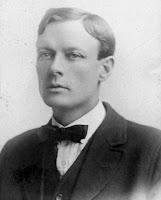
Longworth hired out on the Northern Pacific Railway (NP) in September 1898, at 19 years old. He listed his occupation as locomotive fireman in the 1900 U.S. Census and locomotive engineer in the 1910 census. So somewhere within that 10 year span he was promoted to engineer from fireman.

Longworth married Josephine Devershire and the couple lived in Seattle, WA. They had two children, daughter Melrene and son Thomas. Melrene was born in 1911, Thomas in 1917. Longworth worked for the NP until his death, at age 52, in 1931.

The executor of Melrene’s estate donated her photo collection to the Northwest Railway Museum. The collection consisted of some of George Longworth’s photos and correspondence from his time as an engineer, as well as the passes Melrene used to ride on the train when her dad worked for the NP.
If you are interested in seeing more photos, as well as several artifacts, visit the ladies waiting room at the Snoqualmie Depot. "I've been working on the railroad" is a rotating exhibit showcasing railroad jobs and and the people who performed them. Approximately every six months a new job will premiere.

Photos
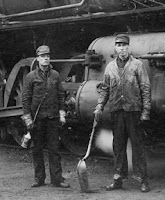
Which one is the fireman and which one is the engineer? Here is a hint: the fireman was responsible for shoveling coal as well as cleaning out the boiler, jobs he probably would have used a coal scoop for. Meanwhile, the engineer was responsible for oiling bearings and sliding surfaces before departure. George Longworth is on the left and is the engineer (holding his tool of the trade, an oil can), his fireman is on the right holding his shovel. Sometimes the fireman can be spotted simply because his clothes are noticeably dirtier from coming into contact with all that coal dust! Northwest Railway Museum Collection

George Longworth, date unknown. Northwest Railway Museum Collection


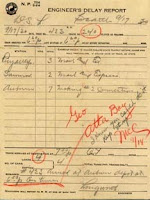
Trainmen were responsible for filing all kinds of paperwork, especially if there was a problem with their run. Here, engineer Longworth receives kudos from his superior: “George - Atta Boy, I knew you could do it, keep it up.” Circa 1930. Northwest Railway Museum Collection

Saturday, September 19, 2009

The Spirit of Cooperation

Two Snoqualmie Valley Museums are sharing a new exhibit, “North Bend’s Own Train,” which depicts the fascinating but untold story of the role the rail line played in the growth and development of North Bend and the Upper Snoqualmie Valley. The display contains the history, historical photos, diagrams and first-hand accounts of how the railroad brought prosperity to the Valley.

Although Snoqualmie had the elaborate depot, and was the heart of the operation, North Bend was where the train and crew were based for many years. (The engine was serviced at night by a watchman, the crew slept in old boxcar converted to a cozy caboose, and the engine was turned on the wye in North Bend.)

A commonality shared by North Bend and Snoqualmie is the critical role the railroad played in the development and sustainability of both communities. Until modern times the only way products like lumber and coal got to customers was by train. The rail line, opened in 1889, has served North Bend and the Upper Snoqualmie Valley for 120 years, bringing trade and tourists and thereby boosting - even enabling - the area’s economy.

The exhibit is the work of Northwest Railway Museum volunteers Dan O. and Thom W. It shows there are many opportunities for individuals to volunteer their particular talents at the valley Museums. Also contributing research, images, data, and stories were the Snoqualmie Valley Historical Museum, the White River Valley Museum in Auburn, the Northern Pacific Railway Historical Association, the North Bend branch of the King County Library System, and a number of individuals.

North Bend’s Own Train will be on loan to the Snoqualmie Valley History Museum through October 30th. Stop by and check out their newest installations; an exhibit on the Snoqualmie Tribe and another reflecting the last 100 years in North Bend. The Snoqualmie Valley History Museum is a short walk from the North Bend Depot. Take a stroll and return on a later train. Don’t be afraid to mention where you saw the information.

Beginning November 1st, the exhibit will move to the North Bend branch of the King County Library System, and then it will be placed on long-term display at the Northwest Railway Museum.

Thursday, December 18, 2008

Rehabilitating a coach

Coach 218 is an average coach. (We gave you a very brief introduction to it in our Coach made of wood piece published on 15 Dec 2008.) Built in 1912, it has much in common with coaches used by nearly all major railroads in the Northwest. It is built from wood but has several steel components that would have been made of wood had it been built just a few years prior. There is nothing terribly out of the ordinary or remarkable about coach 218 except that it has survived into the 21st Century. This makes it a great interpretive piece for the public because it can be used to represent what was once common.

Rehabilitation work began on the 218 in 2007. The first step in any major collection care project is research to develop a body of information that will guide the actual work and aid in its interpretation. Some information is derived from historic records, books and recollections; most is derived from the object itself. Obviously, some of the information gleaned from the object is obtained only as the project proceeds.

This month (Dec 2008) rehabilitation work on coach 218 continues to focus on the carbody and just this week a milestone was reached: volunteers installed a new right side plate, the top rail along the length of the car and that forms not only the top of the car side but the bottom support for the carlins (roof ribs) that make up the horizontal structure for the clerestory roof. (The nature of this work is rather technical – and uses terminology many are unfamiliar with - but the attached photo tells most of the story.)

The original plate was cut from two lengths of 3”x6” southern yellow pine, with a scarf joint connecting the two pieces. The scarfed joint was offset one window set from the center of the car and together made a plate nearly 80 feet long. This plate also had mortises on the under side for each of the window posts, and partial dadoes for the carlins.

Over half the plate on the right side of the car was deteriorated and we determined replacement was the preferred option. The remaining elements of the clerestory were undamaged so we decided to replace the plate in two halves - a top and a bottom - to avoid having to lift the clerestory and allow for installation over the tenons of the window posts. The new plate is also southern yellow pine, made from 2x6-16’ planks glued with marine grade epoxy.

With the new plate installation substantially complete, installation of carlins in this area has begun. As the rest of the car side comes back together, steel tie rods that run through the window center posts and between the windows will be installed to “tie” everything together.

Wednesday, November 19, 2008

Interpretation

Without a story, this large iron and steel object is recognizable to most casual observers as a steam locomotive. Without more information, the "WASH" in the name might lead you to believe is was used somewhere in Washington. The "PLYWOOD" suggests it had something to do with the forest industry. But what was it used for and why was it important? When was it built? Where was it used? How did it change our world?

Answering questions like these is what museums do and we call this interpretation. This year, the Museum completed design, manufacture and installation of ten outdoor interpretive signs that each highlight an artifact of railroad history and the role it played in Washington history. The project was funded by the City of Snoqualmie Lodging Tax revenues and the signs are located along the Centennial Trail in downtown Snoqualmie. Come down, check them out and let us know what you think!