Thursday, October 21, 2021

Out with the new, in with the old

Heavy things are about to move at the Northwest Railway Museum!

Successful museums constantly work to improve the representation of their collections and how it serves their mission.  An art museum may want to better represent notable local artists.  A flight museum might want the aircraft a local astronaut once flew.  A railway museum may want the second diesel electric locomotive to operate on a particular railway, and to return a road switcher to the home road it left more than 40 years ago.  These are all scenarios that have presented themselves at museums, but the last one is actually about to happen.

First, let's review a brief history of two locomotives:

Locomotive 201
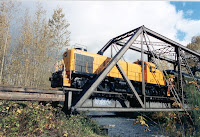
Locomotive 201 transits bridge 35 in North Bend
Locomotive 201 crossing
bridge 35 in North Bend.

In 1983 Kennecott Copper shuttered their operation near Ely, Nevada, and embargoed the Nevada Northern Railway.  They donated many of the diesel locomotives to museums around the west, and their locomotive 909 (earlier known as 201) was sent to the Northwest Railway Museum in Snoqualmie.  This six axle road switcher was built by the American Locomotive Company (Alco) in 1951 as a model RSD4, and it pulled trains on the Museum's Snoqualmie Valley Railroad for more than 20 years.  It has been stored complete ever since the Museum acquired the two much smaller Baldwin switchers that currently pull passenger trains.

Locomotive 125

Walla Walla Valley Railway  
circa 1963.
In the early 2000s, the Port of Longview retired their locomotive 770, an Alco model HH660 built in February, 1940.  Aside from being a really old diesel electric locomotive, it has significance to Washington State railway history.  The Northwest Railway Museum won a sealed bid auction to purchase the locomotive.

Northern Pacific Railway    
circa 1945.
Historically, this locomotive was just the second diesel-electric locomotive on the Northern Pacific Railway, and was first operated in Seattle switching the docks along the waterfront where it served as their locomotive 125. 

Walla Walla Valley Railway 
circa 1950.
In 1949, the NP sold the locomotive to the Walla Walla Valley Railway where it was renumbered 770.  It replaced an electric locomotive just as that interurban line shut down its electric overhead.  It spent several periods in the late 1950s building trains at King Street station when it was leased back to the Northern Pacific and subleased to King Street Station.  By 1971 the locomotive was sold to leasing company Relco and by the early 1980s was assigned to Continental Grain in Longview.  The locomotive was later purchased by the Port of Longview.

The Move

For more than ten years, the Nevada Northern Railway Foundation has been working with the Northwest Railway Museum on a plan to return locomotive 201 to Ely, Nevada.  The 201 operated on the Nevada Northern Railway for many years, and the objective of this initiative is to return this original artifact to its home road.  
Locomotive 125 in its
Port of Longview livery.
As part of this transaction, former Northern Pacific Railway locomotive 125 will be moved from Longview to Snoqualmie resulting in another Alco also returning to a home road.  This is a truly exciting development for both the Northwest Railway Museum's and the Nevada Northern Railway's collection, which will help further align them with their missions and scope of collection.

The moves are planned for early November 2021, but there are many variables that come into play when moving artifacts that weigh more than 330,000 pounds.  

Please stay tuned to the Museum's social media channels for late breaking news as to the date and time!

Sunday, September 12, 2021

Restoring a truss

Pullman builder's photo, courtesy of the
California State Railroad Museum library.
Parlor car 1799 is a Pullman Company product  constructed almost entirely of wood, and completed in 1901.  The car was built for extra fare (first class, similar to business class today) service on the Northern Pacific Railway's Lake Superior Limited serving between Minneapolis/St Paul and Duluth.  Later, the car was transferred to Washington State where it operated on the North Coast Limited between Seattle and Spokane.  The car was retired in 1940 and sold for use as a cottage on Whidbey Island.  It was donated to the Northwest Railway Museum and moved to Snoqualmie in 2018.  

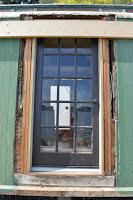
The cottage era doors 
were removed earlier this 
year.
During the cottage era when it resided on Whidbey Island, two entry doors were cut into the carbody in the center of the car, one on each side.  The key objective of the rehabilitation and restoration is to return to the car to its period of significance when it operated on the Northern Pacific Railway.  So the doorways had to be removed and the missing components in the truss restored.  

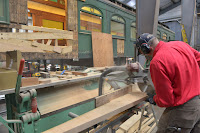
Floyd cuts a truss component to
length for use on the 1799.
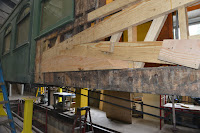
Floyd V. took the lead on this part of the project and fabricated in kind replacement sections of compression truss from southern yellow pine.  Next, the truss plank was replaced in kind using two large planks of Douglas fir.  Then the inter truss blocking was replaced with Douglas fir planks, though they were originally yellow poplar heartwood, which is not currently available to the Museum.  New sections were attached to old with lap slices, wood screws, and marine epoxy.  A replacement window sash set will be fabricated and installed later; new exterior cladding will be applied soon.

The cottage-era doorway is no more; a window
will be placed in the opening.
Rehabilitation and restoration of parlor car 1799 is continuing inside the Northwest Railway Museum's Conservation and Restoration Workshop. Funding for this phase of the parlor car project has been provided by individual contributions, the Washington State Historical Society Heritage Capital program, the Washington Trust for Historic Preservation, and by the Nysether Family Foundation.

Your support is welcome, and will be used to complete this major effort!.  Please click here to be directed to the Museum's contribution page.

New wood is seen in the compression truss of parlor car 1799.
New wood is seen in the compression
truss on parlor car 1799.
Carbody diagram
This 1909 cab builder's diagram illustrates
the carbody structure in a modern wood car
that is normally invisible to passengers.

Monday, August 30, 2021

Snoqualmie Railroad Days returns!


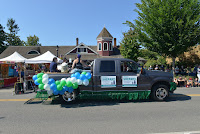
Snoqualmie's original fire truck 
On August 28 and 29, 2021, Snoqualmie Railroad Days made a triumphant return to the live event scene.  Despite the lingering effects of a global pandemic, the annual town festival that has been hosted in downtown for more than 80 years was able to return with a Grand Parade, an impressive car show, and of course the trains.

924 attracted attention
Of course there were many precautions.  Even with local vaccination rates of more than 85%, masks were mandatory inside buildings and on the train.  There were no outside food vendors this year.  Many participants practiced social distancing, and some activities including the wine bar and jazz stage took this year off.  

924 began the parade
The steam locomotive NPR 924 operated on Saturday as a demonstration.  It paced the honor guard leading the Grand Parade.  Then it shuttled between Newton Street and Fir Street all day long, with a brief pause in the north siding at Northern Street to allow the regular train to pass.

Traditionally, Saturday morning of Snoqualmie Railroad Days weekend sees a Grand Parade, and 2021 did not disappoint.  Fancy cars, the Mt Si marching band "Band Is Back!" local politicians and more provided a 45 minute experience.  The parade also included dancers, drill teams, service clubs, local merchants, unicycle demonstrations, and the Grand Marshal.  The 2021 Grand Marshal was the Snoqualmie Valley Healthcare Worker, and was represented in the parade by a diverse group of healthcare workers, and backed up by the Snoqualmie Valley Hospital.


Every four years Snoqualmie elects a mayor, and Snoqualmie Railroad Days often sees competing candidates in the parade and in booths along Railroad Ave.  This year Katherine Ross is facing off against Peggy Shepard.  Both candidates made an impressive showing.


Vendors are always an important part of Railroad Days, too.  Local honey, Gideon Bibles, African art and hand made instruments were just a few of the unique offerings in booths along Railroad Ave.  Other vendors included hand made clothing, book dealers, and a candle maker.

The highlight of this year's event was the Sunday car show.  Hosted by the Roadsters Northwest Club, almost 100 automobiles graced the streets of Snoqualmie on Sunday.  Muscle cars, antique cars, collector cars, sports cars, hot rods and even a few antique pick up trucks were on display.


The Northtwest Railway Museum is delighted that Snoqualmie Railroad Days 2021 was able to proceed despite the lingering effect of a global pandemic.  Thanks and credit to the success go to the Railroad Days Committee and the City of Snoqualmie, but especially to first-time Coordinator Emily B., and to Cole VG. who masterfully pulled off a memorable Grand Parade as the first-time field marshal!

Stay tuned for announcements regarding Snoqualmie Railroad Days 2022!  Meanwhile, join us again for steam this fall; check TrainMuseum.org for dates and times.

Tuesday, August 10, 2021

Day Out With Thomas with a destination!

Thomas the Tank Engine returned to the Snoqualmie Valley in July, but it wasn't just any visit.  During last year's pandemic closure, the Northwest Railway Museum made many site improvements to the Railway History Center.  This prepared the new campus for its first-ever visit with Thomas the Tank Engine!

Prior Day Out With Thomas events were held in historic downtown Snoqualmie.  The grounds around the Snoqualmie Depot were fenced off, tents were erected, and a variety of event-related infrastructure was set up to support the event.  This resulted in successful events, but the site was smaller than the Museum preferred, and it was costly to provide all the temporary infrastructure.

The "new" Day Out With Thomas was a very different experience: Thomas the Tank Engine took all his guests to a museum.  

Passengers boarded the train downtown at the historic Snoqualmie Depot for a short excursion to the Railway History Center.  They arrived and were greeted with a Thomas-themed museum experience that included a visit with Sir Topham Hatt, live music by Eric Ode on the BIG Cedar Tree Stage, bubble tables, a hay bale labyrinth, outdoor games, model trains and more.  

Guests got to tour the exhibit hall and see steam locomotive 924, the chapel car, and even tour a caboose.  Then they boarded a train with Thomas the Tank Engine for a SECOND excursion that took them to Snoqualmie Falls, and then safely returned them to the Snoqualmie Depot.

The "new" Day Out With Thomas was so successful that a second event is now planned for September 11 & 12, 2021.  Why not let Thomas take you on a trip?  Please visit Thomas.TrainMuseum.org for more details or to purchase tickets.

Thursday, June 3, 2021

Creating the Japanese Railroad Workers Exhibit

Exhibits take lots of time, planning, research and resources to create, the Museum’s new Japanese Railway Workers exhibit is no exception.  The process began in 2018 when staff members discussed the railways’ connection to the Snoqualmie Falls Lumber Company that the history of the Japanese community there was an important story that was not regularly told to the wider community.  Seeing this gap in historical interpretation, the Museum felt that creating an exhibit to share this unique history was important. 

Jessie Cunningham, the Museum’s Deputy Director began the research process and applied for a 4Culture grant to produce it.  Ms. Cunningham worked with Robert Fisher at the Wing Luke Museum, as well as Densho and the Snoqualmie Valley Museum. She also independently researched the topic to begin creating what became the exhibit.  Inspired by her research, the exhibit grew from just focusing on Japanese Railway Workers at the Snoqualmie Falls Lumber Co to also introducing the wider history of Chinese and Japanese Railway Workers.

One major challenge Ms. Cunningham found in the research phase was the lack of information and having to piece the story together from limited resources. But of course, that is why the story is so important!

Cristy Lake, the Museum’s Collection Registrar, is also the Assistant Director at the Snoqualmie Valley Museum and helped Jessie in her research throughout the project.  Dave Battey, a Snoqualmie Valley Museum board member and official historian for the town of Snoqualmie Falls, provided research material including a powerpoint created by the now closed Weyerhaeuser Archives and digital copies of documents from the George Abe family. 

The Wing Luke Museum and Densho provided many images and Densho also provided the an oral history interview with a former resident of Snoqualmie Falls. Special thanks to Dana Hoshide from Densho for helping obtain usage permission.

In 2019, 4Culture awarded a grant to create the exhibit. Ms. Cunningham spent much of 2019 researching and creating text for the sections of the exhibit. When, later that year, Ms. Cunningham took a position at another organization, Ms. Lake took over completing the exhibit.  Ms. Lake worked with Arisa Nakamura and Emily Halladay-Ptaček-Choi of Japanese Cultural and Community Center of Washington to provide feedback and recommendations on the content and with Northwest Railway Museum staff members Richard Anderson, Emily Boersma and Peggy Barchi to review the final exhibit content drafts.

Due to space limitations, after much review, the exhibit was streamlined. This proved a difficult task as there were so many important stories waiting to be told. After much work, the exhibit content was sent to Lee Ater of Lot22 Creative who designed the exhibit panels.  Gary James, the Museum’s Shipwright, fabricated the panel stands. Arscentia printed the panel text and images.

In all, the exhibit would not have been possible without the collaboration of numerous people, organizations and businesses; hundreds of hours of work; and supported with grants from 4Culture and the the Quest for Truth Foundation, and by the Museum's general fund.

You can visit this new exhibit in the Museum’s Train Shed Exhibit Hall, currently open Wednesdays through Mondays, 11am to 4pm.

Monday, May 31, 2021

Japanese railroad workers in Snoqualmie

Japanese immigrants to Washington were influential in railway construction, and other industries including forestry. Workers of Japanese ancestry made up the largest ethnic group of workers at the Snoqualmie Falls Lumber Company, outnumbering even Scandinavian immigrants.

Japanese immigrants settled in several regions of the country, but the Northwest was a particularly popular destination. This new exhibit acknowledges the role of Japanese immigrants and their children in the construction of railroads, but also in the success the Snoqualmie Falls Lumber Company.  

In the Snoqualmie Valley, the earliest known Japanese connection was through the construction of the Seattle, Lake Shore and Eastern Railway.  The Chinese exclusion act combined with Japan's emergence from isolationism to position Japanese immigrants as the predominant group recruited for railroad construction and maintenance in this region.  Usually, a contractor provided a Japanese worker to a railroad, and that worker was then required to pay a fee to said contractor, often as much as 10 cents a day.

Persons of Japanese ancestry were part of the fabric of Snoqualmie Falls, but it was an imperfect tapestry: persons of Japanese ancestry lived in a separate bunkhouse or a different part of the community than those of European ancestry.  However, they did attend the same schools. 

The Snoqualmie Falls Lumber Company - and the Snoqualmie Valley - was devastated by the 1942 incarceration of persons of Japanese ancestry.  Overnight, this Weyerhaeuser Timber enterprise lost a significant portion of its work force, and these people - many of whom were either born American citizens or had been living in the United States for decades (Asian immigrants had no path to citizenship) - were interned in camps only because of their ethnic origins.

Japanese Railroaders was funded in part by 4Culture and the Quest For Truth Foundation.  It is a permanent exhibit at the Northwest Railway Museum and is open now in the Train Shed, 9320 Stone Quarry Road, Snoqualmie, WA, Thursday - Sunday, 11 am - 5 pm.

Friday, May 14, 2021

Sign language

Successful heritage tourism is an important goal in our local community, and to successfully attract an audience there are many preconditions.  However, being able to successfully find and then identify the Northwest Railway Museum is one of the key requirements.

Over the last few years, the Museum has been working with Lot22 to develop a successful brand and apply it to every aspect of the marketing effort.  The most recent efforts involve new signage in Snoqualmie.

The "original" Snoqualmie Depot monument sign was installed in 1974, and no longer reflected the image the Museum wanted to convey.  A new sign was developed by Lee A. at Lot22 and fabricated by Northwest Sign.  It incorporates elements of the Museum's brand awareness and includes a reference to the Museum, Depot Bookstore, and the Snoqualmie Valley Railroad.  Construction features a massive cedar plank, and installation was completed by Floyd.

The Museum includes several sites in the upper Snoqualmie Valley and visitors have often been confused about the interconnectedness.  Landscape artist J. Craig Thorpe created a watercolor map to illustrate the operating territory of the Snoqualmie Valley Railroad and identify stops and connected attractions, but chiefly to show where the various parts of the Museum are located.  These new way finding maps are being placed at the Rotary Snowplow at the foot of the Snoqualmie Parkway, and by the exhibit building at the Railway History Center.  Later, another map will be placed at the Snoqualmie Depot.

Though elegant and simple in design, these new signs represent a significant investment of time and money.  The Northwest Railway Museum is grateful for the vision and design work contributed by Lee A., and for the funding contributed by the City of Snoqualmie from the Lodging Tax Fund.  And special thanks to Floyd for installing them!