Showing posts with label Parlor car 1799. Show all posts

Sunday, September 12, 2021

Restoring a truss

Pullman builder's photo, courtesy of the
California State Railroad Museum library.
Parlor car 1799 is a Pullman Company product  constructed almost entirely of wood, and completed in 1901.  The car was built for extra fare (first class, similar to business class today) service on the Northern Pacific Railway's Lake Superior Limited serving between Minneapolis/St Paul and Duluth.  Later, the car was transferred to Washington State where it operated on the North Coast Limited between Seattle and Spokane.  The car was retired in 1940 and sold for use as a cottage on Whidbey Island.  It was donated to the Northwest Railway Museum and moved to Snoqualmie in 2018.  

The cottage era doors 
were removed earlier this 
year.
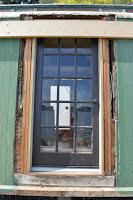
During the cottage era when it resided on Whidbey Island, two entry doors were cut into the carbody in the center of the car, one on each side.  The key objective of the rehabilitation and restoration is to return to the car to its period of significance when it operated on the Northern Pacific Railway.  So the doorways had to be removed and the missing components in the truss restored.  

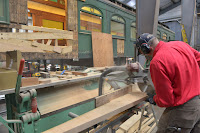
Floyd cuts a truss component to
length for use on the 1799.
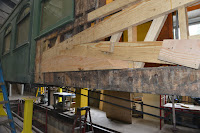
Floyd V. took the lead on this part of the project and fabricated in kind replacement sections of compression truss from southern yellow pine.  Next, the truss plank was replaced in kind using two large planks of Douglas fir.  Then the inter truss blocking was replaced with Douglas fir planks, though they were originally yellow poplar heartwood, which is not currently available to the Museum.  New sections were attached to old with lap slices, wood screws, and marine epoxy.  A replacement window sash set will be fabricated and installed later; new exterior cladding will be applied soon.

The cottage-era doorway is no more; a window
will be placed in the opening.
Rehabilitation and restoration of parlor car 1799 is continuing inside the Northwest Railway Museum's Conservation and Restoration Workshop. Funding for this phase of the parlor car project has been provided by individual contributions, the Washington State Historical Society Heritage Capital program, the Washington Trust for Historic Preservation, and by the Nysether Family Foundation.

Your support is welcome, and will be used to complete this major effort!.  Please click here to be directed to the Museum's contribution page.

New wood is seen in the compression truss of parlor car 1799.
New wood is seen in the compression
truss on parlor car 1799.
Carbody diagram
This 1909 cab builder's diagram illustrates
the carbody structure in a modern wood car
that is normally invisible to passengers.

Monday, May 3, 2021

Restoring a truss - part one

Parlor car 1799 was built by Pullman in 1901.  After 38 years of service for the Northern Pacific Railway, the car found a second use as a seaside cottage.  That new adaptive use removed the distinctive truss rods, queen posts, and needle beams from the wooden car's underbody that supported the car while in service.  These components were vital for the car frame to span from one truck to the next, but no longer required once the car was set on a foundation.  So naturally for the car to return to its appearance and function as a railroad parlor car, the trusses required restoration.

The parlor car was moved from Whidbey Island on Puget Sound to the Northwest Railway Museum using a temporary steel frame.  This adjustable device had been used to move countless homes and served the same purpose for the parlor car.  Once unloaded at the Museum, the car was supported with wood and steel car stands, but to allow the car to return to its former glory as a Pullman parlor car, the truss had to be replaced.

The Museum was fortunate to have retained the needle beam and queen posts from a former Canadian Pacific officials car.  These hardware components were standardized by the Master Car Builders, the forerunner of today's Association of American Railroads.  So the queen posts and needle beams manufactured in the Hochelaga Shops of the Canadian Pacific Railway in Montreal were visually and functionally nearly identical to the components manufactured by the car builder in Pullman, Illinois.

The rehabilitation and restoration of parlor car 1799 to its appearance and function during the early 20th Century is being supported in part by a grant from the Heritage Capital Projects program of the Washington State Historical Society.  Many staff costs are used to meet the obligatory cost share and are funded by the Museum's operating budget, which has been seriously compromised by the closure necessitated by the pandemic.  Your support helps this project continue through to completion, and ensure the museum continues to serve its educational purposes.  

Please consider a contribution to GiveBig 2021.  Your support will help this project overcome the pandemic.

Wednesday, February 10, 2021

Trucks for the Parlor Car

The parlor car in 2016 on Whidby Island 
Parlor car 1799 was built by Pullman in 1901 and is typical of an extra fare day service car of the era.  It and an identical car were the Northern Pacific's very first true all parlor car.  It was donated to the Museum in 2018 and moved to Snoqualmie from Whidbey Island.  It had been used as a seaside cottage for more than 70 years, but is now destined to return to its former configuration as a Northern Pacific Railway parlor car.

The trucks arrive on a truck
When the car was reconfigured as a cottage, the trucks - frames that support the suspension, wheels and bearings - were removed and scrapped.  The original trucks were a standard design developed by the Master Car Builders (MCB) Association, and were of composite wood and steel construction.  This same truck design is found under chapel car 5 Messenger of Peace, and Spokane, Portland and Seattle coaches 213 & 218.  It is a design that was replaced by the late 1910s with all steel cast trucks.

The trucks were unloaded by
simultaneously lifting  all three axles

The Museum is delighted to share that Steven Butler and Morton Machine Works donated a pair of 1900s-vintage MCB trucks to the project.  The former Great Northern Railway baggage car trucks were located at the Texas State Railroad Museum and arrived by highway truck last Sunday morning.  This 25 ton load arrived on time after a four day drive from Palestine, TX.

Both trucks were unloaded in 45 minutes
The fine folks at Imhoff Contractor and Crane Service of Snoqualmie made quick work unloading the "new" parlor car trucks.  They were unloaded onto the Museum's main track and moved into the Conservation and Restoration Workshop where they will be rehabilitated in anticipation of installation under the parlor car later this year.

The transportation and unloading of this pair of MCB trucks was funded in part with individual donations, and grant funding from the Washington Heritage Capital Projects Fund of the Washington State Historical Society.  Work is being guided by research funded by the National Trust for Historic Preservation conducted by Mr. Kyle Wyatt, former Curator at the California State Railroad Museum.  Special thanks to Steven Butler for donating these important components to the parlor car.

Sunday, May 20, 2018

Parlor car arrives

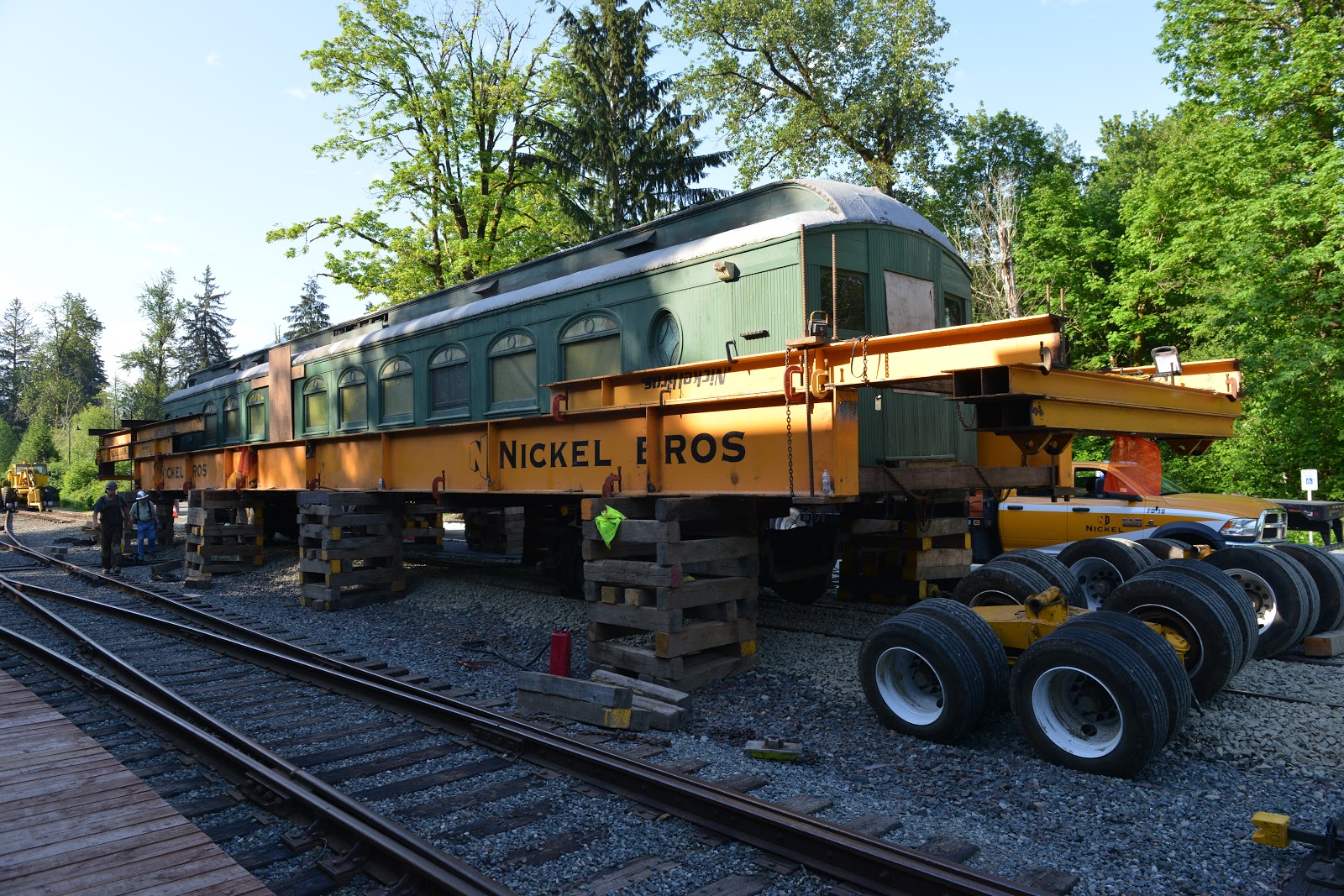
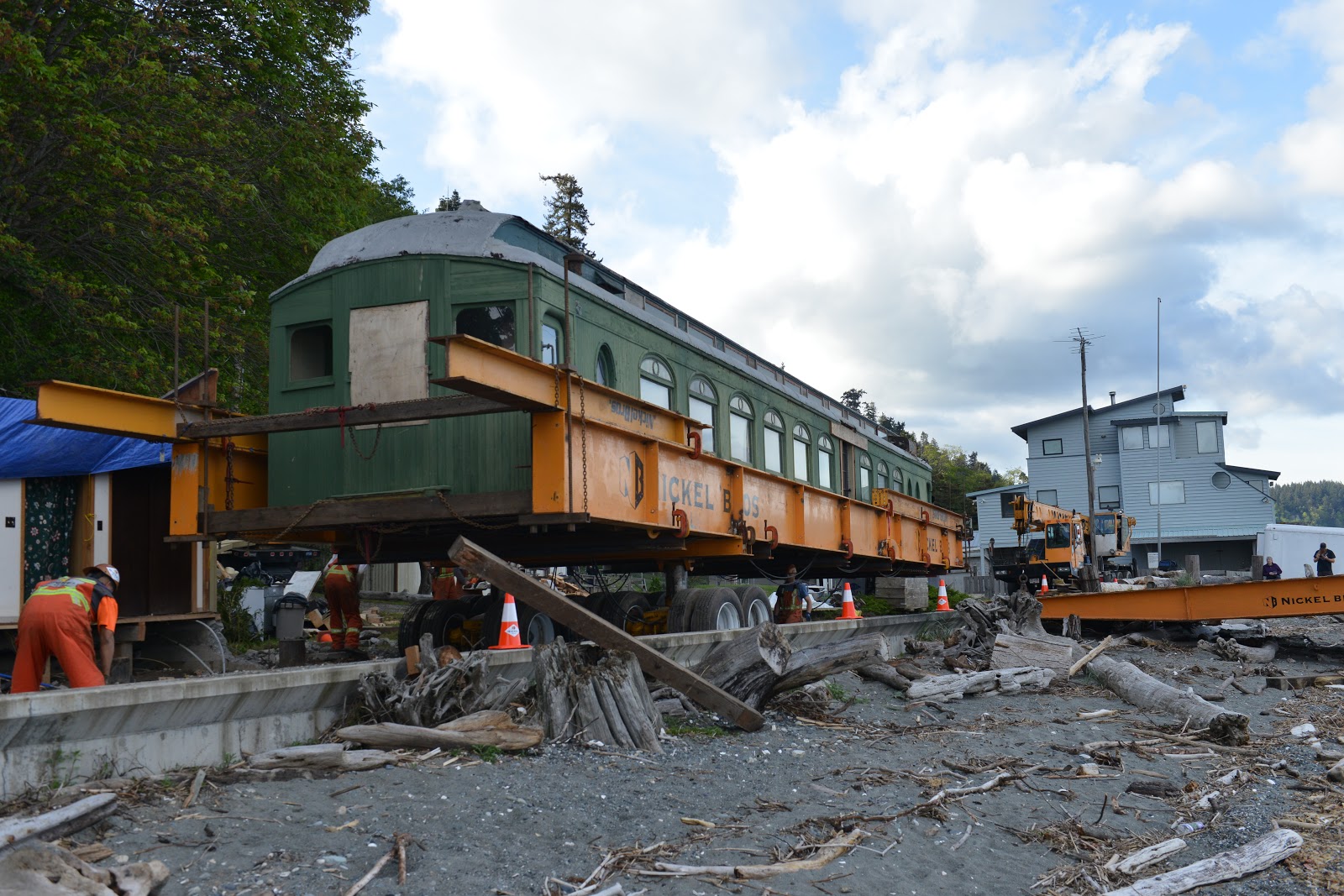
It has been a busy week at the Northwest Railway Museum.  Generous contributions from individualsGive Big, local business, Nickel Bros. and the Schwab Fund for Charitable Giving supported the move of Northern Pacific Railway parlor car 1799.  Its placement on wheels on the Museum's railroad was the result of many months of planning.  Located on Whidbey Island for more than 77 years, car 1799 crossed Puget Sound on a barge, traversed three Interstates to Snoqualmie in a night-time move, passed through downtown Snoqualmie along Railroad Avenue, and - finally - this week was lowered onto a set of trucks (a frame to support wheels and a suspension).

The move was completed by Nickel Bros., a firm best known in Washington and British Columbia for moving historic homes and structures.  They are well-acquainted with moving structures in a marine environment, and devised a system to move the 1799.

Parlor car 1799 was built by Pullman in 1901 for the Northern Pacific Railway.  It served that railway for almost 40 years - including service from Seattle's King Street Station - until it was retired and subsequently purchased by a railroad executive and moved to Whidbey Island for use as a seaside cottage.

Owned by the Shaw Family since the early 1970s, the car has remained in great shape but it was not well-suited for the use of a multi-generational family.  Fortunately, thanks to an introduction arranged by Thomas the Tank Engine, the Shaw family contacted the Museum and offered to donate the car if it could be removed from the seaside parcel it occupied since 1941.

Moving a more than 100-year-old wood railroad car usually involves dealing with substantial deterioration, but not in this case.  Car 1799 was and is in excellent shape.  Notwithstanding, two doorways were cut in the sides, and the truss rods - an important part of the structure - were removed in 1941.  So an elaborate steel frame was constructed to support the car, and allow it to be moved off the beach without damage.


There was considerable effort required to complete the move of car 1799.  One of the important requirements was "flooding" the Museum's track with railroad ballast so the Nickel's truck could roll onto the rails.  Mr. Tom Weber of the Mt. Si Quarry donated 40 tons of 2 inch ballast, which was easily spread and performed admirably.  Mr. Weber also owns Weber Construction, and arranged to lift two passenger car trucks out of storage and back onto the tracks.  The lightweight trucks are quite an anomaly - they were not built until after 1799 was retired - but will support the car until historically-correct trucks arrive.

The house-moving frame did create a few challenges - the assembly was 16 feet wide and occupied two highway lanes.  Yet this was the most practical option, and as of this week, the car is back on the rails, and preserved at the Northwest Railway Museum.

The next step is moving a set of historically appropriate trucks to the Museum and installing them.  Contributions in support of this next phase are welcome. Thank you to the dozens of individuals and businesses that have already made contributions to this project!  


Thursday, May 17, 2018

Parlor car service on the Interstate?

Well, not quite, but the Northern Pacific Railway parlor car 1799 did have an eventful trip on three Interstate highways as it continued its journey to the Northwest Railway Museum in Snoqualmie, destined to arrive via old I-90.  The recent run of unusually hot and dry summer weather - in early May - has served the 1901-built artifact well, and made the process of moving it much easier and less stressful.  And thanks to the careful efforts of Nickel Brothers, the support and cooperation of WSDOT, the City of Seattle, and the City of Snoqualmie, the 1799 has landed in Snoqualmie. 

Moving an oversize load in Washington State is now a little different than it was a few years ago.  Moves of parlor car size must be made at night, cannot go over the floating bridges, and require a police escort.  

The move began by slowly rolling out of the port facility on the Duwamish River.  Just shy of highway 99, the trailer was modified with additional axles, a device most truckers call a jeep, or jeep dolly.  This extended the overall length of the assembly to more than 156 feet, and spread the substantial weight over a greater area.

The really interesting part of the parlor car move was taking up two lanes of traffic, and Spike can attest to the significant volume of traffic on I-405 at 3 AM, and the distraction that the parlor car created.  One brief moment of excitement was when some blocking began to loosen, and the entire convoy stopped on the shoulder in Renton, which really means a wide shoulder plus an entire lane of traffic.  But after some quick work, the parlor car was underway again.

More excitement was in store in Snoqualmie when the parlor car attempted to negotiate the roundabout at the Snoqualmie Casino.  Unfortunately, there was a minor miscalculation and the trailer - even in shortened state - was just a little too long: there is a concrete monument in the center of the roundabout that provides an absolute limit.  So the entire rig was turned around and entered Snoqualmie via the parkway.  The parlor car passed by the Snoqualmie Depot after all, and arrived at the Museum campus just as the sun came up!


Wednesday, May 9, 2018

Give Big, today!

Wednesday, May 9, 2018 is Give Big day in King County and the Seattle region.  Give Big is a charitable giving event benefiting non profit organizations of many differing sizes and missions.  Contributions received on May 9 go directly to the designated non profits.


Parlor car 1799 loaded on barge just off coast of Whidbey Island on April 30, 2018. The Northwest Railway Museum is participating, and has designated the Northern Pacific Railway parlor car 1799 preservation project as its recipient.  1799 is in the process of being recovered from a beach on Whidbey Island on Puget Sound and moved to the Museum in Snoqualmie.

Check out some of the progress over the last two weeks, and please Give Big today!

Videos of barge loading operation

Loading the barge

Preparing the parlor car

Dismantling the parlor car's shelter

Thank you for your Give Big in support of the parlor car 1799 preservation!

Thursday, May 3, 2018

Loading the barge, redux

Parlor car 1799 was loading on a barge to transport it from Whidbey Island to West Seattle.  Preparations for the move were described here and here, and loading of the barge was documented here.  Now, from budding photographer Bennett A. is a time lapse version of loading the barge.  Enjoy, and remember to Give Big on May 9, or better yet, schedule your contribution now!

Not to be outdone, experienced drone operator and videographer Kyle I. filmed the barge loading operation., providing a unique perspective of this undertaking.  Enjoy!


Tuesday, May 1, 2018

Whatever floats your rail car

Parlor car 1799 has recently been the center of considerable attention, and the effort reached its pinnacle when the car rolled onto a barge on Puget Sound.  And yet this culmination of nearly two years of planning was anticlimactic because everything proceeded without significant incident. 

Recapping, Parlor Car 1799 was built by Pullman in 1901 for the Northern Pacific Railway.  In 1941 it was retired and moved to a beach on Whidbey Island for use as a cottage.  The owners have lovingly cared for this historical artifact for many years, but it was time for them to build a more traditional home.  The owners searched for an option that would assure the car's preservation, and they selected the Northwest Railway Museum.

Nickel Bros. specializes in moving homes and was hired to recover the Parlor Car, which had lost its truss rods (part of the structure) in 1941.  Nickel's house moving "erector set" was used to jack and support the car, and a set of wheels that must have been inspired by a large aircraft were attached to one end.  The ungainly vehicle was more than 130 feet long and weighed upwards of 150,000 pounds.

On a bright spring day, a barge arrived under the control of tug Carolyn H.  A ramp system was installed to connect the barge with the seawall, and then it was time for the Parlor Car to move.  

A semi tractor (with a little help from the crane) pulled the car from its resting spot of more than 77 years.  It was gingerly backed onto the barge in a little more than 45 minutes.  There was plenty of crackling wood, but the car was silent: all the noise came from the plywood mats that were placed to keep the semi tractor from sinking into the beach sand.

By 6:50 in the evening, Parlor Car 1799 was on its way to Seattle!  Tug Carolyn H pushed it down the east coast of Puget Sound along the route of the Great Northern (BNSF).  About the time of the Parlor Car's departure, a northbound Amtrak Cascades train was observed on the distant shore.

Facilitating the preservation of the Parlor Car has been a monumental task, and it is not complete yet.  Please help the Northwest Railway Museum complete the effect with a scheduled contribution to Seattle Give Big 2018.  Your support in any amount with go towards the relocation effort.  Thank you for your consideration!

Monday, April 30, 2018

Putting wheels under a parlor car

Parlor car 1799 is situated on a beautiful island beach on Puget Sound.  The former Northern Pacific Railway Pullman-built wood car has been donated to the Northwest Railway Museum, and will be moved to the Train Shed Exhibit building.  However, first it needs wheels!
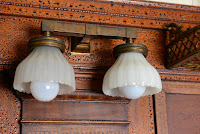
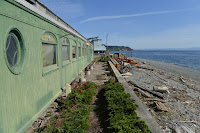
Repurposed as a cottage in 1941, car 1799 has been supported with pilings for more than 77 years, and has retained all of its original elegance.  And since the mid 1970s it has been housed inside a shelter. Last week, the shelter was disassembled, which was detailed in this blog.  This week the next phase begins.
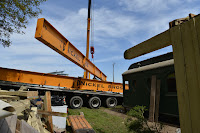
Nickel Bros specializes in transportation of homes and other structures, and they are a natural partner for a wood railroad car that lacks its truss rods.  Nickel's team uses a set of hydraulic jacks to lift structures.  They assemble a steel frame under and beside the building, and then place wheel dollies under the completed assembly.
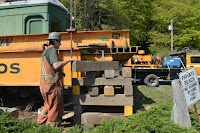
The 1799 is particularly challenging because it has original structure in the car sides that could be easily damaged if jacked carelessly.  Furthermore, the car weighs 80,000 pounds and has to be jacked evenly to avoid the potential for broken windows.

Nickel's solution includes two monstrous H beams that are designed to evenly support the entire car.  Smaller beams extend from one side to the other perpendicular to the large beams.  They directly bear on the bottom of the car and simultaneously pickup the side, intermediate and center sills.
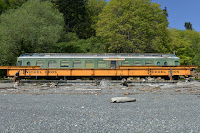
The jacking began quickly and uneventfully; there were no unusual sounds or movement.  The frame had enough integrity that it was self-supporting for short periods of time as the jacks caught up.  This is truly a testament to the car builders at Pullman, Illinois.
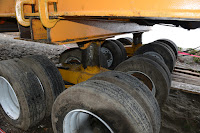
Once the car was jacked up sufficiently, the wheel dollies were hoisted into place.  A double set of wheels was installed to spread the mass over the 14 feet of width.  These rubber-tired dollies have independent steer and adjustable height, both valuable features in avoiding complication on a difficult site.

The process of moving car 1799 to the Museum is an exercise in careful planning.  Now through May 9 you can schedule support for this project through the Seattle Foundation's Give Big event.

Friday, April 27, 2018

Parlor car 1799 move grows near!


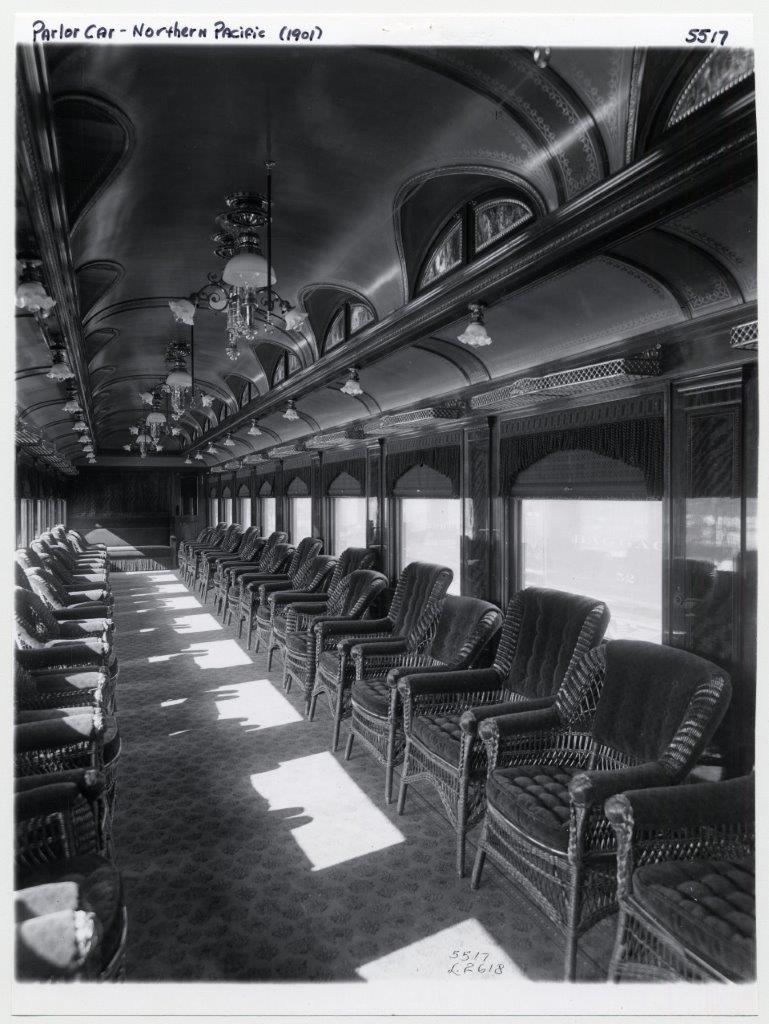
The Parlor Car is ready to move to the Museum!  A Parlor car was an extra-fare car and provided service that would be equivalent to today's business or first class.  In the Golden Age of Rail Travel, the Parlor Car epitomized nearly everything that rail travel could be.


Parlor car 1799 was built by Pullman in 1901 for service on the Northern Pacific Railway.  It is one of the few surviving early 20th Century railway passenger cars known to have served in Washington State.  It is a full-length car built entirely of wood, but it was never upgraded with steel components as so many other wooden cars were.  Instead, it was purchased by an Auburn railroad worker in 1941 and moved to Whidbey Island on Puget Sound for use as a cottage, a use that continued for the next 77 years.


Parlor car 1799 has been generously donated to the Northwest Railway Museum by the Shaw Family.  The car survived well into the 21st Century because it was housed within a protective shelter.  Even so, the car is in remarkable condition because the Shaw family took such great care of it. Soon, it will be housed in the Train Shed exhibit building, but first it has to move off the island by barge and travel on I-90 to the Museum in Snoqualmie.

Car 1799 was listed on the Washington Trust for Historic Preservation's 2017 Most Endangered List and fundraising to aid its preservation began last year with the Seattle Foundation's charitable giving event called Give Big 2017.  Moving an 80,000 pound wooden rail car off an ocean beach is a big undertaking so a great deal of planning has already gone into the project.  Yet the reality of moving such a large object hit home only when a team of more than a dozen Museum Volunteers began dismantling the shelter that has protected the parlor car since the mid 1970s.

The structure built more than 40 years ago and was constructed predominantly of western red cedar.  It was well-built and sturdy, yet the volunteer crew was able to make quick work of the dismantling process, which was performed methodically to avoid damage to the car.

In all, more than 200 hours person hours were invested in the deconstruction process, but there were other aspects to the project too.  When 1799 was improved with the new shelter, new entry doors were cut into the car's sides.  This made the structure more suitable and convenient as a cottage, but it meant the structure that allowed it to function as a rail car had been weakened. To make the car frame strong enough to move, temporary repairs to the letter board and truss plank were performed. 

Meanwhile, the deconstruction crew continued to remove the overlying structure. By late April 2018 as local temperatures reached into the 80s, the car was out in the open for the first time in more than 40 years.  The next step in the process turns the car over to Nickel Brothers for the barge and highway move to the Museum.

Please consider supporting this project with a contribution to Give BIG 2018!  Visit the Museum's page to schedule your donation today!

Monday, November 27, 2017

Giving Tuesday, November 28, 2017

Giving Tuesday is a day of charitable giving held every year on the Tuesday following Thanksgiving, and this year is officially Giving Tuesday in the City of Snoqualmie as declared by Mayor Matt Larson.  The Northwest Railway Museum is part of the Giving Tuesday movement, and invites you to support programs and initiatives.  This year support will be directed towards continuing work on NP steam locomotive 924, to assess Puget Sound Electric Railway interurban car 523, and help move former Northern Pacific Railway parlor car 1799 to the Museum from an island in Puget Sound.  And the Museum is grateful for General Fund support too!

Specifically,

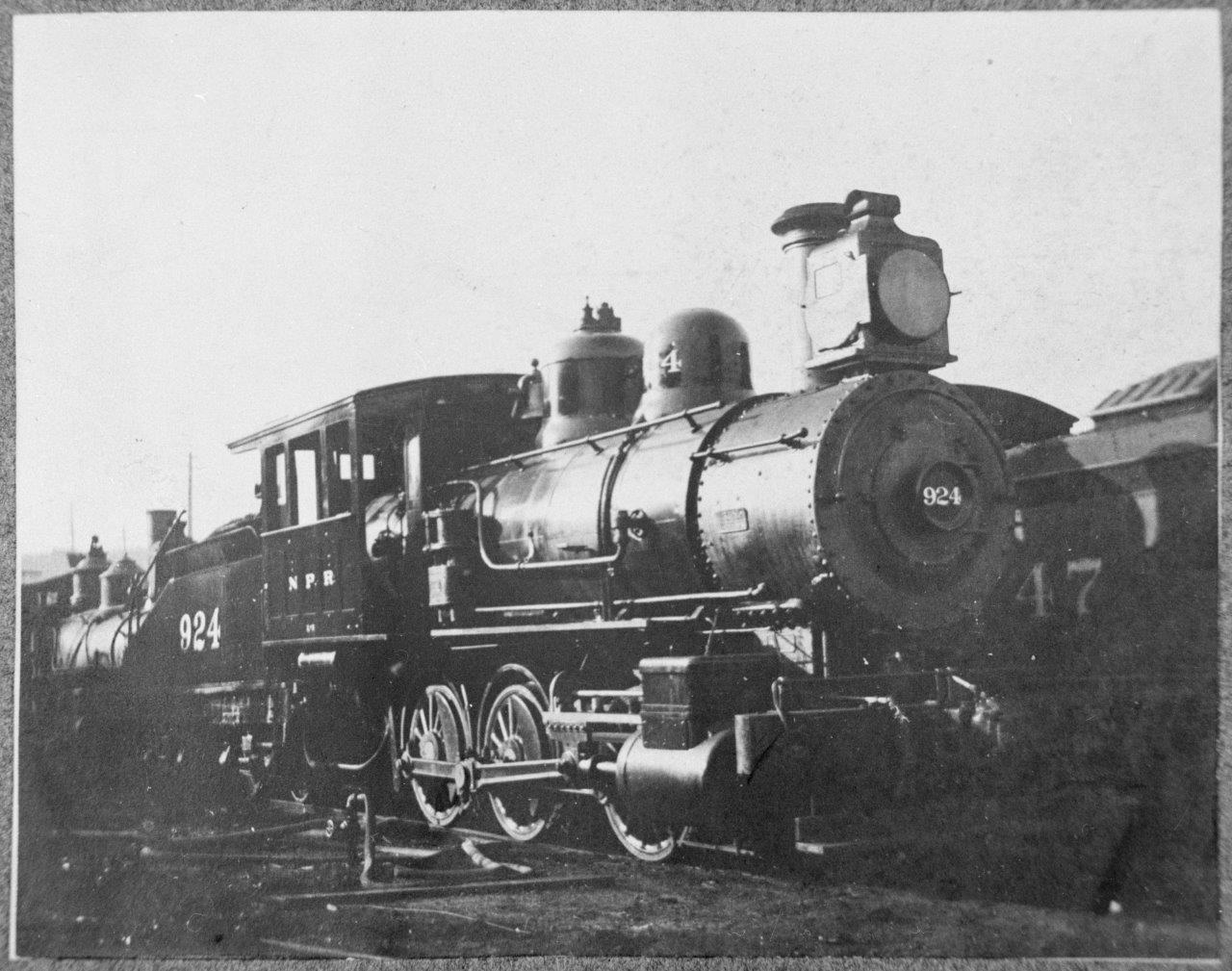
NP 924 circa 1908
Locomotive 924.  Rehabilitation of this former Northern Pacific Railway steam locomotive has been underway for the last two years.  This multi-year effort will allow this 1899-built steam locomotive to operate again!  924 is a City of Snoqualmie and King County Landmark. The locomotive cab and running gear are two of the undertakings contributions are supporting this year, and some additional boiler work will be taking place early next year.  Recent work has included rehabilitation of the steam appliances.  

LC parlor car photoParlor car 1799.  Parlor cars were extra fare cars on passenger trains that catered to the needs of the more affluent.  1799 operated between Seattle and Yakima on through trains.  This former Northern Pacific Railway parlor car is located on an island in Puget Sound, and is included on the Washington Trust for Historic Preservation’s Most Endangered Places list.  The owners have offered the car as a donation provided it is removed from the site.  The project is ready to proceed pending receipt of development permits, which is expected to occur early in 2018.  Support is being directed towards the cost of crane, barge and trucking fees.

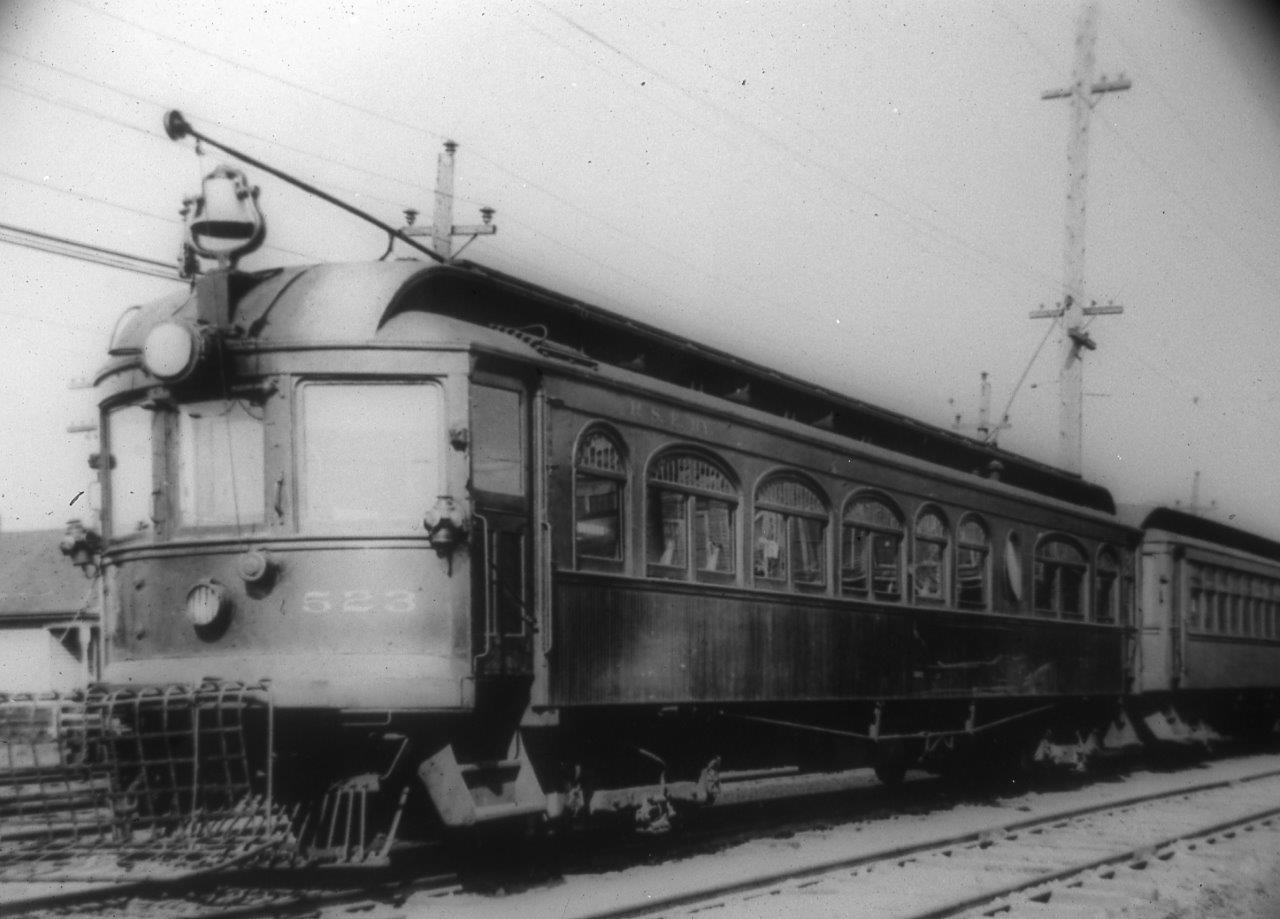
InterurbanInterurban car 523The Puget Sound Electric Railway operated electric trains between Seattle and Tacoma from 1902 through 1928.  Car 523 is the only known surviving car, and originally served as a combination coach/parlor/observation car. It arrived in Snoqualmie in September.  Support towards this project will help funding a complete assessment, and the first phase of its structural rehabilitation to repair side sill damage caused by the car’s reuse as a residential home.

The General Fund is a great way to support the Northwest Railway Museum without designated a specific project or initiative.  Support received designated towards the general fund will be used for regular programs including School Train, operation of the Snoqualmie Depot, and the operation of web sites like www.WellingtonRemembered.org

Giving Tuesday is an opportunity to support the Northwest Railway Museum.  Please visit the donate now page and choose your favorite project!