Showing posts with label Nickel Bros. Show all posts

Sunday, May 20, 2018

Parlor car arrives

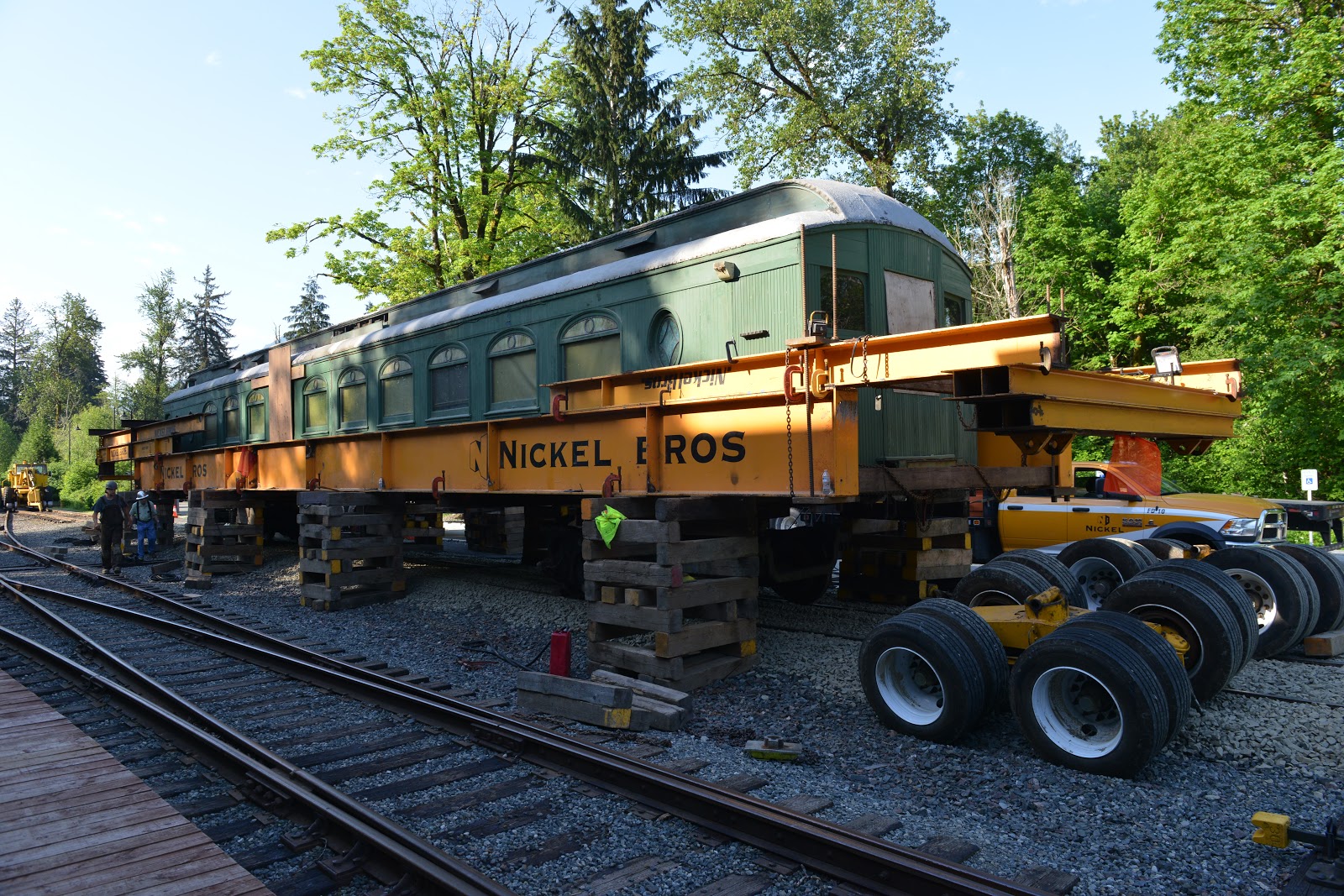
It has been a busy week at the Northwest Railway Museum.  Generous contributions from individuals, Give Big, local business, Nickel Bros. and the Schwab Fund for Charitable Giving supported the move of Northern Pacific Railway parlor car 1799.  Its placement on wheels on the Museum's railroad was the result of many months of planning.  Located on Whidbey Island for more than 77 years, car 1799 crossed Puget Sound on a barge, traversed three Interstates to Snoqualmie in a night-time move, passed through downtown Snoqualmie along Railroad Avenue, and - finally - this week was lowered onto a set of trucks (a frame to support wheels and a suspension).

The move was completed by Nickel Bros., a firm best known in Washington and British Columbia for moving historic homes and structures.  They are well-acquainted with moving structures in a marine environment, and devised a system to move the 1799.

Parlor car 1799 was built by Pullman in 1901 for the Northern Pacific Railway.  It served that railway for almost 40 years - including service from Seattle's King Street Station - until it was retired and subsequently purchased by a railroad executive and moved to Whidbey Island for use as a seaside cottage.
Owned by the Shaw Family since the early 1970s, the car has remained in great shape but it was not well-suited for the use of a multi-generational family.  Fortunately, thanks to an introduction arranged by Thomas the Tank Engine, the Shaw family contacted the Museum and offered to donate the car if it could be removed from the seaside parcel it occupied since 1941.

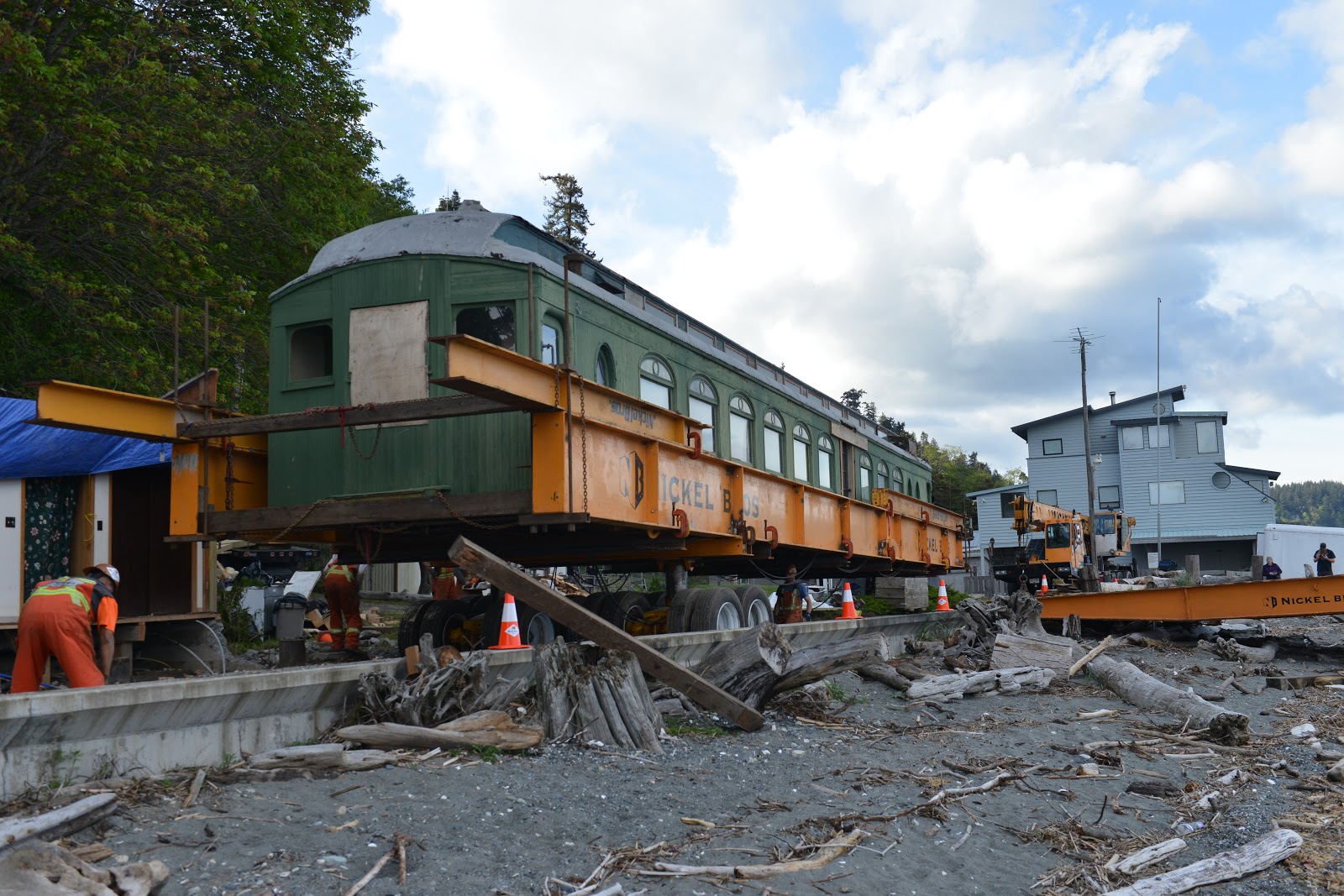
Moving a more than 100-year-old wood railroad car usually involves dealing with substantial deterioration, but not in this case.  Car 1799 was and is in excellent shape.  Notwithstanding, two doorways were cut in the sides, and the truss rods - an important part of the structure - were removed in 1941.  So an elaborate steel frame was constructed to support the car, and allow it to be moved off the beach without damage.


There was considerable effort required to complete the move of car 1799.  One of the important requirements was "flooding" the Museum's track with railroad ballast so the Nickel's truck could roll onto the rails.  Mr. Tom Weber of the Mt. Si Quarry donated 40 tons of 2 inch ballast, which was easily spread and performed admirably.  Mr. Weber also owns Weber Construction, and arranged to lift two passenger car trucks out of storage and back onto the tracks.  The lightweight trucks are quite an anomaly - they were not built until after 1799 was retired - but will support the car until historically-correct trucks arrive.

The house-moving frame did create a few challenges - the assembly was 16 feet wide and occupied two highway lanes.  Yet this was the most practical option, and as of this week, the car is back on the rails, and preserved at the Northwest Railway Museum.

The next step is moving a set of historically appropriate trucks to the Museum and installing them.  Contributions in support of this next phase are welcome. Thank you to the dozens of individuals and businesses that have already made contributions to this project!  


Thursday, May 17, 2018

Parlor car service on the Interstate?

Well, not quite, but the Northern Pacific Railway parlor car 1799 did have an eventful trip on three Interstate highways as it continued its journey to the Northwest Railway Museum in Snoqualmie, destined to arrive via old I-90.  The recent run of unusually hot and dry summer weather - in early May - has served the 1901-built artifact well, and made the process of moving it much easier and less stressful.  And thanks to the careful efforts of Nickel Brothers, the support and cooperation of WSDOT, the City of Seattle, and the City of Snoqualmie, the 1799 has landed in Snoqualmie. 

Moving an oversize load in Washington State is now a little different than it was a few years ago.  Moves of parlor car size must be made at night, cannot go over the floating bridges, and require a police escort.  

The move began by slowly rolling out of the port facility on the Duwamish River.  Just shy of highway 99, the trailer was modified with additional axles, a device most truckers call a jeep, or jeep dolly.  This extended the overall length of the assembly to more than 156 feet, and spread the substantial weight over a greater area.

The really interesting part of the parlor car move was taking up two lanes of traffic, and Spike can attest to the significant volume of traffic on I-405 at 3 AM, and the distraction that the parlor car created.  One brief moment of excitement was when some blocking began to loosen, and the entire convoy stopped on the shoulder in Renton, which really means a wide shoulder plus an entire lane of traffic.  But after some quick work, the parlor car was underway again.

More excitement was in store in Snoqualmie when the parlor car attempted to negotiate the roundabout at the Snoqualmie Casino.  Unfortunately, there was a minor miscalculation and the trailer - even in shortened state - was just a little too long: there is a concrete monument in the center of the roundabout that provides an absolute limit.  So the entire rig was turned around and entered Snoqualmie via the parkway.  The parlor car passed by the Snoqualmie Depot after all, and arrived at the Museum campus just as the sun came up!


Thursday, May 3, 2018

Loading the barge, redux

Parlor car 1799 was loading on a barge to transport it from Whidbey Island to West Seattle.  Preparations for the move were described here and here, and loading of the barge was documented here.  Now, from budding photographer Bennett A. is a time lapse version of loading the barge.  Enjoy, and remember to Give Big on May 9, or better yet, schedule your contribution now!

Not to be outdone, experienced drone operator and videographer Kyle I. filmed the barge loading operation., providing a unique perspective of this undertaking.  Enjoy!


Tuesday, May 1, 2018

Whatever floats your rail car

Parlor car 1799 has recently been the center of considerable attention, and the effort reached its pinnacle when the car rolled onto a barge on Puget Sound.  And yet this culmination of nearly two years of planning was anticlimactic because everything proceeded without significant incident. 

Recapping, Parlor Car 1799 was built by Pullman in 1901 for the Northern Pacific Railway.  In 1941 it was retired and moved to a beach on Whidbey Island for use as a cottage.  The owners have lovingly cared for this historical artifact for many years, but it was time for them to build a more traditional home.  The owners searched for an option that would assure the car's preservation, and they selected the Northwest Railway Museum.

Nickel Bros. specializes in moving homes and was hired to recover the Parlor Car, which had lost its truss rods (part of the structure) in 1941.  Nickel's house moving "erector set" was used to jack and support the car, and a set of wheels that must have been inspired by a large aircraft were attached to one end.  The ungainly vehicle was more than 130 feet long and weighed upwards of 150,000 pounds.

On a bright spring day, a barge arrived under the control of tug Carolyn H.  A ramp system was installed to connect the barge with the seawall, and then it was time for the Parlor Car to move.  

A semi tractor (with a little help from the crane) pulled the car from its resting spot of more than 77 years.  It was gingerly backed onto the barge in a little more than 45 minutes.  There was plenty of crackling wood, but the car was silent: all the noise came from the plywood mats that were placed to keep the semi tractor from sinking into the beach sand.

By 6:50 in the evening, Parlor Car 1799 was on its way to Seattle!  Tug Carolyn H pushed it down the east coast of Puget Sound along the route of the Great Northern (BNSF).  About the time of the Parlor Car's departure, a northbound Amtrak Cascades train was observed on the distant shore.

Facilitating the preservation of the Parlor Car has been a monumental task, and it is not complete yet.  Please help the Northwest Railway Museum complete the effect with a scheduled contribution to Seattle Give Big 2018.  Your support in any amount with go towards the relocation effort.  Thank you for your consideration!

Monday, April 30, 2018

Putting wheels under a parlor car

Parlor car 1799 is situated on a beautiful island beach on Puget Sound.  The former Northern Pacific Railway Pullman-built wood car has been donated to the Northwest Railway Museum, and will be moved to the Train Shed Exhibit building.  However, first it needs wheels!

Repurposed as a cottage in 1941, car 1799 has been supported with pilings for more than 77 years, and has retained all of its original elegance.  And since the mid 1970s it has been housed inside a shelter. Last week, the shelter was disassembled, which was detailed in this blog.  This week the next phase begins.

Nickel Bros specializes in transportation of homes and other structures, and they are a natural partner for a wood railroad car that lacks its truss rods.  Nickel's team uses a set of hydraulic jacks to lift structures.  They assemble a steel frame under and beside the building, and then place wheel dollies under the completed assembly.

The 1799 is particularly challenging because it has original structure in the car sides that could be easily damaged if jacked carelessly.  Furthermore, the car weighs 80,000 pounds and has to be jacked evenly to avoid the potential for broken windows.

Nickel's solution includes two monstrous H beams that are designed to evenly support the entire car.  Smaller beams extend from one side to the other perpendicular to the large beams.  They directly bear on the bottom of the car and simultaneously pickup the side, intermediate and center sills.

The jacking began quickly and uneventfully; there were no unusual sounds or movement.  The frame had enough integrity that it was self-supporting for short periods of time as the jacks caught up.  This is truly a testament to the car builders at Pullman, Illinois.

Once the car was jacked up sufficiently, the wheel dollies were hoisted into place.  A double set of wheels was installed to spread the mass over the 14 feet of width.  These rubber-tired dollies have independent steer and adjustable height, both valuable features in avoiding complication on a difficult site.

The process of moving car 1799 to the Museum is an exercise in careful planning.  Now through May 9 you can schedule support for this project through the Seattle Foundation's Give Big event.