skip to main |
skip to sidebar
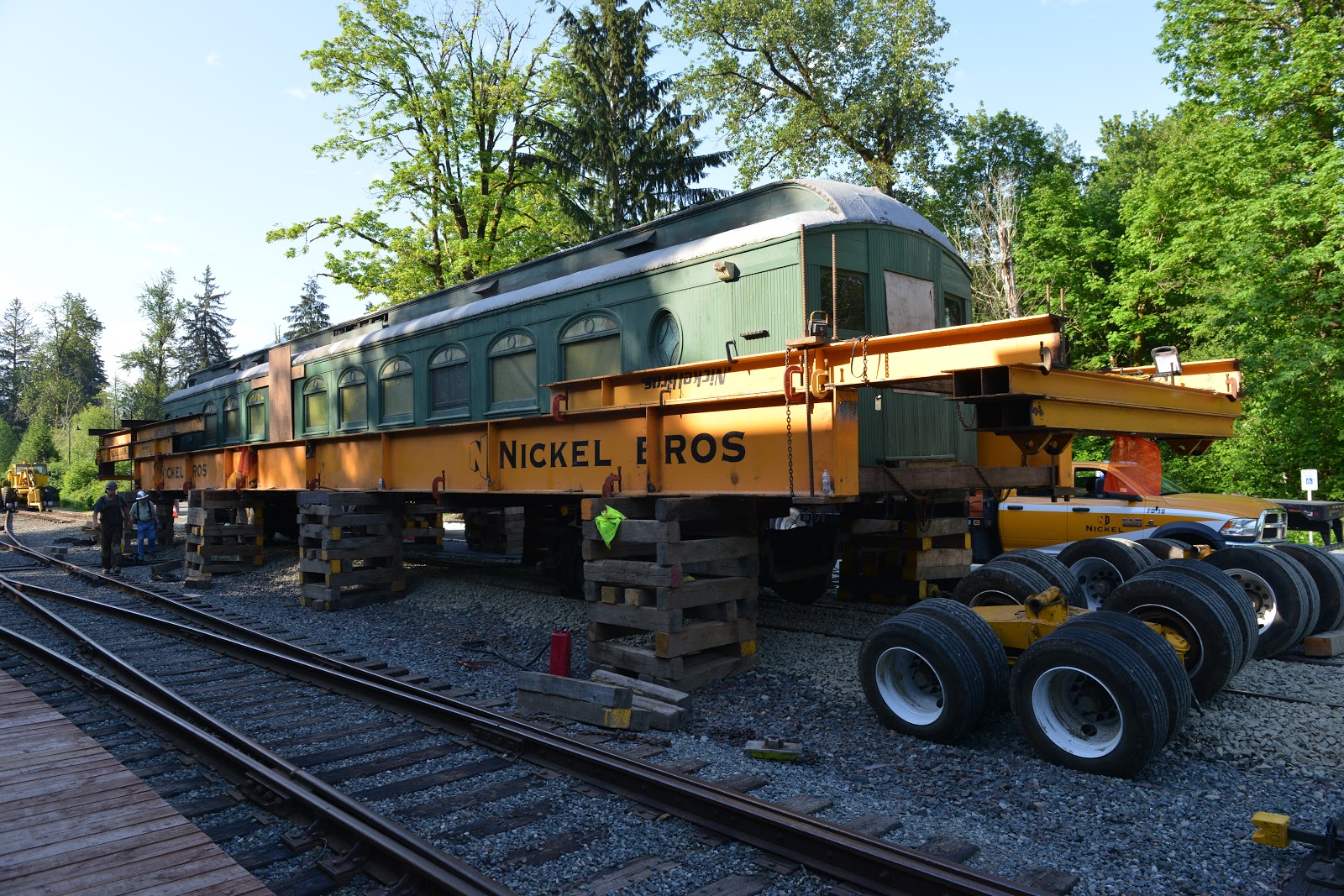
 It has been a busy week at the Northwest Railway Museum. Generous contributions from individuals, Give Big, local business, Nickel Bros. and the Schwab Fund for Charitable Giving supported the move of Northern Pacific Railway parlor car 1799. Its placement on wheels on the Museum's railroad was the result of many months of planning. Located on Whidbey Island for more than 77 years, car 1799 crossed Puget Sound on a barge, traversed three Interstates to Snoqualmie in a night-time move, passed through downtown Snoqualmie along Railroad Avenue, and - finally - this week was lowered onto a set of trucks (a frame to support wheels and a suspension).
 The move was completed by Nickel Bros., a firm best known in Washington and British Columbia for moving historic homes and structures. They are well-acquainted with moving structures in a marine environment, and devised a system to move the 1799.
 Parlor car 1799 was built by Pullman in 1901 for the Northern Pacific Railway. It served that railway for almost 40 years - including service from Seattle's King Street Station - until it was retired and subsequently purchased by a railroad executive and moved to Whidbey Island for use as a seaside cottage.
 Owned by the Shaw Family since the early 1970s, the car has remained in great shape but it was not well-suited for the use of a multi-generational family. Fortunately, thanks to an introduction arranged by Thomas the Tank Engine, the Shaw family contacted the Museum and offered to donate the car if it could be removed from the seaside parcel it occupied since 1941.
 Moving a more than 100-year-old wood railroad car usually involves dealing with substantial deterioration, but not in this case. Car 1799 was and is in excellent shape. Notwithstanding, two doorways were cut in the sides, and the truss rods - an important part of the structure - were removed in 1941. So an elaborate steel frame was constructed to support the car, and allow it to be moved off the beach without damage.

There was considerable effort required to complete the move of car 1799. One of the important requirements was "flooding" the Museum's track with railroad ballast so the Nickel's truck could roll onto the rails. Mr. Tom Weber of the Mt. Si Quarry donated 40 tons of 2 inch ballast, which was easily spread and performed admirably. Mr. Weber also owns Weber Construction, and arranged to lift two passenger car trucks out of storage and back onto the tracks. The lightweight trucks are quite an anomaly - they were not built until after 1799 was retired - but will support the car until historically-correct trucks arrive.
 The house-moving frame did create a few challenges - the assembly was 16 feet wide and occupied two highway lanes. Yet this was the most practical option, and as of this week, the car is back on the rails, and preserved at the Northwest Railway Museum.
The next step is moving a set of historically appropriate trucks to the Museum and installing them. Contributions in support of this next phase are welcome. Thank you to the dozens of individuals and businesses that have already made contributions to this project!
PART I
In one sense, forestry was the Northwest’s “green” industry of the last two centuries. The Train Shed will convey part of that story while simultaneously embodying today’s green industries, such as energy efficiency, local and recycled materials, and stormwater management.
 Climate control is highly important to a museum collection. But the Train Shed is not air conditioned. To regulate temperature, the building relies on automatic louvers, large ceiling fans (which also prevent pockets of moist air from settling) and heavy insulation. The US Department of Energy recommends an R-value of R-16 to R-21 for home wall insulation in King County. The higher the R-value, the greater the ability to resist heat flow. The Train Shed’s wall insulation is R-38.
 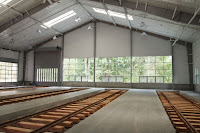 The building’s design utilizes natural lighting. Thermopane windows (which open) are made of special glass that lets in light while blocking 95% of the sun’s damaging ultraviolet radiation. Typical window glass keeps out about 30%. Where natural light needs to be supplemented, metal halide fixtures provide bright, energy-efficient lighting. Exit lights are LEDs.
 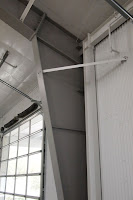 The project incorporates a number of recycled and locally produced materials. Steel columns and beams were fabricated in Arlington, about 90 minutes north of the Museum, at BlueScope Buildings North America, Inc. Interior and exterior cladding is recycled steel, manufactured by AEP (owned by BlueScope) and rolled in Washington. CalPortland provided concrete and crushed rock from its facility across the Snoqualmie River next to the former Weyerhaeuser mill site. The exhibit building’s low-maintenance polished concrete floor is longlasting and easy to vacuum. The Mt. Si Quarry, just up the road from the Train Shed, produced crushed rock for the sub-ballast.
  Tomorrow we’ll tell you about permeable surfaces, native soils and vegetation, and our preferred alternative to creosote ties in Old green, new green: Part II.

 It has been a busy week at the Northwest Railway Museum. Generous contributions from individuals, Give Big, local business, Nickel Bros. and the Schwab Fund for Charitable Giving supported the move of Northern Pacific Railway parlor car 1799. Its placement on wheels on the Museum's railroad was the result of many months of planning. Located on Whidbey Island for more than 77 years, car 1799 crossed Puget Sound on a barge, traversed three Interstates to Snoqualmie in a night-time move, passed through downtown Snoqualmie along Railroad Avenue, and - finally - this week was lowered onto a set of trucks (a frame to support wheels and a suspension).
 The move was completed by Nickel Bros., a firm best known in Washington and British Columbia for moving historic homes and structures. They are well-acquainted with moving structures in a marine environment, and devised a system to move the 1799.
 Parlor car 1799 was built by Pullman in 1901 for the Northern Pacific Railway. It served that railway for almost 40 years - including service from Seattle's King Street Station - until it was retired and subsequently purchased by a railroad executive and moved to Whidbey Island for use as a seaside cottage.
 Owned by the Shaw Family since the early 1970s, the car has remained in great shape but it was not well-suited for the use of a multi-generational family. Fortunately, thanks to an introduction arranged by Thomas the Tank Engine, the Shaw family contacted the Museum and offered to donate the car if it could be removed from the seaside parcel it occupied since 1941.
 Moving a more than 100-year-old wood railroad car usually involves dealing with substantial deterioration, but not in this case. Car 1799 was and is in excellent shape. Notwithstanding, two doorways were cut in the sides, and the truss rods - an important part of the structure - were removed in 1941. So an elaborate steel frame was constructed to support the car, and allow it to be moved off the beach without damage.
 The house-moving frame did create a few challenges - the assembly was 16 feet wide and occupied two highway lanes. Yet this was the most practical option, and as of this week, the car is back on the rails, and preserved at the Northwest Railway Museum.


