skip to main |
skip to sidebar
This is a continuation of yesterday’s post, which outlined the Train Shed building’s sustainable and environmentally-friendly features. Today we take a stroll around the outside of the exhibit building.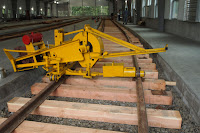 Part II
 The railroad track, built with open graded ballast, is not an impermeable surface. Also, pervious pavers outside the building, and a raingarden to be planted next spring with redflowering currant, cattails and other suitable plants, will enable rainwater to soak into the soil. Stormwater is captured and directed to the raingarden in front of the Train Shed and a detention pond behind the Train Shed so that all water is retained on site except during a major event such as a flood.
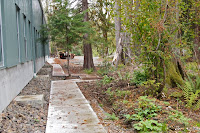 The sidewalk alongside the building dips and curves instead of conforming to the original straight, level design in order to avoid removing existing trees. Nevertheless, for every tree cut down, the Museum plants a new tree. Topsoil was harvested from the site and stockpiled prior to construction. The topsoil was then reused after construction was completed.
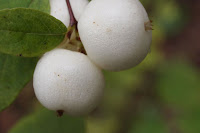
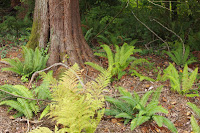 All vegetation being planted on the grounds is native to western Washington. Doug-fir and western redcedar saplings, to be planted at the edge of the surrounding forest, were dedicated during the Train Shed celebration October 2, 2010. Mulch, made from organic material cut from the site during clearing and grading, will help protect against invasives.
When the Train Shed opens to the public, we hope you’ll enjoy the special features of the building and grounds as well as the historic treasures contained inside. 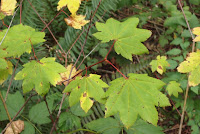
PART I
In one sense, forestry was the Northwest’s “green” industry of the last two centuries. The Train Shed will convey part of that story while simultaneously embodying today’s green industries, such as energy efficiency, local and recycled materials, and stormwater management.
 Climate control is highly important to a museum collection. But the Train Shed is not air conditioned. To regulate temperature, the building relies on automatic louvers, large ceiling fans (which also prevent pockets of moist air from settling) and heavy insulation. The US Department of Energy recommends an R-value of R-16 to R-21 for home wall insulation in King County. The higher the R-value, the greater the ability to resist heat flow. The Train Shed’s wall insulation is R-38.
 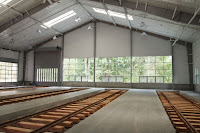 The building’s design utilizes natural lighting. Thermopane windows (which open) are made of special glass that lets in light while blocking 95% of the sun’s damaging ultraviolet radiation. Typical window glass keeps out about 30%. Where natural light needs to be supplemented, metal halide fixtures provide bright, energy-efficient lighting. Exit lights are LEDs.
 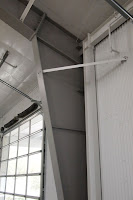 The project incorporates a number of recycled and locally produced materials. Steel columns and beams were fabricated in Arlington, about 90 minutes north of the Museum, at BlueScope Buildings North America, Inc. Interior and exterior cladding is recycled steel, manufactured by AEP (owned by BlueScope) and rolled in Washington. CalPortland provided concrete and crushed rock from its facility across the Snoqualmie River next to the former Weyerhaeuser mill site. The exhibit building’s low-maintenance polished concrete floor is longlasting and easy to vacuum. The Mt. Si Quarry, just up the road from the Train Shed, produced crushed rock for the sub-ballast.
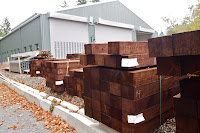
  Tomorrow we’ll tell you about permeable surfaces, native soils and vegetation, and our preferred alternative to creosote ties in Old green, new green: Part II.

 Part II
 The railroad track, built with open graded ballast, is not an impermeable surface. Also, pervious pavers outside the building, and a raingarden to be planted next spring with redflowering currant, cattails and other suitable plants, will enable rainwater to soak into the soil. Stormwater is captured and directed to the raingarden in front of the Train Shed and a detention pond behind the Train Shed so that all water is retained on site except during a major event such as a flood.
  The sidewalk alongside the building dips and curves instead of conforming to the original straight, level design in order to avoid removing existing trees. Nevertheless, for every tree cut down, the Museum plants a new tree. Topsoil was harvested from the site and stockpiled prior to construction. The topsoil was then reused after construction was completed.
  All vegetation being planted on the grounds is native to western Washington. Doug-fir and western redcedar saplings, to be planted at the edge of the surrounding forest, were dedicated during the Train Shed celebration October 2, 2010. Mulch, made from organic material cut from the site during clearing and grading, will help protect against invasives.


