Showing posts with label exhibit building. Show all posts

Friday, May 3, 2019

Train Shed Features New Exhibit

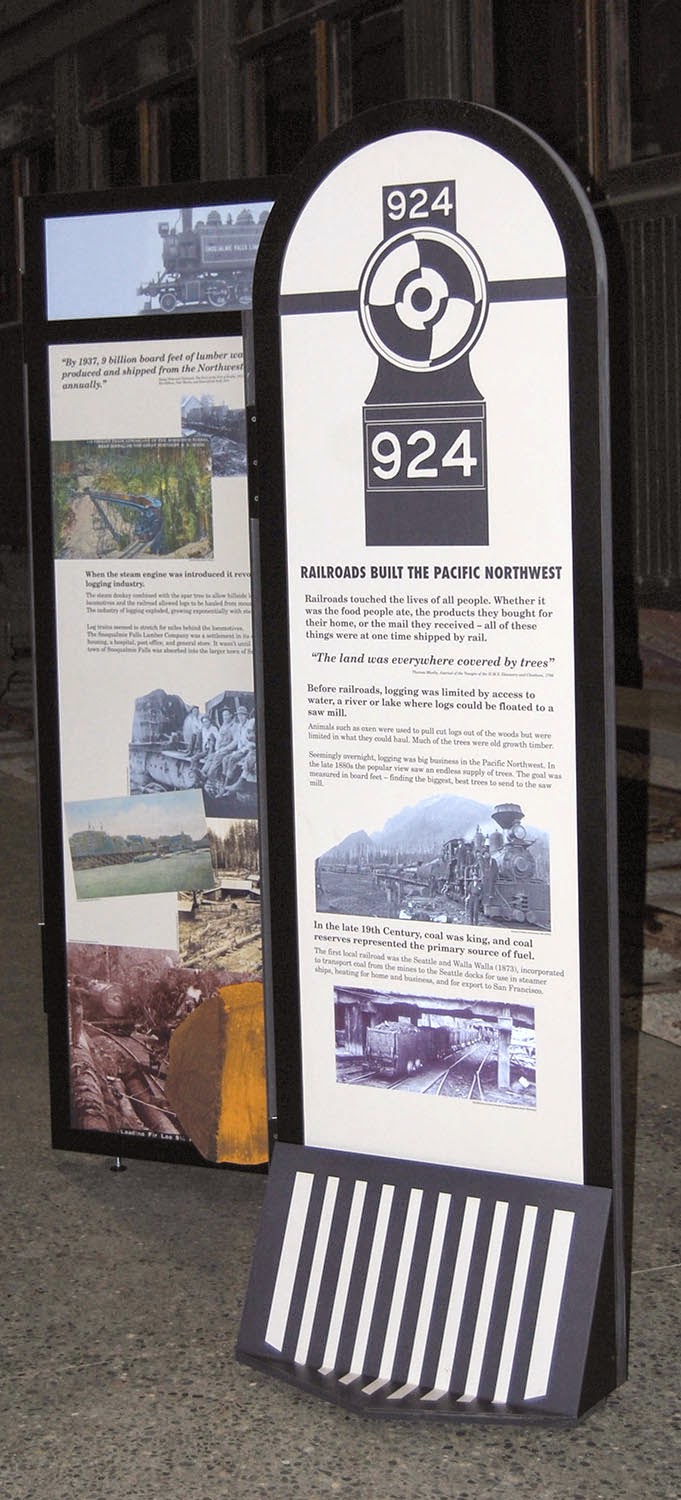
Panels with car 523.
This spring, the Train Shed Exhibit Building features several new exhibits, including Connecting Communities: Story of the Puget Sound Electric Railway. Using the recent acquisition of Puget Sound Electric Railway (PSER) car 523 as a spring-board, the Museum applied for and received a 4Culture Heritage Special Projects grant to fund the exhibit.

PSER was an interurban railway that ran between downtown Seattle and Tacoma and connected many points in between, both large and small. PSER operated from 1902-1928, and was an important factor in settlement along its route. With consistent and timely rail travel available, residents could move out of cities and into more rural areas while still remaining connected to urban centers.

Double-sided panels in Train
Shed Exhibit Building.
Connecting Communities consists of 4 double-sided panels, seven focusing on the story of PSER and one focusing on the history of car 523. The exhibit also includes a large (72"w x 34"h) high-pressure laminate panel that features reproduction of a graphic route map from a PSER public time table. Finally, there is a children's panel (the 1st of its kind at NRM!) that describes the different kinds of transportation children could have used to get around in 1902. That panel features a challenge to children with photos to lift and learn.

Children's panel is at a lower height.
A 2018 4Culture Heritage Special Projects grant funded this exhibit. 4Culture is the cultural funding agency for King County, Washington. Using Lodging Tax and 1% for Art funds, 4Culture has four program areas to serve the county: arts, heritage, historic preservation, and public art. For more info on 4Culture, visit their website at www.4Culture.org. 


A big thank you to 4Culture for continuing to support exhibits at the Northwest Railway Museum!

Also installed in the Train Shed over the winter, a photography exhibit Faces of Railroading that features images of railroad workers taken by Jack Delano during his time working for the Farm Security Administration in 1942-43.

Thursday, September 17, 2015

New exhibit installed in Train Shed

The Northwest Railway Museum recently completed the much anticipated Phase 1 exhibit in the Train Shed Exhibit Building. The railroad changed everything is the guiding interpretive theme for the building and the Tour Package program. The exhibit is stationed in the foyer of the building and consists of four double-sided panels and four exhibit cases showcasing small objects.

The exhibit was curated by Deputy Director Jessie Cunningham. In her role as Deputy Director, Cunningham is responsible for all programming including exhibits and education programs such as School Train. The Phase 1 exhibit has been a long time in the making and Cunningham is please to have it installed. After completing the content and lay-out, the panels went thru several reviews by lead docents. It was important to Cunningham that the exhibit work with the docents and the Tour Package, rather than work against them. At this time, the only public access to the Train Shed is during the Tour Package which has a tight time frame. Cunningham limited the amount of text, allowing the images to be the focus of the panels as well as help illustrate and interpret the history taught to the public during the Tour Package.

The Tour Package is available in Snoqualmie on Saturdays at 12:30pm and includes a short depot tour, train ride to the Train Shed, tour of the train shed, and a train ride to the top of Snoqualmie Falls and back. Reservations can be made by calling the Bookstore between 10am and 5pm daily.

The Museum received a grant from 4Culture to complete the exhibit. 4Culture is a huge supporter of projects at the Northwest Railway Museum as well as countless other organizations in King County. For more info on 4Culture, visit their website at 4Culture.org.

The Phase 1 exhibit will also have a companion website that will be available shortly at TrainMuseum.org.
Small artifacts include a selection of tools of the Trainman's trade as well as items passenger might encounter during a train ride.


Thursday, April 23, 2015

Railroads built the Pacific Northwest

There is a fairly new exhibit on display in the foyer of the Train Shed. Railroads Built the Pacific Northwest was designed by the Webb Group and fabricated by Artcraft Display Graphics Inc. Deputy Director Jessie Cunningham curated the exhibit, which included content development and image selection. Images came from either the Museum’s collection or were purchased from other local sources including Snoqualmie Valley Historical Museum and UW Special Collections. The companion webpage is available on the Museum's website.

The display is the Phase 2 exhibit for the Train Shed Exhibit Building and focuses on the role of passenger service and freight shipment in the early years of railroading here in the Pacific Northwest. Want to know more? The exhibit is now on display every Saturday as part of the Tour Package program!

The Tour Package is a docent lead experience that begins at the Snoqualmie Depot. Your docent will give a brief tour of the Depot before you board the Snoqualmie Valley Railroad for a short ride to the Train Shed Exhibit Building. Detrain and enjoy a 30 minute tour of the 25,000 sq. ft. building that includes large and small artifacts and several exhibits including the award-winning Wellington Remembered exhibit. Re-board the train and travel west to the top of Snoqualmie Falls where you will view water going over the top of Snoqualmie Falls and a beautiful view of the valley and river below the Falls. Your docent will stay with you during your trip to the Falls, interpreting the scenery and providing both historic and contemporary context. The Package ends when the train returns to Snoqualmie Depot. The round-trip experience lasts approximately 2 hours.

The Tour Package is available every Saturday (except July 11 & 18) at 12:30pm. Tickets may be purchased ahead of time through the Bookstore, 425/888-3030 x 7202, or on the day of through the ticket window. 

The exhibit was made possible with generous grants from 4Culture and Humanities Washington. 


Monday, November 29, 2010

Old green, new green: the best of three centuries

PART I

In one sense, forestry was the Northwest’s “green” industry of the last two centuries. The Train Shed will convey part of that story while simultaneously embodying today’s green industries, such as energy efficiency, local and recycled materials, and stormwater management.

steel cladding and louversceiling fan ad metal halide fixtureClimate control is highly important to a museum collection. But the Train Shed is not air conditioned. To regulate temperature, the building relies on automatic louvers, large ceiling fans (which also prevent pockets of moist air from settling) and heavy insulation. The US Department of Energy recommends an R-value of R-16 to R-21 for home wall insulation in King County. The higher the R-value, the greater the ability to resist heat flow. The Train Shed’s wall insulation is R-38.

natural lighting and special glassThe building’s design utilizes natural lighting. Thermopane windows (which open) are made of special glass that lets in light while blocking 95% of the sun’s damaging ultraviolet radiation. Typical window glass keeps out about 30%. Where natural light needs to be supplemented, metal halide fixtures provide bright, energy-efficient lighting. Exit lights are LEDs.

steel columnThe project incorporates a number of recycled and locally produced materials. Steel columns and beams were fabricated in Arlington, about 90 minutes north of the Museum, at BlueScope Buildings North America, Inc. Interior and exterior cladding is recycled steel, manufactured by AEP (owned by BlueScope) and rolled in Washington.

CalPortland provided concrete and crushed rock from its facility across the Snoqualmie River next to the former Weyerhaeuser mill site. The exhibit building’s low-maintenance polished concrete floor is longlasting and easy to vacuum. The Mt. Si Quarry, just up the road from the Train Shed, produced crushed rock for the sub-ballast.

polished concrete floorsTomorrow we’ll tell you about permeable surfaces, native soils and vegetation, and our preferred alternative to creosote ties in Old green, new green: Part II.

Sunday, November 7, 2010

X101 caboose caper

At the Train Shed dedication on October 2, 2010, the daughter of the late Jack Hoover of Belt, Montana announced the donation of his caboose to the Northwest Railway Museum. Christina Blackwell selected the Northwest Railway Museum to receive her father's caboose "so it can be housed inside the new Train Shed exhibit building and be accessible to the public." Initially, the caboose will be used as part of the Museum's Wellington Remembered exhibit and is typical of the type of car that could have operated through that Great Northern company town.

Caboose X101 (the first X101) was built in 1892 at St Cloud, Minnesota. A wreck-related rebuilding in 1897 and again in 1909 resulted in changes to the visual and structural characteristics of the car, but few changes have occurred since then or after retirement in 1935. Conductor Ed Shields of Great Falls retired that year too and asked the company if he could keep the caboose. They obliged him and he used a bull dozer to move the caboose 1.5 miles to his back yard. Fast forward to 1973. Jack Hoover had an opportunity to purchase the X101 and despite its then-deteriorated condition, he acquired it and moved it to his home in Belt. Years of dedicated care transformed it back to its former glory.

Receiving a donation and moving it to the Museum are significant undertakings when the object weighs 33,000 pounds and is located 650 miles from Snoqualmie. The Museum faced similar challenges when Chapel Car 5 Messenger of Peace was donated in 2007 and was able to draw on that experience to plan and execute the move of X101.


Heavy Haul Inc. of Kelso, Washington was selected to move the caboose. (They did an excellent job of transporting the chapel car and specialize in unusual moves including railroad cars.) H & H Crane Service of Great Falls, Montana lifted the caboose and trucks and placed them on the truck for shipping. In Snoqualmie, Imhoff Contractor Crane Service reassembled the caboose on the Museum's rail line. (Imhoff has been involved in a variety of Museum projects including construction of the Train Shed, Conservation and Restoration Center, Bridge 31.3 and with the chapel car move.) With completion of the move, the X101 is sitting on live rail for the first time since 1935.


Jack Hoover was a much beloved man who resided in Belt, Montana, about 20 miles from Great Falls. He was born on April 17, 1923 and lived in the area for his entire 86 years, except for 4 years of military service in WW II. He had strong interests in several fields and was renowned for his collections of guns, railroad memorabilia, western art, books and industrial architecture. Some of his firearms and western art will be perpetuated at the C.M. Russell Museum in Great Falls; his drover's coach has been preserved at the Minnesota Transportation Museum in St. Paul. A beautiful tribute to his life was detailed by Prairie Mary in her blog here. Mr. Hoover is survived by his wife Karen and daughter Christina, and by countless friends.


The Northwest Railway Museum is honored to have been selected as the recipient of caboose X101 and is incredibly grateful for the family's generosity. The caboose will be placed inside the Train Shed exhibit building in early 2011 and will be placed on public exhibit when that facility opens later in the year. It is a tribute to the late Jack Hoover that the caboose be preserved for this and future generations, and that it be used to interpret the role railroads played in the settlement and development of the Northwest.


Here is a short video of the great caboose move of 2010:


Thursday, October 28, 2010

Congressional candidates visit

This month the Northwest Railway Museum was honored to receive visits from both Congressional candidates. Early in October candidate Suzan DelBene toured the Conservation and Restoration Center. Then on October 28 Congressman Dave Reichert toured the Museum.

Reichert was in town to tour downtown Snoqualmie’s infrastructure reconstruction. That project is replacing sidewalks, burying overhead utilities, replacing street furniture, and expanding parking. A federal grant is helping fund this downtown revitalization project situated across the street from the Snoqualmie Depot.

Congressman Dave Reichert toured the Snoqualmie Depot, the Museum’s 1890-built National Register train station. Snoqualmie Mayor Matt Larson proudly highlighted the depot’s new public restrooms, an innovative partnership between the City of Snoqualmie and the Northwest Railway Museum that benefits tourists, including 90,000 Museum visitors per year. The restrooms were completed earlier this year funded by Lodging Tax dollars collected at the Salish Lodge and Spa, and represent one of the many ways Snoqualmie is supporting the museum.

After the depot tour, the Congressman climbed aboard locomotive 4012 (a 1954-built Baldwin RS4-TC) for the short trip to the Railway History Center. On the final segment of the journey, Reichert had an opportunity to student engineer. He received some instruction and eased the locomotive to a stop outside the Conservation and Restoration Center. There, he received a tour of the Train Shed and Conservation and Restoration Center.

Photos from top to bottom:
Tour of the Snoqualmie Depot. (L to R) Sue Van Gerpen, Marketing Manager; Richard R. Anderson, Executive Director; Congressman Dave Reichert; Snoqualmie Mayor Matt Larson, Jessie Cunningham, Educator.
Snoqualmie Mayor Matt Larson & Congressman Dave Reichert view the new public restrooms in the Snoqualmie Depot.
Congressman Dave Reichert operates locomotive 4012 en route to the Railway History Center.

Thursday, April 15, 2010

Vote to fund the chapel car!

A vote a day can help keep decay away!

Between now and May 12, a public vote is helping determine the outcome of Partners in Preservation Seattle Initiative. 25 historic properties in the Puget Sound Region are competing for a share of $1 million. Chapel car 5 Messenger of Peace is one of the properties and, if it is selected for an award from Partners in Preservation, the Museum will have enough funding to allow substantial completion of the chapel car rehabilitation.

This initiative is also an opportunity to launch a Messenger of Peace web site at http://www.messengerofpeace.org/ and a Messenger of Peace Facebook page.

Check out the Museum's promotional video:


So what is Partners in Preservation? The National Trust for Historic Preservation and the American Express Foundation created this initiative five years ago and have run the program in San Francisco, Chicagoland, New Orleans, and Boston. Local projects are pre-vetted and a short list is presented to the public for a vote. The top vote-getter receives full funding. Additional projects are selected for funding by a committee set up by the National Trust and American Express; for those projects the total number of votes will be a consideration.

The Northwest Railway Museum is delighted to learn that Partners in Preservation has selected the railroad chapel car to compete for funding in the Seattle initiative. This is the first railroad car and railway museum to be involved in this five-year-old initiative, and the program is an excellent opportunity to raise the profile of this little-known but impactful part of history. In all, 25 projects are competing for a share of funding; project values range from $65,000 to $125,000. The Chapel Car is competing for $100,000.

Chapel car 5 Messenger of Peace was built by Barney and Smith in 1898 and served the Baptist Publication Society, Baptist Home Mission Society and the Railroad YMCA for fifty years. It operated in at least 11 states and traveled extensively in the Pacific Northwest. After retirement, it was used in several creative ways from 1948 until 2006 including as a roadside diner, seaside cottage, and an unlicensed pharmaceutical distribution facility. In 2007 it was donated and moved to the Northwest Railway Museum in Snoqualmie, Washington.

The chapel car requires extensive rehabilitation and restoration to return it to the glory of its period of significance. The Save America’s Treasures grant awarded in December 2009 will combine with a Washington State Historical Society grant, funding from 4Culture and private contributions to allow carbody work to begin. Partners in Preservation funding, if awarded, will allow substantial completion of the project including fabrication of missing pews for the sanctuary.

To learn more and vote, visit http://www.trainmuseum.org/ Be the chapel car's saviour - vote today and every day until May 12!

Wednesday, March 31, 2010

Train Shed milestone

Train Shed construction has been continuing despite delays in the arrival of building materials – such as American-made steel. Nevertheless, the new Train Shed exhibit building has completed 50% of the roof with the entire south side of the building now fully under cover. It is a modest but important victory in the construction of this major new structure to preserve the collection and provide year ‘round opportunities for programming.

Meanwhile, flashing around windows and doors is being installed paving the way for windows and doors to also be installed. The most obvious addition is the bright green moisture barrier that is being installed to keep water away from the wall insulation but allow water vapor to escape. The exterior cladding that will cover this material is now on site but will not be installed until the window flashing and roof are complete.

The Train Shed construction continues to progress while maintaining the highest standards in workmanship and general quality. Unfortunately, lengthy building material delays have had an impact on the schedule and completion has been pushed into June. It will nevertheless be a structure for the Museum and the Community to be proud of.

Wednesday, December 23, 2009

Steel erection begins!

The Train Shed is now beginning to take shape. On Tuesday, December 22, 2009 subcontractor CHG Building Systems began erecting steel columns for the Train Shed. CHG is not a newcomer to the Museum – they were also involved in construction of the Museum’s Conservation and Restoration Center in 2005 and performed work on that project to a high standard. For this repeat performance, CHG is using a crane, telescoping lifts and of course a highly skilled team of erectors, and the building is beginning to take shape.

The Train Shed will be a fully enclosed and semi conditioned exhibit building for the Northwest Railway Museum’s collection of railway transportation artifacts including locomotives, coaches and freight cars. Priority exhibits will include the most vulnerable objects – typically the oldest and those built predominantly of wood – and will include the 1898-built Chapel Car 5 Messenger of Peace, White River Lumber Co caboose 001, and Northern Pacific Railway steam locomotive 924.

Construction began in July 2009 and substantial completion of the steel structure is anticipated in March 2010. Track construction will begin after the building is completed; project will be dedicated in August 2010. This nearly $4 million project has been in development for five years.

Major funders include the Washington State Historical Society’s Capital Projects for Washington’s Heritage, McEachern Charitable Trust, 4Culture, The Seattle Foundation, TEA-21 Transportation Enhancements, Puget Sound Energy Foundation, Nysether Family Foundation, Osberg Family Foundation, Washington Department of Commerce, Schwab Fund for Charitable Giving, and hundreds of individuals. Additional support is requested and can be made through the Museum’s web site here or on the American Express Giving Express site here.

Tuesday, December 1, 2009

Train Shed steel

The Train Shed construction is continuing to proceed but some of the most impressive work takes place in a manufacturing facility. Take the steel columns and girders as an example, part of the Varco-Pruden brand building designed for the Museum. They are being fabricated at Wick Constructor's subconcontractor BlueScope Buildings NA, Arlington, Washington facility, about 90 minutes north of the Museum.

Ironically, the BlueScope Buildings NA facility is located adjacent to the BNSF Railway and a section of former Seattle, Lake Shore and Eastern Railway that is just about the same physical distance the Train Shed is being built from the Museum's section of former Seattle, Lake Shore and Eastern Railway. And for the record, mill steel is still delivered to the BlueScope facility by rail however the Train Shed is being built with components fabricated from American-made sheet and roll steel delivered by truck.

A recent tour of the BlueScope facility conducted by mill manager Phil S. revealed a plant dedicated to quality and safety. Much of the welding is performed by automated machines however due to the custom design of many buildings there were a number of welders manually completing the fabrications by hand. The actual Train Shed components were on the floor in fabrication and it was really interesting to see the transformational process from basic steel plate to finished column or girder. At the end of the production line, the components were physically dipped into primer to ensure full coverage of all surfaces.

The Train Shed fabrications are nearly complete and structural steel is scheduled for shipping to the Northwest Railway Museum on Friday, 4 December 2009. Train Shed erection will begin on Monday, 7 December 2009; assembly will take approximately three months.

Additional images are available for viewing on the Museum's WASteam web site.

Friday, August 7, 2009

Train Shed official ground breaking

The site was cleared and graded, equipment was mobilized, the temperature was a comfortable 72 degrees, and then the sun came out making it a perfect Northwest evening. So on the eve of the beginning of the foundation construction (specifically, of the driving of 76 augercast piles) supporters gathered for a brief ceremony. Standing in what will be the main entrance of the new Train Shed, shovel was put to dirt. Performing the honors were (L to R) City of Snoqualmie Mayor Matt Larson, Museum President Susan Hankins, Benjamin and Kaela Getz (who together were representing all youth), Museum Executive Director Richard Anderson and Washington State Representative (5th District) Jay Rodne.

Speaking at the ceremony held Wednesday, August 5th, 2009, Representative Jay Rodne spoke of the important role the Northwest Railway Museum plays in connecting generations. "This project is about preserving the past, but it is also about our future: our youth."

Snoqualmie Mayor Matt Larson who has been instrumental in supporting the project also spoke adding, "This is an important project for Snoqualmie and I hope it will be one of the things my administration will be remembered for."

Museum Executive Director Richard Anderson took the opportunity to announce a funding partnership with the North American Railway Foundation who will be supporting two public access components of the project. Their support will total more than $62,000 and is another important step in completing this cultural facility.

Museum President Susan Hankins thanked everyone for supporting the project and talked about the importance of community. Hankins spoke of the long road (rail, of course) it took for the Museum to get to this moment and of the significant work remaining to complete the vision.

But surely the highlight of the evening was the opportunity for over 100 supporters to visit the new site and see for themselves how big 25,000 square feet is. Many who attended gathered for a group photo and were afterwards rewarded with ice cream donated by Kyle T. from Tweede’s Cafe in North Bend. Thanks Kyle!

Thursday, June 11, 2009

Train Shed contract let

Two years of design and permitting, nearly four years of fundraising, and many hours of negotiation have culminated in a contract for construction of the new Train Shed. The Train Shed will be an indoor exhibit building for large artifacts including locomotives, coaches and freight cars and will incorporate 25,000 square feet. Construction will be predominantly steel with a concrete stem wall. The design is earthquake resistant to magnitude 7.4, and flood proof to a level approximately 2 feet above the 100 year flood plane.

The Train Shed will provide fundamental preservation for critically endangered artifacts including Chapel Car 5 Messenger of Peace, White River Lumber Caboose 001, and Northern Pacific steam locomotive 924. It will also provide an attractive and comfortable environment for museum visitors. This classroom will be used to preserve, teach and perpetuate Northwest railroad history.

The bidding process was complex. With a large grant from the Federal government, special contracting provisions were required including administration of the project by King County Road Services. A call for proposals was issued in February and bids closed in late March. A period of analysis occured and an apparent low bidder was identified. Additional analysis delayed an offical decision until late May and a contract was signed in early June. The successful bidder is Wick Constructors of Bellevue, a firm with a variety of successful commercial building experiences. They are expected to complete the building in the first quarter of 2010.

The next step is a notice to proceed. This will be issued after all the required submittals including insurance and additional contracting documents are received by the County.

Tuesday, February 17, 2009

Train Shed goes to bid

The long planned Train Shed exhibit building has gone out to bid! The project's projected cost is between $2.6 million and $3.1 million. Proposals are due on March 10 at King County; a Federal grant is requiring the project to be administered by a public agency.

As outlined in an earlier post and on the Museum's web site, the structure will have 25,000 square feet, incorporate 4 parallel tracks, and provide exhibition space for the collection's most vulnerable objects. You can read the bid advertisement here.

With a soft economy, it is a wonderful time to bid a project of this type. Regardless, the Museum has no way of knowing who will bid and whether there will be a proposal that is responsive to the specifications. However, assuming a qualified bidder is selected, construction should be underway by June. The project is expected to take 1 year to build and will be located a few hundred feet from the Conservation and Restoration Center on Stone Quarry Road in Snoqualmie.

A number of exhibits are being planned for the Train Shed. They will incorporate diverse railway history topics that are intended to provide broad appeal to the typical Northwest Railway Museum visitor. Who is the typical visitor? There is a nearly 50% chance she is a woman or girl that does not have a life-long interest in trains, and is visiting as part of a family.

Some of the exhibits being planned include religion by rail featuring chapel car Messenger of Peace, logging on the rails featuring the Enumclaw-built White River Lumber Company caboose 001, and an exhibit on the steam locomotive featuring a locomotive once assigned to switch the King Street station in Seattle (Northern Pacific 924), which will be used to describe what it was like to work inside the “furnace” called a locomotive cab.

Monday, December 29, 2008

Funding the Museum

We’re often asked how the Northwest Railway Museum is funded, and perhaps more to the point, people want to know how donor funds are “invested” in the Museum. This is a great question, particularly in light of the recent awareness of how some investor-owned businesses have been spending investor money. So here it is: unless otherwise directed by the donor, contributions are invested in new facilities and in collection care. However at this point in the Museum’s history, it is really in the facilities where donors can make the biggest difference.

The Conservation and Restoration Center is one such facility and it was completed in 2006 at a cost of $2.4 million after years of permitting and fundraising. This collection care facility is allowing the Museum to perform some truly awesome work on really important objects. Caboose 001, built by White River Lumber in 1945 is an example and is shown here in a 2008 post-rehabilitation photo. Incidentally, donor funds paid for materials and over 5,000 volunteer hours performed the rehabilitation.

The next facility will be an exhibit building to place large objects such as locomotives and coaches inside, out of the weather. This 25,000 square foot facility will revolutionize how the Museum preserves and exhibits its collection. This project is expected to cost approximately $3.7 million (exact cost will be determined in a bidding process) and $2.7 million has been pledged or received.

So how can supporters contribute? The Museum’s web site has a secure donation page here. There is also the Giving Express program through American Express that can be used to donate cash, or even membership rewards points. And you can always visit in person – the Depot Bookstore is open every day except New Years, Christmas and Thanksgiving – and speak with a real person. But you don’t have to give money to be a supporter. You can volunteer, come and participate in programs, or simply tell your friends and family about what we are doing and why you believe in it. Thank you!