Showing posts with label Northern Pacific Railway locomotive 924. Show all posts

Thursday, October 1, 2020

Critical Times Need Critical Support

How is the Northwest Railway Museum handling the pandemic?  This is arguably the most difficult period in the Museum's 63 year history, and continued community support is critical to recovery.  Notwithstanding, the Museum has used the closure to perform upgrades.  Exhibits, artifacts, and even publications are getting attention, and we are confident the Museum’s audience will see and appreciate the difference.

Notably, The Museum's publication, The Sounder, was redesigned in an effort led by Lee Ater of LOT22.  The changes bring the newsletter into line with branding standards, easier to produce and make it more visually interesting.

Meanwhile, with the expectations for reopening the Museum came an opportunity to upgrade exhibits. This resulted in more interpretive content, and transformed the hall into a more visually-interesting experience, both of which are vital to attracting and retaining an audience.

Sadly, many pandemic-related orders are affecting the Museum in truly negative ways.  The continuing prohibition on events is particularly damaging because it devastates both audience and income.  And even if events were permitted in King County, they would be limited to just 50 people. Unfortunately, none of the Museum’s events are economically viable when serving smaller groups.

The Museum is unable to host Halloween or Santa Train this year. However, we are improvising, and hope you will attend our alternative Safe Start activities! Beginning October 3, the Museum will operate regular train ride excursions, using  social distancing practices, most weekends through the end of the year.  At Halloween and during the Christmas season, trains will operate with appropriate holiday themes such as the Yuletide Express, but guests will remain on board for the duration of their visit.  We know this may not be to everyone’s liking, but it does appear to be the Museum’s best practical alternative that keeps staff, volunteers and visitors safe, and complies with the law. 

Externally, we sadly share that the pandemic has been particularly difficult for all museums. The Bellingham Railway Museum closed its doors in March, and it was soon apparent that it would never reopen. NRM staff and volunteers worked with their officers and former staff to ensure their collection is preserved, and remains in the public domain. Over the summer the collection was boxed up and moved to Snoqualmie. Their beloved Lionel 027 layout has been reassembled in the Train Shed, and will soon be operational. We extend our heart-felt condolences to their staff and volunteers for their loss—closing a museum is heart-breaking.

Your Support is Critical

We wish to thank you for your continued support during these uncertain times. The Northwest Railway Museum is dynamic and successful in part because of people just like you. Now, during the Covid-19 crisis, we need your support more than ever. Please consider helping to sustain the Museum in any of the following ways:

Visit TrainMuseum.org to find out how you can help.


Not everything about 2020 has been negative. The happiest news of the year remains the success of steam locomotive 924. Despite challenges, the 924 has successfully operated under its own power this year. Like the chapel car 5 project before it, the 924 work generated more questions than expected, but the skillful dedication of museum volunteers and staff have allowed work to continue. We hope you will be able to join us for the first run this fall—check TrainMuseum.org for updates.

Tuesday, August 18, 2020

924 takes the main

In celebration of a social-distant, Snoqualmie Railroad Days lite, the Northwest Railway Museum was pleased to introduce to the community newly certified steam locomotive 924, an 1899 Roger's built 0-6-0 that served the Northern Pacific Railway in Washington until 1923, and continued in service for the Inland Empire Paper Company until donated to the Museum in 1969.


NPR 924 arrives at Snoqualmie on Aug 15, 2020

The open cab helped the crew tolerate temperatures in the 90s.

Northern Pacific Railway 0-6-0 924 has been undergoing rehabilitation and restoration for more than five years, and on Saturday, August 15, 2020, it finally had an opportunity to "strut its stuff" on the main track.  The operation was technically just a testing day, and was planned to check out - or prove - all the work that had been performed up until that time.  The 924 was accompanied by a combine car with several observers, and diesel-electric locomotive 4024 to provide a light braking load as desired, and to allow for safe backup movements.  And the day was a spectacular success: the only issues evident were already known to the 924's team.  

The 924 is temporarily sporting an open cab while plumbing is continuing to be adjusted.

How remarkable was Saturday's run?  The last time the 924 propelled itself up a main track Jimmy Carter was President, Amtrak was still introducing the original Superliners, and EMD/GMD's model SD40-2 locomotive was enjoying peak production. That was in 1979 when the 924 was on loan to the Chehalis-Centralia Railroad, and the 924 steamed its way down to the Burlington Northern mainline to greet British Columbia's Royal Hudson 2860 as it passed by on a tourism promotion tour.

Good lubrication, and appropriate procedures to apply it are essential on a steam locomotive of this vintage.  All the bearing surfaces are "plain" and if they run dry of oil, they will be quickly consumed.

The day was also an opportunity to continue the training process for crew members new to steam. The 924 has been set up to burn solid fuel, and there is a little more planning required before moving the locomotive.  Planning?  Solid fuel takes time to ignite so the fireman has to ensure the fire is already hot and the boiler is producing more steam before the engineer cracks open the throttle.  Otherwise, the locomotive will quite literally run out of steam.

Beginning this month, the 924 is now sporting its circa 1906 cab side lettering.

The original plan for Snoqualmie Railroad Days 2020 was to mark substantial completion of the 924 with steam powered excursions to commemorate the Suffrage Specials.  Two of those trains visited Washington State in the years leading up to the ratification of the 19th Amendment that gave women the vote on August 18, 1920.  Unfortunately, the Covid 19 crisis allowed only social distant viewing of the 924; other elements of Snoqualmie Railroad Days were hosted on the web.

What's next?  The 924 will be getting some plumbing and running gear adjustments.  The tender will be painted.  The sand dome will be reinstalled.  And the volunteer crews will be practicing their wood chopping and chucking skills.

Tuesday, May 19, 2020

924 steams!

The 924 builds steam on a warm spring day.
Locomotive 924 was constructed in 1899 by the Rogers Locomotive Works of Paterson, New Jersey, and was delivered along with two identical sisters to the St.Paul and Duluth Railroad.  By 1901 it was under ownership of the Northern Pacific Railway, and was soon serving their needs in the Puget Sound region of the Pacific Northwest.

Steam and air plumbing fills the cab; the
roof has been left off the cab for now to
improve access and lighting.
In 1924, the 924 became superfluous to the needs of the N.P. R. and was sold to the Inland Empire Paper Company near Spokane, WA.  The locomotive met the needs of its new owner until 1969 when company president William H. Cowles Jr. donated the 924 to the Northwest Railway Museum.  The 924 briefly operated in Chehalis, and was later moved to the Museum headquarters in Snoqualmie.  In 2015 it was nominated and listed on the King County and City of Snoqualmie Landmarks Register.  Work was immediately underway on a major rehabilitation effort, which is now nearing completion.


A wood fire crackled for about four hours
before the boiler reached operating
pressure. 924 will be fueled with wood
rather than coal.
May 18, 2020 represents an important milestone for the 924: it returned to steam and operated under its own power in testing on the shop track.  An inspection conducted by the Federal Railroad Administration observed that the boiler safety valves opened and closed at appropriate pressure levels, and the steam-powered air pump was able to deliver the required air flow.  During the visit, Museum staff also demonstrated successful operation of both Ohio injectors, and the hydro-static lubricator, all of which were rebuilt by Backshop Enterprises.  And an additional day under steam gave collections care specialists - steam specialists, really - an opportunity to perform additional testing and troubleshooting.  Steven B., Josh K., Scott, and Gary performed most of the effort required to boil the boiler water, but dozens of additional volunteers and staff contributed efforts that allowed this to happen.

Work on the 924 is continuing and completion of vital systems is anticipated in 2nd quarter 2020.  Work has been funded by contributions from individuals, companies, foundations, and government agencies including 4Culture, Washington's Heritage Capital Fund, the Northern Pacific Railway Historical Association, Emery Rail Trust, Schwab Fund, and more. You can support completion of the project by visiting the Museum's donation page, making a pledge, and selecting the steam program here.

Check out two days of steam in photos and videos:


The hydrostatic lubricator, automatic brake valve, steam gauge,
and air gauges.

924 was built with one water glass but
regulations now require two.

Setting safety valves to the correct pressure involves verifying
they open at the desired pressure.
Checking the water level.

Verifying the open and close pressures for the safety valves.

924 simmers in the Snoqualmie Valley
sunshine.
The Museum's director and the inspector from the Federal
Railroad Administration discuss locomotive 924.


Thursday, September 5, 2019

Hydro-static test

Locomotive 924 circa 1908
Northern Pacific Railway steam locomotive 924 has been undergoing restoration in the Conservation and Restoration Center.  This 1899-built Rogers locomotive served the Northern Pacific Railway until 1924. It is a King County and City of Snoqualmie Landmark, with project support from many individuals, foundations and public agencies including 4Culture, Washington Heritage Capital Projects, the Northern Pacific Railway Historical Association, the Emery Rail Heritage Trust and more.

Fire in the 924 firebox
For the last several years a variety of project work has been underway, but the most important division of work has been on the boiler.  The boiler is where water is heated and converted to steam, usually with an oil, coal or wood fire.  The boiler must withstand high temperatures and considerable pressure.  

Locomotive 924 is filled with water, 
and then the water is lightly heated so
as to reduce the strain on the boiler 
when it is pressurized.
For the general public, a little known fact about locomotive boilers is that they must be designed to withstand four times their operating pressure.  So an operating pressure of 180 psi requires the boiler be designed to withstand 720 psi.  This is called the factor of safety, and must consider any wasting or other deterioration of the boiler that occurred since it was built.

FRA inspector Brandon King witnessed
the 924's official hydro-static test.  He
found no exceptions, which is the best
possible outcome.  This means the
inspection found that the Museum
is complying with the regulations.
After measurement, analysis and calculations demonstrate that the boiler construction is capable of withstanding 720 PSI, a non-destructive test called a hydrostatic test is performed.  This test is performed by the locomotive owner, but is witnessed by an inspector from the Federal Railroad Administration.  During the test, the boiler is filled with water, lightly heated, and pressurized to 125% of its stated operating pressure.  

Kyle I. operated the hand
pump.
It was a beautiful morning on Thursday, September 5th when Museum volunteers and staff arrived to "fire" the boiler on locomotive 924.  Recycled wood logs and waste wood were used as fuel, and the temperature was brought up to 100 degrees.  At that point, the fire was dropped and a hand pump was used to bring the pressure up to 225 psi. Visual and aural inspections were all positive - just some light weeping from a handful of rivets.  Most impressive to the Museum volunteers and staff was how tight the boiler was.  One stroke from the hand pump every 15 or so seconds was sufficient to maintain 225 psi.

Kyle and David remove the steam dome
lid and throttle to allow an internal
inspection.
Upon completion of the hydro-static test, the boiler was drained.  After this 125% test, an interior inspection of the boiler and hammer testing of the stay bolts was required.  For the interior inspection, the steam dome lid and throttle was removed so an inspector could enter and crawl along the top course of tubes.

The Northern Pacific Railway steam locomotive 924 rehabilitation and restoration project continues to progress.  The hydro-static test brought great news so now the next phase - steam plumbing - can begin.  Donor support remains critical to the ultimate success of the project; your support really makes a difference.  Please consider a making a donation on the Museum's web site: Donate Now

Thank you for your support!

Friday, July 5, 2019

Back in the boiler

Steam locomotive 924 is a former Northern Pacific Railway switch engine that operated in the Seattle area from 1901 until 1924.  It is listed on the King County and City of Snoqualmie Landmark Registers, and is a property truly representative of our collective history in the settlement and development of the region.

The 924 has been undergoing a major rehabilitation and restoration inside the Museum's Conservation and Restoration Center in Snoqualmie, WA.  Despite several unanticipated setbacks in the project, it has moved forward and real progress is becoming evident.

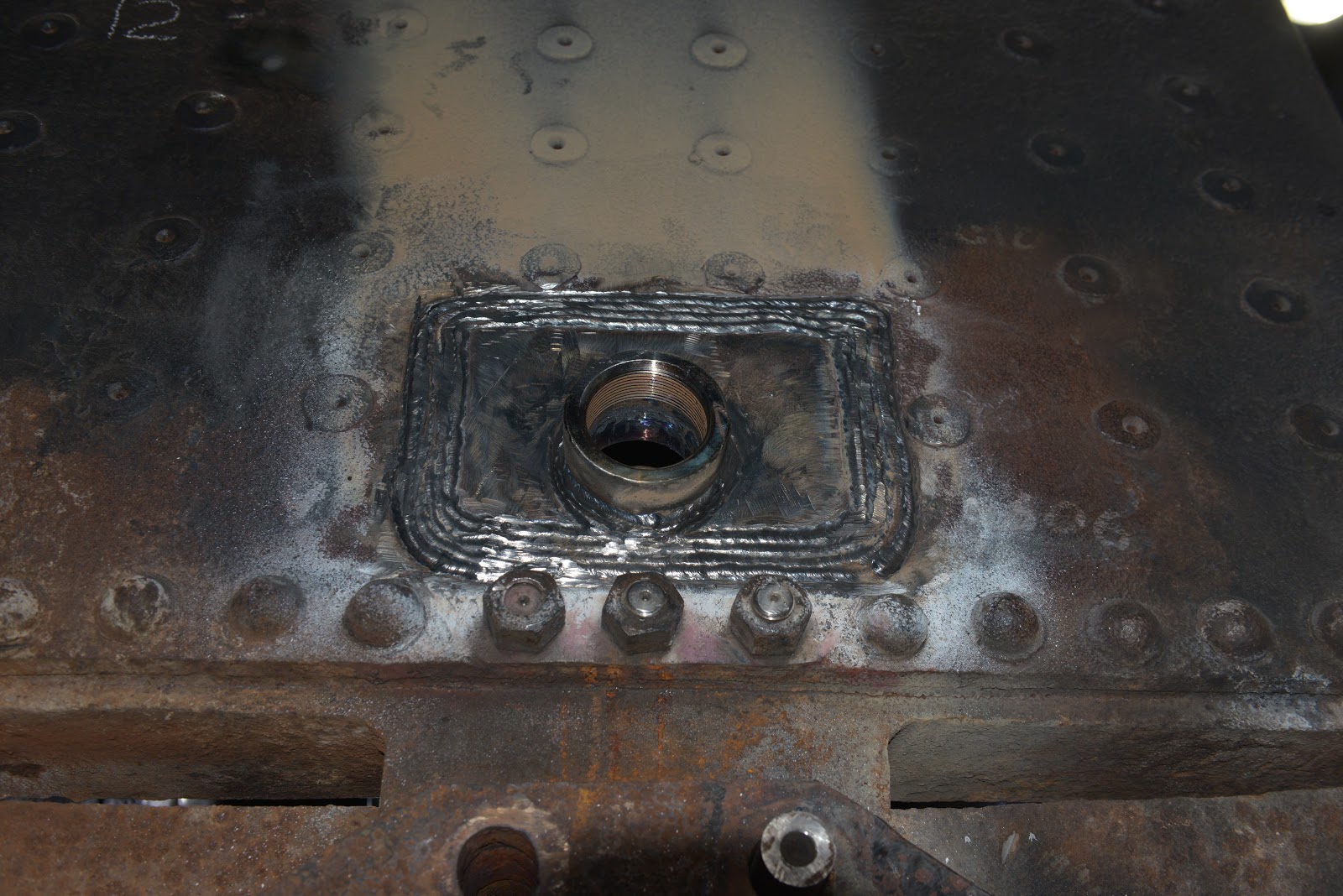
This past week, the last major known work on the 924's boiler was performed.  Seattle Boiler Works visited the Museum to remove the portion of the throat sheet that supports the blow down valve.  A patch had been installed here with patch bolts at least 70 years ago, and the "new" material had wasted in places almost 50% of its original thickness.  So replacement was definitely warranted.

The original patch was removed, which also required three rivets in the mud ring to be cut out.  Then the affected area was cut out, and the perimeter was beveled to allow for welding.  A dye penetrant was used to check for cracks and other flaws.

Seattle Boiler Works installed a flush patch and welded a coupling for a new blow down valve.  The process involved a full penetration weld, and preheating of the native material to about 350 degrees.  Repeated passes, grinding, welding, and continual evaluation took a full day, but the results are impressive.

Up next: three replacement rivets, two new stay bolts, and more.


Wednesday, April 24, 2019

Pressure builds on the 924 project!

If "bake a cake" is old railroad slang for building up steam in a locomotive, then you could say that the restoration crew at the Northwest Railway Museum has been mixing a lot of batter lately.  With major boiler issues either already addressed or with a plan to mitigate, preparations for the first pressure test of the boiler are nearing completion.

The boiler was filled with water to the top of the dome to check for leaks.Over the past several weeks, the dry pipe has been "lapped" with the throttle body and the branch pipe manifold, the throttle valve has been lapped, and the components reassembled inside the boiler.  (Lapping is the process of grinding and polishing the mating surfaces to allow them to fit together without leaking.)  Then the boiler was filled with water to check for leaks.  Some minor leaking was detected around several new rivets and some of the new stay bolts, but nothing serious.

Gary James used his borescope to check for leaks inside the dry pipe.Gary James is a shipwright who usually leads the work on coaches and other wood projects, but he has a very diverse skill set, and some great tools, too.  His borescope displays an image on his phone and was inserted into the dry pipe to check for any leaks.  He found the assembly leak-free, at least under atmospheric pressure.

The copper gasket for the steam dome was heated and quenched to soften it in preparation for bolting on the lid.Meanwhile, the copper gasket for the steam dome was annealed by heating it with a torch and quenching it in cold water.  This makes the copper soft and prepares it to take shape as the dome lid is tightened down.  This thin ring of copper provides the steam seal.

The steam dome lid was gently placed on the copper gasket and bolted down.Lastly, the dome lid was replaced and tightened down.  Machinist Gerry Petitjean did the honors and verified the lid was pulled evenly against the gasket.  The water was filled all the way to the top and the last of the air was exhausted so the entire vessel could be inspected for leaks.  

What is next?  In the coming weeks water in the boiler will be heated to around 30 degrees C.  Then a small hand pump will be used to raise the pressure in the boiler to approximately 200 psi.  This process will identify any remaining leaks, or other issues that need to be addressed.  When all the remaining leaks are repaired, the hydro-static test will be repeated for the Federal inspector.

16 bolts hold the steam dome lid on locomotive 924.The Museum is grateful for 4Culture, Washington Heritage Capital Fund, Schwab Fund, Osberg Family Trust, Emery Rail Heritage Trust, Northern Pacific Railway Historical Association, and more than 100 individuals for their support in funding the restoration of the 924.

Want to see and learn more?  Join us for the Snoqualmie Wine Train on Saturday, April 27 beginning at 2:30 PM in the Snoqualmie Depot.  Your Wine Train experience will include a visit to the Conservation and Restoration Center to see locomotive 924.

Friday, July 7, 2017

Steel chemistry

Rehabilitation of former the Northern Pacific Railway steam locomotive 924 has been underway in the Conservation and Restoration Center for the past year and a half. One of the remaining boiler vessel requirements is completing the package of documentation used to obtain regulatory approval. And one of the remaining details is confirming the chemical composition of the boiler plate, which is a factor used in determining the pressure vessel's maximum operating pressure.

The preliminary calculations used data from the manufacturer's marketing literature.  This is useful for a theoretical exercise, but unreliable for the final document because every batch of steel is different. Furthermore, steel used for patches and other repairs conducted over the last 118 years may greatly differ from what the locomotive was constructed with in 1899. So 23 test sites were identified and prepared with a flapper wheel to remove all paint, rust and other contaminants.

The Mistras Group was engaged to test each of the plates used in the boiler. In all, 23 individual plates were identified and received an arc-flash optical emission spectrometer test. Carbon is one of the components that the Museum is concerned about and this method is an efficient way to determine if the sample is OK, or if further investigation is required. Rogers Locomotive Works claimed that their boiler plate was manufactured with not more than .18% carbon content. More carbon means stronger plates, but it also makes them brittle and prone to cracking, particularly if welded.   

The Mistras technician Haley Lowe conducted optical emissions spectroscopy using a Metorex Arc-Met 930 Metals Analyzer.  The portable device (or at least when compared to the small refrigerator-sized mass spectrometer) was introduced more than 25 years ago and is popular in laboratories and foundries where chemical analysis of metals is required.

The device creates a high voltage electric arc on the surface of the metal.  The device analyzes the light created by the arc and produces a print out indicating material composition by percent. The report includes sulfur, silicone, and carbon, but also other common components including chromium, manganese, copper, tungsten, and phosphorus.

The testing provided lots of good news and reason for optimism, but also revealed three plates that will have to receive further testing, and in the absence of better news may have to be replaced due to abnormally high carbon content. Two sheets are in the firebox and are most likely replacements installed after the locomotive was built.  The third sheet appears to be a patch that will most likely have to be replaced.  Is this bad news?  Not really.  The locomotive is 118 years old and defects were expected.  And it may be good news because these potential issues have been discovered before the locomotive was reassembled!

Monday, March 21, 2016

Tubing the 924

It has been a busy two weeks at the Conservation and Restoration Center with great progress shown in the rehabilitation of Northern Pacific Railway steam locomotive 924.

The last Blog article highlighted the work required to prepare the locomotive for its Federal Railroad Administration internal inspection and approval.  Now, the time had come for tubing the boiler.  Some may ask if this process is premature as the FRA mandates that the 15 year boiler clock begins one year after the first tube is placed or first fire, whichever comes first.  A great deal of work remains on NP 924, including a full running gear rebuild, and by committing to a tube job at this time, it means that completion must be reached within the next year otherwise federal boiler time is wasted.  Although this concern is valid, the rebuild of NP 924 is on an expedited timeline, with rehabilitation to service if not complete in one year, will be mostly so.

In order expedite the project, it was time to protect the internal surfaces of the pressure vessel from deterioration in service by the application of a product called Apexior, produced by Dampney.  Often referred to as a boiler paint, Apexior is actually a Bitumen coating that prevents rust, scale, and other unwanted byproducts from boiling water from forming or adhering to the interior sheets of the boiler.  An interesting fact about this product is that this same product has been continuously produced by the same company since the steam era on American railroads.  Therefore this product not only makes sense from an artifact care and investment standpoint, but also as a period-appropriate material and technique.  

At the same time as Apexior was being applied, the boiler tubes were being prepared for installation.  This process involved the removal of mill scale from the exterior and interior ends of the tubes.  By removing this oxide coating, the bare steel of the tube can be rolled into the hole in the tube sheets, assuring a tight seal with no contamination.  Following this step, the tubes were cut to length and ready to install.  Although the tube sheets in 924 were straightened as much as possible, any locomotive will exhibit variation in the lengths of various tubes.  The 238 tubes in locomotive 924 were no exception, which required every tube hole to be measured for length so that every single tube could be custom cut to fit.  

With tubes sitting at the ready, it was time to start inserting the tubes into the boiler.  This seems an easy task until one realizes the steam delivery pipes leading to the cylinders cover approximately 1/3rd of the front tube sheet, making simple insertion of many of the tubes impossible.  To complete this job, tubes had to be inserted through a hole near its final location in the front tube sheet, cross several holes over into the rear sheet, be pushed inside the front sheet, then manipulated with a bar to line up with the appropriate hole in the front sheet, then pushed forward into the hole.  Sometimes this had to be done several times to reach the final placement of a tube.

This task being completed, it was time to roll the tubes into the sheets. A tube roller, consists of three hardened steel rollers in a cage, driven by a central tapered pin.  This taper pin is rotated by an air motor which serves to expand the tube into the hole in the sheet, crushing it into the hole and forming a pressure tight seal.  The rolling process requires a great deal of judgment as it is possible to over-roll a tube and thin it to the point it would fail prematurely.  Many specialists in the steam locomotive rehabilitation field say the best rolled tube is the one that weeps just barely on its first hydrostatic test.

Although the seal formed by rolling is critical, it is not by any means the end of tubing a locomotive.  Structurally, the most important step is the next process known as beading.  Beading uses a special tool and small air hammer to roll the edge of the tube sticking out of the tube sheets over against the sheet.  This process turns every tube into a hollow rivet by forming a head that prevents the sheet from pushing off the rolled end of the tube.  This work is intensely physical, but makes for a much stronger product, and is historic.  Another important result of the beading process is that it makes the tubes much less prone to fire cracking and burning away of the steel.

Related to this prevention of fire cracking and burning, seal welding of the firebox end of the tubes is also critical.  The term "seal welding" is actually a bit of a misstatement as the weld is not intended to prevent leaking as the roll should provide adequate sealing.  Instead, a small weld is made around the circumference of the bead on the rear sheet in order to pull heat away from the thin tube, and allow it to flow into the much thicker tube sheet.  This prevents the tube ends from overheating and burning away or cracking to an even greater degree than just a bead alone.  In addition, this process was also historically used on steam locomotives, particularly on locomotives that burned oil rather than coal.
Following seal welding, the tubes are lightly rerolled front and back to assure the seal was not disturbed during the beading and welding processes, and then the job was complete!


Substantially completing the boiler work on locomotive 924 involved many facets.  First and foremost, funding was secured.  King County 4Culture awarded a Landmarks Capital grant to fund purchase of the new 2 inch boiler tubes, seal welding rod, and new staybolt material.  Second, an awesome team of volunteers performed much of the cleaning, cutting, and tube installation.  Third, Curator Pappas' pressure vessel skills allowed quick and efficient completion of the work, including the rolling, beading and welding.

The next task is to install the blast nozzle in the smoke box, and reapply the smoke box front. After this, the running gear rebuild will begin.  So stay tuned for another update!


--Photos in this post by Dave Honan and Spike.  Used with permission.

Friday, December 11, 2015

Seasons Greetings!

The Museum's key staff represent a very
diverse group of qualifications that sup-
port many mission-critical functions. 
From left to right, Gary James, ship-
wright; Richard Anderson, executive
director; Cristy Lake, registrar and
volunteer coordinator; Lara Ballinger,
bookstore buyer; Stathi Pappas, large
object curator; Peggy Barchi, market-
ing manager; Jessie Cunningham,
deputy director and educator; James
Sackey, visitor services; and Jennifer
Youngman, bookkeeper.
From all the Trustees and Staff at the Northwest Railway Museum to all the supporters, patrons, volunteers, donors, visitors, and all 'round fans, thank you for another great year.

There are many components in a successful Museum, and chief among those are willing and generous supporters.  So whether you donated goods, services, funds, volunteer hours (more than 14,000 in 2015!), or bought tickets to visit or ride, thank you for your role in making 2015 successful!

The senior staff recently got together to reflect on the last 12 months, and tour Chapel Car 5 Messenger of Peace.  As 2015 winds down, the Museum has secured necessary permits to build the new Railway Education Center, installed a new exhibit in the Train Shed, made significant progress in the rehabilitation of steam locomotive 924, successfully nominated 924 to the Landmark Register, operated more than 37 days of steam with the visiting SCPC 2, refinished the floors in the Snoqualmie Depot, performed additional rehabilitation on chapel car 5 Messenger of Peace, and performed major work on coach 276

Wow, 2015 was a busy year!  Yet 2016 looks like it may be even busier with plans for construction of the new Railway History Center, near completion of locomotive 924, additional coach work, and more.  Your support always makes a difference and we invite you to consider - even encourage you - an end of year donation to the Northwest Railway Museum so that this important work may continue.

Seasons Greetings, and thank you for your support.

Friday, August 14, 2015

Steam locomotive 924 insulation removal

Locomotive 924 is a six-coupled, former Northern Pacific locomotive.  It is held in the collection of the Northwest Railway Museum and beginning in November 2014 rehabilitation work has been underway.  The objective is to return the 924 to its former glory and operate it on the Museum's railway between Snoqualmie Falls and North Bend. 

924 ready for insulation removal
Urethane foam was used to seal weak
areas until the removal project was
ready to begin.
Since the fateful day last November when the locomotive was pushed into the Conservation and Restoration Center, the boiler interior has been stripped of tubes and scale, the Form 4 engineering package begun (regulatory requirement for operating a steam locomotive), new firebox side sheets fabricated and welded in place, a new all riveted tender cistern fabricated, the tender frame rehabilitated for service, and tank installed on the frame.  However, a major hurdle for the completion of the boiler work remained the locomotive's jacketing and insulation.  In order to complete the Form 4 process, the exterior of the boiler had to be stripped for visual inspection, and the final ultrasonic thickness data collected.  

Director Anderson and
Curator Pappas wore
elaborate protective
equipment.
Preliminary testing determined that the insulating material was a form of asbestos, commonly used for locomotive boiler insulation, but now found to be harmful to human respiratory systems, causing malignant cancers, formation of plaques that inhibit lung function, and a host of other nasty, potentially life-ending conditions. Needless to say, the work of removing this material needed to be performed in a safe manner for everyone involved.  Hiring a remediation contractor is quite expensive, and it was the suggestion of volunteer Zeb Darrah to obtain the necessary training and certification to legally conduct the remediation in house.  He recommended several potential training programs, and did the majority of the preliminary fact finding for the legalities of doing this work in house. In preparation for this museum director Richard Anderson and curator Efstathios Pappas received training from Argus Pacific, a private firm that specializes in hazardous material handling training.  

Edwin from Global Asbestos
Contractors checks verifies
the entry door seal on the
containment structure.
In early August, remediation work began working with Global Asbestos Abatement, a licensed asbestos contractor.  By partnering with this firm, valuable advice and experience was available to the team, but perhaps more importantly the necessary equipment to complete the job safely and effectively.  

A double-wall containment structure
was built over locomotive 924.
Over the course of three days, the mandated double wall containment was constructed of polyethylene sheeting, and taped so as to be air tight to a minimum of -.018 inches of mercury with HEPA negative air machines running.  A three stage decontamination chamber was built and attached to the front of the enclosure, and pre-abatement samples taken so as to demonstrate a clean and safe working environment, and provide comparison for the post abatement samples.  All work conducted in the enclosure was accomplished using full face respirators with external supplied air, full coverage Tyvek suits, as well as appropriate personal protective gear such as hearing protection, gloves, etc.  

Insulation is sprayed with water prior
to removal to reduce the likelihood
that fibers will be introduced to the
atmosphere.
The removal of the jacket and insulation took approximately a day and a half to remove and safely bag for disposal.  Although the original jacket was in very poor shape, the reason for involving trained museum professionals in the actual remediation was highlighted in the data collected that will be useful as rehabilitation of the locomotive continues.  Hardware such as boiler band brackets, washout plug ferrules, and other assorted hardware was removed, cleaned and saved for reuse.  In addition, various samples of trim treatments, riveting of jacket panels, etc were also saved, and will allow the team to match the original methods of construction as closely as possible.  Illustrating how this benefits the Museum was a discovery made on the inner surface of the jacket located just beneath the hydrostatic lubricator bracket: an uncorroded patch of the original American Iron boiler jacket surface.  Samples such as these are rare because the oxide finish of both Russian and American Iron was extremely prone to corrosion and loss if not kept continuously oiled.  Curator Pappas noted the extremely oil soaked appearance of the jacket and insulation in this area due to frequent overfilling and leakage of the hydrostat over many decades of service, and was particularly mindful of the potential presence of an unadulterated sample.  

Clean boiler!
Following the removal of the material, the arduous process of cleaning all surfaces of the locomotive and containment began.  The next three days were required to assure the successful completion of the job.  The surface of the boiler was rough due to surface corrosion, and provided an ideal surface for asbestos fibers to be trapped and potentially endanger individuals working on the locomotive in the future.  To avoid this possibility, all flaky rust was removed with a chipping hammer and wire brushed while moistened to clean the surface.  More aggressive methods such as needle gunning and wire wheeling are usually not employed as these can raise the concentration of fibers in the containment to unsafe levels, even with full face mask protection.  After this step, all surfaces of the locomotive and containment were vacuumed using a HEPA vaccum cleaner, and all debris double bagged and removed from the containment.  Although this may sound like a relatively simple matter, the work in full protective gear on a hot summer day can be exhausting!

After the insulation was double bagged
and removed, the enclosure room was
cleaned and locked down. An air
sample was collected during a two
hour interval to verify that there was
no airborne fibers prior to removal of
the containment.
Once everything was cleaned, a final wash down with water was conducted over every surface.  The water was then collected below the engine, and pumped through approved water filters to remove any asbestos micro fibers.  All of the secondary inner walls of the containment were sprayed with a fixative called Lockdown, taken down, rolled, and double bagged for removal.  Then all primary surfaces were also sprayed with lockdown and clearance air samples taken.  This last step is critical to assure the safety of anyone in the shop, as once the containment is breached, any contamination will remain.  After the samples were examined by a third party local laboratory, air quality was found to be ideal, with the lowest presence of asbestos recordable!  

Although a great deal of time and effort was expended to conduct this remediation, the money saved, and opportunities for artifact care and documentation were worth the effort.  With this work completed, it is time to finish the boiler work and proceed to the running gear.  Look for more updates soon as Snoqualmie rings with the sounds of heavy boiler work again!  Until then, we hope to see you all in Snoqualmie.