Showing posts with label steam program. Show all posts

Tuesday, February 16, 2016

Under the Dome and more

The New Year is off to a blazing start at the Northwest Railway Museum!  Already, significant progress has been achieved on Northern Pacific Railway steam locomotive 924 with substantial completion of some major boiler work and, thanks to new funding from the Emery Rail Heritage Trust, has included pretty much everything under the dome... 

The key to any successful steam locomotive rehabilitation is quality work done to exacting standards, particularly in the realm of the pressure vessel (boiler) and running gear.  No locomotive will operate properly or safely if these areas are not completely and adequately examined, rebuilt, and maintained in service. 

The pressure vessel on NP 924 was by no means in good condition for an easy return to service, and as previous blog postings have noted, new firebox side sheets had to be installed, as well as a new steam dome.  In particular, the new steam dome construction involved an alteration of the original design in order to assure safety in operation.  The original design employed a longitudinal lap seam where the flat plat the dome was rolled from overlapped slightly and was held via rivets.  This design of joint induces nonlinear stresses that degrade the sheet material adjacent to the joint, and if not properly monitored can lead to potentially catastrophic failure. 

The original dome exhibited signs of degradation such as cracking and rivet shearing, indicating the original design was not ideal.  In order to rectify this situation, a new dome was built employing riveted buttstrap construction of the longitudinal joint.  A buttstrap joint has the rolled round of the barrel butt together for the longitudinal seam, and employs plates inside and out with rivets through all three on either side of the seam.  This design is far superior and does not impart any non linear forces in the plates other than hoop tension.  In order to accomplish this repair, the joint efficiency needed to be calculated so as to assure a safety factor of at least four times.  In the final analysis, the safety factor was found to be over seven times, assuring a long life of service ahead.  After the design process was completed, the Federal Railroad Administration (FRA) in Washington DC had to approve the alteration and engineering so as to assure public safety.  This step completed, and using funding awarded by the Emery Rail Heritage Trust, construction of the dome was able to progress unfettered. 
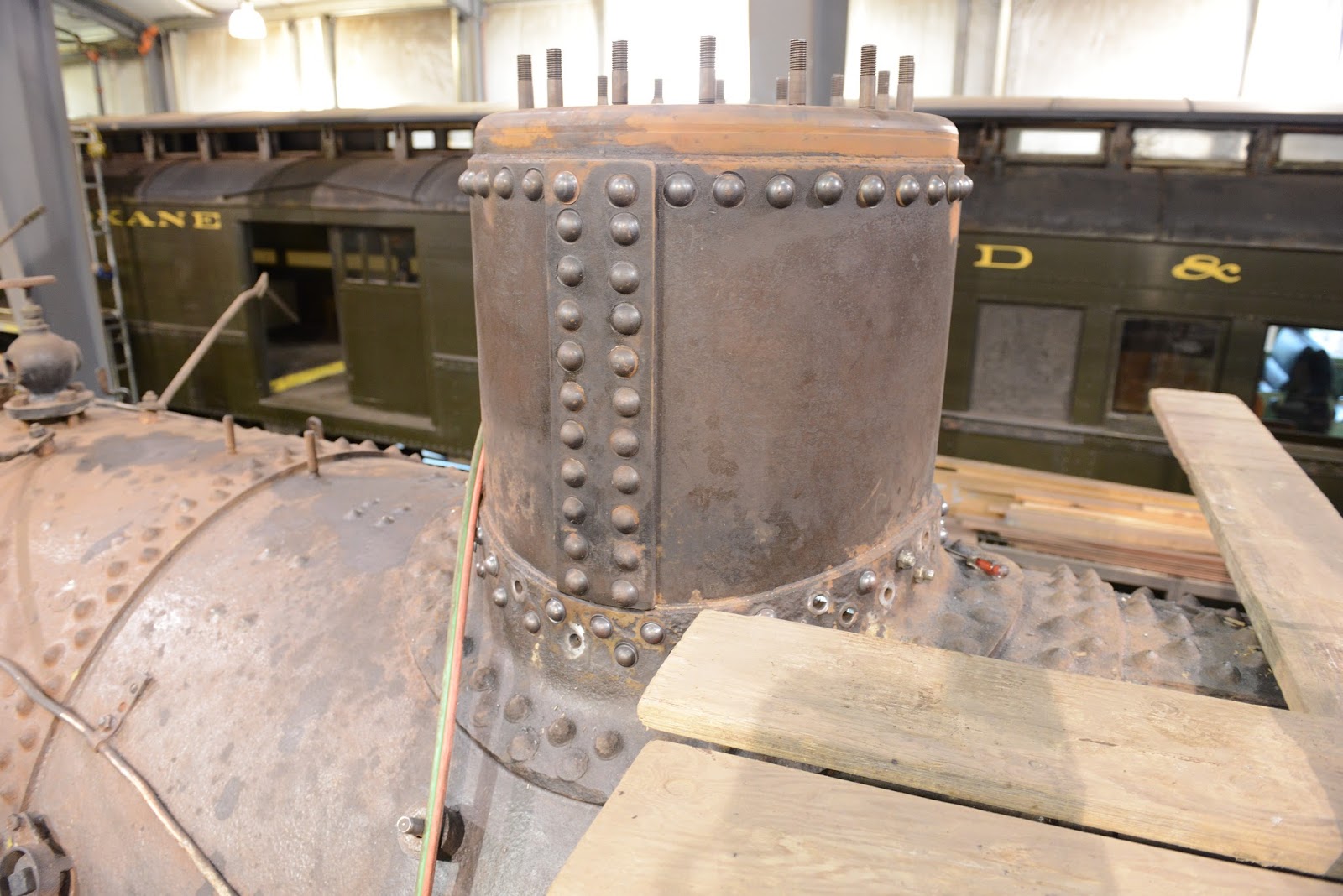
At least until appropriate rivet material could not be sourced.  Fabricating the dome and readying it for installation on the boiler was accomplished with appropriate boiler rivets from a local source.  However, the smaller ¾” rivets that would secure the dome to the flange on the back of the barrel could not be acquired.  The steel used for pressure vessel riveting is made to a specification called ASTM A31 Grade B (or A31b for brevity), which is an extremely ductile, low carbon steel.  In searching for a cost reasonable source, it became clear that proper materials for steam locomotive construction continue to get harder to find.  Luckily, the Museum’s curator Pappas had a small stash of A31b bar, and through the construction of a rivet jig, new rivets could be formed in house at the Museum using material of the correct specification.  Once this task was completed, the dome was riveted on and ready for service. 

Following this task, part of the longitudinal seam on the first barrel course was in need of work.  The sand dome had collected water beneath it and extensively corroded the outer welt strip of the buttstrap joint.  This welt strip needed partial replacement, as well and replacement of 22 rivets, and a small pad weld on each side of the seam.  Pad welding is compliant with the regulations, but must be conducted to a national standard.  The areas in question were small enough that they did not require prior approval, but the process was still communicated to the regulatory authorities prior to undertaking the work. 
 
Pad welding was conducted by curator Pappas, who holds 6g welding certification, and following appropriate National Board Inspection Code (NBIC) procedures so as to eliminate internal stresses from the welding process.  The work was then radiographed (x-rayed) and proven to be clean and free from all defects.  Following this, a new welt strip patch was welded into the seam, and new rivets installed. 
 
As noted above, the large rivets needed for the seam were difficult to source so these were also manufactured in house of A31b.  The installation of these rivets was doubly difficult in that they had to be inserted from the inside of the boiler, backed with an air buck, and the formed head driven on the outside with an air hammer.  This may not seem overly difficult, until one realizes the delivery pipe from the throttle runs directly under this seam, only three inches from where the final rivet heads would be!  Through the creation of specialized tooling, and a large influx of enthusiastic volunteer labor, the Museum’s team was up to the task, and the riveting was completed in one day. 

FRA inspectors
Brandon, Gary (ret.),
and Zack check out
the 924.
After this step, the next task was to bring in the local FRA inspectors to review the work and inspect the interior of the boiler, which must be done prior to the installation of fire tubes.  To get ready for this step, the interior of the barrel was cleaned to bare metal, tube sheets straightened and dye penetrant tested to check for cracking, and tube holes polished.  Our work passed the FRA’s stringent standards with flying colors and was approved for completion of the tube job. 

Let it be reiterated that boiler work such as this is not to be undertaken lightly, and the importance of the public’s safety is always first priority when undertaking pressure vessel work.  Stay tuned for the next installment in the continuing rehabilitation of Northern Pacific Railway steam locomotive 924: tubing! 

Friday, October 16, 2015

Engineering the 924 boiler

In September 2015 another major milestone was passed in the rehabilitation to service of Northern Pacific Railway steam locomotive 924. 

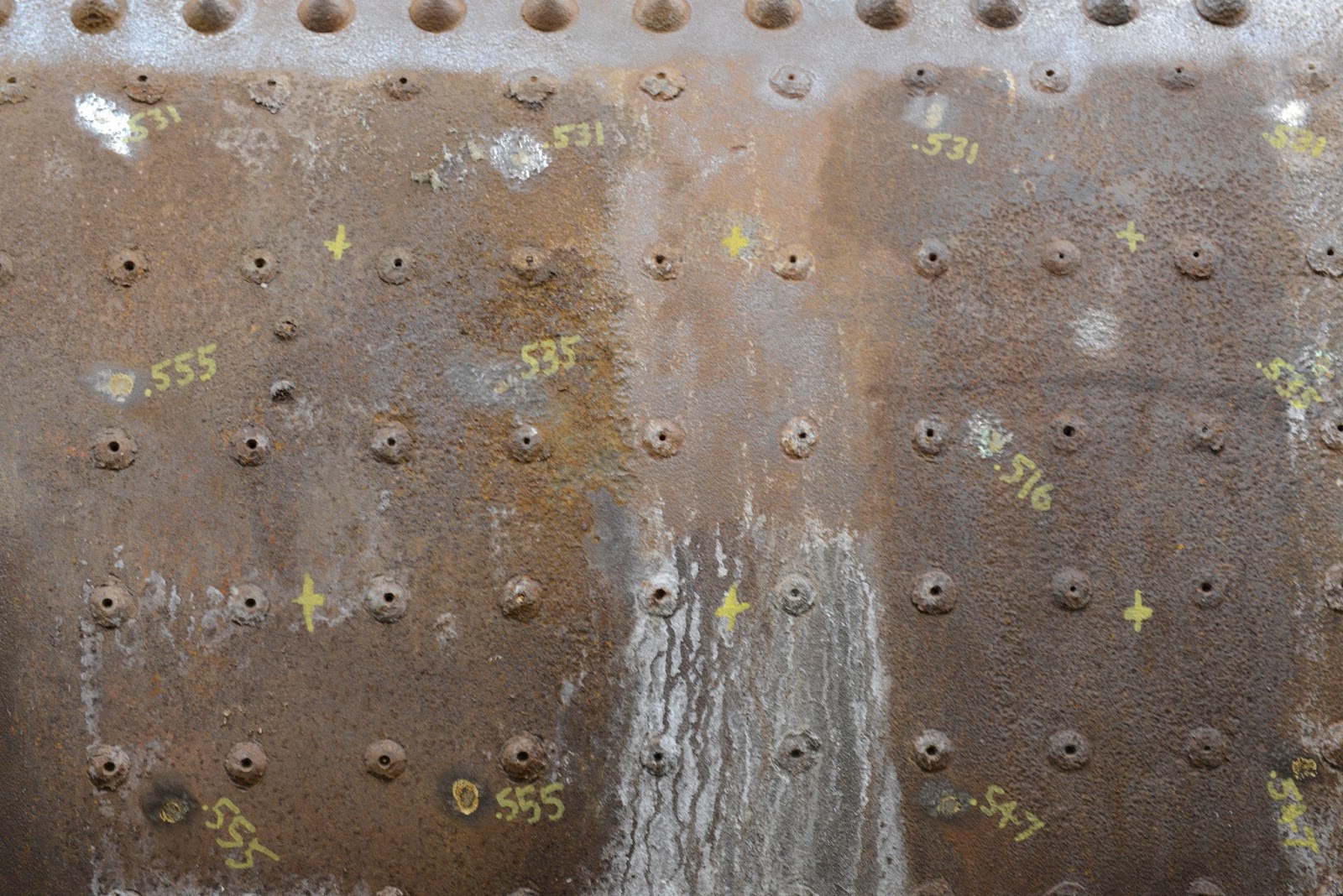
In November 2014, the boiler tubes were removed from the locomotive and a preliminary engineering package was created based upon the thicknesses and geometries of the existing vessel.  During this time, a complete ultrasonic thickness grid was laid out and measured from the water and fire side of the boiler sheets, and the results were more than encouraging.  However, for the locomotive pressure vessel to be legal under the regulations of the Federal Railroad Administration (“FRA”), the exterior jacketing and lagging had to be removed.  This allowed for a visual inspection and for documentation of the final ultrasonic thickness measurements of any critical areas that were not possible to reach from the inside of the boiler.  So following the abatement of the asbestos lagging in late July and early August, it was time to finalize the form 4 engineering package, external visual inspection, and ultrasonic grid. 

Preparing the pressure vessel for an external inspection and for ultrasonic measurements involved a variety of tasks.  First, the boiler shell was stripped of rust and scale, as well as any other appurtenances that obstructed the exterior of the boiler.  Then, a grid pattern was laid out with data points polished to bright steel so as to allow the ultrasonic transducer to couple with the material and give an accurate reading.  Any areas found to exhibit additional pitting or deterioration were also tested to find the thinnest points in each boiler component. 

Preliminary calculations indicated the pressure vessel to be in good shape, especially following the installation of new firebox side sheets in January.  However, visual inspection found questionable rivets and some cracking present in the steam dome barrel near these rivet holes.  The original design of the dome also included a longitudinal lap seam, which although legal to remain in service, would require additional inspection and care in service.  The dome ring at the top of the steam dome was also found to be cast iron, which was not a good choice for pressure vessel use due to its lack of ductility and low tensile strength.  Curator Stathi Pappas made the decision to replace the steam dome with a new fabrication using A-516-70 steel and butt strap riveted construction to provide for both safety and longevity of service. 

At this point, Curator Pappas brought in friend and colleague Jon Brewster - who is an expert in boiler calculations - to run the final numbers and determine the health of the pressure vessel with the alterations and repairs as noted above.  Although locomotives may operate with severely derated boiler pressures, these locomotives are often but shadows of their former selves in capability, power, and economy.  In order to be true living history, philosophically, locomotives should be rebuilt to behave as they would have in their period of significance.  This being the case, Northwest Railway Museum is pleased to announce that NP 924 will once again be legal for her original full working pressure of 180 psi, just as Rogers intended!!!

Following this achievement, no time was wasted in beginning the construction of the new steam dome.  A new upper ring was machined on the Museum’s 48” Bullard Spiral Drive vertical turret lathe from a 5.5” thick plate of A-516-70 steel to match the original.  This machine was able to bore the center hole removing up to 1” of material in one pass.  Now that is mid-century American machine tools being used as intended!  At the same time a new dome barrel was rolled by Liberty Metal in Portland, Oregon out of A-516-70 steel.  By mid September, the new ring and rolled round were fitted together and welded preparatory to riveting.  Although the rivets are more than strong enough to support the joints in this new dome, Curator Pappas (who is a certified 6G welder) welded the dome for additional strength, prevention of leaking seams, and dimensional stability during the riveting process.  By using appropriate riveted construction and welding, this dome may even outlast the rest of the pressure vessel.  During this time, the old dome was removed and all rivets from the dome saddle removed preparatory to installation of the new dome. 

Fall 2015 will see the completion and installation of this new dome on the 924. Following this achievement, the stay bolt work on the new side sheets can them be completed, tube sheets prepped, and the vessel will be ready for tubes and a hydrostatic pressure test. 

Stay tuned for continuing developments from the Northwest Railway Museum Conservation and Restoration Center!
 
 
"Engineering the 924 boiler" was a guest post by Northwest Railway Museum Curator Stathi Pappas.

Friday, August 14, 2015

Steam locomotive 924 insulation removal

Locomotive 924 is a six-coupled, former Northern Pacific locomotive.  It is held in the collection of the Northwest Railway Museum and beginning in November 2014 rehabilitation work has been underway.  The objective is to return the 924 to its former glory and operate it on the Museum's railway between Snoqualmie Falls and North Bend. 

924 ready for insulation removal
Urethane foam was used to seal weak
areas until the removal project was
ready to begin.
Since the fateful day last November when the locomotive was pushed into the Conservation and Restoration Center, the boiler interior has been stripped of tubes and scale, the Form 4 engineering package begun (regulatory requirement for operating a steam locomotive), new firebox side sheets fabricated and welded in place, a new all riveted tender cistern fabricated, the tender frame rehabilitated for service, and tank installed on the frame.  However, a major hurdle for the completion of the boiler work remained the locomotive's jacketing and insulation.  In order to complete the Form 4 process, the exterior of the boiler had to be stripped for visual inspection, and the final ultrasonic thickness data collected.  

Director Anderson and
Curator Pappas wore
elaborate protective
equipment.
Preliminary testing determined that the insulating material was a form of asbestos, commonly used for locomotive boiler insulation, but now found to be harmful to human respiratory systems, causing malignant cancers, formation of plaques that inhibit lung function, and a host of other nasty, potentially life-ending conditions. Needless to say, the work of removing this material needed to be performed in a safe manner for everyone involved.  Hiring a remediation contractor is quite expensive, and it was the suggestion of volunteer Zeb Darrah to obtain the necessary training and certification to legally conduct the remediation in house.  He recommended several potential training programs, and did the majority of the preliminary fact finding for the legalities of doing this work in house. In preparation for this museum director Richard Anderson and curator Efstathios Pappas received training from Argus Pacific, a private firm that specializes in hazardous material handling training.  

Edwin from Global Asbestos
Contractors checks verifies
the entry door seal on the
containment structure.
In early August, remediation work began working with Global Asbestos Abatement, a licensed asbestos contractor.  By partnering with this firm, valuable advice and experience was available to the team, but perhaps more importantly the necessary equipment to complete the job safely and effectively.  

A double-wall containment structure
was built over locomotive 924.
Over the course of three days, the mandated double wall containment was constructed of polyethylene sheeting, and taped so as to be air tight to a minimum of -.018 inches of mercury with HEPA negative air machines running.  A three stage decontamination chamber was built and attached to the front of the enclosure, and pre-abatement samples taken so as to demonstrate a clean and safe working environment, and provide comparison for the post abatement samples.  All work conducted in the enclosure was accomplished using full face respirators with external supplied air, full coverage Tyvek suits, as well as appropriate personal protective gear such as hearing protection, gloves, etc.  

Insulation is sprayed with water prior
to removal to reduce the likelihood
that fibers will be introduced to the
atmosphere.
The removal of the jacket and insulation took approximately a day and a half to remove and safely bag for disposal.  Although the original jacket was in very poor shape, the reason for involving trained museum professionals in the actual remediation was highlighted in the data collected that will be useful as rehabilitation of the locomotive continues.  Hardware such as boiler band brackets, washout plug ferrules, and other assorted hardware was removed, cleaned and saved for reuse.  In addition, various samples of trim treatments, riveting of jacket panels, etc were also saved, and will allow the team to match the original methods of construction as closely as possible.  Illustrating how this benefits the Museum was a discovery made on the inner surface of the jacket located just beneath the hydrostatic lubricator bracket: an uncorroded patch of the original American Iron boiler jacket surface.  Samples such as these are rare because the oxide finish of both Russian and American Iron was extremely prone to corrosion and loss if not kept continuously oiled.  Curator Pappas noted the extremely oil soaked appearance of the jacket and insulation in this area due to frequent overfilling and leakage of the hydrostat over many decades of service, and was particularly mindful of the potential presence of an unadulterated sample.  

Clean boiler!
Following the removal of the material, the arduous process of cleaning all surfaces of the locomotive and containment began.  The next three days were required to assure the successful completion of the job.  The surface of the boiler was rough due to surface corrosion, and provided an ideal surface for asbestos fibers to be trapped and potentially endanger individuals working on the locomotive in the future.  To avoid this possibility, all flaky rust was removed with a chipping hammer and wire brushed while moistened to clean the surface.  More aggressive methods such as needle gunning and wire wheeling are usually not employed as these can raise the concentration of fibers in the containment to unsafe levels, even with full face mask protection.  After this step, all surfaces of the locomotive and containment were vacuumed using a HEPA vaccum cleaner, and all debris double bagged and removed from the containment.  Although this may sound like a relatively simple matter, the work in full protective gear on a hot summer day can be exhausting!

After the insulation was double bagged
and removed, the enclosure room was
cleaned and locked down. An air
sample was collected during a two
hour interval to verify that there was
no airborne fibers prior to removal of
the containment.
Once everything was cleaned, a final wash down with water was conducted over every surface.  The water was then collected below the engine, and pumped through approved water filters to remove any asbestos micro fibers.  All of the secondary inner walls of the containment were sprayed with a fixative called Lockdown, taken down, rolled, and double bagged for removal.  Then all primary surfaces were also sprayed with lockdown and clearance air samples taken.  This last step is critical to assure the safety of anyone in the shop, as once the containment is breached, any contamination will remain.  After the samples were examined by a third party local laboratory, air quality was found to be ideal, with the lowest presence of asbestos recordable!  

Although a great deal of time and effort was expended to conduct this remediation, the money saved, and opportunities for artifact care and documentation were worth the effort.  With this work completed, it is time to finish the boiler work and proceed to the running gear.  Look for more updates soon as Snoqualmie rings with the sounds of heavy boiler work again!  Until then, we hope to see you all in Snoqualmie.  

Monday, July 6, 2015

Tender tank gets wheels

Tender tank project volunteers and staff pose with the new tank on the tender frame.A major milestone was achieved on the Northern Pacific Railway steam locomotive 924 last week: substantial completion of the new cistern (tank) for the tender.  For more than five months, a replacement tender tank has been taking shape on the floor of the Conservation and Restoration Center.  Other than a couple additional baffles and the rear coal board, all structural and seam riveting was completed such that is was time to move on to other aspects of the project.  The tender frame had already been rehabilitated and prepared for placing the tank some weeks before.  

During this phase of the project, additional research determined that this tender frame is actually far more ancient than the locomotive and tank.  The tender frame and trucks were originally built for a Northern Pacific 4-4-0 C class locomotive in the early 1880s, predating the construction of 924 by more than 15 years.  Later in 924's service life for the NP, the original frame and trucks were replaced by the running gear from one of the many 4-4-0s that were being retired in the 1910s and 1920s.  Contemplating the implications, this tender frame hardware and trucks were potentially in service prior to completion of the Northern Pacific as a transcontinental railroad!

Remachined bottom valve installed on bottom of new tank.
Before the tank could be placed on the frame, the water valves at the ends of the water legs needed to be remachined and installed in the floor of the tank.  The lack of access and upside-down nature of this work would have made it very difficult to install once the tank was in place.  The valve bodies were faced, bored, and valve seats recut using one of Museum’s large lathes.  Then the valves were fitted into position, holes drilled in the base of the tank, and mounted.  

Large loader lifts new tender tank from floor in Conservation and Restoration Center.With the bottom valves in position, it was finally time to install the new tank on the tender frame.  Weber Construction is the Museum’s neighbor and is also owner of the local rock quarry.  Their repertoire of machinery includes large excavators and loaders that each can lift tens of thousands of pounds.  So Weber was hired to perform the lift and arrived Friday, June 26th with a very large loader with forks mounted on the leading edge.  The 16,000 pound tender tank was picked up from the floor, removed from the CRC and placed on the frame.  Everything fit perfectly the first time, and the total elapsed time from start to finish was just two hours!

A significant amount of work remains to be done on the tender before it is ready for service. The tank requires installation of the rear coal board, filler hatch, four small baffles, hand rails, rear headlight, additional seal welding, and interior and exterior paint.  And not to forget, large white numerals proudly displaying her number!  However, the shop floor is now open and uncluttered so that Museum forces can begin placing and powering up the new large machine tools that were acquired earlier in 2015.  This will allow work effort to slowly transition to the locomotive and its many needs.

New cistern on tender frameThis achievement was made possible by the hard work and sacrifice of many museum volunteers and staff, and is a testament to the scale and quality of work that can be accomplished through teamwork.  At this time, there still remains much work to complete 924's return to operation.  However, the list just got a lot shorter!
 
 
--Special thanks to Dave Honan for taking photos of this special day, and to Stathi Pappas for providing the content of this post--


Tuesday, June 30, 2015

Steam trains return July 4 & 5!

Steam trains are returning to the Northwest Railway Museum on July 4 and 5, 2015!  The first departure is at 11:30 AM from Snoqualmie.  Tickets are $20 for adults, $18 for seniors, and $12 for children.  You can purchase tickets in advance and pickup them up at will call prior to boarding the train. There is no service charge for using the Museum's online ticketing system, and it will reserve space for you and your family!  So why wait?  Order here today!
 
Trains will be pulled by Santa Cruz Portland Cement steam locomotive 2.  There will be departures from Snoqualmie each day at 11:30 AM, 1:00 PM, 2:30 PM, and 4:00 PM.  Just a year into service after years of effort were expended restoring this early 20th Century gem, "The Chiggen" is ready to steam for the weekend. This will be the last weekend of regular trains before Thomas the Tank Engine visits Snoqualmie so come and ride the line in style, behind SCPC 2!

Wednesday, May 20, 2015

SCPC 2 winter work

The Santa Cruz Portland Cement steam locomotive 2 ("SCPC 2") is at present the resident steam locomotive at the Northwest Railway Museum in Snoqualmie.  It is from the personal collection of Stathi Pappas, the Museum's Curator of Collections, and is the flagship of the developing steam program introduced at the Museum last year.  While the Museum's locomotive - Northern Pacific Railway 924 - undergoes a complete rehabilitation, the SCPC 2 is leading all steam excursions and is training new engine crew.  However, like all steam locomotives, an ongoing preventative maintenance and upgrade program is essential to sustainable success.  So this past winter, the SCPC 2 received some important attention.

First of all, a little about the 2.  In 2014, SCPC 2 ran over 1,000 miles on four different railroads across the west coast, and everything relating to her rebuild (completed in 2013) performed very well.  However, a few items were not addressed in the initial project as time constraints of the west coast tour just would not allow everything to be completed before departing for California.  These were remachining the piston rods, pistons and ring grooves, new piston rings, redesigned packing, new crosshead wedges, remachining and relining the crosshead guides, and remachining the crosshead slippers. Although there was no evidence of blow by, and the bores and pistons were inspected prior to being put in service, the author decided to finish these last few items before returning the 2 to service Memorial Day weekend.

In January the author and his crew of volunteers ("Team Chiggen") stripped the cylinder saddle of covers, crossheads, guides, pistons, etc and began the process of rebuilding.  In order to assure perfect concentricity and no taper of the piston rod, the best method of machining is to rough machine to round, then use a tool post grinder to assure surface finish and concentricity.  At the same time, the team turned the ring grooves, preparatory for new rings.  
 
The specification for engines this size is for a the ring groove to be .005" over the width of the rings to assure steam tightness.   Meanwhile, new rings were purchased from Niagara Piston Ring to specific dimensions. Although Team Chiggen is more than capable of making piston rings in house, it is less expensive to source completed rings than to buy the rough material to manufacture from scratch.

At the same time, the original rod packing on the locomotive left a lot to be desired.  The author had researched going to a La France style packing similar to what the Cumbres and Toltec, and the Durango and Silverton use on their locomotives, and found a very competitively priced version available through That Steam Guy.  This owner - though not associated with the seller - is quite happy with the product.  In response to more recent steam locomotive practice, also installed were four packing elements per side based upon the South African Railway and Chinese data for multiple packing elements rather than the more familiar two. 

While piston work was underway, Team Chiggen remachined and set up the crosshead guides in order to maintain perfect alignment of the piston rod within the packing gland to prevent premature wear of the piston rod, rings, pistons, and bores.  After the guides were machined and and temporarily installed, string lines were run through the bores perfectly in alignment with the cylinder and checked against the guides to assure parallelism.  

On the left side, all was well, but the right side (shown at right) required work to bring the guides into specification with the bores, thus demonstrating the necessity of doing this type of work, even if things "look ok."  

After a little effort, the piston, rod, and ring assembly were ready to re install on the right side.  Those with keen eyes will notice the presence of double rings in each groove.  The owner decided to do this rather than two wide rings due to the overwhelming evidence to support the higher sealing abilities of multiple narrow rings over wide ones.


Now, in order to assure the piston rod is running parallel to the bores and crosshead guides, the crosshead slippers themselves must be machined and fit to assure the center line of the tapered socket is in the right place.  The accompanied photos show one of the four remachined slippers ready for installation, and the entire assembly, straight and true, with a new machined crosshead wedge to assure years of trouble free operation.  

So after all this work, there is no better way to prove if it all works than to try it.  So last Sunday was test day: Team Chiggen fired the locomotive up, and put her on the head end of the last passenger train of the day.  Rest assured that diesel is in isolation, and the Chiggen is pulling the consist up the 1.2% grade to the top of Snoqualmie Falls. Everything performed admirably and the team called the test so successful, there was a second charge up the hill just for fun!

So for all of you in the local area, come on out this Saturday through Monday (Memorial Day Weekend) and take an excursion at Northwest Railway Museum behind the new and improved SCPC 2!  Fares and times are here.  And remember, there is full summer season of steam this year, and a variety of special programs including Snoqualmie Railroad Days in August, so check out the details on the Museum's web site at www.trainmuseum.org

A special thanks to Team Chiggen: John Graddon, Adam Phillips, Zeb Darrah, Karl Klontz, Nathan Iverson, Steven Hughes, Mark Speer, Mike Donnelly, Jason Hill, CJ Vargas, Bill Gejerstad, David Wilhite, Andy Walker, Ken Liesse, Jason Sobcynski, and many others who help make this all possible!

--SCPC winter work was a guest post by Northwest Railway Museum Curator of Collections Stathi Pappas--

Monday, May 4, 2015

Give BIG on Tuesday, May 5!

May 5 is an opportunity to be a part of something truly remarkable.  May 5 is an opportunity to donate in support of the steam locomotive 924 rehabilitation.

The Seattle Foundation's annual giving event "Give BIG!" is scheduled for May 5 and the Northwest Railway Museum is participating.  This year, contributions will support the steam program, and specifically the efforts to rehabilitate the 1899-built steam locomotive 924 now underway in the Conservation and Restoration Center at the Railway History Center.

The new cistern for 924's tender is
taking shape on the floor of the
Conservation and Restoration Center.
Contributions received between midnight and midnight on Tuesday, May 5, 2015 via the Museum's gateway page on the Seattle Foundation's website will be eligible for a partial match from the Seattle Foundation, and will complete for a one of the "Golden Tickets," which is an additional $1,000 contribution.

Your support truly makes a difference, and will help put locomotive 924 back in steam for its second Century of service.  Make a contribution here on Tuesday, May 5 between midnight and midnight and be a part of something truly remarkable.

Locomotive 924 moves to the Conservation and Restoration Center in this
October 2014 image.


Friday, January 30, 2015

Curing boiler ache

The Museum's curator cuts out around
the stay bolts that secure the inside
sheet to the outside sheet.  During
operation, water between the sheets
is heated by combustion in the firebox.
Rehabilitation and restoration of a steam locomotive that is more than 115 years old can present many challenges, sometimes even when components appear to be in great shape.  Take the boiler for instance.  It's a pressure vessel designed to operate at up to 180 pounds per square inch. It represents a discipline that saw continuous change throughout the first half of the 20th Century as new techniques were developed, and older practices were sometimes found deficient.  Fast forward to the 21st Century and the best practices and regulations of the past have been combined with the knowledge and scholarship of the present to form the "new" regulations that govern the eventual certification of locomotive 924. 
The lower portion of the side sheet on
the right side of the firebox has been
removed allowing the back side of the
wrapper sheet to be inspected.  Several
small cracks were found radiating from
stay bolt holes.

With today's regulations - and the genuine desire to operate in a safe and efficient manner - there are some parts of the locomotive boiler that are being replaced.  Inside the firebox, the side sheets were repaired with a mixture of gas and early electric welding techniques, perhaps as many as 90 years ago.  Unfortunately, this presents challenges for the certification and sustainable operation of the locomotive.  Even if these repairs could be dissected and the boiler approved for operation, these repairs of unverifiable workmanship could present a problem during the next 1,492 days of operation, and require remedial repairs in the middle of an operating season.

The new side sheet sections are welded
into the boiler.  The holes will soon be
tapped for new stay bolts.
So in December 2014 the lower portion of the side sheets on both sides of the locomotive - together incorporating at least two prior repairs - were cut out.  This work required each individual stay bolt to be cut out so the sections of side sheet could be removed.  Inside, the outer sheet or wrapper was found to be in good condition, though several small cracks were found radiating from the stay bolt holes. Thanks to the added efforts of more than a dozen volunteers, the surfaces were cleaned up in preparation for new sheets.

Brand new sheets were purchase, fitted, drilled, and installed.  A modern electric welding machine was used to install the plate and the holes are being tapped for new stay bolts.  While working inside the firebox, some of the rear sheet seams were welded to improve performance and reliability when the locomotive is converted from coal to oil.

Replacing the lower portions of the side sheets inside the boiler is just one of many tasks required in the process of rehabilitating and restoring former Northern Pacific Railway steam locomotive 924.  This intensive process will take approximately two years of effort.  Already, dozens of volunteers have contributed more than 750 hours, and the Museum's curator is committing 85% or more of his work day to the project.  It is just the beginning, but a measurable effort for a project that began less than four months ago.

Wednesday, January 14, 2015

924 begins to progress towards steam!

(L to R) Nathan I., Mark S., Zeb D., Karl., Stathi P., Mike, Al, and CJ V. (center) are just a select few of the many people working on the loco- motive 924 project, some from as far away as California and Idaho.  All except Stathi are volunteers!
Hammers are hammering, saws are sawing, torches are torching, welders are welding, and progress is beginning to show.  Projected as a two year effort, the scope of work for the rehabilitation and restoration of Northern Pacific Railway locomotive 924 is extensive so success is inextricably linked with methodical and consistent efforts.  In plain English?  No rest for the weary!  For the past several weeks, efforts have focused on documentation, disassembly, and the beginnings of boiler repairs.  Now, more than 20 people are involved so progress has picked up! 

The locomotive 924 is being rehabilitated and restored following the Secretary of the Interior Standards for the Treatment of Historic Properties.  These are the same standards used for the chapel car 5 Messenger of Peace, Snoqualmie Depot, White River Lumber caboose 001, and Spokane, Portland and Seattle coach 218.  An important component of demonstrating compliance with the standards - and also a museum best management practice - includes thorough documentation of the object before, during and after.  So photographs, motion pictures, material samples, sketches, scale drawings, descriptive narratives, and more are used.

The 924 tender is intact but is in poor
shape.  The tank fabrication will be
replaced in-kind, but the frame and
trucks will be used largely "as is."
Thanks to several highly talented volunteers (Adam P., Dave H., Zeb D., and many others), the 924 tender has been documented.  A thorough evaluation has concluded the tank is in extremely poor condition.  Given the plan to operate the 924, the tender must be able to hold water.  Literally.  A steel tank that is more than 100 years old and riddled with pinholes throughout the lower half presents some challenges that are difficult to overcome.  So the tank will be completely replaced using new steel, but the existing frame, trucks, stairs, the post electric dynamo headlight, and pretty much every rivet (count 'em boys!) will faithfully replaced in the new fabrication.

The locomotive 924 cab has been
completely removed to allow boiler
work to be undertaken.
The 924 locomotive cab presents a dilemma similar to the tender tank.  While the cab remained intact, it was far from complete or suitable for an operating locomotive.  Extensive documentation has been completed by Mike, George, Russ S. and many others, and now the team is able to slowly deconstruct the cab.  Individual parts have been numbered and inventoried, and everything is being saved.  Removing the cab allows boiler work to be undertaken, and for the cab to be restored to its period of significance when it served the Northern Pacific Railway. 

The interior of the smoke box takes on
a surreal look with a work light shining
through the tube sheet.
Meanwhile, Mark and others are finishing up the scaling and cleaning process inside the boiler.  As reported in December, all the tubes have been removed and the interior appears to be in great shape.  However there will be some repairs required, including some firebox sheet replacement.  That work has begun and will be the subject of a future 924 blog report.

The 924 work is now well underway, but your support is critical to its success.  Costs to rehabilitate and restore two steam locomotives are projected at more than $600,000.  Your contribution in any amount will help allow work to continue, and is tax deductible to the extent permitted by law.  Please visit the Museum's donate now page and select "steam program."  All contributions received with this restriction will be used to purchase materials and services in support of locomotive 924 and (following completion of 924) locomotive 14.