Showing posts with label tools. Show all posts

Thursday, March 19, 2015

Tools that made tools

Consider this: every tool or machine was made by a tool or machine.  So there are factories full of tools and machines that do nothing but make tools or machines.  For the connoisseur of fine machines, the tool-making tool is highly sought because it is usually well maintained and precise.

Imagine the excitement in the Northwest Railway Museum's Conservation and Restoration Center when word arrived of an opportunity to tour the shop in Yakima where the Century lathe was built.  Now imagine the excitement when they learned it was possible to buy some of the machines to equip the Museum's collection care center. 

Store front for McIlvanie
Machine Works in
Yakima, WA.
Opened in 1922, the McIlvanie Machine Works made the famed Century Lathe at their facility in Yakima.  (The shop has a heritage rail connection too: it fronts the Selah branch of the Yakima Valley Transportation Company interurban line, a former Union Pacific property now owned by the City of Yakima and operated by the Yakima Valley Trolley.)  The last owner passed on and family heirs chose other career paths.  And certainly the machinery is out of date: there is not a computer anywhere to be seen.  These machines are old-school, relying entirely on the skill of the machinist, and exactly what a railway museum needs to maintain Century-old machinery!  So please enjoy a few photos of what has become a rare resource: a machine shop without CNC (Computer Numerically Controlled) capability.


A famed Century lathe, though this one probably never left
the factory. It is on the production line and was used to
produce parts for new Century lathes.
 
American Pacemaker lathe.

A McIlvanie drill press, probably the
prototype.  Note how it operates from a
driveline.  You changed speeds by
selecting a larger or smaller pulley
diameter.
 
The pattern for the McIlvanie drill press.  This aluminum
pattern was pressed into casting sand.  Then the molten steel
was poured into the void that the pattern left behind. 


Overhead drivelines were located throughout the front shop.

The capstan on a turret lathe.  Different holes can be machined
into a piece mounted in the lathe chuck.  The turret or capstan
can be turned to each tool bit so it can be used over and over
again without having to remove and reinstall the bit.

The speed selectors on a Century lathe.

Thread cutting tool.

Radial arm drill press, and this one will
soon be inside the Museum's Conservation
and Restoration Center!
 

Thursday, December 5, 2013

New tools of the trade

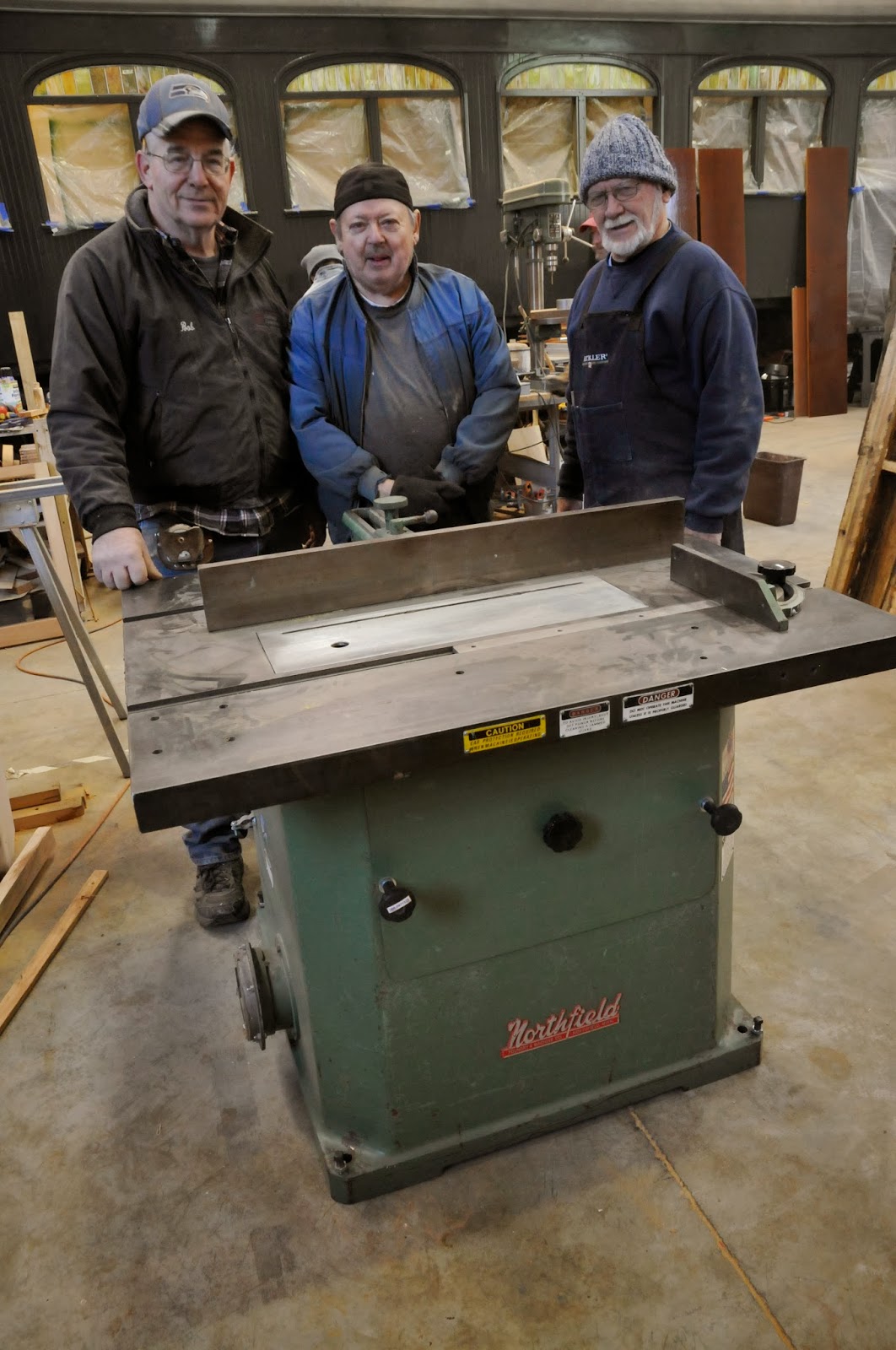
The Museum's "new" Northfield model 4
Many skilled professionals will agree: having the right tool for the task is worth at least half the effort.  And so it applies to railroad cars and locomotives, but the tools are a little bigger than most people are accustomed to. 

Recently, with funding from a heritage 4Culture fixed asset grant, the Northwest Railway Museum added a power feeder and large table saw to the tool inventory. These acquisitions improve safety and efficiency for collections care efforts performed in the Conservation and Restoration Center

The Museum purchased a Northfield model 4 table saw complete with a 7.5 HP motor.  The 1990s-vintage saw tips the scales at nearly 2,000 pounds and will accommodate a blade diameter up to 20 inches.  It was located in Kentucky and shipped to the Museum in November.

Bob models the new 1 HP power feeder

The Northfield model 4 remains in production today in their factory in Minnesota.  Parts are available and so is technical support.  A new model 4 retails today for more than $16,000; the Museum paid less than 1/3 of the new cost for its lightly-used model 4.  This newer and larger saw is more stable and will allow workers to rip thicker and harder wood than the saw is replaces, which was built in 1926 and weighs "only" a few hundred pounds.

A new Grizzly-brand power feeder now graces the spindle shaper table too.  The Museum’s Oliver shaper features a 5 HP motor and hand feeding of stock is incredibly dangerous.  The new power feeder has been sized for this application and is used to slowly feed wood into the cutter head.  It was recently used to shape the rails and stiles for new coach 218 windows.  The shaper is also used to shape the moldings used both inside and outside the coaches.

4Culture offers the fixed asset equipment program to arts and heritage organizations located in King County, and funds the awards with lodging tax revenue.  Sound systems, stage lighting, instruments, shelving, and image scanners are other examples of purchases funded by the program in King County-based museums and arts organizations. This recent award is the Northwest Railway Museum's first fixed asset grant.

Thank you 4Culture!