Friday, July 5, 2013
Thomas the Tank Engine arrives!
Monday, June 24, 2013
Winning the lottery?
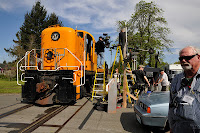
A film crew sets up the interior shot of
"Jim" operating his locomotive.
|
The commercial filmed at the Museum features "Jim," a character who wins the lottery and upgrades his HO scale locomotive to a full size model. Of course the real locomotive happens to be the Museum's locomotive 201, a model RSD-4 built by the American Locomotive Company in 1951 for Kennecott Copper. This 1,600 HP locomotive is similar to the once ubiquitous ALCO road switchers that operated on more than a dozen railroads in the Northwest. The bright orange behemoth was pulled by one of the Museum's Baldwin RS4TC locomotives, which was "removed" from the film in post production. An actor sat in the engineer's seat pretending to operate it. A home and garage were also added in during the post production process.
Locomotive 4012 pushed and pulled
the 201 but was rendered invisible
during post production.
|
Thanks go out to the many Museum volunteers that met or exceeded the client's expectations and made it all come together for a clever and amusing ad.
The commercial is now running on local television; watch for it!
Sunday, June 9, 2013
Coach 218 windows, part 2
Clerestory windows are a distinguishing feature of early 20th Century coaches. Obviously, these windows let light in but their primary function was - and is - to provide ventilation in an era before air conditioning, not to mention daily showers!
Coach 218 was built in 1912 and has 41 of these attractive windows. Rehabilitation and reinstallation of these windows is an important part of the coach's rehabilitation so that museum visitors traveling in the car will experience it like travelers did in the 1920s.
Dedicated volunteers repaired, rebuilt or recreated all the color glass glazing, which is set in zinc came and soldered together. In May and early June 2013 all 41 windows were reinstalled into coach 218. Rehabilitation and reinstallation took nearly 800 person hours of labor, a significant amount of it performed by volunteers!
The clerestory window hinges are unusual; the design dates from the 19th Century. They were produced by Dayton Manufacturing, the hardware manufacturer owned by the Barney and Smith Car Company in Dayton, Ohio. Later, similar hinges were produced by Adams and Westlake, a company that remains in business today. A few of those "replacement" hinges are in the car and were likely installed as a result of a broken hinge.
So another milestone is achieved. Rehabilitation of coach 218 is moving towards completion when it will enter service on the Museum's interpretive railway. Remaining work includes rehabilitation or repair of lower window sashes, exterior painting and lettering, metal work on end roof hoods, interior floor (maple) installation, interior paneling (mahogany) panel rehabilitation or replacement and installation, lighting and seating.
Coach 218 was built in 1912 and has 41 of these attractive windows. Rehabilitation and reinstallation of these windows is an important part of the coach's rehabilitation so that museum visitors traveling in the car will experience it like travelers did in the 1920s.
Dedicated volunteers repaired, rebuilt or recreated all the color glass glazing, which is set in zinc came and soldered together. In May and early June 2013 all 41 windows were reinstalled into coach 218. Rehabilitation and reinstallation took nearly 800 person hours of labor, a significant amount of it performed by volunteers!
The clerestory window hinges are unusual; the design dates from the 19th Century. They were produced by Dayton Manufacturing, the hardware manufacturer owned by the Barney and Smith Car Company in Dayton, Ohio. Later, similar hinges were produced by Adams and Westlake, a company that remains in business today. A few of those "replacement" hinges are in the car and were likely installed as a result of a broken hinge.
So another milestone is achieved. Rehabilitation of coach 218 is moving towards completion when it will enter service on the Museum's interpretive railway. Remaining work includes rehabilitation or repair of lower window sashes, exterior painting and lettering, metal work on end roof hoods, interior floor (maple) installation, interior paneling (mahogany) panel rehabilitation or replacement and installation, lighting and seating.
Clerestory windows
separate the lower and
upper clerestory.
|
Clerestory windows swing into the car.
|
Windows fit snuggly in the openings.
|
These windows have
unusual hinges made by
Dayton Manufacturing.
Each is custom fit for an
opening.
|
Flashing is formed and soldered under
and around each window opening to
keep the water out. Note the window
hinges, a segment that looks like part
of a wagon wheel, and a spring
housing.
|
Saturday, June 1, 2013
Chapel car photo opportunity
The chapel car 5 Messenger of Peace achieved substantial completion in April. This 1898-built mobile church has been under rehabilitation in the Museum's Conservation and Restoration Center ("CRC") beginning in February 2011.
In May, though a little dusty, the car was temporarily moved to the Train Shed to allow coach 218 to occupy track two in the CRC so it can have some of its new windows installed. Later this season the Messenger of Peace will return to the CRC for lettering. But on a beautiful sunny day in May just a few days short of the 115th anniversary of its dedication in Buffalo, New York, the chapel car posed for outdoor photos in Snoqualmie, Washington. And its first trip outside the CRC in over two years!
Monday, May 13, 2013
Chapel car organ plays on!
In March Spike reported on the acquisition of an organ for the chapel car 5 Messenger of Peace. In April Brian Tate and Wes Spore offered to rehabilitate the "new" organ by cleaning the reeds and repairing anything that wasn't quite right. Wes put many of the rehabilitative hours into the organ and in the end even replaced the bellows, the heart of a pump organ. The results are spectacular; check out the unique and awesome sound of this newly rehabilitated Estey pump organ!
The work that Wes has performed is truly remarkable. Although the organ was functional when it was acquired, his work has restored its brightness and clarity to how we believe it sounded when it was new over 125 years ago. His skill has prepared the organ for use during the chapel car's next 100 years!
Here is a brief description of some of the work Wes and Brian performed:
- Dismantle and blow out accumulated dust.
- Clean reeds (gentle brass brush) replacing one previously ruined.
- Remove and clean all pallets – no insect damage noted.
- Repair several wood/felt rod bearings.
- Redo cloth hinges on front wood swell and back swell (two inner and two outer)
- Rebuild Vox Humana – removing old cardboard from grooves in center stick and glue in new cardboard.
- Replace broken drawknob end and replace action rod wood yoke.
- New spring wire felt pads and two new spring wires.
- Repair damage to two white key tops (hole carved into two adjacent keys).
- Clean and remove old cloth from pump feeders and main bellows. Redo with new rubber cloth.
- Redo flapper valves and main gasket. (This consumed half the labor!)
- Rework under keyboard front middle panels for correct alignment and removal.
- Tune reeds that are out of tune with majority pitch (about 12).
- Test drive organ to discover any problems (usual couple of reeds sucking in dust and going silent; one reed slow to speak; otherwise working fine).
Thank you Wes Spore and Brian Tate!
Tuesday, April 30, 2013
Coach 218 windows, part 1
Bob McNall begins a
window installation
|
| Closeup of colored glass lights. |
Bob drives in large wood screws just
like the original car builders, except he
uses and electric drill and impact
screw driver.
|
Rehabilitation of the 218 is now underway in the Museum's Conservation and Restoration Center. The project is being supported in part by King County 4Culture and the Nysether Foundation. Substantial completion is planned for later in 2013.
Wednesday, March 27, 2013
Organ donor
Well, not quite, but at a price that felt like a donation!
"One (1) Estey reed organ, cottage or school house model, mahogany, circa 1885. Fully functional but missing one knob. $125." This is "pretty close" to the reed organ from the chapel car Messenger of Peace that the Estey Organ Company donated to the car in 1898, though the original was likely made from white oak.
Mr. Dennis Shadduck offered his family's Estey Organ for sale through Craig's List; supporters Jay S. and Brian T. helped keep the Museum informed of available organs on that service and elsewhere. So locating a suitable organ has been another important milestone towards completion of the Chapel Car 5 Messenger of Peace rehabilitation. Thank you Mr. Shadduck!
A "new" Estey organ arrived at the
Conservation and Restoration Center
on a warm March 27, 2013.
|
"One (1) Estey reed organ, cottage or school house model, mahogany, circa 1885. Fully functional but missing one knob. $125." This is "pretty close" to the reed organ from the chapel car Messenger of Peace that the Estey Organ Company donated to the car in 1898, though the original was likely made from white oak.
Mr. Dennis Shadduck offered his family's Estey Organ for sale through Craig's List; supporters Jay S. and Brian T. helped keep the Museum informed of available organs on that service and elsewhere. So locating a suitable organ has been another important milestone towards completion of the Chapel Car 5 Messenger of Peace rehabilitation. Thank you Mr. Shadduck!
Subscribe to:
Posts (Atom)