Tuesday, April 12, 2016

Enhancing Train Shed Programs

The Northwest Railway Museum recently completed and installed the Train Shed Tour Package Enhancement. This project, installed in time for the regular train season to kick off on April 2, was funded by a 4Culture Heritage Special Projects grant.

The grant funded improvements to the Tour Package program, but is actually benefiting everyone who rides the train since ~ new this season ~ almost all trains now stop and let passengers off for a visit to the Train Shed. Improvements include purchase and large format printing of historic images used to illustrate various pieces of rolling stock on display in the Train Shed. Curator Jessie Cunningham found images that showed the inside of freight and passenger cars to better illustrate the use of such cars. The grant also purchased easels for displaying the images as well as two voice boosters to help docents project their voices during the Tour Package.

The large format images have received a great response since the beginning of the season. The Tour Package is available on the 1st and 3rd Saturdays of each month, April thru October, at 12:30pm at the Snoqualmie Depot. The Tour Package includes a short Depot tour, train ride to the Train Shed (ahead of the general public riding the train), Docent tour of the Train Shed, and new this year, the Tour Package also includes a trip to the CRC to view the ongoing restoration projects! After re-boarding the train, participants enjoy a train ride to Snoqualmie Falls and back to Snoqualmie. The round trip program is 2.5 hours long and is great for train and history enthusiasts that are looking for a more educational or informative experience. Reservations can be made in the Depot Bookstore or by phone at 425/888-3030 x 7202.

For those who cannot take a train ride or the Tour Package, the images will be on display in the Snoqualmie Depot freight room within the next week. The Depot is open 10am to 5pm daily.

The Museum is grateful to 4Culture for supporting our programming with this Special Projects grant! 4Culture, the cultural services agency for King County, Washington is committed to making our region stronger by supporting citizens and groups who preserve our shared heritage, and create arts and cultural opportunities for residents and visitors. The Northwest Railway Museum has received a great deal of support and funding, both large and small, from 4Culture over the years.
Stock car unloading cows.


Crew relax inside their caboose.
 

Thursday, April 7, 2016

Not just a train ride anymore . . .

In its 49th year of public programs, the Northwest Railway Museum has made a significant change to its excursion railway operating plan.  Beginning in April 2016, all regular trains stop at the Train Shed Exhibit Building for passengers to take a self-guided tour.  It's not just a train ride anymore!

The Museum has been developing the Railway History Center campus for more than 10 years.  Located on Stone Quarry Road in Snoqualmie, the campus will feature all the Museum's critical facilities including visitor services, an exhibit hall, collection storage, and collection care.  Given the building permit, zoning, and public safety requirements, this is a multi million dollar development.  However, there is some great news: the initial development is nearing completion with the third phase now under construction.  So it's time to open the exhibit building to the public!

The new regular train schedule features a two hour excursion.  Passengers board in Snoqualmie, travel to North Bend, then return to the Railway History Center where they have an opportunity to detrain and take a self-guiding tour of the Train Shed Exhibit Building.  The 30 minute visit is an opportunity to see chapel car 5 Messenger of Peace, White River locomotive 1 and caboose 001, exhibits that detail how the railroad changed everything, and more.  Then, passengers entrain to continue their excursion to Snoqualmie Falls, and a return to the Snoqualmie Depot.  A similar schedule also departs the North Bend Depot.

Still want more??? Take the Train Shed Tour Package on the first and third Saturdays at 12:30 PM.  A docent-led tour will also include a visit to the Conservation and Restoration Center where you will learn about the rehabilitation of former Northern Pacific Railway steam locomotive 924.

Check out fares and schedules here on the Museum's web site.  Please note that the new operating schedule is in effect through October, but does not apply on Mother's Day or Father's Day weekends, or during Day Out With Thomas, Snoqualmie Railroad Days or Santa Train.  Visit the Northwest Railway Museum for a completely new experience, because it isn't just a train ride anymore!

Tuesday, March 29, 2016

Archive construction begins

An excavator clears away brush and
organic soil in preparation for GeoPier
piles.
On an unremarkable and cloudy day in March 2016, an excavator was delivered to the Railway History Center on Stone Quarry Road in Snoqualmie.  It attracted little notice from Mt. Si high school students, who sped along Stone Quarry Road in the parent's cars at their usual speeds, which rivaled those attained by Amtrak Cascades.  Yet the excavator was soon meaningfully changing the way the Northwest Railway Museum will operate in the future.  The excavator was on site to begin building a public parking lot, and to clear and grade the footprint for the new Railway Education Center ("REC"), the third building on the Railway History Center campus.

Railway Education Center rendering
developed by Miller|Hull.
The REC will be a modern building designed to appear similar to a train station, but using a modern architectural flavor developed by designers at the Miller|Hull Partnership. It is a project valued at nearly $3 million, and is moving to construction after a lengthy permitting process, and the time required to secure construction financing.  The general contractor is Kirtley-Cole, who is experienced in the construction of institutional buildings of this size. Construction began in earnest in mid March, and will hit its peak in early summer.  The project is scheduled to reach substantial completion in early fall 2016, but many uncontrollable factors including weather could affect the completion date.

Parking lot construction adjacent to
Stone Quarry Road begins to take
shape.
Fundamentally, it will be a tool to expand public access and improve preservation.  It will house essential facilities and services including public restrooms, admissions, and a small gift shop, but it will also incorporate an environmentally-controlled archival vault to preserve the Museum's irreplaceable collection of photographs, documents, and books that illustrate, interpret and document the railway history of the Pacific Northwest.  A reading room will be provided to allow students and other researchers to access the collection.  The collection lab will be used to process and conserve small objects and paper-based materials.  A classroom will provide for lectures, presentations, tours, and school groups to congregate and learn about regional railway history. 

First floor layout.  Library and archives
will be located on the second floor.
The REC is a facility that addresses needs first identified when the Museum was founded in 1957.  Its design has been under development for more than seven years; it is being constructed between the Conservation and Restoration Center (2007) and the Train Shed (2011). After completion, this new facility will allow the Railway History Campus to open to the public when there are no trains operating, which will allow the Museum to serve a broader and more diverse audience.  A lack of public restrooms, parking, and program offices are just three factors that have limited the Museum's ability to expand public access, but which this new facility addresses.

Major funding has been awarded for the REC by 4Culture, the Washington State Historical Society's Capital Heritage Fund, the Schwab Fund, major corporations including Puget Sound Energy and the BNSF Railway, and hundreds of individuals.  The Museum has additional support opportunities including the upcoming May 3rd Give BIg event (click on the link at www.trainmuseum.org), and  a live donate now link here.  Your support will help expand public access and improve preservation.
 

Monday, March 21, 2016

Tubing the 924

It has been a busy two weeks at the Conservation and Restoration Center with great progress shown in the rehabilitation of Northern Pacific Railway steam locomotive 924.

The last Blog article highlighted the work required to prepare the locomotive for its Federal Railroad Administration internal inspection and approval.  Now, the time had come for tubing the boiler.  Some may ask if this process is premature as the FRA mandates that the 15 year boiler clock begins one year after the first tube is placed or first fire, whichever comes first.  A great deal of work remains on NP 924, including a full running gear rebuild, and by committing to a tube job at this time, it means that completion must be reached within the next year otherwise federal boiler time is wasted.  Although this concern is valid, the rebuild of NP 924 is on an expedited timeline, with rehabilitation to service if not complete in one year, will be mostly so.

In order expedite the project, it was time to protect the internal surfaces of the pressure vessel from deterioration in service by the application of a product called Apexior, produced by Dampney.  Often referred to as a boiler paint, Apexior is actually a Bitumen coating that prevents rust, scale, and other unwanted byproducts from boiling water from forming or adhering to the interior sheets of the boiler.  An interesting fact about this product is that this same product has been continuously produced by the same company since the steam era on American railroads.  Therefore this product not only makes sense from an artifact care and investment standpoint, but also as a period-appropriate material and technique.  

At the same time as Apexior was being applied, the boiler tubes were being prepared for installation.  This process involved the removal of mill scale from the exterior and interior ends of the tubes.  By removing this oxide coating, the bare steel of the tube can be rolled into the hole in the tube sheets, assuring a tight seal with no contamination.  Following this step, the tubes were cut to length and ready to install.  Although the tube sheets in 924 were straightened as much as possible, any locomotive will exhibit variation in the lengths of various tubes.  The 238 tubes in locomotive 924 were no exception, which required every tube hole to be measured for length so that every single tube could be custom cut to fit.  

With tubes sitting at the ready, it was time to start inserting the tubes into the boiler.  This seems an easy task until one realizes the steam delivery pipes leading to the cylinders cover approximately 1/3rd of the front tube sheet, making simple insertion of many of the tubes impossible.  To complete this job, tubes had to be inserted through a hole near its final location in the front tube sheet, cross several holes over into the rear sheet, be pushed inside the front sheet, then manipulated with a bar to line up with the appropriate hole in the front sheet, then pushed forward into the hole.  Sometimes this had to be done several times to reach the final placement of a tube.

This task being completed, it was time to roll the tubes into the sheets. A tube roller, consists of three hardened steel rollers in a cage, driven by a central tapered pin.  This taper pin is rotated by an air motor which serves to expand the tube into the hole in the sheet, crushing it into the hole and forming a pressure tight seal.  The rolling process requires a great deal of judgment as it is possible to over-roll a tube and thin it to the point it would fail prematurely.  Many specialists in the steam locomotive rehabilitation field say the best rolled tube is the one that weeps just barely on its first hydrostatic test.

Although the seal formed by rolling is critical, it is not by any means the end of tubing a locomotive.  Structurally, the most important step is the next process known as beading.  Beading uses a special tool and small air hammer to roll the edge of the tube sticking out of the tube sheets over against the sheet.  This process turns every tube into a hollow rivet by forming a head that prevents the sheet from pushing off the rolled end of the tube.  This work is intensely physical, but makes for a much stronger product, and is historic.  Another important result of the beading process is that it makes the tubes much less prone to fire cracking and burning away of the steel.

Related to this prevention of fire cracking and burning, seal welding of the firebox end of the tubes is also critical.  The term "seal welding" is actually a bit of a misstatement as the weld is not intended to prevent leaking as the roll should provide adequate sealing.  Instead, a small weld is made around the circumference of the bead on the rear sheet in order to pull heat away from the thin tube, and allow it to flow into the much thicker tube sheet.  This prevents the tube ends from overheating and burning away or cracking to an even greater degree than just a bead alone.  In addition, this process was also historically used on steam locomotives, particularly on locomotives that burned oil rather than coal.
Following seal welding, the tubes are lightly rerolled front and back to assure the seal was not disturbed during the beading and welding processes, and then the job was complete!


Substantially completing the boiler work on locomotive 924 involved many facets.  First and foremost, funding was secured.  King County 4Culture awarded a Landmarks Capital grant to fund purchase of the new 2 inch boiler tubes, seal welding rod, and new staybolt material.  Second, an awesome team of volunteers performed much of the cleaning, cutting, and tube installation.  Third, Curator Pappas' pressure vessel skills allowed quick and efficient completion of the work, including the rolling, beading and welding.

The next task is to install the blast nozzle in the smoke box, and reapply the smoke box front. After this, the running gear rebuild will begin.  So stay tuned for another update!


--Photos in this post by Dave Honan and Spike.  Used with permission.

Friday, March 18, 2016

One Mallet too many

Locomotive 108 at the Snoqualmie
Depot.
Responsibly managing a museum collection means that some artifacts are added to the collection and at other times they are removed.  In short, the Collection changes to meet the needs of the institution and its Mission.

At the Northwest Railway Museum two of the criteria used to evaluate the collection are support of the Mission and redundancy.  A decade ago, a number of large artifacts including an electric locomotive from Utah, a coach from the Midwest, and a steam locomotive from California were deaccessioned (removed) from the Collection.  However, the process of evaluating the collection continues every day.

For more than 40 years, the Museum has had custody or ownership of three Mallet-type 2-6-6-2 steam locomotives.  All three have a great deal in common: they operated in the Pacific Northwest; were built within a few years of each other, by the Baldwin Locomotive Works; are nearly identical in design and size; illustrate the same narrative (they tell the same story); and each require tremendous resources to properly care for.  With those facts, the Museum Board of Trustees and Staff reached a consensus to deaccession one 2-6-6-2 Mallet steam locomotive.  So which one?

The Museum's Trustees
required insulation to be
removed before the l08
could leave the property.
The 108 was chosen as the locomotive to deaccession.  The 108 was built in 1926 and served the Weyerhaeuser Timber Company until 1954.  It is a tank engine (think Thomas the Tank Engine!) and aside from a tender, locomotive 6 (one of the other Mallets in the Museum collection) is nearly identical.  (Locomotive 11 is also a 2-6-6-2 Mallet. It is a slightly different design, and is a tank engine converted to a tender engine.  It is owned by Washington State Parks under the curatorship of the Northwest Railway Museum.  It remains on exhibit at the Snoqualmie Depot.)


Locomotive 108 was prepared for shipping
at the Museum's Conservation and
Restoration Center.
As luck would have it, another heritage railway operates a locomotive nearly identical to locomotive 108.  The Black Hills Central Railroad in Hill City and Keystone, South Dakota operates their 2-6-6-2T steam locomotive 110 in daily service on a more than 4% grade.  Their long term plan called for acquisition of a second similar locomotive to allow for expansion, and better operational
coverage in the event of a mechanical problem or other issue.  So the stage was set for an appropriate and welcome change in ownership that would assure a bright future for this valuable museum artifact.  


Locomotive 108's boiler hoisted onto
a truck for the 20 hour journey to Hill
City, South Dakota.
Speaking with Black Hills Central President Meg Warder shortly after a deal was reached stated, "the Black Hills Central Railroad ... is honored to have the opportunity to [acquire] and restore the Weyerhaeuser Timber Co #108 Baldwin from the Northwest Railway Museum.  Our knowledgeable and dedicated crew will restore the engine back to its glory with the intention of having the engine in service by 2018.  The #108 engine will proudly work alongside the BHCRR’s restored #110 Mallet,  the current powerhouse of the Black Hills line."

 
The rear steam engine hoisted onto a
truck bound for the Black Hills Central.
 
Speaking while the loading process was underway, Northwest Railway Museum Executive Director Richard Anderson stated, "museum collections are dynamic and their size and scope must reflect the institution's available resources to care for it.  We are delighted to have found a successful heritage railway willing to take on the massive undertaking of rehabilitating, restoring and operating this impressive historical artifact."


Monday, February 29, 2016

Finance and administration on track too

There are many facets to a successful and sustainable railway museum.  Rarely seen but always felt are the results of successful finance and administration efforts.  This week provided a excellent illustration when the Northwest Railway Museum closed on a tax exempt bond issued by the Washington State Housing Finance Commission.  The once-in-four-years opportunity closed February 29, 2016.

Building the Railway History Center in Snoqualmie has been a monumental effort for an organization the size of the Northwest Railway Museum.  There is now more than 33,000 square feet of indoor exhibit, collection storage, and collection care space.  And another 5,000 square feet will be under construction in a few short weeks., which will provide public restrooms, a classroom, an archival vault, collection lab, admissions and program offices.  All of this is the result of tens of thousands of volunteer hours, thousands of full time staff hours, and an investment of millions of dollars, most of it donated to the cause.  However, some of the infrastructure has eluded even the best fund raising efforts.  Fortunately, the Museum found a viable alternative.

Washington State has a tax exempt bond program that was created for low income and below market rate housing, and for community facilities such as hospitals, and even history museums.  After a months long process, Pacific Continental Bank of Eugene, Oregon has purchased a tax exempt bond from the Washington State Housing Finance Commission.  (Pacific Continental is a regional bank that specializes in banking services for non profit corporations.  They have a branch in Bellevue, Washington too.) Proceeds of this 25 year bond are underwriting current and future infrastructure needs including the city water main extension to the site, the force sewer main that stretches more than 1/2 mile into Snoqualmie, a parking lot, and more.  The interest rate is similar to a jumbo home mortgage, and provides long term financial stability for the Museum.  Now the Museum can focus on the next phase of construction: let the digging begin!

Tuesday, February 16, 2016

Under the Dome and more

The New Year is off to a blazing start at the Northwest Railway Museum!  Already, significant progress has been achieved on Northern Pacific Railway steam locomotive 924 with substantial completion of some major boiler work and, thanks to new funding from the Emery Rail Heritage Trust, has included pretty much everything under the dome... 

The key to any successful steam locomotive rehabilitation is quality work done to exacting standards, particularly in the realm of the pressure vessel (boiler) and running gear.  No locomotive will operate properly or safely if these areas are not completely and adequately examined, rebuilt, and maintained in service. 

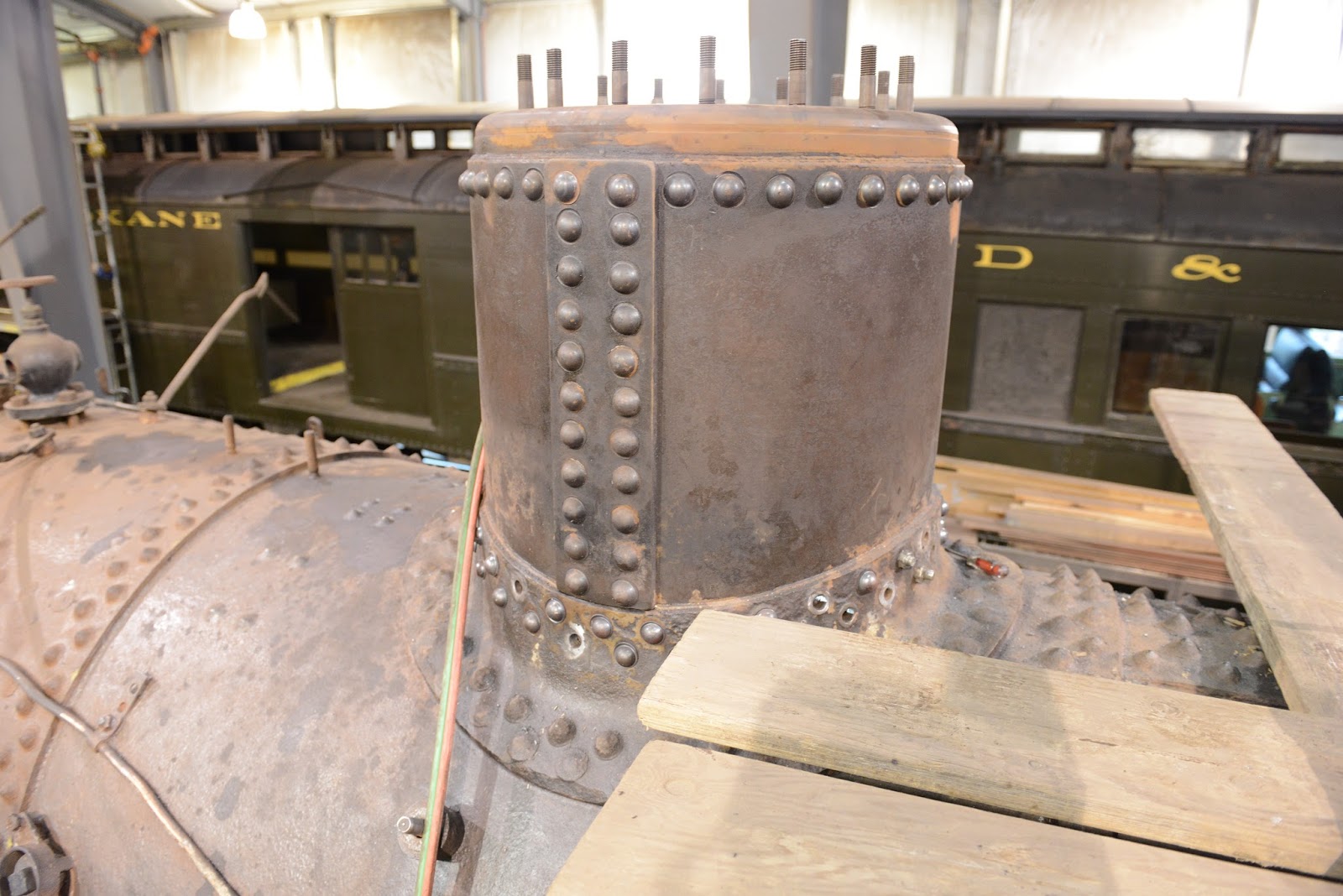
The pressure vessel on NP 924 was by no means in good condition for an easy return to service, and as previous blog postings have noted, new firebox side sheets had to be installed, as well as a new steam dome.  In particular, the new steam dome construction involved an alteration of the original design in order to assure safety in operation.  The original design employed a longitudinal lap seam where the flat plat the dome was rolled from overlapped slightly and was held via rivets.  This design of joint induces nonlinear stresses that degrade the sheet material adjacent to the joint, and if not properly monitored can lead to potentially catastrophic failure. 

The original dome exhibited signs of degradation such as cracking and rivet shearing, indicating the original design was not ideal.  In order to rectify this situation, a new dome was built employing riveted buttstrap construction of the longitudinal joint.  A buttstrap joint has the rolled round of the barrel butt together for the longitudinal seam, and employs plates inside and out with rivets through all three on either side of the seam.  This design is far superior and does not impart any non linear forces in the plates other than hoop tension.  In order to accomplish this repair, the joint efficiency needed to be calculated so as to assure a safety factor of at least four times.  In the final analysis, the safety factor was found to be over seven times, assuring a long life of service ahead.  After the design process was completed, the Federal Railroad Administration (FRA) in Washington DC had to approve the alteration and engineering so as to assure public safety.  This step completed, and using funding awarded by the Emery Rail Heritage Trust, construction of the dome was able to progress unfettered. 

At least until appropriate rivet material could not be sourced.  Fabricating the dome and readying it for installation on the boiler was accomplished with appropriate boiler rivets from a local source.  However, the smaller ¾” rivets that would secure the dome to the flange on the back of the barrel could not be acquired.  The steel used for pressure vessel riveting is made to a specification called ASTM A31 Grade B (or A31b for brevity), which is an extremely ductile, low carbon steel.  In searching for a cost reasonable source, it became clear that proper materials for steam locomotive construction continue to get harder to find.  Luckily, the Museum’s curator Pappas had a small stash of A31b bar, and through the construction of a rivet jig, new rivets could be formed in house at the Museum using material of the correct specification.  Once this task was completed, the dome was riveted on and ready for service. 

Following this task, part of the longitudinal seam on the first barrel course was in need of work.  The sand dome had collected water beneath it and extensively corroded the outer welt strip of the buttstrap joint.  This welt strip needed partial replacement, as well and replacement of 22 rivets, and a small pad weld on each side of the seam.  Pad welding is compliant with the regulations, but must be conducted to a national standard.  The areas in question were small enough that they did not require prior approval, but the process was still communicated to the regulatory authorities prior to undertaking the work. 
 
Pad welding was conducted by curator Pappas, who holds 6g welding certification, and following appropriate National Board Inspection Code (NBIC) procedures so as to eliminate internal stresses from the welding process.  The work was then radiographed (x-rayed) and proven to be clean and free from all defects.  Following this, a new welt strip patch was welded into the seam, and new rivets installed. 
 
As noted above, the large rivets needed for the seam were difficult to source so these were also manufactured in house of A31b.  The installation of these rivets was doubly difficult in that they had to be inserted from the inside of the boiler, backed with an air buck, and the formed head driven on the outside with an air hammer.  This may not seem overly difficult, until one realizes the delivery pipe from the throttle runs directly under this seam, only three inches from where the final rivet heads would be!  Through the creation of specialized tooling, and a large influx of enthusiastic volunteer labor, the Museum’s team was up to the task, and the riveting was completed in one day. 

FRA inspectors
Brandon, Gary (ret.),
and Zack check out
the 924.
After this step, the next task was to bring in the local FRA inspectors to review the work and inspect the interior of the boiler, which must be done prior to the installation of fire tubes.  To get ready for this step, the interior of the barrel was cleaned to bare metal, tube sheets straightened and dye penetrant tested to check for cracking, and tube holes polished.  Our work passed the FRA’s stringent standards with flying colors and was approved for completion of the tube job. 

Let it be reiterated that boiler work such as this is not to be undertaken lightly, and the importance of the public’s safety is always first priority when undertaking pressure vessel work.  Stay tuned for the next installment in the continuing rehabilitation of Northern Pacific Railway steam locomotive 924: tubing!