Tuesday, December 30, 2014

Steam begins to simmer

Museum's Curator of Collections peers
from the 924's firebox door opening.
Rehabilitation of locomotive 924 is underway!  Some important progress has already been achieved with significant and positive news emerging since bringing the locomotive into the Conservation and Restoration Center this past fall. 

Inside the boiler barrel, scale is removed
from the inside of the tube sheet.
The first objective was to inspect the inside of the boiler, which required the boiler tubes to be removed.  To allow for tube removal, some other appliances and components had to be removed first including the master mechanic’s front end (helps direct exhaust and improve combustion), smoke box front, steam dome lid, and throttle valve.  Once that work was completed, then all the boiler tubes were removed to allow scaling and inspection of the boiler barrel interior.  The process has yielded some wonderful news: the inside of the barrel is in great shape.  Some of the witness marks used to lay out the rear tube sheet can still be seen!

Boiler sheet thickness measurements
were entered directly into a spreadsheet.
With a clean boiler barrel and access to the firebox, the team measured the thickness of the boiler sheets using an ultrasonic thickness tester.  Measurements were taken along a grid and provided data that was entered into a spreadsheet, which performed preliminary "form 4" boiler calculations.  The form 4 is what the Federal Railroad Administration uses to evaluate a request for approval to operate a locomotive boiler, and at this point in the project it represents a sort of acid test as to whether an historic locomotive is feasible to rehabilitate.  And the 924 successfully buffered the acid: preliminary calculations suggest an operating pressure of approximately 170 pounds per square inches, and without any major boiler work, provided there are no serious issues on the exterior.

A Federal Railroad Administration
inspector examines the 924's firebox.
During the annual inspection of SCPC 2, inspectors from the Federal Railroad Administration were able to make a brief visit to the 924.  They reviewed the initial work plan and looked inside the firebox.  Ensuring the Federal inspectors remain apprised of the work plan and progress is also an important part of the project.

An area of firebox side
sheet is being removed
to allow for replacement.
Certainly there is work to perform on the boiler that is desirable and will help ensure a full 1472 days of operation before the operating approval expires.  One area of attention involves the side sheets inside the firebox.  This area received some type of repair many decades ago, and the repair was performed with gas welding.  Today, such repairs are generally performed with electric welding and to ensure the integrity of the vessel, the old repair is being removed and replaced with a new patch.  this process will also require the stay bolts restraining this area to be replaced, in all numbering about 200 items.

So as 2014 draws to a close, the 1899-built locomotive 924 has a wonderful New Year to look forward to, and your support can ensure that the work continues!  Please consider a tax-deductible contribution to the "steam program campaign". All contributions will be used to rehabilitate and restore locomotive 924.


Cutting around stay bolts in the firebox side sheet.


Wednesday, December 24, 2014

Successful Santa Train 2014

Last Saturday, the Northwest Railway Museum wrapped up a successful Santa Train, an event that was first hosted in 1969.  Reflecting on the eight-day event, 11,200 guests were served, more than 24,000 cookies were baked, about 320 gallons of hot cocoa were prepared, and 40 gallons of coffee were brewed.  This year's event also featured the first steam-powered Santa Train in 25 years.  In all, this was the largest Santa Train by numbers served, with 500 more guests than the previous record.

Many thanks are in order.  First and foremost, to the 61 volunteers that contributed time and talent to running the event and making it successful.  Volunteers put up seasonal decorations, served as Santa's helpers, addressed any problems as they occurred, served on the train crew, baked cookies, served the refreshments, helped in the gift shop, cleaned up garbage, and helped direct guests to Santa and the kitchen car.

Thanks are also in order to the many Museum supporters.  Many thanks to Continental Mills who donated Krusteaz cookie dough to the event; to the many media partners who helped spread the word; the City of Snoqualmie parks staff who helped clean the restrooms in the Snoqualmie Depot; the Si View Park District who maintained the restrooms in the North Bend Depot; the Snoqualmie Valley Chamber of Commerce staff who helped publicize the event and host the ice rink for several days in downtown Snoqualmie; 4Culture and City of Snoqualmie who provided sustained support grants to the Museum using lodging taxes collected at the Salish Lodge and Spa, and hotels and motels across King County; and last but certainly not least, anyone who helped support the event who Spike has inadvertently omitted from this important list.

There are also thanks owed to the Museum's Board of Trustees who provide the governance and oversight that allow this event to continue, to the part and full-time staff who work additional hours to ensure the event operated smoothly (even helping clean the restrooms!), and especially to the two very talented Santa actors and their two elf actors!

And thanks to all the guests who purchased tickets, enjoyed the event, and made all the other efforts worthwhile!

Seasons Greetings from all of us at the Northwest Railway Museum.

Saturday, December 20, 2014

Steam Santa Train

In another important 2014 development for the Northwest Railway Museum, the first steam-powered Santa Train since 1989 operated on December 19, 2014.  The Santa Cruz Portland Cement 2 pulled sold-out four-car trains from North Bend to Snoqualmie where passengers disembarked to visit with Santa and receive refreshments prepared inside the railway kitchen car.  The SCPC 2 is owned by the Museum's curator and is helping train volunteers in preparation for a permanent steam program.  While not indigenous to the Northwest, the SCPC 2 is an excellent example of a small steam locomotive and is a powerful tool for interpreting steam locomotive operation.
 
Steam Santa Train was quite popular and successful  More than 1,200 people made the journey on December 19, and younger visitors who still believe received a small gift from Santa, which this year was an LED flashlight.  The day closed without incident and will likely be repeated in 2015 - check out the steam-centric photos of the event below!

Steam Santa Train departs from the North Bend Depot and travels to
Snoqualmie where the Santa experience takes place.

Periods of sunshine brightened the day, but crisp air allowed escaping steam
to persist making the event feel rather ethereal.

Santa Train has a tight schedule: the train completes a run every sixty minutes.

To maintain the schedule, a water truck topped up the water in North Bend at
the end of each run.

The SCPC 2 was very popular with the visiting public and crowds quickly
gathered after each arrival.

Steam Santa Train included a very rare 4:00 departure, which meant nearly
the entire experience occurred after sunset.

Heading up the coach consist was the newly-rehabilitated SP&S 218, a wood
coach built by Barney and Smith in 1912.
 
There is something truly magical about a steam locomotive operating after
sunset!

Friday, December 19, 2014

Happy Holidays!

From right to left, Gary, shipwright;
Peggy, marketing; Cristy, registrar 
and volunteer coordinator; Jessie,
deputy director; Jennifer, bookkeeper;
Stathi, curator of collections; James,
visitor services; Richard, director.
The museum staff got together this week to reflect on another successful year for the Museum.  Most importantly, the Museum served more than 120,000 visitors on the train, in the depot, on a tour, or in a classroom.  To advance the cause, a number of important projects were completed.  The first steam in 25 years, completion of coach 218 rehabilitation, major work on bridge 35, reconstruction of track at Snoqualmie Falls near the Snoqualmie Falls Depot, completion of a new exhibit "The Railroad built the Northwest," and completing design and securing permits for the new restrooms, classroom, and library at the Railway History Center were just a few of the year's highlights. 

How was all this possible? The generous support of local agencies, individuals, foundations, local and state government, business, more than 14,000 hours from 137 volunteers, and the governance of an engaged and supportive Board of Trustees of 11 people.  A lot goes into running a successful museum!

From all of us to all of you, thank you for your continued interest and support, and Happy Holidays!

Wednesday, November 26, 2014

Gearing up locomotives for Santa Train!

Santa Train is the Northwest Railway Museum's annual family event held after Thanksgiving.  First hosted in 1969, this seasonal excursion has become a tradition for thousands of Northwest families.

Locomotive 4012 as it arrived in 2000.
4012 was acquired from the Yakima.
While preparing for this year's event, an engine crew caught locomotive 4012 being a little too much in the spirit of the season: it was a emitting a sound strangely similar to the Ghost of Christmas Past from Dickens' A Christmas Carol.  The 4012 is a 1953-built Baldwin-Lima-Hamilton RS4-TC that has operated for the Museum for many years.  It has been a very reliable locomotive and has rarely been out of service.  A quick assessment found that the culprit was the engine cooling fan, which had suffered a partial failure.

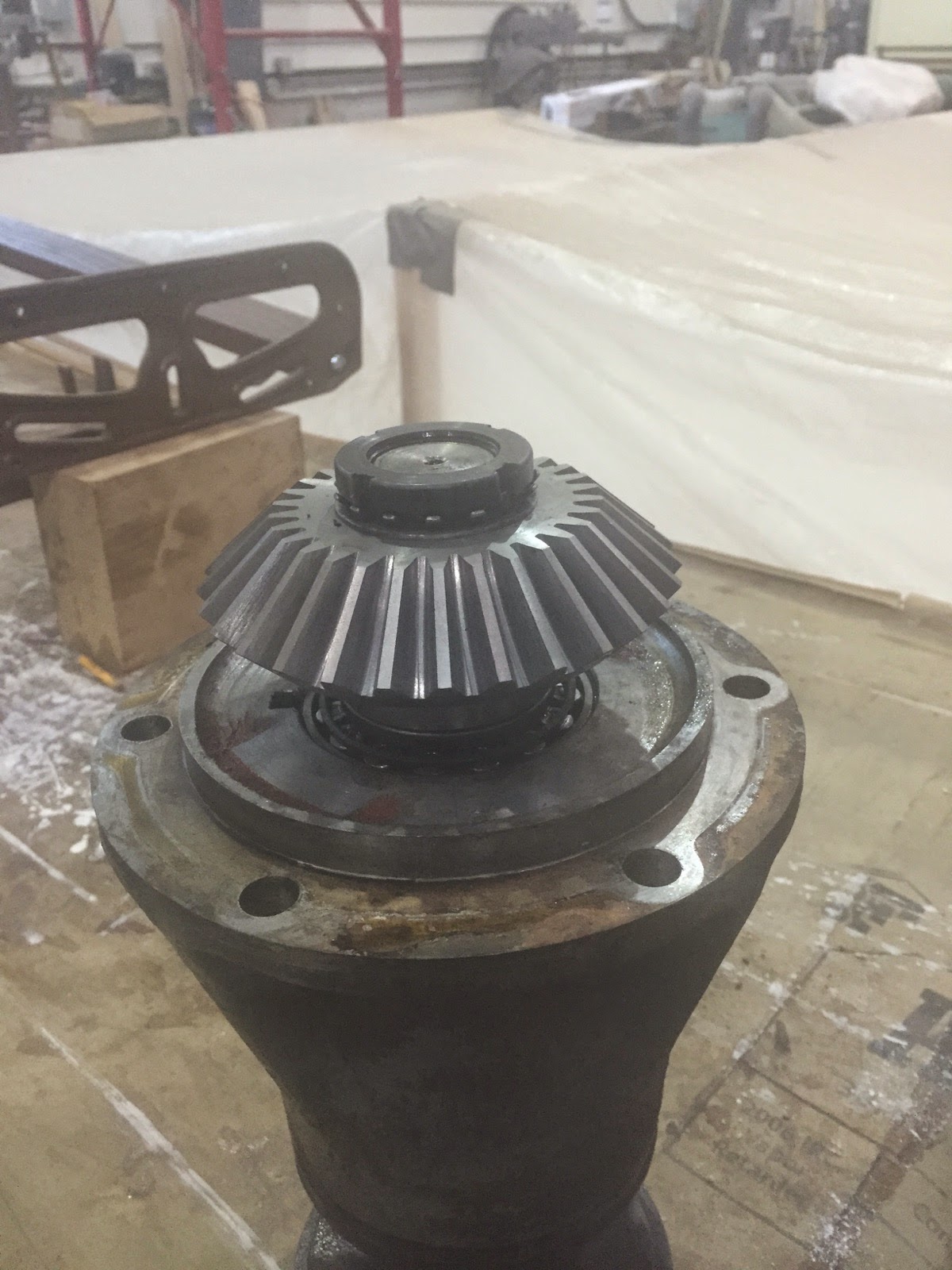
The cooling fan is an important part of any diesel engine.  On the 4012, it is powered with the diesel engine by coupling a universal joint to the end of the engine driveshaft.  The universal transmits power to an angle drive and the cast aluminum blades are mounted directly on top. The speed of the fan is directly proportional to the speed of the diesel engine.  

After the fan drive was disassembled, the problem was evident: a number of gear teeth had stripped off one of the miter gears.  So each rotation of the shaft caused the gear to slip, which also damaged the universal joint.  If left unchecked, continued use would have stripped all the teeth off the gear and resulted in an overheated diesel.

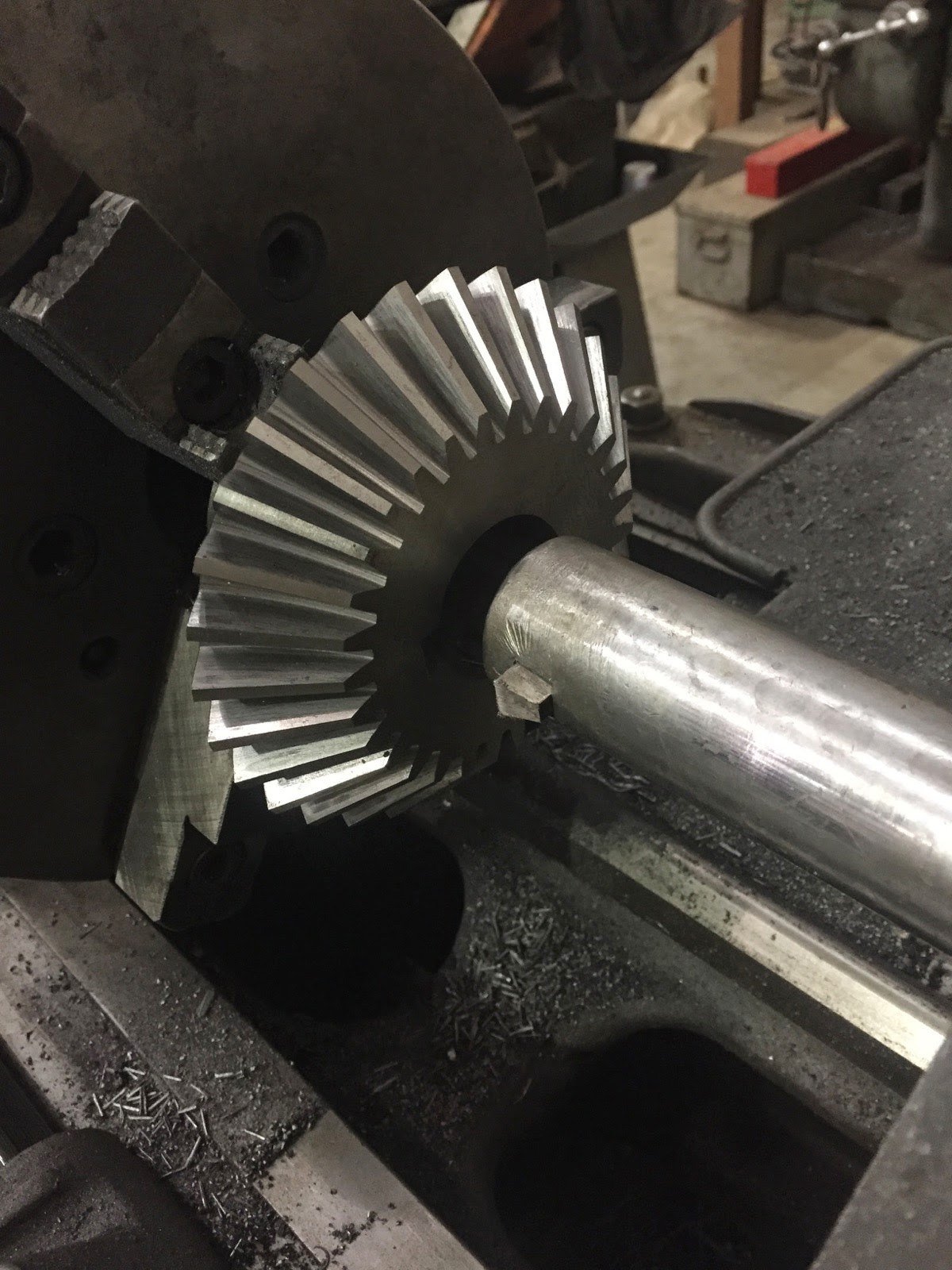
Broaching a keyway.
Fortunately, an identical  6 diametrical pitch, 30 tooth, 45 degree miter gear with a 20 degree pressure angle was available from a gear manufacturer.  Unfortunately, the bore was too small for the existing driveshaft.  So Curator Pappas has his work cut out for him.

Gear mounted on shaft.
Using the Museum's Monarch engine lathe, the bore was enlarged.  The second step was broaching a keyway in the bore to engage the key present in the shaft to assure power transmission rather than slipping.  Rather than purchase an expensive broaching set or contracting this work out, this was handily achieved by grinding a broaching single point tool and running it on a boring bar by hand with the lathe carriage.  This yielded a perfect keyway that needed no hand fitting.  The final step was facing the hub of the bear so as to set the lash.  The gear pressed on the shaft with no problems and the gearbox has been reassembled.

A test run of the 4012 quickly established that everything was correctly fitted.  Now locomotive 4012 is ready to pull nine days of regular Santa Train 2014 to North Bend, and to support steam locomotive SCPC 2 on the special Friday, December 19 Steam Santa Train. 


Friday, November 14, 2014

Exhibit companion website launched

The Museum has launched the companion website of the new exhibit: Railroads Built the Pacific Northwest. The exhibit is a free-standing display of 4 double-sided interlocking panels highlighting early passenger and freight service in the PNW. The companion website features content and images from the exhibit, plus a little extra that didn't fit into the panels!

The exhibit was designed by the Webb Group and fabricated by Artcraft Display Graphics Inc. Deputy Director Jessie Cunningham curated the exhibit, which included content development and image selection. Images came from either the Museum’s collection or were purchased from other local sources including Snoqualmie Valley Historical Museum and UW Special Collections. The Museum is excited to offer the companion webpage, since it makes the exhibit accessible to those that cannot travel to the Museum to see the exhibit in person.

The display, Railroads Built the Pacific Northwest, is the Phase 2 exhibit for the Train Shed Exhibit Building. The exhibit will be stored during Santa Train but may be in the freight room over the winter. It will be installed in the Train Shed next spring along with the Phase 1 exhibit. Tour Package program participants will have more to see and experience in 2015!

The exhibit was made possible with generous grants from 4Culture and Humanities Washington.


All images from the Northwest Railway Museum Collection.


Tuesday, November 11, 2014

Happy Birthday, Washington State — remix


Five years ago, we took credit on these pages for Washington State's 120th birthday. Well, we won't do that again.

Instead, we'll take credit for its quasquicentennial!

We said it then and we'll say it again: it was no coincidence that railroad builder D. H. Gilman signed this Seattle, Lake Shore and Eastern Railway Company stock certificate in 1888, and that U.S. President Benjamin Harrison signed Proclamation 294 admitting Washington into the Union the following year.

SLSE stock certificate
Today, we think the pace of life has rapidly increased with electronics, computers, smartphones — instant this and instant that. And so it has. But that's just what it felt like as the final decades of the 19th Century hurtled toward the 20th. The railroad turned a laborious multi-day journey from Seattle to Snoqualmie into a picnic. Literally. An excursion to Snoqualmie Falls became a recreational day trip. And folks in Snoqualmie? Whatever they wanted could be brought in by rail. Quickly. Life was transformed. So resist that sleepy historic town stereotype and let the flavor and flourish of those days swirl around you. The Depot and other wood buildings from the period can help you picture it.

President Benjamin Harrison
President Harrison. Courtesy FCIT.
Trains have operated out of the Snoqualmie Depot — the same building — since 1890. The sound of our footfalls may be different without lace-up boots and hard heels. But the creak of the boards would be familiar to those who stepped across the platform and into the ladies' waiting room to purchase their tickets. Incidentally, lengths of rail currently in front and back of the Depot pre-date the building. So if you step over the track to get to the platform, you may touch the very rail that was here when President Harrison signed that proclamation on November 11, 1889.

What else was here then? The two-story building behind the Depot was built not long after — in 1902 — for the Modern Woodmen's fraternal organization. Across King Street, the tavern is the original first floor of a two-story hotel built in 1910.

Across the main street from the Depot, at 8096 Railroad Avenue, another wood building harbors stories of Snoqualmie dating from 1909. And not much more than a block away at the corner of River Street and Falls Avenue, the hip roof porch and posts are among the features that maintain the historical appearance of another 1909 building, although additions and changes have been made to the structure since its original construction for Reinig Brothers General Merchandise.

Snoqualmie 1897. Northwest Railway Museum Collection.
Is the Snoqualmie of today — a main row of businesses facing the Depot, with additional enterprises peppered around neighboring streets, all in the shadow of Mount Si — so very different from the Snoqualmie shown here in 1897? The Depot-centered activity that greeted Washington's birth as a state has its echoes in activity surrounding the Depot today. More than 1,000 people rode the train during the last weekend of October. And the Northwest Railway Museum recently launched a steam program. So when you board the newly rehabilitated coach 218 with its mahogany paneling and mohair-covered seats, you might have an opportunity to ride in the wake of a steam locomotive. Just like the passengers who looked out those coach windows when the State of Washington was just a whippersnapper.

Santa Cruz Portland Cement 2 pulling coach 218
Santa Cruz Portland Cement 2 pulls coach 218 in 2014.