Showing posts with label maintenance of way. Show all posts

Tuesday, June 21, 2022

Electromatic Mk II

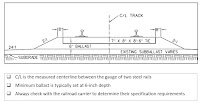
Typical track cross section
The basis of any good railroad is track, which consist of rails supported by ties held in place by ballast.  Unlike roads and highways, when track settles the original profile can be restored by jacking and tamping ballast under the ties to hold them in position.  This is an advantage that railroads have over highways, but track is also less forgiving and failure to maintain profile may result in a derailment.  So whether it is an Amtrak Cascades train or a Northwest Railway Museum steam train, the ability to maintain the track profile is important.

Jackson Jr Tamper from the 
Northern Pacific Railway
For more than 40 years, the Museum has maintained its track with a Jackson Junior Tamper, a unit first delivered to the Northern Pacific Railway in the early 1950s.  After about 70 years of service, the Junior Tamper has become difficult to maintain in operation.  In short, the correct replacement parts are no longer available.

The Museum's new tamper
arrived on a truck designed 
for moving rail equipment.

The Museum has been searching for a new tamper for several years and the right opportunity arrived in late May 2022: a machine used in Sioux Falls, South Dakota on the BNSF Railway.  It was completely rebuilt in 2012 and has just 691 hours of service since that rebuilding. It was purchased through Maintenance of Way Equipment Services in Houston, Texas, but was sold "as is" in South Dakota.

The tamper was carefully rolled
off the truck under its own powe
r
The new tamper arrived at the Museum on Wednesday, June 15.  As expected , there were several minor issues: machines are not usually retired in perfect working order.  Some electrical wires were eaten by mice.  There was debris in the fuel tank.  Several switches were dirty or worn and not functioning correctly.  However, the machine was in very good shape overall and after a few hours of work is functional.

A turntable feature allows the
tamper to be jacked and rotated 
180 degrees.
The tamper is a Canron/Tamper Electromatic Mark II ES originally manufactured in 1983 for the Burlington Northern Railroad.  In 2012 it was remanufactured by the BNSF Railway at Brainard, Minnesota to bring it back to original specifications, and to upgrade components that were obsolete.  It features adjustable workheads for tamping turnouts (switches), and a turntable to allow the machine to operate effectively in both directions.  Notably, it features something not yet invented when the old Jackson was produced: the hydraulic squeeze to help consolidate ballast under each tie.  

The model ES features adjustable
work heads for tamping switches
The Mark II has already been out tamping track and is a welcome addition to the collection of maintenance equipment.  While not yet historic, it will help ensure the Museum's heritage railway remains in operation for years to come.

Monday, February 25, 2013

Main Street crossing reconstruction

"We've been working on the railroad" and there is another new highway crossing to show for! 


Railroad crossings represent one of the bigger funding challenges for the Northwest Railway Museum.  With a total of 18 roadway crossings, the Museum devotes significant resources towards maintenance and reconstruction.  This latest project cost was in excess of $51,000 and replaced a double track crossing in downtown North Bend, which was required to continued operating trains into the North Bend Depot.


Concrete panels arrive and await
installation on Main Street as an
excavator sets the grade.
Main Street was last reconstructed in 1988.  Normally, a new double track crossing of that size would have cost over $100,000 and there was no funding to perform work on that scale.  Fortunately, the Museum was able to leverage several opportunities to make the project viable.

The Museum learned about a small track removal project in the City of Redmond, about 20 miles from the Museum.  There, two concrete tub crossings that were installed in 1997 were being removed to allow installation of a new sewer.  Often, used tub crossings are scrapped because they are difficult to remove without damage.  So with little commercial value, the City of Redmond was able to donate the panels to the Museum.  In the end, of the 70 panels removed, 40 were reclaimed, repaired and reused.  This “saved” the Museum over $35,000 versus the cost of new crossing tubs.
The new crossing takes shape on Main
Street in North Bend.  Concrete tubs
eliminate the use of railroad ties in the
crossing.
 
The Museum was able to secure a grant from the Washington Utilities and Transportation Commission (“WUTC”).  The WUTC is one of the agencies that provide regulatory oversight of the Museum’s railway.   They maintain a Grade Crossing Protective Fund, which awarded a $20,000 grant towards the cost of new welded rail and its installation. 

Other important project support came from the City of North Bend, which provided all the traffic control required to close the road and detour traffic, and forgave three years of user fees for the North Bend Depot for a combined benefit of over $11,000.
The crossing has been completed; it opened as soon as the
asphalt cooled.

And the Museum was able to secure some relay rail for the side track (new rail was used on the main).  As well, the Museum's dedicated volunteers were able to perform the required repairs on the used crossing panels.

The project allowed for six days of construction but it was completed in less than five.  RailWorks Track Systems, Asphalt by George, and Snoqualmie's Imhoff Contractor Crane Service performed the balance of the work. 

Thursday, April 5, 2012

Trains are running again!

The Jackson tamper was introduced in
the 1950s on the Northern Pacific
Railway and continues in a new role
at the Northwest Railway Museum.
It has been an unusually long winter in the Northwest but spring weather has finally arrived.  Track machines and crews have been working on the railroad and trains are running again between North Bend and Snoqualmie Falls.  Check out this season’s schedule here; regular trains are operating on Saturday and Sunday through the end of October.

Vibrating work heads pack ballast
(rock) under the ties.
There are many aspects to a operating a railroad that are not apparent to the casual observer. Whether historic or contemporary, railroads have a right of way to maintain and it is a significant responsibility that consumes the majority of a railroad's resources. Bridges are "big ticket" items but even the ubiquitous tie (at the Museum there are more than 3,000 per mile) are valued at more than $100 each to purchase and install.  Signals and railroad crossings also require significant resources to inspect and maintain in compliance with Federal regulations.

A hyrail excavator from RailWorks
installs a new stringer in one of the
Museum's bridges.  Each timber is
9 inches x 18 inches and can be over
30 feet long.
Over the winter, volunteer and community work crews changed more than 150 ties and tamped them, performed maintenance along the right of way including brush cutting, and performed annual, periodic and monthly maintenance on signals. Bridges were inspected and bridge maintenance performed. In addition, the locomotives were check out, oiled and fueled.  Coaches had minor repairs and were cleaned. Now the Museum is ready for an estimated 50,000 guests who are expected to ride the railroad this year.  Come up and visit this weekend and take a trip back in time!

Monday, November 9, 2009

More on regulation

Ballast regulation that is.

Progress on rehabilitation of the Museum’s Kershaw ballast regulator was featured in an August post and the project is nearing completion. By November 6, Rich W. completed rewiring. He installed new switches, wires, a new battery, and a battery isolation switch. Additional work was performed by Brandon C.

Rich also applied all new flood lights, a new fan for the cab, and new ignition wires. Later in November, new sealed window units will be installed and a new cab heater too. The hood and wings will be reattached and the project will be all but complete.

Also noteworthy this month was receiving correspondence from Knox Kershaw of the Knox Kershaw Company. He shared with Museum staff how he remembers in 1965 seeing models just like the Museum’s regulator being assembled on the factory floor. He expressed how delighted he was to see photos of the Museum’s regulator from the August Blog post.

Tuesday, October 20, 2009

Need spikes? Zap it!

Back in the 1970s, a forward-thinking company called RMC-Portec (track machine division now part of Harsco) came up with a machine design that holds a railroad tie in place under the rails and spikes it. Mind you an operator (or two or three) is required to manipulate a joy stick and some push buttons, it is nevertheless an effective and fast machine that takes most of the heavy labor out of the equation.

The Northwest Railway Museum has a former British Columbia Railway Portec Model B "Zapper" Automatic Spike Driver ASP-3. With the upcoming construction of the tracks inside the new Train Shed exhibit building, and the turnouts and siding connecting to it, Richard Wilkens has been leading an effort to get the Zapper back in working order and reports on some significant progress:

In September a rebuilt blower for the three-cylinder Detroit 3-53 diesel was installed along with a rebuilt starter. On Labor day weekend Brandon C. and Steve P. were successful in getting the engine running, despite it being out of service for 19 years. The engine on this machine is in very good condition with only a couple revolutions it fires right off. Other work leading up to its return to operation included draining the fuel tank to install shut off valves and a sight glass for the fuel level.

For those not familiar with this machine it is used to nip and insert spikes with a minimum of physical effort, something good for those of us not 18 any more. Using 3 people, two operators and one spike loader, the controls consist of a toggle switch to control movement, a foot pedal air brake pedal, and push buttons and joy sticks to place the spikes. After reaching the tie to be spiked a push button is pressed and clamps descend around the tie to nip it up snug to the base of the rail. Spikes are held in holders above the tie plates and a joy stick is used to line up the spike to the hole in the tie plate. After the spike is in the proper position a button is pushed and a hydraulic cylinder pushes down and sets the spike. After the cylinder retracts a new spike is placed in the holder for the next tie. Normally spikes are driven on both rails but the spike chutes on one side have been removed.

Being out of service for so many years we are in the laboriously slow process of checking electric circuits from the switches to relays and to solenoids that operate the air and hydraulic cylinders. So far part of the circuits are working but more testing is needed. Besides the previously mentioned work another major task has been repairing the roof. Several weeks ago the roof was pulled and placed on saw horses so we could remove peeling paint and deal with some rusted out areas. The largest rusted area is 3’ by 4’ and the failed metal was cut out and a patch was made.

First step was to remove paint and tar type undercoat on the bottom of the roof and this was done by Dan C., Dale C., Brandon C., Richard W., and Dick H. and a coat of primer was applied followed by a coat of yellow paint. On the weekend of the 10th and 11th the roof was flipped and the surfaced cleaned and primered. This past Thursday the 16th Richard W. applied the sheet metal patch and also some roof sealing tape to deal with smaller rusted areas. Saturday the 17th saw additional rust repairs and Sunday two coats of yellow paint was applied. This coming weekend plans are to reinstall the roof and to do final touchup painting, painting of lettering, and more work towards getting the machine to 100%.

So there you have it, thanks to this Shop Log update from Richard Wilkens. While a month or two of volunteer effort still remains, a few months of effort inside the Conservation and Restoration Center has restored basic operation to an RMC-Portec Model B Zapper. We'll update progress again soon.

Tuesday, August 4, 2009

Regulating track ballast

It's not a form of government control but an essential component in good railway track. Track ballast is part of the track structure. It provides supports to the ties from below and holds the ties and rail in place by resisting the moving - or dynamic - forces caused by a passing train. In a curve, the train tries to push the curve outwards. On tangent track, any rocking and rolling of the cars tries to force the track to one side or the other. When braking down a descending a grade, a train tries to push the track down the hill. A sufficient amount of properly placed ballast resists these forces and holds the track in position.

Ballast has existed since the first colliery railroad some 200 years ago. Historically, it was often little more than locally-mined sand and gravel, and in many instances was no better than the best local native material. That meant it could have been sand, or even just dirt. Today, however, most railroads including the Northwest Railway Museum have graduated to crushed rock - meaning fully-fractured faces with no round edges - because it holds the track level and within lateral alignment ("in profile") far better than sand or gravel and helps promote good drainage. But crushed rock is heavy and difficult to shovel so working with it by hand is very labor intensive. During the labor shortages of WW II, that gave a cleaver railroad contractor in Alabama the incentive to develop a better way. Royce Kershaw designed and built the first ballast regulator by mounting a set of railroad push car wheels on a old Ford pickup and attaching a plow blade to the front.

A ballast regulator in its simplest form is a plow blade that spreads ballast evenly along the track, often right after it is dumped along the track by a rail car. In a more complex configuration, it uses a series of plow blades to transfer ballast from one side of the track to the center, or even from one side of the track to the other. Today, many "regulators" have also added a broom attachment that is used to sweep the excess rock off the top of the ties and spread it along the sides of the track.

The Museum holds a classic ballast regulator in its collection. This 1963-built Kershaw was used on the Great Northern Railway and successor Burlington Northern in Stevens Pass. Powered by a Detroit 3-53 diesel engine, it has been undergoing rehabilitation in the Museum's Conservation and Restoration Center. Leading the effort is Brandon C. with active participation from Rich W., Dan C., Ian, Earl W. and Dale C. Several bearings have been reworked, some missing and damaged hardware has been replaced, sheet metal panels have been straightened and cleaned, cracks in the plows have been welded, and everything has been painted. With a few more weeks of work remaining, this ballast regulator will be fully functional; more will be posted about the regulator in the coming weeks.

Friday, March 13, 2009

Flood recovery continues

It has been an interesting winter for the Northwest Railway Museum. Our first January flood (historically, most flooding occurs in November) has created a variety of challenges but also a few opportunities.

To recover quickly, a rail contractor is performing the track repairs. For the Museum, this means that the track being repaired will get new ballast and a surface, line and dress. While we all would have preferred to avoid flood damages, it is comforting to know that the track will be at least as good as it was prior to the flood event.

It is an interesting period of contrasts too. Consider these two photos taken just two months apart at Fir Street in downtown Snoqualmie. One shows track being rendered unusable and the other shows it being rendered useful.

Here at the Northwest Railway Museum we are grateful for the broad-based community support that is allowing timely repairs. Without public support, the museum would not have been able to begin the flood repairs. An event such as this reminds some of us that many arts and heritage organizations can be just one major disaster away from permanent closure.

Tuesday, March 10, 2009

Tamping track

So Spike, what makes rough track smooth again? A surface, line and dress. Huh?

A few short decades ago, gandy dancers did this work with lining bars, hand operated jacks and tamping bars or shovels. Today, workers (or more correctly, one worker) use a multifunction machine called a production tamper to level and line the track, then "tamp" (or compact) ballast under the ties to hold them in position. A production tamper uses lights, sensors and a servo circuit to detect deviations from profile (low spots in the track or lateral misalignment). Another function activates a jack to lift the track to the proper level and push it to one side or another until the sensors indicate that it is back in a straight line (or conforms to a predetermined curve). Confusing? Perhaps to most of us so instead check out these photos of a Jackson 6300 in action (followed by a ballast regulator to broom the extra ballast off of the track) and see the end result at the bottom. (Tip: if you click on the photo, you will be able to view a full screen version.)


Sunday, March 8, 2009

Flood repairs begin

Damage surveys are complete, reports have been written, and funding applications have been filed. Resources to fully fund the repairs will take months to secure – or at least attempt to secure – but now it’s time to begin the repairs so they will be completed in time for April trains. RailWorks of Chehalis-Centralia was the low and successful bidder, and they began work this week. There were three bids with base prices that ranged between $59,000 and $140,000. Bids were based on unit costs and the actual cost will reflect the final quantity of materials and footage of track.

A large contractor such as RailWorks has a lot of resources to draw on in undertaking the flood repairs. Arriving on site this week was a veritable parade of specialized equipment, most of it new and all of it fully operational. And with it came a well-qualified and dedicated crew including the foreman Jim W., a Mt Si High graduate and former resident of Fall City. Some of the equipment is specialized for railroad work but other pieces are more common machines with hyrails, special railroad wheels that can been lowered or raised to operate on or off the track. Examples of the latter include a small excavator and a dump truck.

Repair work included in the scope of this project includes replacing about 700 tons of washed out ballast, surfacing over 2,000 feet of track, and adding rip rap to the inlet and outlet of a large culvert. Also as part of the project, nearly 100 cross ties are being replaced. Work is expected to take about 2 weeks. This contract will not address damage to electric gates, journal boxes, the Rainier gang car, or general debris clearance.

Thursday, February 26, 2009

Spacing out the ties

Railroad ties are ubiquitous and often taken for granted yet there is more to a tie than meets the eye. At the Northwest Railway Museum, a standard cross tie is 6 inches by 8 inches by 8 feet long and it is treated with either creosote or copper naphthanate. In well-drained ballast (the crushed rock the tie is placed in), it will last for 30 or more years. and over that time support millions of tons of trains.

Ties support the rails and distribute the weight of a passing train on the ballast. Ties also hold the track "in gauge," which is the distance between the two rails. For maximum effectiveness, ties must be evenly spaced. But when trains are braking or accelerating, or even just as the rails expand and contract in the heat and cold, there is a tendency for the track to "creep" and this causes ties to "creep" too. The end result is crooked alignment and uneven spacing. Once upon a time, badly misaligned ties were straightened by digging out the ballast from around the tie and moving it with a long steel bar -all by hand.

In the 1970s, some enterprising design engineers devised a hydraulic tie spacer. A diesel engine drives a hydraulic pump to pressurize a fluid - usually oil - to about 2,000 pounds per square inch. This pressurized fluid is used to force giant pistons back and forth. Those pistons are connected to a steel foot that can hook the end of a tie and move it in either direction. Of course the hydraulics are used to perform other functions too including propulsion.

The Northwest Railway Museum has a tie spacer that came from the British Columbia Railway but is similar to units once used in Washington by the BNSF and Union Pacific. Last fall, the tie spacer was rehabilitated in the Conservation and Restoration Center and is now used to help maintain the railway.

Wednesday, February 4, 2009

Getting the word out

Bad news doesn’t always travel as fast as we wish it would. The effects of the recent catastrophic flood event in the Snoqualmie Valley are still being felt by many businesses and residents. The Northwest Railway Museum is one of the many. Debris is still being picked up, sanitizing of equipment remains to be finished, and then the real work begins. The Museum’s right of way holds over two miles of washed out track that needs to be restored before train operations begin in mid March. Some of the wash outs are five feet deep. Ballast will need to be brought in, spread and tamped in dozens of locations. The common thought is that federal funds will pay for a disaster like that, but guess what? No such funds are available this year. The Museum is currently seeking help with this project. So, how to get the word out? Our story has been picked up by bloggers around the area and word is traveling. See Good Life Northwest and Heritage Advisor and Snoqualmie Valley Star and Snoqualmie Valley Star Editorial for added perspective on this story.