Thursday, April 2, 2009

Artifact scholarship

Artifact scholarship? Perhaps the gentle reader will now suggest that my name Spike references the additives in my coffee, but why shouldn't we study the artifacts we care for? "Scholarship" is learning and the artifacts at the Northwest Railway Museum have many stories to tell, we just need to learn how to read them. Is our assumption of its origin correct? Was it really painted green? What was the number? Where was it made? Did it have 20 windows or 40? We can’t always answer these questions but often a study of the artifact can provide strong evidence as to the likelihood.

On March 28, 2009, noted wood rail car expert Glenn Guerra from Guerra Museum Services of Wisconsin visited the Museum to conduct a 4Culture-funded condition assessment and treatment plan for Chapel Car 5 Messenger of Peace. Messenger of Peace is already better documented than most objects in the collection, but it still has many secrets to reveal. Built in 1898, it is a true wood car and is a rare surviving example from the golden age of railcar construction.

Take this apparently plain yet very heavy door from Messenger of Peace shown laying on a set of saw horses inside the CRC. A preliminary examination suggests it was constructed from white oak and has multiple coats of paint. A closer examination of the top edge finds a series of stampings, a common feature on railway car doors and windows because they were often removed at regular intervals for servicing.
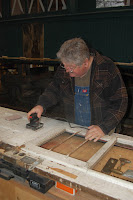
The experience of Glenn Guerra suggested sanding the paint off in the center of the door. Then more sanding, this time by hand with 320 grit wet/dry sand paper and mineral spirits. Still more sanding, still by hand but with 600 grit wet/dry sand paper and mineral spirits. Carefully, the surface was wiped with alcohol. (Earlier testing confirmed that the “original” finish was shellac and it will dissolve in alcohol but not mineral spirits.) About two hours were invested in this "scholarship" and the results are real and lasting: the now 111-year-old builder's original guilded and hand lettered "name plate" has been identified, recorded and preserved. Check it out for yourself - click on the image to view a larger version.

Tuesday, March 31, 2009

Landmarks Listing

The Chapel Car Messenger of Peace earned City of Snoqualmie landmark status by a unanimous vote Thursday night. The King County Landmarks and Heritage Commission sitting as the City of Snoqualmie Landmarks Commission met on March 26 at the Conservation and Restoration Center to consider the Chapel Car nomination. [[Pictured at left are members of the King County Landmarks Commission: In the first row, from left to right, are Lauren McCroskey, Lynette Weber and Tom Hitzroth. Rick Chouinard is in the middle. On the platform of the 001 Caboose are Steve Day and Brian Rich. Not pictured are Bob Weaver, Susan Ranf and Kathryn Merlino.]] Landmarks staff outlined the history and significance of the car and the public had an opportunity to testify. One speaker was noted railcar expert Glenn Guerra who was in town conducting a 4Culture-funded (from the Collections Care Program) condition assessment of the Chapel Car. Landmark status bestows recognition for the object’s significance and raises its public profile. A benefit of landmark status is eligibility for support from the Landmarks Rehabilitation program administered by 4Culture.

Built to bring religion to communities in a self-contained mobile church with living quarters, the chapel car did that and more. This church on wheels – and twelve others similar in design operated by the American Baptists, Catholics, and Episcopalians - brought modern evangelism and civility to disparate communities that sprung up across the West. Frontier towns were far apart and roads were almost nonexistent. There were very few of today’s transportation alternatives and for most communities the only viable access was by rail. (The chapel car concept appears to have been adapted from the chapel cars developed in the 1880s by the Russian Orthodox Church to serve remote communities across Siberia. Click here to see some images of Russian chapel cars from the 1880s through modern times.)

Culturally significant to the City of Snoqualmie, the Snoqualmie Valley, King County, Washington State and the entire United States as a Nationally-significant property, the Messenger of Peace ran on the Museum’s track right by the Snoqualmie Depot on a visit to North Bend over 92 years ago. It played a critical role in the settlement and development of this area by fostering the formation of religious congregations, renewing those that waned, and promoting religion (Christianity) in far flung communities across the west.

Tuesday, March 24, 2009

He's Got the Spirit

The spirit of giving is alive and well in western Washington. One of our members, 5¾ years-old Hal C. donated the entire contents of his piggy bank to flood relief for the Northwest Railway Museum. When asked, Hal confided he was worried that his favorite Museum might not be there anymore. He decided on his own, to contribute the contents of his piggy bank. The quarters and dollar bills spilled out onto the counter of the Depot Bookstore. Hal and James, the bookstore manager, counted it together and the total came to $11.00. Hal’s father, Eric C. made a contribution as well.

What a wonderful boost on a rainy first day of spring. Here’s a big thank you to a very thoughtful young man and his family for showing us all how to make a difference.

Monday, March 16, 2009

Locals and Visitors Adore Isadora's

Visiting the Northwest Railway Museum and riding the train can give you quite an appetite. So, where is a great place to have lunch? One that we're fond of is Isadora’s.

A favorite among locals, Isadora’s CafĂ© recently came under the new ownership of Jody Sands. Jody grew up in Snoqualmie, had worked at Isadora’s and always loved it. When the cafe became available, she jumped at the chance to own her favorite place.

Isadora’s is offering an expanded menu and featuring breakfast on the weekends. It’s the same great food in an expanded format. Jody has upgraded the menu by offering more choices, like potatoes or rice with breakfast. All of the food is made from scratch; even the Panini bread for the delicious sandwiches available for lunch.

In addition to the delectable food, Isadora’s supports the arts by featuring the work of local artists. You can find handmade ornaments, painting and photography for sale at Isadora’s. The Enigma Rag spotlights local poets, artists and authors. Check out the entertainment lineup when you’re looking for a special musical night out.

Mark your calendars for Isadora’s newest offering: Toddler Train Story Time. Jody plans to offer this opportunity for parents and their toddlers, on the first Thursday of each month, beginning April 2nd. Timed between dropping the older kids off for school and naptime, this is sure to become a favorite among the preschool set. Kids, don’t forget to bring your parents!

Be sure and check out this local jewel the next time you’re in Snoqualmie.

Friday, March 13, 2009

Flood recovery continues

It has been an interesting winter for the Northwest Railway Museum. Our first January flood (historically, most flooding occurs in November) has created a variety of challenges but also a few opportunities.

To recover quickly, a rail contractor is performing the track repairs. For the Museum, this means that the track being repaired will get new ballast and a surface, line and dress. While we all would have preferred to avoid flood damages, it is comforting to know that the track will be at least as good as it was prior to the flood event.

It is an interesting period of contrasts too. Consider these two photos taken just two months apart at Fir Street in downtown Snoqualmie. One shows track being rendered unusable and the other shows it being rendered useful.

Here at the Northwest Railway Museum we are grateful for the broad-based community support that is allowing timely repairs. Without public support, the museum would not have been able to begin the flood repairs. An event such as this reminds some of us that many arts and heritage organizations can be just one major disaster away from permanent closure.

Tuesday, March 10, 2009

Tamping track

So Spike, what makes rough track smooth again? A surface, line and dress. Huh?

A few short decades ago, gandy dancers did this work with lining bars, hand operated jacks and tamping bars or shovels. Today, workers (or more correctly, one worker) use a multifunction machine called a production tamper to level and line the track, then "tamp" (or compact) ballast under the ties to hold them in position. A production tamper uses lights, sensors and a servo circuit to detect deviations from profile (low spots in the track or lateral misalignment). Another function activates a jack to lift the track to the proper level and push it to one side or another until the sensors indicate that it is back in a straight line (or conforms to a predetermined curve). Confusing? Perhaps to most of us so instead check out these photos of a Jackson 6300 in action (followed by a ballast regulator to broom the extra ballast off of the track) and see the end result at the bottom. (Tip: if you click on the photo, you will be able to view a full screen version.)


Monday, March 9, 2009

A Train Runs Through It

Attribute it to luck, good fortune or just plain hard work. Once again, the beauty of the upper scenic Snoqualmie Valley will be showcased through the windows of our antique train, as it glides along the rails of our newly restored right-of-way. We’re pleased and grateful to announce that thanks to public agencies, such as 4Culture, the City of Snoqualmie, and the heroic efforts of private individuals who donated funds and/or volunteer hours to aid in the clean up, the Northwest Railway Museum season will officially open April 4, resuming full train service through the scenic Upper Snoqualmie Valley. While there are still repairs to perform and funds to raise, repairing the track is well underway and work on that segment of the flood damage should be completed in another week. So beginning on Saturday, April 4, and on each Saturday and Sunday through October, the Northwest Railway Museum will offer 75-minute round-trip train rides to the top of Snoqualmie Falls. A full schedule is available here .

Snoqualmie Valley Railroad’s 2009 season features two new offerings on its schedule: Easter Train (April 11 & 12) and Snoqualmie Railroad Days (August 22.) Greatly anticipated are the return of the Museum’s other popular family programs, including Mothers Ride Free, Fathers Ride Free, Grandparents’ Grand Excursion, Halloween Train, Santa Train® and Day Out with ThomasTM.

Visitors to the Northwest Railway Museum experience the excitement of a working railroad while learning about the important role railroads played in shaping the character of the Pacific Northwest. The depot and bookstore are open to the public 10:00 AM – 5:00 PM daily.