Monday, May 16, 2011
Chapel car windows
Chapel car 5 rehabilitation continues in the Conservation and Restoration Center and with a recent delay in the arrival of heavy timbers work shifted to another important element: windows.
Windows are among the most distinctive features of a 19th Century railroad car. There was an almost unimaginably wide array of different window designs from the simple and functional to the elaborate. For a Baptist car, simple and functional were the expectations of the day yet by 21st Century standards, they are exceptional.
There were three main types of windows in the car: clerestory (operating) sash, upper sash and lower (operating) sash. The upper and lower sashes had one light (glass piece) each.
The clerestory sashes had three lights and were probably originally built with double glue chip glazing but over time several lights received single glue chip glazing. The clerestory windows adorned the car from end to end and provided light – and ventilation – throughout the car.
The car had nearly all the clerestory windows, although many of the bottom rails were damaged or missing. Six windows were missing altogether. Six new windows and a supply of replacement bottom rails were produced in the Conservation and Restoration Center.
The upper and lower sashes were located along the sides of the car and also provided light and ventilation (remember, air conditioning was an invention of the twentieth century.) There were 41 pairs in all but just one survived until 2011 when rehabilitation began. Fortunately, the one remaining sash combination was nearly complete allowing a very accurate restoration of the missing windows.
With just one window, dozens of questions were answered: type of wood – white oak; joinery – mortise and tenon; interior finish – shellac; window latch location – right side; thickness – one inch; and glass type – double strength. Additional details were inferred from old hardware mounting holes, paint shadows on the carbody, and a few remaining window stops.
While it would be more cost effective to use modern window joinery, the chapel car is a national treasure and the Secretary of the Interior Standards prescribe a greater attention to detail and authenticity. Traditional mortise and tenon joinery was used to make all replacement windows, along with the same cut and species of wood - 1/4 sawn white oak. In fact, there were only a few modern materials used: glue and brads. A modern paint will also be used on the exterior. Windows were produced over a two week period by Kevin P., Meg G., and Clark M. They will receive their shellac and color coats this summer.
Major funding for the chapel car window project has been provided by 4Culture - Landmark Rehabilitation Program, Partners In Preservation Seattle (National Trust For Historic Preservation and American Express Foundation), Save America's Treasures and the Washington State Historical Society - Capital Projects for Washington's Heritage.
Photos:
(Top) Chapel car window assembly as seen through the eye of a camera with Meg G. and Kevin P. performing.


Thursday, May 5, 2011
Destination heritage
King County has a rich heritage. Agriculture, maritime and industry themes along with its people shaped the County into what it is today. A new website entitled Destination Heritage highlights some of the preserved buildings and heritage resources located within the County, and includes descriptions and informational links. There are print versions in each category; click on each name to download a copy: agriculture, maritime and industry. The industry theme includes the Northwest Railway Museum and Wellington too.
King County is one of the largest counties in all of America. Home to dozens of cities including Seattle, the County's population is nearly 2 million. Three transcontinental railroads - the Northern Pacific, Great Northern and Milwaukee Road - functionally terminated here, and today the largest private employers include Microsoft, Paccar, Boeing, American Seafoods, and Amazon. Today's King County has a rich and colorful history. Carnation and Weyerhaeuser are just two household names that are inextricably linked to King County's history.
Destination Heritage was created by 4Culture with additional support from the King County Historic Preservation Program, the National Trust for Historic Preservation and Preserve America, a program of the National Park Service. Holly T.'s Past Forward Inc assisted in the creation of content. One of the most comprehensive features is the interactive map that can zoom and pan. And with King County's long and close relationship with railroads, there are plenty of resources to interest a railway historian.
Destination Heritage is an outstanding effort. It has received an award of merit (2010) from the American Association for State and Local History, and Outstanding Achievement in Media (2010) from the Washington State Historic Preservation Officer. Congratulations to 4Culture and their dedicated staff!
King County is one of the largest counties in all of America. Home to dozens of cities including Seattle, the County's population is nearly 2 million. Three transcontinental railroads - the Northern Pacific, Great Northern and Milwaukee Road - functionally terminated here, and today the largest private employers include Microsoft, Paccar, Boeing, American Seafoods, and Amazon. Today's King County has a rich and colorful history. Carnation and Weyerhaeuser are just two household names that are inextricably linked to King County's history.
Destination Heritage was created by 4Culture with additional support from the King County Historic Preservation Program, the National Trust for Historic Preservation and Preserve America, a program of the National Park Service. Holly T.'s Past Forward Inc assisted in the creation of content. One of the most comprehensive features is the interactive map that can zoom and pan. And with King County's long and close relationship with railroads, there are plenty of resources to interest a railway historian.
Destination Heritage is an outstanding effort. It has received an award of merit (2010) from the American Association for State and Local History, and Outstanding Achievement in Media (2010) from the Washington State Historic Preservation Officer. Congratulations to 4Culture and their dedicated staff!
Thursday, April 28, 2011
Wellington Remembered receives accolades
The Northwest Railway Museum has received an award for its Wellington Remembered exhibit. The Association of King County Historical Organizations (“AKCHO”) has recognized Wellington Remembered with its 2011 Exhibit Award. The Exhibit Award is presented annually to an organization for an outstanding permanent, traveling, outreach, or temporary display or exhibit of any size that uses historical collections as the educational source material.
Wellington Rem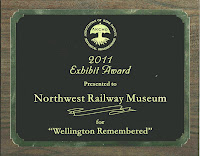 embered is an exhibit and web site launched in February 2010 commemorating the town of Wellington (1892 – 1929) and the Wellington Disaster (1910). This broad-based effort included the Museum’s Oberg Collection of Wellington images and resources from a variety of other regional institutions including the Wenatchee Valley Museum and Cultural Center, Skykomish Historical Society, Everett Public Library, University of Washington Special Collections, and the Washington State Historical Society. In the first year, over 100,000 people visited the exhibit or web site. Volunteers assisted in assembling a half scale section of snow shed used as the exhibit venue. The project was curated by the Museum’s educator Jessie C., and was funded by 4Culture and the Museum's general fund.
The award was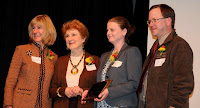 presented on April 26 at AKCHO’s annual awards reception held at the Museum of History and Industry. King County Councilmember Jane Hague was the MC. Other recipients include the Museum of Flight for the Boeing B-29 restoration, a 19 year effort; Dr. Quintard Taylor for BlackPast.org; and Preserving the Stories of Fall City, a memory book project of the Fall City Historical Society.
AKCHO is a professional association that exists to encourage cooperation among historical organizations and to promote and encourage the study and preservation of the history and heritage of King County through member organizations, individual members, and the community they serve, and to support such preservation efforts through public awareness and understanding of legislative issues. Meetings are held monthly and are open to the public.
Wellington Rem
embered is an exhibit and web site launched in February 2010 commemorating the town of Wellington (1892 – 1929) and the Wellington Disaster (1910). This broad-based effort included the Museum’s Oberg Collection of Wellington images and resources from a variety of other regional institutions including the Wenatchee Valley Museum and Cultural Center, Skykomish Historical Society, Everett Public Library, University of Washington Special Collections, and the Washington State Historical Society. In the first year, over 100,000 people visited the exhibit or web site. Volunteers assisted in assembling a half scale section of snow shed used as the exhibit venue. The project was curated by the Museum’s educator Jessie C., and was funded by 4Culture and the Museum's general fund.The award was
 presented on April 26 at AKCHO’s annual awards reception held at the Museum of History and Industry. King County Councilmember Jane Hague was the MC. Other recipients include the Museum of Flight for the Boeing B-29 restoration, a 19 year effort; Dr. Quintard Taylor for BlackPast.org; and Preserving the Stories of Fall City, a memory book project of the Fall City Historical Society.
AKCHO is a professional association that exists to encourage cooperation among historical organizations and to promote and encourage the study and preservation of the history and heritage of King County through member organizations, individual members, and the community they serve, and to support such preservation efforts through public awareness and understanding of legislative issues. Meetings are held monthly and are open to the public.
Photo (top): The award plaque presented to Jessie C. and Richard A. at the awards ceremony.
Photo (bottom): Councilmember Jane Hague and Jo Ann E. ~ the 2010 exhibit award winner from Kenmore Heritage Society ~ presented the award to Jessie C. and Richard A.
Thursday, March 31, 2011
Rehabilitating track at Snoqualmie Falls
 The world's first underground power generating station is located at Snoqualmie Falls. It was opened in 1898 by Charles Baker, who just a few years earlier was a civil engineer for the Seattle, Lake Shore and Eastern Railway. Fast forward to 2010. Puget Sound Energy owns the Snoqualmie Generating station and began a major reconstruction of the 112 year old plant. Scope of work includes new penstocks and replacement of a 1910 era generator. (The original 1898-built generators will return to service after project completion.)
 In August 2010, efforts to construct a retaining wall above the water intake did not go as planned. Soil conditions and other factors caused movement of the hillside. Unfortunately the hillside also supports the Northwest Railway Museum’s railway, the former Seattle, Lake Shore and Eastern. Train service was immediately suspended and additional geotechnical investigation began. Changes in construction techniques, longer soil anchors, some clean ballast for the railroad, and two years of monitoring are among the mitigation measures that have been adopted.
In late March 2011 rehabilitation of the railway began. Railworks of Centralia, WA was the successful bidder and are reconstructing over 400 feet of track in a difficult location. Their crews are dismantling track, excavating old ballast and installing new, and rebuilding the track. Work is expected to take two weeks and will allow regular trains to operate on April 2, 2011.
Please enjoy this two minute video illustrating the work:
Photos:
(Top) Railworks hyrail excavator at Snoqualmie Falls spreading new ballast; Salish Lodge and Spa is across the river in the distance.
(Bottom) Video shot at Snoqualmie Falls illustrating track reconstruction.
Monday, March 21, 2011
Preservation field school
 The Northwest Railway Museum recently hosted an historic structure field school. Maintenance and repair of historic structures is a course regularly offered by the Army Corp of Engineers and outlines the unique characteristics of historic structures and the technical knowledge, skills, and procedures used to care for historic properties owned by the Federal Government. The course also addresses the concomitant legal and administrative requirements.
The course was conducted by Horace Foxall, Jr., a nationally-recognized historic preservation expert and a member of the National Advisory Council on Historic Preservation. Mr. Foxall recently retired as the manager of the Army Corps of Engineers’ Center of Expertise for Preservation of Historic Structures and Buildings. Participants from all across the United States toured the Snoqualmie Depot and observed demonstrations in the Conservation and Restoration Center.
 Clark M., Meg G, and Kevin P. led a demonstration of the techniques used to construct accurate replacement window sashes for the chapel car rehabilitation project. They also demonstrated techniques they use to disassemble the chapel car’s three-light clerestory windows for repair and reassembly. Many of the window construction methods are identical to those traditionally applied to older structures including the use of blind tenons.
Bill H. led a tour and described the techniques used to rehabilitate coach 218, a 1912-built passenger coach used on the Spokane Portland and Seattle Railway. Coach 218 has received a new floor, the car sides have been completely rehabilitated and new cladding has been applied. New carlines were installed and the end platforms are now being restored.
Both objects are built of wood and apply the Secretary of the Interior Standards for the Treatment of Historic Properties, but the reuse of each object will be very different presenting an interesting contrast for session attendees. Coach 218 is destined for regular operation on the Museum’s railroad where it will carry up to 84 passengers on an 11 mile excursion. The chapel car 5 Messenger of Peace is being rehabilitated for exhibit inside the new Train Shed and will not be used to carry passengers. While functionally complete, the chapel car will rarely operate in deference to its significance and its age. The chapel car is a National treasure listed on the National Register of Historic Places and heroic efforts are being made to reuse as much of the original materials as possible including at least half of the exterior cladding.
The preservation field school was an opportunity to showcase the work the Northwest Railway Museum is doing to preserve Northwest railroad history. This event and others like it help raise awareness in the historic preservation community about the Museum's activities and share the skills and techniques being developed - or resurrected - to rehabilitate railway history of the region.
Friday, March 11, 2011
Working on the Railroad success
Many charities run benefits that are designed to just make money. Others run events that inform, educate and entertain, but also support the institution. Working on the Railroad 2011 was the latter.
 The Northwest Railway Museum hosted its second annual benefit dinner on Friday, March 4, 2011 at the Salish Lodge and Spa in Snoqualmie. A total of 90 people were on hand for an evening themed around chapel car 5 Messenger of Peace, the National treasure now being rehabilitated in the Museum’s Conservation and Restoration Center. Proceeds will benefit the chapel car rehabilitation effort.
Guests were treated to a splendid meal prepared by the Salish’s executive chef. Each table was adorned with a collection plate loaned from Snoqualmie United Methodist Church, Mt. Si Lutheran, and North Bend Community Church. A short three item live auction conducted by Phil L. followed (a silent auction operated during the cocktail hour) with great items including the opportunity to be a locomotive engineer for an hour. Then, local actors Gary Schwartz and Denise Paulette took on the roles of Reverend and Mrs. Neil, the first missionaries assigned to chapel car 5 Messenger of Peace. They dramatized several notable moments in the car’s early history and talked about what it was like to live on a railroad car for two years with just 200 square feet of personal living space. The evening finished off with a lovely cake prepared by George’s Bakery in North Bend.
Thank you to the many donors including North Bend Theatre, Salish Lodge and Spa, North Bend Bar and Grill, Charmichael's True Value, Hit Entertainment, Think2a, Down to Earth Flowers and Gifts, Boxley’s, Down to Earth Photography by Mary, the Museum of Flight, Bob M., Rocky B., Allan W., James D., Rocky B., Russ S., & Jon B.
Working on the Railroad 2011 was a successful event raising awareness of the chapel car project and helping support its rehabilitation. Thank you to all the wonderful businesses and individuals in the community who made it a success!
Photograph: Guests at Working on the Railroad included (L to R) North Bend Mayor Ken Hearing, Gary Schwartz portraying the Reverend Neil, Denise Paulette portraying Mrs. Neil, Museum Executive Director Richard R. Anderson and Snoqualmie Mayor Matt R. Larson.
 The Northwest Railway Museum hosted its second annual benefit dinner on Friday, March 4, 2011 at the Salish Lodge and Spa in Snoqualmie. A total of 90 people were on hand for an evening themed around chapel car 5 Messenger of Peace, the National treasure now being rehabilitated in the Museum’s Conservation and Restoration Center. Proceeds will benefit the chapel car rehabilitation effort.
Guests were treated to a splendid meal prepared by the Salish’s executive chef. Each table was adorned with a collection plate loaned from Snoqualmie United Methodist Church, Mt. Si Lutheran, and North Bend Community Church. A short three item live auction conducted by Phil L. followed (a silent auction operated during the cocktail hour) with great items including the opportunity to be a locomotive engineer for an hour. Then, local actors Gary Schwartz and Denise Paulette took on the roles of Reverend and Mrs. Neil, the first missionaries assigned to chapel car 5 Messenger of Peace. They dramatized several notable moments in the car’s early history and talked about what it was like to live on a railroad car for two years with just 200 square feet of personal living space. The evening finished off with a lovely cake prepared by George’s Bakery in North Bend.
Thank you to the many donors including North Bend Theatre, Salish Lodge and Spa, North Bend Bar and Grill, Charmichael's True Value, Hit Entertainment, Think2a, Down to Earth Flowers and Gifts, Boxley’s, Down to Earth Photography by Mary, the Museum of Flight, Bob M., Rocky B., Allan W., James D., Rocky B., Russ S., & Jon B.
Working on the Railroad 2011 was a successful event raising awareness of the chapel car project and helping support its rehabilitation. Thank you to all the wonderful businesses and individuals in the community who made it a success!
Photograph: Guests at Working on the Railroad included (L to R) North Bend Mayor Ken Hearing, Gary Schwartz portraying the Reverend Neil, Denise Paulette portraying Mrs. Neil, Museum Executive Director Richard R. Anderson and Snoqualmie Mayor Matt R. Larson.
Thursday, March 10, 2011
Research and the process of education
Education at the Northwest Railway Museum has many levels. It is interpretation – whether a small or large exhibit or even a sign found around the site. It is education programs like Pre-School Train and School Train. It is educational tours of the Depot or the CRC. It is also the train rides which begin again in April. Education has many levels, all of which require background knowledge of the subject matter to be presented, and background knowledge comes from research.
Sometimes the re search has already been done and all one needs to do is read and absorb the information so they can present it in a coherent manner (whether in verbal or written form). Often times, though, research is required. So where to begin? Once you have your topic, the easiest first step is searching our archives. What does the Museum have that relates to the subject? Once we have established what we have, then we need to determine what we need. This could be written material to build our content, photos to add visual depth to the presentation, or archival documents to connect people and events across time.
There are some great online resources to help with this type of research, among them is the University of Washington’s digital collections, Washington State Archives, and the Library of Congress digital collections. There are many additional sites that can be very helpful, but these three are a great place to start looking for information and resources.
On a recent online tr ip we found multiple images and maps that could work well in a tentative Train Shed exhibit, along with interesting primary documents pertaining to the need – in Washington Territory – for a railroad. This research is how we begin to build exhibits and interpretation (= education) here at the Museum. And while it can sometimes be difficult locating the information you need – when you finally find, or stumble, upon the missing piece – it can be very rewarding. It is much like completing a puzzle when you don't have the box and picture to help guide your work!
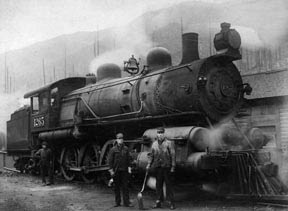
Photograph: Locomotive #1265 at Lester, WA. Longworth Collection, Northwest Railway Museum.
Certificate: Certificate of marriage, Colville, WA circa 1915. Washington State Archives.
Sometimes the re
 search has already been done and all one needs to do is read and absorb the information so they can present it in a coherent manner (whether in verbal or written form). Often times, though, research is required. So where to begin? Once you have your topic, the easiest first step is searching our archives. What does the Museum have that relates to the subject? Once we have established what we have, then we need to determine what we need. This could be written material to build our content, photos to add visual depth to the presentation, or archival documents to connect people and events across time.
There are some great online resources to help with this type of research, among them is the University of Washington’s digital collections, Washington State Archives, and the Library of Congress digital collections. There are many additional sites that can be very helpful, but these three are a great place to start looking for information and resources.
On a recent online tr
 ip we found multiple images and maps that could work well in a tentative Train Shed exhibit, along with interesting primary documents pertaining to the need – in Washington Territory – for a railroad. This research is how we begin to build exhibits and interpretation (= education) here at the Museum. And while it can sometimes be difficult locating the information you need – when you finally find, or stumble, upon the missing piece – it can be very rewarding. It is much like completing a puzzle when you don't have the box and picture to help guide your work!
Photograph: Locomotive #1265 at Lester, WA. Longworth Collection, Northwest Railway Museum.
Certificate: Certificate of marriage, Colville, WA circa 1915. Washington State Archives.
Subscribe to:
Posts (Atom)