Thank you to all our Volunteers, Donors, Trustees, Supporters, Members, Benefactors, and Patrons for a wonderful and successful 2012.
A railway museum is about more than just the excitement of a train: it is education, heritage and historic preservation, community identity, the economic sustainability of a small community, and enjoyment. Thank you to everyone who played a part in 2012.
2013 will bring many exciting developments to the Museum: completion of the chapel car, improvements to the interpretive railway, and expanded educational programs. We all look forward to welcoming you back to the Museum next year!
--Staff of the Northwest Railway Museum: Richard, James, Cristy, Jennifer, Jen, and Jessie.
Monday, December 24, 2012
Friday, December 14, 2012
A 12/12/12 marriage to remember
Messenge of Peace trucks and car body married again!
|
Chapel car 5 Messenger of Peace has wheels again! Messenger of Peace was married with a pair of passenger
car trucks in a lengthy ceremony held on the much-coveted 12 December 2012, or
12/12/12. The car lost its original
trucks in 1949 when it was adapted for reuse as a roadside diner. The rehabilitation work it is undergoing
inside the Museum’s Conservation and Restoration Center includes elements of
restoration, including the trucks.
The car body underside showing the
centerplate.
|
Railway car trucks are assemblies that include a frame,
wheels, bearings, brakes, and a mounting plate for the car body. For the chapel car, these trucks each have
six wheels and are constructed predominantly of wood. A blog post describing the removal process is
here.
Car body centerplate and the truck
centerplate slowly come together.
|
Marrying trucks to a car body requires very careful
alignment. For the chapel car, 22 months
of time on car stands had resulted in the car shifting slightly off center. So the rehabilitation crew carefully nudged
the car body back to the center of the tracks in a process that consumed hours. They used a set of hydraulic jacks to undertake this work on the 60,000 lb car body. Certainly a great deal was at stake should the car be knocked off the car stands!
Bob, Kevin and Gary roll the rear truck
under the car body.
|
So 12/12/12 marks a marriage to last: the trucks and the
chapel car car body. And this is both symbolic and indicative of the final stages of this two year project to rehabilitate this national treasure. Stay tuned for more reports about this incredible project!
Tuesday, December 11, 2012
Something old, something new
6 wheel wood, steel reinforced
passenger truck
|
Later this month inside the Conservation and Restoration Center, the chapel car 5 Messenger of Peace will
be married to its new trucks, which are special frames with wheels, bearings,
and brakes. The trucks (we think, based
on castings and other details) date from circa 1901 and will get some new parts,
are in a sense borrowed, and will be carbon black. So how appropriate to now look at the origins
of those trucks and how they compare to the originals.
Messenger of Peace was built by Barney and Smith of Dayton,
Ohio in 1898. The car was one of the
longest cars built to that date and incorporated all the latest design
advances. It included 6 wheel trucks
reinforced with steel flatbars on either side of the oak frame members. Sadly, those original trucks were (we
believe) scrapped in 1948 when the car was repurposed as a roadside diner.
The Museum has several railroad cars it has been holding to
provide parts for others. While most
were originally acquired for the Collection, they were later removed either
because they were redundant or because they were in very poor condition. They
provide couplers, brakes, hardware, and even wood moldings to make objects in
the Collection more complete.
Imhoff Crane lifts the X-127 while the
Museum's Pettibone exchanged the
trucks.
|
A late nineteenth
Century car called the X-127 was one such car.
It was outfitted with trucks of the same design that the chapel car was
built with and they are in great shape.
They received some structural upgrades circa 1927, but are visually
nearly identical to the originals.
Earlier this month, Snoqualmie’s own Imhoff Crane set up at the CRC and made
quick work of the truck exchange. They
lifted the car one end at a time and replaced the original trucks with a set of
shop trucks the Museum uses to move projects around.
So something old (the chapel car), something new (new center
plates), something borrowed and something carbon black (black trucks from
another car) will be in the marriage of chapel car 5 and its trucks. Later, Spike will post some marriage photos
along with the circa 1902 photo taken at Novinger, MO that has been used to
rehabilitate the car.
Perhaps only to a curator's eye, this is a classic wood-era
passenger car truck
|
Saturday, December 1, 2012
Adaptive reuse
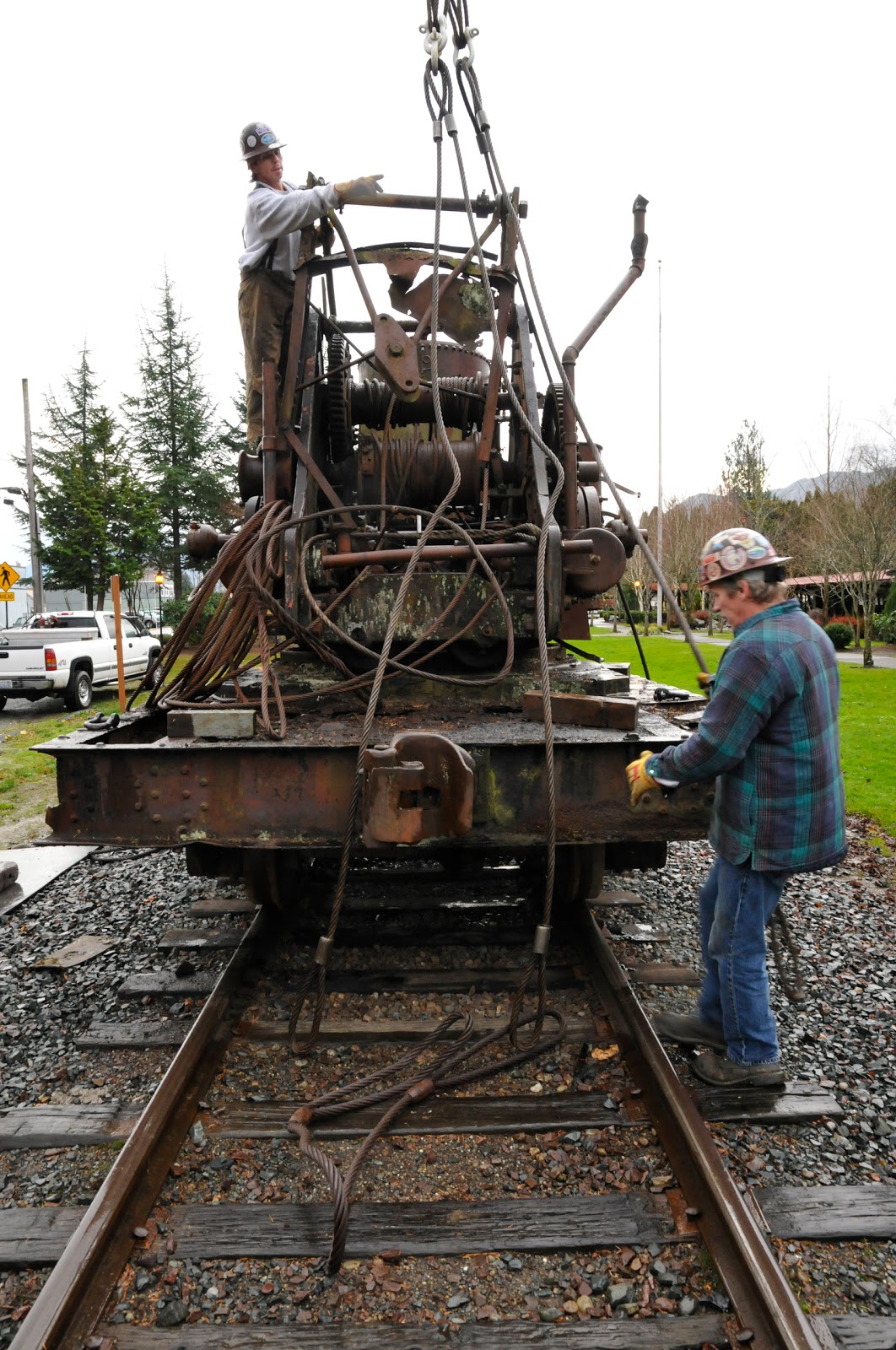
Steam crane is prepared
for shipment.
|
The Northwest Railway Museum has offered objects that are
outside its scope of collection or redundant to other museums. Over the last 20 years, more than a dozen
large objects have be sold or transferred to other institutions. And when other museums are not interested,
objects may be offered to a broader audience.
Imhoff's 65 ton conventional crane
makes quick work of lifting the
circa 1903 steam crane.
|
Adaptive reuse is the process of retasking a building or object. It allows something that may have outlived its usefulness and repurposes it for something else. So an old school could become condominium housing. An old caboose could become a cottage or office. And a coal-fired steam crane could become the focal point of a new restaurant development where it supports an outdoor canopy.
Jon Burget poses with
his new acquisition.
|
Snoqualmie’s own Imhoff Crane was hired to lift the vintage crane – all 45,000 pounds of it – and Seattle’s Ballard Transfer was hired to transport it. The move took most of a day and no doubt turned some heads on Interstate 90.
Congratulations to Jon Burget of Pavingstone Supply Inc on the
acquisition of this interesting historical object for his new restaurant. When he opens next summer, Spike will
broadcast the date, time and place so you can see adaptive reuse in
action!
Labels:
Adaptive reuse,
collection management,
crane
Wednesday, November 21, 2012
New marketing director appointed
Ms. Osborn arrives at the Museum via the Snoqualmie Valley Chamber of Commerce where she performed the functions of Business Manager. She brings with her a wealth of community knowledge and connections.
Jennifer’s new responsibilities at the Museum include managing Snoqualmie Railroad Days, leading of the overall marketing effort, and community outreach. Principally, Jennifer will be working with the Museum’s other key staff to update and implement the strategic marketing plan. The plan will feature improved awareness for the Museum’s favorite annual events: Santa Train, Day Out With Thomas, and Snoqualmie Railroad Days. It will also focus on building attendance throughout the year, especially for educational programming.
Ms. Osborn has a strong background in education. Prior to working at the Chamber, she completed her Masters degree in Education, which included an internship in guidance counseling at Aviation High School in Seattle. She has also worked for the Snoqualmie Valley School District at Snoqualmie Middle School.
Jennifer was raised in Vancouver, British Columbia and
always wanted to return to the Pacific Northwest. Her family has lived in the
Snoqualmie Valley for the last eight years after relocating here from Carlsbad,
California. Both of her daughters attend Mt. Si High School and are very active
in their school community.
Jennifer is very involved in the local community. She is a member of the Snoqualmie Valley Historical Museum Board and is a member of the Snoqualmie Valley Schools Foundation Board. The history and future of the Snoqualmie Valley are very
important to her and make her a great fit for the Northwest Railway Museum.Welcome aboard Jennifer!
Wednesday, October 31, 2012
Crossing repairs
Center of crossing is re-
paired on North Bend Way.
|
The Northwest Railway Museum has 13 public crossings at
grade or, more simply stated, 13 public roads that cross the tracks. The Museum has certain statutory
responsibilities to maintain portions of these crossings even though it is cars
and trucks and not trains that wear them out. Other portions of the crossing are generally
the responsibility of the road authority.
Asphalt By George's crew compacts
new asphalt on Stone Quarry Road.
|
Projects usually turn
out better when groups and individuals work together, and road and railway
projects often work the same way. So the City of Snoqualmie and the Northwest
Railway Museum hired Snoqualmie’s own Asphalt By George to perform repairs on
Northern Street, Stone Quarry Road and North Bend Way and then split up the
costs according to areas of responsibility.
These crossings were damaged by heavy use, snow plows, and just plain old
age.
| George's crew poses at Northern Street
along with locomotive 4024.
|
Deteriorated wooden planks and broken asphalt were removed
and replaced with new asphalt. A spacer
was used to ensure the slots to accommodate the car and locomotive wheels were
inserted. And old asphalt was shipped to
the asphalt plant to be recycled into new asphalt. Kudos to the great workers at Asphalt By
George, and to the City of Snoqualmie Public Works Department for working with
the Museum!
Thursday, October 11, 2012
Checkin' It Twice
![]() |
| Santa Claus checks his list while riding Santa Train (R). |
Imagine you and your family aboard a vintage train with the scenic Cascade foothills outside your antique coach window. As you journey from North Bend to Snoqualmie, you hear the wheels on the train clickety-clack beneath you. The train pulls into the station and you see Santa Claus, Ms. Claus and Zoe the Elf waving from the platform. As you alight from the train, the aroma of fresh-baked cookies greets you. You hurry into the railway kitchen car for hot cocoa and coffee to go with your cookies. Santa is waiting to see your family in the depot and he has a small gift for each of your children.
Is this a dream? No, it’s Santa Train®, the more than four
decades old tradition at the Northwest Railway Museum. You and your family can
be part of it. Purchase your Santa Train tickets online or in person now, or by
phone beginning October 29.
Santa and the cookies will be waiting for you!
Labels:
interpretive railway,
Santa Train
Subscribe to:
Posts (Atom)