Wednesday, December 25, 2013

Merry Christmas!

Deputy director Jessie C., Visitor services 
James S., Volunteer coordinator Cristy L., 
Bookkeeper Jennifer Y. and Director 
Richard A.
Christmas and the railroad

In their roles as museum educators, staff work hard to remain truthful and accurate in creating interpretive programming. However, they must also use today's conventions to help people understand yesterday's.  Identifying the year-end holiday season as "Christmas" considers a recent Angus Reid Global poll that found 80% of people in the United States, Britain and Canada prefer to call the holiday season "Christmas." That is a pretty convincing majority!

So what do a refer car, box car, brakeman, coach car, express car, locomotive, conductor, railroad bridge, depot, and chapel car all have to do with "Christmas?"  Everything!

While examining the impact of railroads on the Northwest it is nearly impossible to ignore the role of significant cultural practices, including the celebration of Christmas. Why? Christmas and other major holidays have had - and continue to have - a tremendous impact on railway transportation including express, freight and passenger service.  Railroads brought (bring) families together, letters and packages to family members, and goods to retailers. Railroads even transport many Christmas trees from farms to your local communities.  So Christmas might not be very merry without the railroad!

Thank you to everyone! 

As another successful Santa Train program is completed and 2013 draws to a close, I am delighted to reflect upon another great year at the Northwest Railway Museum. In doing so, what is clearly evident are all of the generous contributions of time, talent and funding that have helped make the Northwest Railway Museum and its programs possible.  By the numbers, the human side of the Museum's success was a handful of management and other key staff, a dozen trustees and advisers, a gaggle of special contractors, more than 125 volunteers, and hundreds of donors. They all worked together to serve more than 90,000 guests who got to see and understand the role railroads played in the development and settlement of the Northwest.  

From all of us to all of you, have a Merry Christmas!

--Spike

Thursday, December 5, 2013

New tools of the trade

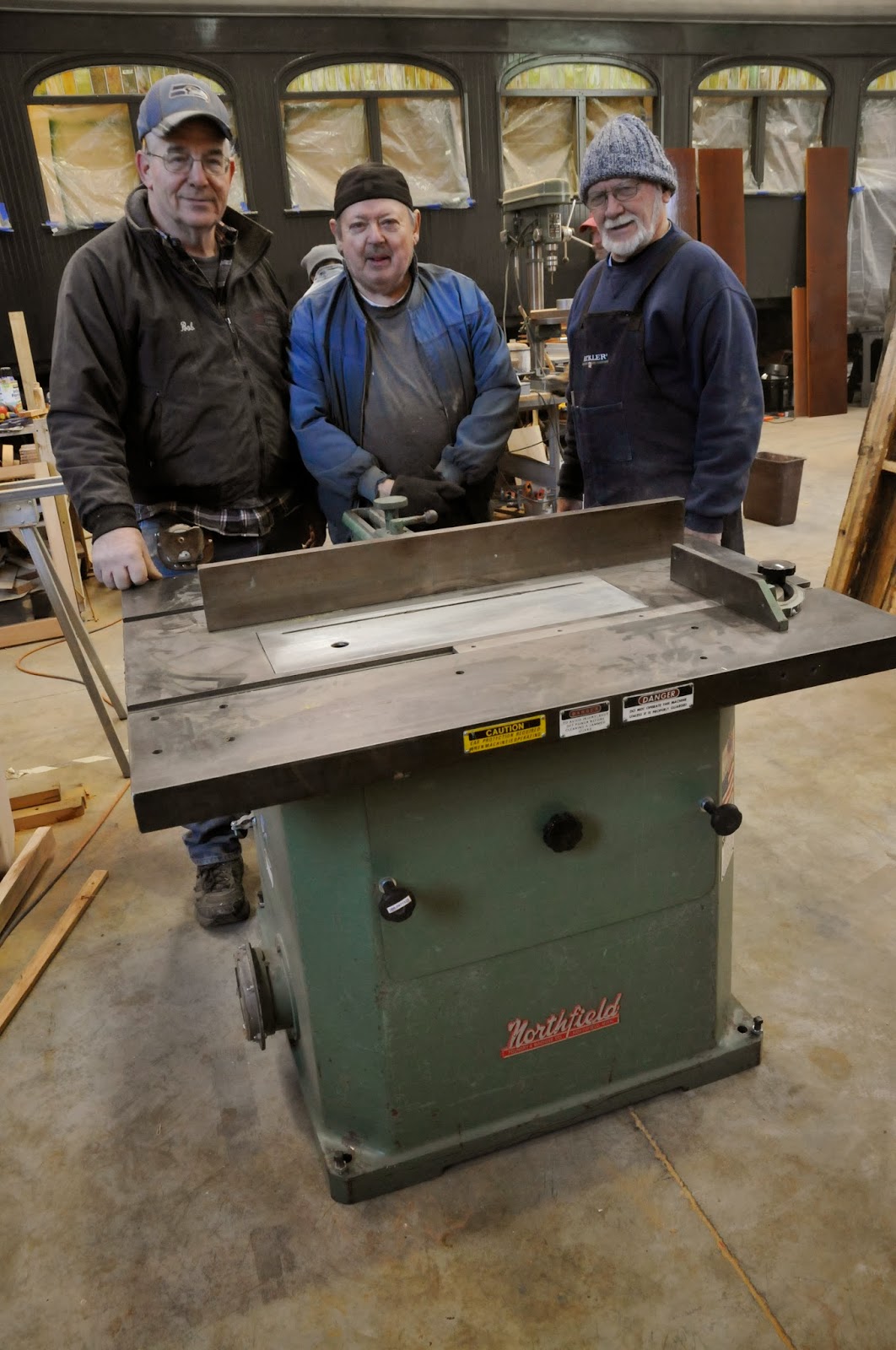
The Museum's "new" Northfield model 4
Many skilled professionals will agree: having the right tool for the task is worth at least half the effort.  And so it applies to railroad cars and locomotives, but the tools are a little bigger than most people are accustomed to. 

Recently, with funding from a heritage 4Culture fixed asset grant, the Northwest Railway Museum added a power feeder and large table saw to the tool inventory. These acquisitions improve safety and efficiency for collections care efforts performed in the Conservation and Restoration Center. 

The Museum purchased a Northfield model 4 table saw complete with a 7.5 HP motor.  The 1990s-vintage saw tips the scales at nearly 2,000 pounds and will accommodate a blade diameter up to 20 inches.  It was located in Kentucky and shipped to the Museum in November.

Bob models the new 1 HP power feeder

The Northfield model 4 remains in production today in their factory in Minnesota.  Parts are available and so is technical support.  A new model 4 retails today for more than $16,000; the Museum paid less than 1/3 of the new cost for its lightly-used model 4.  This newer and larger saw is more stable and will allow workers to rip thicker and harder wood than the saw is replaces, which was built in 1926 and weighs "only" a few hundred pounds.

A new Grizzly-brand power feeder now graces the spindle shaper table too.  The Museum’s Oliver shaper features a 5 HP motor and hand feeding of stock is incredibly dangerous.  The new power feeder has been sized for this application and is used to slowly feed wood into the cutter head.  It was recently used to shape the rails and stiles for new coach 218 windows.  The shaper is also used to shape the moldings used both inside and outside the coaches.

4Culture offers the fixed asset equipment program to arts and heritage organizations located in King County, and funds the awards with lodging tax revenue.  Sound systems, stage lighting, instruments, shelving, and image scanners are other examples of purchases funded by the program in King County-based museums and arts organizations. This recent award is the Northwest Railway Museum's first fixed asset grant.

Thank you 4Culture!
 

Tuesday, November 12, 2013

Bridging the gap

Bridges are vitally important to railroads.  They allow trains to cross rivers and gullies, swamps and streams, roads and highways, and sometimes other railroads, too.  It was evolving bridge technology that allowed steel bridges to be built in remote areas of the west, and for the train and locomotive mass to rise dramatically.

Railroad bridges are different than other kinds of bridges because they are subjected to unique dynamic forces.  An interesting historical fact is that even today railroad bridges are designed using the Coopers loading system, a system developed in 1894 and based on the loading of two consolidation-type steam locomotives. 

The Northwest Railway Museum has a collection of bridges representative of those that transformed the west.  Timber trestles, open and ballasted decks, a pin connected truss and even a voided-slab concrete span are all critical structures on the Museum's railroad.  All these structures are inspected annually by an independent railroad bridge inspector, and periodically by Museum staff.

During bridge inspections components are inspected and rated.  Elements that remain effective but show any signs of deterioration are placed on a watch list.  On each subsequent inspection, the "watch" parts can be closely examined and an informed decision can be made about when to replace a part.

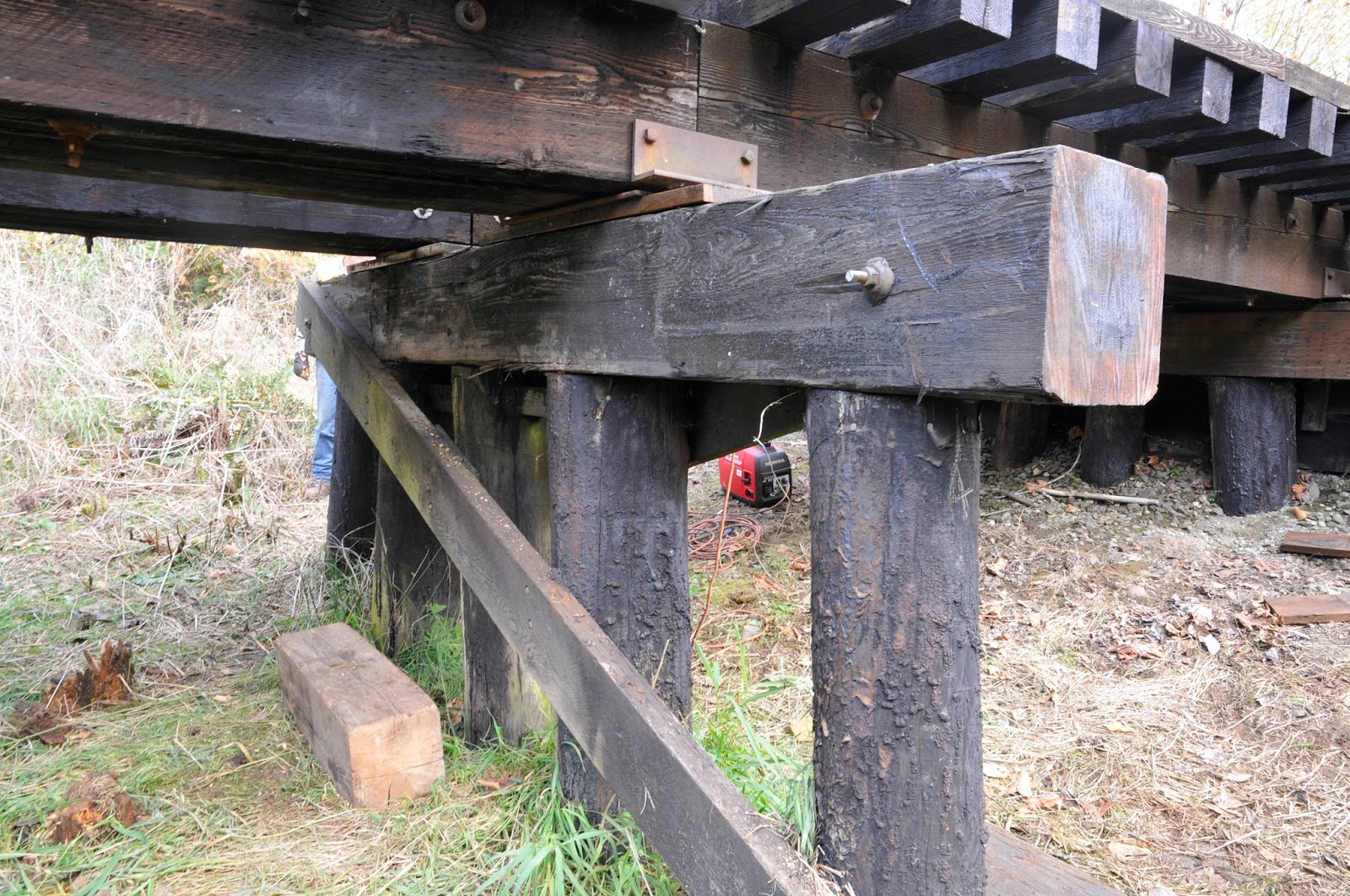
To change a cap, the stringers and
bridge deck are jacked and supported
from adjacent pile caps.  This removes
the weight from the affected cap and
allows it to be changed.
During the 2013 inspection, two pile caps were identified for replacement.  Caps are large timbers that sit on top of the piles and support the stringers, the long beams that run from one pile cap to the next and support the deck.  The inspection team estimated that they each had less than two years of life remaining.  So in Fall 2013, two recycled old growth timber caps each 14 inches by 15.5 inches and 14 feet long were purchased from a dealer and installed.  Each cap took approximately 7 hours to exchange and work was completed without delay or incident.


With the weight off the cap, the old one is removed and a new one is inserted. 
Shims are inserted to make up any difference in height between the old and
new cap.  Then the weight is placed back on the cap and everything is bolted
together again.


Tuesday, October 29, 2013

A floor for coach 218

Rehabilitation of coach 218 is involving nearly every aspect of the car. This fall, the focus has been returning the floor to its former grandeur. The solid maple floor was badly deteriorated and the decision to completely replace it was made early in the project.  The completed floor is now ready to receive its first guests!

New sugar maple flooring was supplied by a regional wholesaler and installation began in late August.  (A botanist confirmed that samples of the original flooring were hard or sugar maple.)  A layer of roofing felt was applied below the flooring.  To help stabilize and strengthen the floor, a 3/8 plywood underlay was installed over the sub floor.  This feature was a departure from the original design but was added to improve stability over the bolsters at the car ends.


Each 1x4 was carefully positioned and hand nailed.  Then, many hours of sanding ensued to assure a smooth, even and attractive surface. To finish the floor, the Glitza floor finish system consisting of two seal coats and a semigloss top coat was applied. Funding of this work was made possible with the generous support of the Snoqualmie Tribe and 4Culture.  

Sunday, September 22, 2013

Day of Caring 2013


Each September, United Way of King County organizes Day of Caring, an event where thousands of volunteers take the day off from work and volunteer in their communities.  United Way asks non-profit organizations to sponsor projects, and group leaders from the supporting businesses select projects and organize volunteers.  This year, on September 20, 2013, the Northwest Railway Museum participated in Day of Caring by sponsoring a series of projects. 

This year there were a variety of projects at the Railway History Center to help preserve and share railway history.  Teams of volunteers set up more than 1,200 cubic feet of new collection shelving, moved a substantial number of additional shelving pieces, planted native plants and gardened around the Train Shed, worked on window screens and seats for the Spokane, Portland and Seattle coach 218, prepared windows for painting on coach 272, did a thorough cleaning of the Chapel Car, and generally had a fun time of helping care for the Museum.  A total of 35 volunteers from Microsoft participated, and they were assisted by several regular Museum volunteers who helped coordinate the event.


The Northwest Railway Museum thanks all of the volunteers from Microsoft and the Northwest Railway Museum.  It was a very successful day that allowed projects to be completed in one day that would have otherwise taken months to complete.  If you have a group that would like to volunteer for a day, please contact Volunteer Coordinator Cristy Lake.  Volunteering as a group for the day can be a fun way to serve the community and have an enjoyable time with friends and coworkers too. 

Sunday, August 25, 2013

Copper for a coach roof

Individual copper sheets were attached
with a folded seam and soldered.
Most early 20th Century railroad coaches had canvas roofs.  Some railroads specified that the entire roof be clad with canvas while others preferred copper cladding on the car ends. Copper was not an afterthought but an option specified when the cars were built.  Oxidation and the limitation of black and white photography often make it difficult to identify this in the 1912-era photos, but the Museum is confident that coach 218 was built with copper hoods. 

Completed lower hood.  One improve-
ment over 1912 materials is the use of
marine calking to seal edges.
Certainly one of coach 218's distinguishing features is this copper cladding on the roof ends, but unfortunately the original surviving copper was brittle and riddled with perforations.  So restoring these to their "as built" appearance and condition has been one of the project priorities. These "hoods" feature compound curves and are areas where it is more difficult to keep out rain water on this design of railroad car.  The copper cladding improves durability and reduces long term maintenance. (Some years ago, Spike had an opportunity to work on two Canadian Pacific Railway passenger cars that featured full canvas roofs and can attest to the fact that the canvas fails first on the compound curve at the ends of the cars.)

Bob M. attached the last of the clere-
story cladding to allow the final piece
of copper to be attached.
The design of the hoods is simple but the tin smith skills to install it are no longer common.  Fortunately, Gary J. is a highly accomplished marine carpenter and this work was an easy adaptation for him.  To begin, copper sheets were cut into small rectangular sections that would conform to the roof curve.  The edges were bent up or over to allow a folded seam with the adjacent roof panels.  All the seams were tapped flat and then soldered to provide a watertight seal.  The final product mimics the original roof but the appearance of the soldered seam is slightly different, probably because of the difference in performance between an internally and externally heated soldering iron.

Completed copper hoods debuted dur-
ing Railroad Days 2013.
Work continues on coach 218 but completion of the copper hoods allowed its use during Railroad Days 2013 where it carried an estimated 120 additional passengers.  Work is being funded with the generous support of 4Culture, the Nysether Family Foundation, proceeds from GiveBIG 2013, the Snoqualmie Tribe, and individual contributions from people just like you!


Thursday, August 8, 2013

Smoke or heat?

A critical responsibility of every museum is the general protection of the Collection.  Broadly defined, that could mean protecting it from everything, which is unrealistic.   However, prudent steps can be taken to protect the collection from things that could reasonably occur.  Examples may include exposure to bright sunlight, rapid changes in heat or humidity, small to moderate earthquakes, and fire. 

An articulated lift allows a fire alarm
technician to exchange fire detection
sensors inside the Train Shed, high above
chapel car Messenger of Peace.
Inside the Northwest Railway Museum's new Train Shed exhibit building, some of the most important and representative objects in the Collection are protected with UV-filtering windows, R-30  insulation, a structure designed to the most modern seismic code, and a fire detection and suppression system.  Yet no system is perfect and unfortunately the Museum has had a variety of issues with the fire detection system. 

Local codes required smoke detectors in the original construction because, as Spike has been advised, they often detect a fire sooner than a heat sensor.  However, in a building with fans running all the time and nearly 750,000 cubic feet of air, there have been problems with these sensors.  Since completion in 2010, the Train Shed has experienced as many as 50 false alarms.  Fortunately, the Snoqualmie Fire Department has been very understanding and supportive, and several fire fighters now know almost as much about the Collection as some of the regular docents.  However a problem like this cannot be allowed to continue. Aside from the story about The Boy Who Cried Wolf, what if the fire department is responding to a false alarm when your house is on fire?

The Museum and its contractor partners have worked hard to determine the cause of the false alarms from the smoke detectors.  The Train Shed is not particularly dusty - in fact a lot cleaner than the Conservation and Restoration Center, which also has a number of smoke detectors.  There are no sudden changes in temperature that could cause condensation to form inside the detectors. The model of sensor does not have a history of issues.  There has even been consideration as to whether an infestation of insects or spiders is causing the problem. However, without being able to pinpoint an exact cause, it has been determined that smoke detectors are not reliable inside the Train Shed, and the local municipality approved a change. 

Early in August 2013, E Squared Systems was on site to replace the smoke detectors with heat sensors. This is quite a feat in a structure filled with artifacts, with ceilings as high as 35 feet, and not a lot of floor space to operate a 14,000-pound lift.  Now the Museum looks forward to improved reliability, and the Snoqualmie Fire Department looks forward to fewer late night museum visits.