Wednesday, November 25, 2015

Weathering another storm

Main track at the Snoqualmie Depot
during peak rainfall. 
November in Western Washington is synonymous with severe winter storms.  High winds, heavy precipitation, and power outages occur nearly every November and this year was no exception.  Fortunately, no significant damage occurred, but it was a nail-bitter because this was the first major storm event since completion of the PSE power plant reconstruction, and combined with the 2005-era Army Corps of Engineers section 205 river widening project.

Snoqualmie River at Snoqualmie
approaching peak flow.  Sandy Cove
Park is completely flooded.
The first indications of a threat usually arrive in the form of a flood warning.  A stage three flood is fairly common in Snoqualmie with several occurrences per year, while the more severe stage four floods occur every few years.  The National Oceanic and Atmospheric Administration ("NOAA") predicts peak water flow using computer models based on data from prior storms.  There is some margin for error, but the model updates as the storm progresses. 

South Fork of the Snoqualmie River
at peak flow.  Under normal flow,
there is approximately 20 feet of
headway under Bridge 35.
Flooding is one of the greatest threats to both the City of Snoqualmie and the Northwest Railway Museum.  Since 1948 there have been more than two dozen Presidential disaster declarations, and track and/or bridge damage has occurred in every event.  Tracking historical river peaks, there has generally been track damage at or above 43,000 cubic feet per minute as measured at Snoqualmie.  November 17, 2015's flood was projected at more than 48,000 cubic feet per second.  Actual peak flow was almost 49,000 cubic feet per second, yet there was no track or bridge damage.

The Museum is fortunate the flood reduction measures have worked in favor of preserving track and bridges, yet concerns remain about the ever-increasing frequency and severity of high rainfall events.  And, as with all high water events, all the affected bridges were inspected for damage and were found safe and suitable for service. Though no damage occurred, significant resources were utilized monitoring conditions and preparing for potential impacts.  Hopefully, snow levels will drop and the threat of further high rainfall events will diminish!                          (In the interest of full disclosure, the flood reduction measures have been controversial below Snoqualmie Falls and many think that flood impacts have now in creased in Fall City, Carnation, Duvall, and all points in between.)

Monday, November 9, 2015

Chapel car visit

Late last month the Northwest Railway Museum was pleased to welcome the Art Hodgins Family to the Train Shed exhibit building for a tour of Chapel Car 5 Messenger of Peace.  In 2007 the Hodgins Family graciously donated Messenger of Peace to the Museum where it has been extensively rehabilitated and is now on exhibit.  
 
The Chapel Car 5 was built in 1898 for the American Baptist Publication Society and served the Church for more than 50 years.  Later used as a roadside diner in Snohomish County, Art Hodgins Sr. saved the car from the path of a road widening project and preserved the car, first in his back yard, and later on his beachfront property near Grayland, Washington.  It was donated and moved to the Museum in 2007.
 
Rehabilitation is more than 95% complete and several additional features will soon be added to brighten the experience for everyone.  Stay tuned for details soon to be announced!

Saturday, October 24, 2015

Snoqualmie Depot floors

Douglas fir.  Almost every stick of wood that was used to build the Snoqualmie Depot (the shingles are red cedar) was cut from Douglas fir, a species of softwood native to the Northwest, and vital to the forest industry.  And the Depot's contractor didn't have far to search far because in 1890 tall stands of Douglas fir adjoined the mainline of the Seattle, Lake Shore and Eastern Railway almost all the way to the foot of Western Avenue in downtown Seattle.  So clear Douglas fir lines the walls, ceilings and floors of the Snoqualmie Depot and is an important part of its character.

Fast forward to the 21st Century and continuing efforts to preserve the Snoqualmie Depot, the most iconic structure in historic downtown Snoqualmie.  The interior flooring was last refinished in the early 1990s.  Despite a very hard finish, some of the surface was beginning to wear through to bare wood.  So Hardwood Specialties was hired to sand, repair, and refinish the waiting rooms floors.


Refinishing the floors in what is now better known as the Depot Bookstore required moving the retail operation out of the room it has occupied since 1982.  The Depot Bookstore was moved in its entirety to the women's waiting room, right next door to the Gentlemen's waiting room it has occupied for the past 33 years.  Then, in late September and early October 2015, the floors were sanded, filled, resanded, sealed, and coated.

There are a variety of floor finishing systems to choose from, but many are ill-suited to a floor that sees almost 134,000 visitors per year. The "Swedish Finish" system was selected, which is a modern, long-lasting finish.  Three coats - two sealer coats and one top coat - were applied and allowed to cure.  The sealer coats are a type of epoxy similar to what is used in the railroad car preservation work.  For the finish system, a full cure takes approximately three weeks.  Now the Snoqualmie Depot waiting room floors are ready for another 25 years of service!

Friday, October 16, 2015

Engineering the 924 boiler

In September 2015 another major milestone was passed in the rehabilitation to service of Northern Pacific Railway steam locomotive 924. 

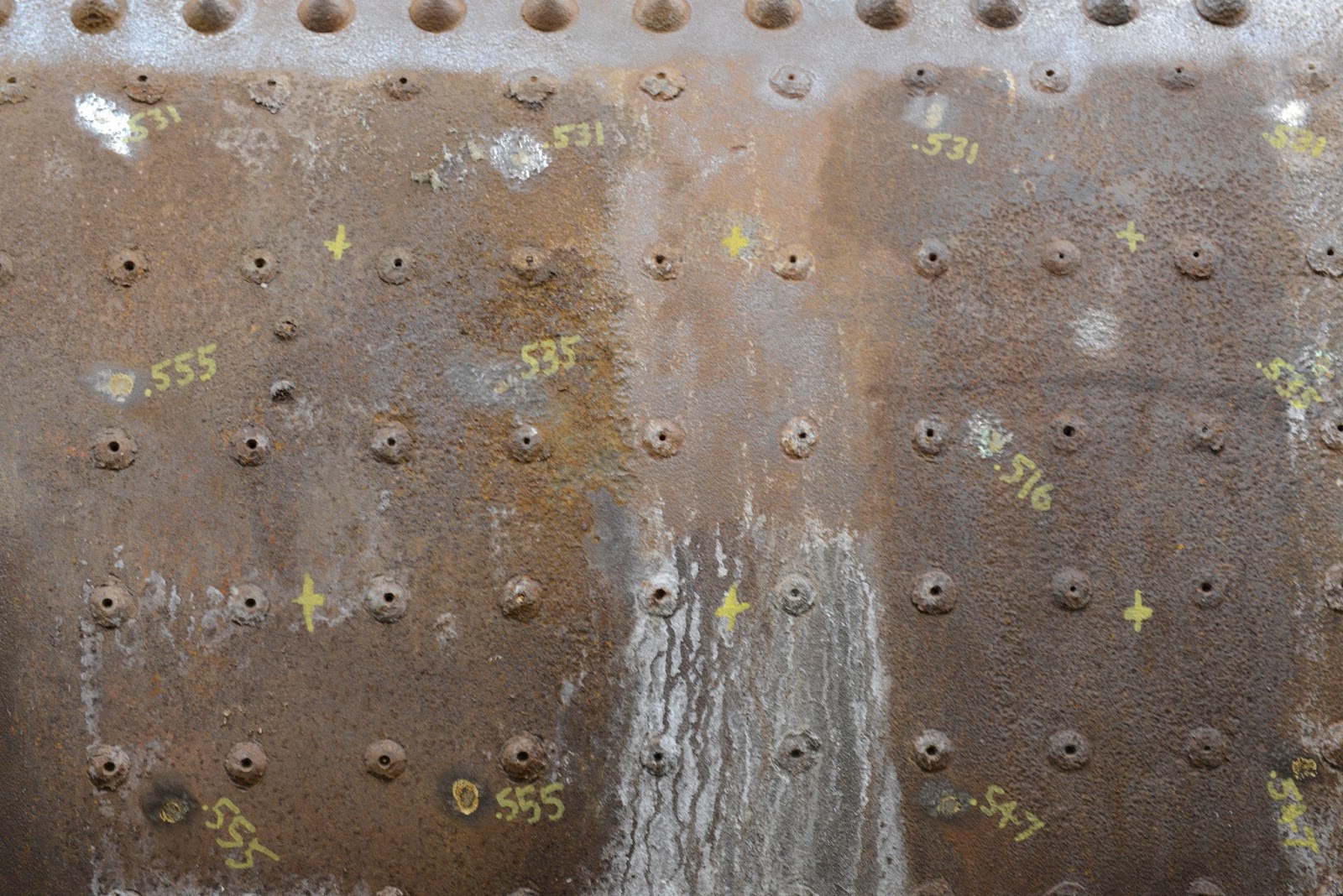
In November 2014, the boiler tubes were removed from the locomotive and a preliminary engineering package was created based upon the thicknesses and geometries of the existing vessel.  During this time, a complete ultrasonic thickness grid was laid out and measured from the water and fire side of the boiler sheets, and the results were more than encouraging.  However, for the locomotive pressure vessel to be legal under the regulations of the Federal Railroad Administration (“FRA”), the exterior jacketing and lagging had to be removed.  This allowed for a visual inspection and for documentation of the final ultrasonic thickness measurements of any critical areas that were not possible to reach from the inside of the boiler.  So following the abatement of the asbestos lagging in late July and early August, it was time to finalize the form 4 engineering package, external visual inspection, and ultrasonic grid. 

Preparing the pressure vessel for an external inspection and for ultrasonic measurements involved a variety of tasks.  First, the boiler shell was stripped of rust and scale, as well as any other appurtenances that obstructed the exterior of the boiler.  Then, a grid pattern was laid out with data points polished to bright steel so as to allow the ultrasonic transducer to couple with the material and give an accurate reading.  Any areas found to exhibit additional pitting or deterioration were also tested to find the thinnest points in each boiler component. 

Preliminary calculations indicated the pressure vessel to be in good shape, especially following the installation of new firebox side sheets in January.  However, visual inspection found questionable rivets and some cracking present in the steam dome barrel near these rivet holes.  The original design of the dome also included a longitudinal lap seam, which although legal to remain in service, would require additional inspection and care in service.  The dome ring at the top of the steam dome was also found to be cast iron, which was not a good choice for pressure vessel use due to its lack of ductility and low tensile strength.  Curator Stathi Pappas made the decision to replace the steam dome with a new fabrication using A-516-70 steel and butt strap riveted construction to provide for both safety and longevity of service. 

At this point, Curator Pappas brought in friend and colleague Jon Brewster - who is an expert in boiler calculations - to run the final numbers and determine the health of the pressure vessel with the alterations and repairs as noted above.  Although locomotives may operate with severely derated boiler pressures, these locomotives are often but shadows of their former selves in capability, power, and economy.  In order to be true living history, philosophically, locomotives should be rebuilt to behave as they would have in their period of significance.  This being the case, Northwest Railway Museum is pleased to announce that NP 924 will once again be legal for her original full working pressure of 180 psi, just as Rogers intended!!!

Following this achievement, no time was wasted in beginning the construction of the new steam dome.  A new upper ring was machined on the Museum’s 48” Bullard Spiral Drive vertical turret lathe from a 5.5” thick plate of A-516-70 steel to match the original.  This machine was able to bore the center hole removing up to 1” of material in one pass.  Now that is mid-century American machine tools being used as intended!  At the same time a new dome barrel was rolled by Liberty Metal in Portland, Oregon out of A-516-70 steel.  By mid September, the new ring and rolled round were fitted together and welded preparatory to riveting.  Although the rivets are more than strong enough to support the joints in this new dome, Curator Pappas (who is a certified 6G welder) welded the dome for additional strength, prevention of leaking seams, and dimensional stability during the riveting process.  By using appropriate riveted construction and welding, this dome may even outlast the rest of the pressure vessel.  During this time, the old dome was removed and all rivets from the dome saddle removed preparatory to installation of the new dome. 

Fall 2015 will see the completion and installation of this new dome on the 924. Following this achievement, the stay bolt work on the new side sheets can them be completed, tube sheets prepped, and the vessel will be ready for tubes and a hydrostatic pressure test. 

Stay tuned for continuing developments from the Northwest Railway Museum Conservation and Restoration Center!
 
 
"Engineering the 924 boiler" was a guest post by Northwest Railway Museum Curator Stathi Pappas.

Thursday, September 17, 2015

New exhibit installed in Train Shed

The Northwest Railway Museum recently completed the much anticipated Phase 1 exhibit in the Train Shed Exhibit Building. The railroad changed everything is the guiding interpretive theme for the building and the Tour Package program. The exhibit is stationed in the foyer of the building and consists of four double-sided panels and four exhibit cases showcasing small objects.

The exhibit was curated by Deputy Director Jessie Cunningham. In her role as Deputy Director, Cunningham is responsible for all programming including exhibits and education programs such as School Train. The Phase 1 exhibit has been a long time in the making and Cunningham is please to have it installed. After completing the content and lay-out, the panels went thru several reviews by lead docents. It was important to Cunningham that the exhibit work with the docents and the Tour Package, rather than work against them. At this time, the only public access to the Train Shed is during the Tour Package which has a tight time frame. Cunningham limited the amount of text, allowing the images to be the focus of the panels as well as help illustrate and interpret the history taught to the public during the Tour Package.

The Tour Package is available in Snoqualmie on Saturdays at 12:30pm and includes a short depot tour, train ride to the Train Shed, tour of the train shed, and a train ride to the top of Snoqualmie Falls and back. Reservations can be made by calling the Bookstore between 10am and 5pm daily.

The Museum received a grant from 4Culture to complete the exhibit. 4Culture is a huge supporter of projects at the Northwest Railway Museum as well as countless other organizations in King County. For more info on 4Culture, visit their website at 4Culture.org.

The Phase 1 exhibit will also have a companion website that will be available shortly at TrainMuseum.org.
Small artifacts include a selection of tools of the Trainman's trade as well as items passenger might encounter during a train ride.


Friday, August 21, 2015

Snoqualmie Depot celebrates 125 years!

Snoqualmie Railroad Days 2015 included a special celebration, one that occurs just once in an historic structure's life cycle. Sunday, August 16, 2015 commemorated the 125th birthday of the Snoqualmie Depot.  

It was a beautiful day in historic downtown Snoqualmie.  The temperature was in the low 70s and there was not a cloud in the sky.  More than 125 people gathered before the Snoqualmie Depot's distinctive octagonal turret to hear a dedication by Museum Board President Dennis Snook.  Surrounded by historic reenactors dressed in their late 19th Century finery, President Snook spoke of the Depot's construction in 1890, how it was completed in 90 days, and cost just $4,200. Constructed by the firm of Anderson and Scott, the Seattle, Lake Shore and Eastern Railway commissioned this unusually elaborate depot designed in the late Queen Anne style.    

City of Snoqualmie Councilmember Bob Jeans presented a proclamation from Snoqualmie Mayor Matt Larson acknowledging the Depot's birthday, its importance to the community's past, present, and future, and declaring Sunday, August 16, 2015 as Snoqualmie Depot Day. The success of the Depot as the centerpiece of historic downtown Snoqualmie has been a cornerstone of the redevelopment of the district and the City of Snoqualmie has been an important partner with the Museum.


The next presentation was by Mike Seal, one of the founding partners of Sigillo Cellars in Snoqualmie.  They dedicated a special limited bottling of wine in commemoration of the Snoqualmie Depot's 125th anniversary.  "Cab 125" is 2013 vintage of Cabernet Sauvignon available at Sigillo Cellars in Snoqualmie (right across the street from the Depot) for $25 per bottle until it is sold out.  The spectacular artwork was developed by Sharon D. Siegel and donated to the effort.


The event was capped off with a splendid "coming together" of steam and diesel in front of the Snoqualmie Depot.  Snoqualmie Valley Railroad locomotive 4012 and Santa Cruz Portland Cement 2 made a ceremonious coupling to the delight of all in attendance.  Then all attendees were invited to join the Museum's Board of Trustees for cake and lemonade. Happy 125th Anniversary Snoqualmie Depot!


Photos courtesy of Dave Honan.  Special thanks to the Northwest Railway Museum Board of Trustees for organizing the Snoqualmie Depot 125 Celebration.

Friday, August 14, 2015

Steam locomotive 924 insulation removal

Locomotive 924 is a six-coupled, former Northern Pacific locomotive.  It is held in the collection of the Northwest Railway Museum and beginning in November 2014 rehabilitation work has been underway.  The objective is to return the 924 to its former glory and operate it on the Museum's railway between Snoqualmie Falls and North Bend. 

924 ready for insulation removal
Urethane foam was used to seal weak
areas until the removal project was
ready to begin.
Since the fateful day last November when the locomotive was pushed into the Conservation and Restoration Center, the boiler interior has been stripped of tubes and scale, the Form 4 engineering package begun (regulatory requirement for operating a steam locomotive), new firebox side sheets fabricated and welded in place, a new all riveted tender cistern fabricated, the tender frame rehabilitated for service, and tank installed on the frame.  However, a major hurdle for the completion of the boiler work remained the locomotive's jacketing and insulation.  In order to complete the Form 4 process, the exterior of the boiler had to be stripped for visual inspection, and the final ultrasonic thickness data collected.  

Director Anderson and
Curator Pappas wore
elaborate protective
equipment.
Preliminary testing determined that the insulating material was a form of asbestos, commonly used for locomotive boiler insulation, but now found to be harmful to human respiratory systems, causing malignant cancers, formation of plaques that inhibit lung function, and a host of other nasty, potentially life-ending conditions. Needless to say, the work of removing this material needed to be performed in a safe manner for everyone involved.  Hiring a remediation contractor is quite expensive, and it was the suggestion of volunteer Zeb Darrah to obtain the necessary training and certification to legally conduct the remediation in house.  He recommended several potential training programs, and did the majority of the preliminary fact finding for the legalities of doing this work in house. In preparation for this museum director Richard Anderson and curator Efstathios Pappas received training from Argus Pacific, a private firm that specializes in hazardous material handling training.  

Edwin from Global Asbestos
Contractors checks verifies
the entry door seal on the
containment structure.
In early August, remediation work began working with Global Asbestos Abatement, a licensed asbestos contractor.  By partnering with this firm, valuable advice and experience was available to the team, but perhaps more importantly the necessary equipment to complete the job safely and effectively.  

A double-wall containment structure
was built over locomotive 924.
Over the course of three days, the mandated double wall containment was constructed of polyethylene sheeting, and taped so as to be air tight to a minimum of -.018 inches of mercury with HEPA negative air machines running.  A three stage decontamination chamber was built and attached to the front of the enclosure, and pre-abatement samples taken so as to demonstrate a clean and safe working environment, and provide comparison for the post abatement samples.  All work conducted in the enclosure was accomplished using full face respirators with external supplied air, full coverage Tyvek suits, as well as appropriate personal protective gear such as hearing protection, gloves, etc.  

Insulation is sprayed with water prior
to removal to reduce the likelihood
that fibers will be introduced to the
atmosphere.
The removal of the jacket and insulation took approximately a day and a half to remove and safely bag for disposal.  Although the original jacket was in very poor shape, the reason for involving trained museum professionals in the actual remediation was highlighted in the data collected that will be useful as rehabilitation of the locomotive continues.  Hardware such as boiler band brackets, washout plug ferrules, and other assorted hardware was removed, cleaned and saved for reuse.  In addition, various samples of trim treatments, riveting of jacket panels, etc were also saved, and will allow the team to match the original methods of construction as closely as possible.  Illustrating how this benefits the Museum was a discovery made on the inner surface of the jacket located just beneath the hydrostatic lubricator bracket: an uncorroded patch of the original American Iron boiler jacket surface.  Samples such as these are rare because the oxide finish of both Russian and American Iron was extremely prone to corrosion and loss if not kept continuously oiled.  Curator Pappas noted the extremely oil soaked appearance of the jacket and insulation in this area due to frequent overfilling and leakage of the hydrostat over many decades of service, and was particularly mindful of the potential presence of an unadulterated sample.  

Clean boiler!
Following the removal of the material, the arduous process of cleaning all surfaces of the locomotive and containment began.  The next three days were required to assure the successful completion of the job.  The surface of the boiler was rough due to surface corrosion, and provided an ideal surface for asbestos fibers to be trapped and potentially endanger individuals working on the locomotive in the future.  To avoid this possibility, all flaky rust was removed with a chipping hammer and wire brushed while moistened to clean the surface.  More aggressive methods such as needle gunning and wire wheeling are usually not employed as these can raise the concentration of fibers in the containment to unsafe levels, even with full face mask protection.  After this step, all surfaces of the locomotive and containment were vacuumed using a HEPA vaccum cleaner, and all debris double bagged and removed from the containment.  Although this may sound like a relatively simple matter, the work in full protective gear on a hot summer day can be exhausting!

After the insulation was double bagged
and removed, the enclosure room was
cleaned and locked down. An air
sample was collected during a two
hour interval to verify that there was
no airborne fibers prior to removal of
the containment.
Once everything was cleaned, a final wash down with water was conducted over every surface.  The water was then collected below the engine, and pumped through approved water filters to remove any asbestos micro fibers.  All of the secondary inner walls of the containment were sprayed with a fixative called Lockdown, taken down, rolled, and double bagged for removal.  Then all primary surfaces were also sprayed with lockdown and clearance air samples taken.  This last step is critical to assure the safety of anyone in the shop, as once the containment is breached, any contamination will remain.  After the samples were examined by a third party local laboratory, air quality was found to be ideal, with the lowest presence of asbestos recordable!  

Although a great deal of time and effort was expended to conduct this remediation, the money saved, and opportunities for artifact care and documentation were worth the effort.  With this work completed, it is time to finish the boiler work and proceed to the running gear.  Look for more updates soon as Snoqualmie rings with the sounds of heavy boiler work again!  Until then, we hope to see you all in Snoqualmie.