Thursday, October 28, 2010

Congressional candidates visit

This month the Northwest Railway Museum was honored to receive visits from both Congressional candidates. Early in October candidate Suzan DelBene toured the Conservation and Restoration Center. Then on October 28 Congressman Dave Reichert toured the Museum.

Reichert was in town to tour downtown Snoqualmie’s infrastructure reconstruction. That project is replacing sidewalks, burying overhead utilities, replacing street furniture, and expanding parking. A federal grant is helping fund this downtown revitalization project situated across the street from the Snoqualmie Depot.

Congressman Dave Reichert toured the Snoqualmie Depot, the Museum’s 1890-built National Register train station. Snoqualmie Mayor Matt Larson proudly highlighted the depot’s new public restrooms, an innovative partnership between the City of Snoqualmie and the Northwest Railway Museum that benefits tourists, including 90,000 Museum visitors per year. The restrooms were completed earlier this year funded by Lodging Tax dollars collected at the Salish Lodge and Spa, and represent one of the many ways Snoqualmie is supporting the museum.

After the depot tour, the Congressman climbed aboard locomotive 4012 (a 1954-built Baldwin RS4-TC) for the short trip to the Railway History Center. On the final segment of the journey, Reichert had an opportunity to student engineer. He received some instruction and eased the locomotive to a stop outside the Conservation and Restoration Center. There, he received a tour of the Train Shed and Conservation and Restoration Center.

Photos from top to bottom:
Tour of the Snoqualmie Depot. (L to R) Sue Van Gerpen, Marketing Manager; Richard R. Anderson, Executive Director; Congressman Dave Reichert; Snoqualmie Mayor Matt Larson, Jessie Cunningham, Educator.
Snoqualmie Mayor Matt Larson & Congressman Dave Reichert view the new public restrooms in the Snoqualmie Depot.
Congressman Dave Reichert operates locomotive 4012 en route to the Railway History Center.

Friday, October 15, 2010

Train Shed: where past and future intertwine


“Some of you might have thought we were going to pound in the golden spike,” said Museum Director Richard Anderson at the Train Shed Dedication October 2, “but that’s not the case.”

He went on to outline how in 1900 the Great Northern Railway had recently acquired controlling interest in the Northern Pacific Railway and was on the verge of insolvency. At that time, the sale of 900,000 acres of land to Frederick Weyerhaeuser forever changed the fortunes of the Pacific Northwest, because a few weeks later Frederick launched the Weyerhaeuser Timber Company, and the railroad became the primary connection between producer and customer.

“So I believe it’s rather fitting that we celebrate the completion of the Train Shed with the placement of two juvenile trees, one a Douglas-fir and the other a western redcedar.” These two species played vital roles in the success of Northwest forest and rail industries.

While dignitaries dedicated the Doug-fir, other special guests - children and teens - dedicated the western redcedar. “Even though we’re representing history here,” said Anderson, this facility “is all about tomorrow. And for tomorrow, it’s the youth of today.”

“How exciting it is to see people coming here today in strollers and on walkers,” King County Councilmember Kathy Lambert remarked. “It is both ends that make [this project] so important.... I want you to know that we appreciate what’s happened here. It’s part of the economic development. It’s part of...the city having a new vibrance. It’s really exciting to see.”

In the creation of this new exhibit building, history and future unite in a number of ways. While Lambert spoke of vision, Snoqualmie Mayor Matt Larson presented another forward-moving concept. “If I was to pick one word to describe a theme for where Snoqualmie and the Northwest Railway Museum is right now in its history, that word would be momentum,” Larson said. “This town of Snoqualmie had not had a lot of great things happen for several decades. It just went into a lot of slow decline.... It takes a tremendous amount of effort to start that momentum, just to get things moving.”

Snoqualmie Councilmember Bob Jeans added, “Not only is our history tied together, but the future of Snoqualmie and the future of the Museum are inexorably tied together.”

The Train Shed honors history. But it’s also making history. The project is possible because of a complex land exchange never before done in Washington State. The Museum offered up some land down the road, and King County, the City of Snoqualmie, the City of North Bend, the State of Washington and Meadowbrook Farm Preservation all approved a transfer which enabled the Museum to create a 6-acre site in combination with its railroad right of way. Another first: the North American Railway Foundation, based in Harrisburg, Pennsylvania, made its first contribution in Washington State to this project.

A further way in which yesterday and tomorrow join forces is in the building itself, in design and materials. The Train Shed and grounds feature natural lighting, recycled steel, locally produced concrete, ultraviolet-filtering windows, a rain garden, pervious pavers and native plants, plus other sustainability-driven innovations.

“But in the end,” said Museum Director Anderson, “this is really about all of you. Successful museums are engaged with their communiities, and achieving that engagement is the very essence of a museum’s success. For the Northwest Railway Museum, it means having an engaged and representative board of trustees, being located in an open-minded and inclusive community, having participation from a broad spectrum of volunteers and earning the support of individual donors from across the region.”

The Museum is grateful to many supporters and donors, including State Representative Jay Rodne, whose support helped secure substantial funding for the project; the Puget Sound Regional Council; and 4Culture, who awarded the Train Shed’s first large grant, which the Museum repeatedly leveraged for additional outside funding.

So what do you think? As the Douglas-fir and western redcedar take root and grow, will they symbolize yesterday or tomorrow? Or - in their branches as in the Train Shed - will past and future intertwine?


Photos from top
to bottom:
Train Shed groundbreaking ceremony August 5, 2009
Train Shed dedication October 2, 2010
Western redcedar sapling

Youth dedicatin
g western redcedar
"People here today in strollers and on walkers"
Museum President Susan Hankins, Snoqualmie Mayor Matt Larson and King County Councilmember Kathy Lambert
Snoqualmie Councilmember Bob Jeans

Guests enter the Train Shed
Train Shed interior
After the ceremony
Special performance by world-renowned violinist Lenore Vardi
Douglas-fir sapling
Special train arrives at the dedication event


To view a video of the Train Shed Dedication, click here.

Tuesday, September 28, 2010

Weyerhaeuser Timber locomotive 1 rehabilitation

Weyerhaeuser is perhaps the best-known forest products company in the Northwest and has a long and colorful association with railroads. It was formed in 1900 shortly after Fredrick Weyerhaeuser purchased nearly 1 million acres of forestland from the Great Northern Railway’s James J. Hill (athough technically Northern Pacific Railway land). By 1903, Weyerhaeuser had over 1.5 million acres of land and would soon become a dominant industry force.

In the coming decades Weyerhaeuser got involved in many of the most successful forest product operations in the Northwest including the Snoqualmie Falls Lumber Company and the White River Lumber Company, two of the most significant forest industry operations in King County.

White River Lumber was based at Enumclaw, Washington until its operations wound down in the early 21st Century. In its earlier years, logging was conducted by rail. A series of railroad spurs was built into the woods and radiated from Enumclaw. Steam locomotives dominated these lines until the summer of 1951 when a brand new locomotive arrived – a Fairbanks Morse H12-44 diesel electric locomotive. This modern locomotive was designed around the famous FM opposed-piston D38 1/8 marine diesel engine. This workhorse was well-built by standards of the day but its unusual diesel engine design was poorly understood by the railroad industry and did not become widely popular.

White River’s Fairbanks Morse locomotive carried the number 1 and for nearly three years operated on the logging railroads radiating from Enumclaw. (For a period of time, it also operated with White River caboose 001, also in the Museum’s collection.) However by 1954, logging operations had transitioned to trucks and the locomotive 1 was relegated to the short branch line connecting the mill with railroad interchanges on the Northern Pacific Railway and the Milwaukee Road. Later, it was transferred to Weyerhaeuser’s operation at Vail, and still later was sold for use as an industry switcher.

Locomotive 1 was acquired by the Northwest Railway Museum in the 1980s. It is complete and has remained in service for nearly 60 years. It saw a number of repairs and minor modifications but remains largely “original.” Notwithstanding, 59 years of service exacts a toll and locomotive 1 was in need of attention.

Beginning in November 2009, locomotive 1 has been undergoing a major rehabilitation in preparation for exhibition in the new Train Shed exhibit building and to allow its continued use on the interpretive railway. Work has included electric traction motor cleaning and brush replacement (see 18 November 2009 blog post), replacement of the piston rings in the upper pistons (to be detailed in an upcoming blog post), steel carbody repairs, and extensive preparation for repainting. Aided by a grant from the National Railway Historical Society (“NRHS”) the work has been performed in the Conservation and Restoration Center by a combination of volunteers and contractors. The project is expected to wrap up later in 2010 and is valued at nearly $25,000.
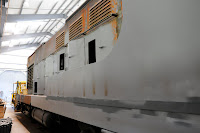
Carbody: Fairbanks Morse built a very robust carbody but steel plus water still equals rust. So badly deteriorated steel sheeting along the side of the battery boxes was cut out and replaced. A plasma cutter was used to remove the rusted panels and a Metal Inert Gas (“MIG”) electric welder was used to replace them with new. Meanwhile, a metal skirting – part of the Raymond Lowey-designed streamlining – was cleaned and primed for reattachment. New metal studs were cut and welded to the side of the locomotive and the skirting was in turn welded to the studs. Several broken and cracked welds found elsewhere on the carbody were also repaired.

Paint preparation: At some point in the locomotive’s past, two incompatible paints were applied. As a consequence, at 59 years of age, paint was peeling off in large sheets. Unfortunately, the only effective way to address coating failure is to remove the failed coatings. Abrasive blasting is often used to remove old paint from steel but it can be very hard on old locomotives. Grit can get into bearings and the force of the blasting can damage the steel panels. So the Museum used a more labor intensive but less damaging method called needle scaling. A needle scaler has a set of metal pins that are fired at paint or rust and the concussion causes the foreign material to break off and separate from the steel. A common application has also been to remove scale from the inside of a boiler. After the majority of the paint and rust has been removed in this manner, a sander is used for final surface preparation. Then it is primed with a polyurethane primer.
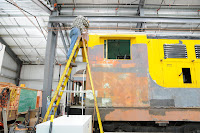
After the entire locomotive is prepared, it will be painted with a high gloss industrial polyurethane coating. It will be placed on exhibit in the new Train Shed exhibit building in 2011.

Friday, September 17, 2010

Hot riveting

Traditional methods and materials are essential to good collections care at a railway museum. So over the last nine months, Volunteers and full time staff at the Northwest Railway Museum have been learning to hot rivet. Hot riveting was (is) used to attach two or more metal parts and was widely used in car and locomotive construction prior to the widespread introduction of electric welding. It is labor intensive and is almost a lost art.

The riveting crew recently had an opportunity to try out their skills. The Museum has contracted to perform some rehabilitation work on Issaquah Historical Society’s former Weyerhaeuser caboose. A damaged section of side sheet needed to be reattached to the side sill. So approximately 36 replacement rivets were required.

A gas-fired forge was moved from the Conservation and Restoration Center to the Issaquah Depot. An air compressor, a rivet gun, and some hand tools also made the trip. And on a cool September morning, all the tools were set up to begin riveting.

The replacement section of side sheet was welded to the existing car side a few days prior. Holes were predrilled and aligned with the side sill. The gas forge was lit and rivets were set inside to begin heating. Meanwhile, the rivet gun was oiled and connected to the air supply. Allan W. volunteered to do the honors and climbed under the caboose to operate the gun.

When the rivets were orange, Roger S. picked up a rivet with the tongs and inserted it into a hole in the caboose side. Clark M. alternating with Bill W. “bucked” the rivet with a second unpowered rivet gun while Allan W. operated the powered rivet gun. The die in Allan’s gun shaped the now red hot end of the rivet into an oval head to secure it on the inside of the caboose frame. As the rivet cooled, it shrank and pulled the side sheet very tightly against the side sill.

Check out this video showing the process:

Tuesday, September 14, 2010

Dining by rail

The shelf labeled “Dining on the Train” is always a big draw for browsers at the Northwest Railway Museum's Depot Bookstore in Snoqualmie, WA. With a couple of recent additions, the selection has broadened, ranging from serious biography to cookbooks, and from the East Coast to the West.

The biography is the newly published Appetite for America: How Visionary Businessman Fred Harvey Built a Railroad Hospitality Empire That Civilized the Wild West by Stephen Fried. Fred Harvey created the best-known food service operation in America, encompassing restaurants, hotels and dining cars on the Santa Fe Railway from Chicago to the West Coast. Fried details Harvey’s creation of “the first national chain” – a chain that, unlike modern-day chain stores and restaurants, was known for raising, rather than lowering, quality standards when it arrived in a new town.

The Fred Harvey phenomenon has inspired more than one book (not to mention a Judy Garland musical). The Depot Bookstore also offers the popular Harvey House Cookbook: Memories of Dining Along the Santa Fe Railroad by George H. Foster and Peter C. Weiglin, which combines history with recipes from various Harvey venues. Then there’s When Molly Was a Harvey Girl by Frances M. Wood, a novel about the adventures of a teenage (13 pretending to be 18) Harvey House waitress in New Mexico, written by the great-granddaughter of a Harvey girl.

Moving on from the Santa Fe, the latest addition to the dining shelf is Dining on the B&O by Thomas J. Greco and Karl D. Spence, a handsome volume of recipes and menu reproductions from the Baltimore and Ohio Railroad published in association with the famed B&O Railroad Museum. And from the other side of the continent, the bookstore has Dinner Is Served: Fine Dining Aboard the Southern Pacific by Jim A. Loveland, a former public relations manager for the SP.

Two items in the store offer looks at a variety of railroad dining experiences: Dining Cars and Depots: Train Food in America by Patricia B. Mitchell, with recipes from regional carriers such as the Georgia Southern and the Missouri Pacific; and the Great Recipes From Great Trains notepad, with two dozen recipes from the likes of the Twentieth Century Limited and the Super Chief.

Finally, Dining Car to the Pacific: The “Famously Good” Food of the Northern Pacific Railway by William A. McKenzie, tells the story of dining service on the Snoqualmie depot’s own railway, and concludes with more than 150 recipes. Written by a former public relations manager for the NP, it includes photos of the line’s dairy and poultry farms in Kent, and its Seattle commissary. The latter, when constructed in 1914, featured a 40-foot representation of the NP’s famous “Great Big Baked Potato” on the roof, complete with a glowing cube of butter and a spoon.

The recipe for those famous potatoes is included, but if you’re going to try one, bring your appetite – and your patience. They took two hours to cook, and ran up to two pounds each!

Thursday, August 5, 2010

Train Shed substantial completion

A vision dating from the Museum’s incorporation in 1957 has been realized: construction of an indoor exhibit hall. The building has achieved substantial completion and the contractor is working to complete a short punch list of corrections. The completed structure is one of the most significant railway museum facilities west of the Mississippi River and the only facility of its type in the Northwest.

The Train Shed incorporates 25,000 square feet and when track construction is complete will have 1,130 track feet inside the heated space. Concrete walkways provide public access to all tracks as required or desired. The structure is nestled in the forest providing an appropriate and unmistakable connection with the industry that was defined by late 19th and early 20th Century railroad construction: the forest industry.

The Train Shed addresses the two most pressing needs for the Museum’s large object collection: preservation and access. The Train Shed will allow a dramatic improvement in program quality and allow services to be offered equally well in the winter and summer. Its heating and ventilation system helps preserve the large artifacts, but also makes the environment comfortable for the visiting public.

The greatest impact will be on the most vulnerable objects in the Collection, typically cars built predominantly of wood. For these objects – many of which were built in the late 19th Century or very early 20th Century – heated indoor storage and exhibit space this new facility is essential to their preservation. A notable example is the chapel car 5 Messenger of Peace, which will make the Train Shed its permanent home following completion of its rehabilitation.

Conceptual planning and fundraising for the Train Shed began more than seven years ago when permitting for the Conservation and Restoration Center was underway. Following design and permiting, a contract was awarded to Wick Constructors of Bellevue. Construction began in July 2009 and completion was projected for early 2010. Unfortunately a variety of factors conspired to postpone completion including delays in the arrival of exterior cladding, and a problem boring the augercast pilings, but the completed structure is everything the Museum’s leadership envisioned. The completed structure is stunning for its functionality and appearance.

The Train Shed has earned a temporary occupancy permit. Additional work includes construction of the railway track, landscaping, and exhibits. Track – over 2,300 feet and six turnouts – is being constructed by Museum Volunteers; materials began arriving in July. The temporary occupancy permit allows the public to use the facility however under the limited operations planned for the next few years all public visits will be guided by a museum docent.

The Train Shed is the most ambitious project in the Museum's 53 year history. It is the largest component of the planned Railway History Center and is the only railway museum structure of its type in the Pacific Northwest. Total project costs top $4.1 million; funding has been provided by individuals, foundations, regional government, state government and the US government. Additional funding is required to continue developing the Railway History Center and contributions are gratefully accepted on the Museum's web site at https://www.trainmuseum.org/nrm/ssl/Donation.aspx


Wednesday, June 16, 2010

Partners in Preservation funds chapel car

Chapel car 5 Messenger of Peace has been awarded funding by the Partners In Preservation (“PiP”). PiP is an initiative of the National Trust for Historic Preservation and the American Express Foundation, and this was the fifth year of the competition. The $50,000 grant has been made to support rehabilitation of car 5’s deteriorated structure, windows, assist in replacement of the special railcar pews, and other interior components.

25 projects competed for funding in a public vote. The top vote getter was awarded full funding and other projects were awarded grants by a committee based in part on the popular vote, but also on the overall impact of the project, viability, and sustainability. The chapel car was one of 11 projects funded by the program. Other notable projects competing for funding included the Kirkland Arts Center, King Street Station, Washington Hall, Point No Point Lighthouse and Ferry House at Ebey’s Landing.

Each historic site was responsible for rallying the public to vote. Techniques such as Facebook, fliers, emails, word of mouth, web site announcements, and open houses raised awareness of the projects. The public was invited to vote for their favorite project once a day for 30 days and the top vote getter was fully funded. In an interesting twist, two projects tied for first place: the Schooner Adventuress and Town Hall Seattle. Nine additional projects – including Messenger of Peace – were also funded. The remaining 14 projects received a $5,000 grant to help their projects proceed.

Chapel car 5 Messenger of Peace was built in 1898 for the American Baptist Publication Society and served until 1948 traveling through more than 11 states including Washington and Oregon. It was introduced as “a tool of modern evangelism” and its work touched the lives of thousands of people. It is listed on the National Register of Historic Places and is a City of Snoqualmie Landmark. A major rehabilitation effort is about to begin supported with funding awards from 4Culture, Capital Projects for Washington’s Heritage, Save America’s Treasures, private donations, and now Partners in Preservation.

Following completion of the rehabilitation effort, Messenger of Peace will be placed on exhibit in the new Train Shed exhibit building now under construction in Snoqualmie. It will be used in part to interpret how railroads were used to bring new ideas to communities.