Friday, March 11, 2011

Working on the Railroad success

Many charities run benefits that are designed to just make money. Others run events that inform, educate and entertain, but also support the institution. Working on the Railroad 2011 was the latter.

The Northwest Railway Museum hosted its second annual benefit dinner on Friday, March 4, 2011 at the Salish Lodge and Spa in Snoqualmie. A total of 90 people were on hand for an evening themed around chapel car 5 Messenger of Peace, the National treasure now being rehabilitated in the Museum’s Conservation and Restoration Center. Proceeds will benefit the chapel car rehabilitation effort.

Guests were treated to a splendid meal prepared by the Salish’s executive chef. Each table was adorned with a collection plate loaned from Snoqualmie United Methodist Church, Mt. Si Lutheran, and North Bend Community Church. A short three item live auction conducted by Phil L. followed (a silent auction operated during the cocktail hour) with great items including the opportunity to be a locomotive engineer for an hour. Then, local actors Gary Schwartz and Denise Paulette took on the roles of Reverend and Mrs. Neil, the first missionaries assigned to chapel car 5 Messenger of Peace. They dramatized several notable moments in the car’s early history and talked about what it was like to live on a railroad car for two years with just 200 square feet of personal living space. The evening finished off with a lovely cake prepared by George’s Bakery in North Bend.

Thank you to the many donors including North Bend Theatre, Salish Lodge and Spa, North Bend Bar and Grill, Charmichael's True Value, Hit Entertainment, Think2a, Down to Earth Flowers and Gifts, Boxley’s, Down to Earth Photography by Mary, the Museum of Flight, Bob M., Rocky B., Allan W., James D., Rocky B., Russ S., & Jon B.

Working on the Railroad 2011 was a successful event raising awareness of the chapel car project and helping support its rehabilitation. Thank you to all the wonderful businesses and individuals in the community who made it a success!

Photograph: Guests at Working on the Railroad included (L to R) North Bend Mayor Ken Hearing, Gary Schwartz portraying the Reverend Neil, Denise Paulette portraying Mrs. Neil, Museum Executive Director Richard R. Anderson and Snoqualmie Mayor Matt R. Larson.

Thursday, March 10, 2011

Research and the process of education

Education at the Northwest Railway Museum has many levels. It is interpretation – whether a small or large exhibit or even a sign found around the site. It is education programs like Pre-School Train and School Train. It is educational tours of the Depot or the CRC. It is also the train rides which begin again in April. Education has many levels, all of which require background knowledge of the subject matter to be presented, and background knowledge comes from research.

Sometimes the research has already been done and all one needs to do is read and absorb the information so they can present it in a coherent manner (whether in verbal or written form). Often times, though, research is required. So where to begin? Once you have your topic, the easiest first step is searching our archives. What does the Museum have that relates to the subject? Once we have established what we have, then we need to determine what we need. This could be written material to build our content, photos to add visual depth to the presentation, or archival documents to connect people and events across time.

There are some great online resources to help with this type of research, among them is the University of Washington’s digital collections, Washington State Archives, and the Library of Congress digital collections. There are many additional sites that can be very helpful, but these three are a great place to start looking for information and resources.

On a recent online trip we found multiple images and maps that could work well in a tentative Train Shed exhibit, along with interesting primary documents pertaining to the need – in Washington Territory – for a railroad. This research is how we begin to build exhibits and interpretation (= education) here at the Museum. And while it can sometimes be difficult locating the information you need – when you finally find, or stumble, upon the missing piece – it can be very rewarding. It is much like completing a puzzle when you don't have the box and picture to help guide your work!


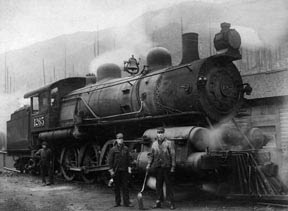
Photograph: Locomotive #1265 at Lester, WA. Longworth Collection, Northwest Railway Museum.

Certificate: Certificate of marriage, Colville, WA circa 1915. Washington State Archives.

Thursday, February 24, 2011

Annual Banquet & Volunteer Recognition

This year the Annual Banquet and Volunteer Recognition was held on Saturday February 19th at the Hilton Garden Inn in Issaquah. Acting Board President Dennis S. addressed the crowd before we enjoyed a lovely plated lunch, followed by brownies donated by George’s Bakery of North Bend. Participants enjoyed a slide show of Museum activities and programs in 2010, as well as a gift raffle. After lunch there was the State of the Museum address by Executive Director Richard R. Anderson followed by our awards ceremony. This year’s awards were as follows:

The Legacy Award recognizes volunteers who have made exceptional long-term contributions and commitments towards the success of the Northwest Railway Museum. This year’s Legacy Award winner was Jason P.. While involved for a number of years in various capacities, Jason received the Legacy award for his dedication to sound at Day Out With Thomas and RR Days and for his recent leadership in the kitchen car during Santa Train. Jason is always upbeat and seems to easily maintain composure during stressful or adverse conditions. He is a pleasure to work with – thank you Jason!

Hugh H. is this year’s Cliff Sharpe Award winner. The Cliff Sharpe Award is given to a train crew volunteer who makes outstanding contributions towards the operation of the Snoqualmie Valley Railroad. Unless he is out of town, Hugh usually spends a day a weekend on train crew, mostly as fireman or rear brakeman. This is a significant commitment towards train operations, done with a friendly demeanor and a great attitude – thank you Hugh!

The Conservation and Restoration Award is presented in recognition of outstanding service in the care of our collection of historic railway transportation artifacts. Typically the award is given upon completion of a restoration or rehabilitation project. This year, however, we chose to honor an individual’s body of work on a currently incomplete project. Marty B., a travelling volunteer, put in 550 hours in three months on the coach 218 project before heading south to warmer weather. Marty primarily worked on windows and was able to complete a significant amount of work. We will always think of Marty when we see coach 218’s windows!

This year’s Community Partner Award goes to Phil S. and Lisa M. of Finaghty’s Irish Pub & Restaurant. Phil has volunteered to manage the main stage during Snoqualmie Railroad Days, including finding and hiring bands, hiring the sound engineer and getting the stage donated. As music is a very important component of the event – having someone volunteer to take care of the whole thing has been greatly appreciated. A big thank you to Phil and Lisa for their community support of our RR Days event!

All in all it was another great day! Thank you to all the volunteers and special guests who attended the banquet - we thoroughly enjoyed the event and hope you did too.

Tuesday, February 22, 2011

"The scenes of the last few days haunt me"

I don’t know about you, but I grew up thinking history was all dates, wars and Important Names. But the word story is in there for a reason.

In college, my American Westward Movement professor radically transformed my tinder-dry concept of history. He sat back, put his feet on his desk and filled the hour with stories. The voices of nameless, lonely women going crazy on the Great Plains where the wind never ceased, and of countless families mournfully giving up their most cherished objects to lighten their load as they rolled west, have never left me.

So it’s pretty cool when a museum finds just the right object to ignite interest and, better yet, insight into the lives of those who came before us. Chapel Car 5 Messenger of Peace is one such object. It’s not that Important Names weren’t associated with this railway car. They were. Thomas Edison provided phonographs for most of the chapel cars - attracting even the non-religious. And W.C. Coleman (an Important Name to the campers among us) installed his new lighting system free of charge when he saw for himself the need for brighter, more reliable light.

But they’re not what make Chapel Car 5 Messenger of Peace nationally significant. The car’s uncelebrated role in “taming the West” - the number of ordinary lives touched and townscapes altered - infuse it with enduring meaning.

“The scenes of the last few days haunt me,” wrote Reverend Neil in 1900. Rev. Neil, accompanied by his wife Nellie, was the first pastor aboard Chapel Car 5. He was in Missouri, stunned by the superstition, drunknenness and lack of education prevalent there. Rev. and Mrs. Neil’s work not only resulted in the establishment of Sunday Schools and churches. Secular schools were erected in at least two Missouri communities as well.

Further west, the chapel car attracted people who as a rule never set foot inside a church. One pastor said, “...this is the story everywhere. The compactness, the dignity, the simple beauty of the car wins the people."

Well, maybe dignity wasn’t always what drew people. "I've been to a good many circuses, and I've seen all the grandest exhibitions that have come west,” said one man, “but this is the biggest show yet."

Chapel Car 5 has carried many things. Now it’s carrying stories into the 21st Century. You’ll have an unprecedented opportunity to hear stories of Rev. Neil and those whose lives the chapel car touched, during a theatrical presentation Friday, March 4, at the Salish Lodge & Spa. Hosted by the Northwest Railway Museum, “Working on the Railroad” includes chapel car stories, a delicious dinner and a small silent auction, all near the famous Snoqualmie Falls, from 6:00-9:00 PM. Tickets must be purchased in advance; proceeds benefit Chapel Car 5.


Illustration above of Thomas Edison speaking into phonograph courtesy FCIT

Wednesday, February 16, 2011

Chapel car rehab begins

The chapel car 5 Messenger of Peace’s rehabilitation has begun in earnest. The Museum has been fundraising for this long-planned project for over three years. On January 31, 2011 a crew consisting of a project manager, lead restoration woodworker and restoration woodworker began working fulltime. Clark M., Kevin P., and Meghan G. work on the chapel car 5 days a week. Already, progress is apparent on this 1898-built National treasure.

All the original wood siding – or cladding - has been carefully removed and stored for repair and reinstallation after structural repairs are completed. (Watch the video at the end of this post to see cladding removal using a slide hammer.) Some sections of cladding are being set aside for preservation, specifically those pieces that that carry the faded but discernible lettering: "Entrance" on the kitchen stove (right) side and "Messenger of Peac" (sic) on the Baker heater (left) side. Both lettering examples date from circa 1924 and have survived because at that time the car was “modernized” with light sheet metal. These pieces of car siding are extremely delicate and have been treated with ‘Smith’s Penetrating Epoxy’ to stabilize them; they will become permanent objects in the Museum’s reference collection and will not be reinstalled on the car.

It has been over 60 years since the Messenger of Peace was deconsecrated but it continues to reveal rich heritage. Some newly uncovered evidence suggests that the car cladding was made of catalpa wood, aka catawba wood, and not the yellow poplar commonly used in the construction of passenger cars during the wood era. Samples have been sent to a forest products lab for positive identification, but so far the evidence is pretty compelling. Catalpa speciosa is native to the upper Mississippi valley, was readily available, machines well and is decay resistant. In 1906, the Messenger’s builders, Barney & Smith Car Company of Dayton, Ohio built two entire sections of a railroad passenger car out of catalpa wood, including the furniture.

The chapel car rehabilitation will continue for the next 18 months, but on Friday, March 4, 2011 at 6 PM you have an opportunity to learn more about life on the rails in chapel car service as well as an update of the rehabilitation process. Please join us Friday evening March 4, 2011 for a Working On The Railroad benefit dinner theatre for the Messenger of Peace at the Salish Lodge and Spa. Tickets are $75 and are available here.

Thank you to chapel car project manager Clark M. for writing content for this post and providing photos.

Monday, December 20, 2010

Old project, new project

Fall 2010 was an eventful season inside the Museum’s Conservation and Restoration Center. The center of attention has been a first generation diesel-electric locomotive with ties to the local forest industry and the results are spectacular! Funded with a grant from the National Railroad Historical Society, private donors and a Boeing Company matching grant, the project is wrapping up this month.

Earlier this year, the Museum began rehabilitation work in earnest on locomotive 1, a Fairbanks-Morse model H12-44 from Enumclaw’s White River Lumber division of Weyerhaeuser. Built in 1951, the locomotive has an opposed piston diesel common in the marine sector, but unique in the railroad industry. When built, the locomotive was remarkable for delivering an incredible 1,200 horsepower with just a six cylinder/twelve piston diesel.

Rehabilitation work has included car body repairs, new piston rings, new electric traction motor brushes, auxiliary generator repairs, surface preparation, new windows as required, and painting. Over 1,800 hours of effort has been invested in the project and the locomotive was moved out of the CRC last week. The lettering has not yet been applied; warmer weather will facilitate that final visual aspect of the project. Some of the work has been highlighted in Museum blog posts here and here.

Substantial completion of locomotive 1 also leads to a new beginning: chapel car 5 “Messenger of Peace” was moved into the CRC to begin an extensive rehabilitation. Earlier this year, many museum supporters participating in the Partners in Preservation initiative of the National Trust for Historic Preservation and American Express by voting for their favorite project. Those efforts resulted in a $50,000 award in support of chapel car 5. Other support includes the Save America’s Treasures award, the Capital Projects Fund for Washington’s Heritage, 4Culture and individual and corporate donors.

Chapel car 5 is listed on the National Register of Historic Places under National criteria acknowledging it as one of the most historically significant artifacts in the Museum’s collection. Rehabilitation work will include repairs to the car’s frame, especially to deteriorated sections of side sill. Work will also include rehabilitation of the exterior cladding, reconstruction of the interior living quarters, restoration of the sanctuary, and restoration of the end platforms. Project completion is expected in two years.

So the end of one project is the beginning of another.


Photos:

Top - Locomotive 1 on the CRC lead after repainting.

Second - Locomotive 1 and just a few of the dozens of people involved in its rehabilitation. Top, left to right, Allan W., Bob M., Clark Mc., Hugh H., Jon B., Roger S., & Russ S.

Third - Pettibone Speedswing moves the chapel car into the CRC.

Bottom - Project manager Clark Mc. begins assessing chapel car 5 shortly after it arrived in the CRC.

Video - images of the locomotive 1 moving out of the CRC and the chapel car moving in.

Wednesday, December 15, 2010

Rock photographer Jini Dellaccio does photo shoot at the Museum

It’s not often that rock photographers show up on the other side of the camera. But breaking with tradition is nothing new for Jini Dellaccio.

A pioneering rock photographer in the Pacific Northwest in the 1960s, Jini Dellaccio and her remarkable life and work are the subject of an upcoming documentary, now in the final stages of production, by Karen J. Whitehead, Producer/Director, Five Star Films, Inc.

Jini DellaccioDellaccio’s adventurous, varied, unplanned career took her from Indiana to Chicago to California to Washington State – from musician to graphic designer to fashion photographer to rock photographer. Her images have received international acclaim. Neil Young, The Who and Jim Valley of Paul Revere and the Raiders are among the musicians she has captured on film. Or maybe “freed” on film is what really happened to musicians when Dellaccio got behind a camera. She once told Neil Young to climb up on the roof of a garage and “fly like a bird.”

Jini Dellaccio photographs the Moondoggies at the Snoqualmie DepotDellaccio’s art and life story captivated Whitehead, who contacted the Northwest Railway Museum earlier this year for permission to film some scenes here for her documentary. “As part of the filming,” wrote Whitehead, “Jini, who still always has a camera in her hand, wants to do a photo shoot with an up and coming Seattle band. We were interested in having the wonderful scenery around your railroad and a train ride as a backdrop for this.”

In turn, Hasselblad became fascinated with Dellaccio’s story when Whitehead approached them in hopes of providing Dellaccio with the experience of shooting with Hasselblad’s new H4D-40. Hasselblad brought their new model to the photo shoot at the Museum.

Five Star Films Inc films Jini Dellaccio for a documentaryAnd the band lucky enough to be photographed by Jini Dellaccio in her 93rd year? That was the Moondoggies, who recently returned to Seattle from a California tour. The Snoqualmie Depot, the interior of Coach 213 and the corridor between the train set and the Silver Bullet all gave Dellaccio rich material to work with. How much do you recognize in this brief video, filmed during last April’s photo shoot?

Moondoggies on the Snoqualmie Depot platformThe non-profit Northwest Film Forum is providing a fiscal sponsorship for the Jini Dellaccio documentary, which allows supporters to make tax-free donations to the independent film through the Forum. For information about this and other opportunities to get involved, or for more information about the documentary, please contact filmmaker Karen Whitehead.

All photos copyright Five Star Films Inc 2010


(My thanks to Butch Leitz for providing helpful perspective for this post.)