Monday, December 20, 2010

Old project, new project

Fall 2010 was an eventful season inside the Museum’s Conservation and Restoration Center. The center of attention has been a first generation diesel-electric locomotive with ties to the local forest industry and the results are spectacular! Funded with a grant from the National Railroad Historical Society, private donors and a Boeing Company matching grant, the project is wrapping up this month.

Earlier this year, the Museum began rehabilitation work in earnest on locomotive 1, a Fairbanks-Morse model H12-44 from Enumclaw’s White River Lumber division of Weyerhaeuser. Built in 1951, the locomotive has an opposed piston diesel common in the marine sector, but unique in the railroad industry. When built, the locomotive was remarkable for delivering an incredible 1,200 horsepower with just a six cylinder/twelve piston diesel.

Rehabilitation work has included car body repairs, new piston rings, new electric traction motor brushes, auxiliary generator repairs, surface preparation, new windows as required, and painting. Over 1,800 hours of effort has been invested in the project and the locomotive was moved out of the CRC last week. The lettering has not yet been applied; warmer weather will facilitate that final visual aspect of the project. Some of the work has been highlighted in Museum blog posts here and here.

Substantial completion of locomotive 1 also leads to a new beginning: chapel car 5 “Messenger of Peace” was moved into the CRC to begin an extensive rehabilitation. Earlier this year, many museum supporters participating in the Partners in Preservation initiative of the National Trust for Historic Preservation and American Express by voting for their favorite project. Those efforts resulted in a $50,000 award in support of chapel car 5. Other support includes the Save America’s Treasures award, the Capital Projects Fund for Washington’s Heritage, 4Culture and individual and corporate donors.

Chapel car 5 is listed on the National Register of Historic Places under National criteria acknowledging it as one of the most historically significant artifacts in the Museum’s collection. Rehabilitation work will include repairs to the car’s frame, especially to deteriorated sections of side sill. Work will also include rehabilitation of the exterior cladding, reconstruction of the interior living quarters, restoration of the sanctuary, and restoration of the end platforms. Project completion is expected in two years.

So the end of one project is the beginning of another.


Photos:

Top - Locomotive 1 on the CRC lead after repainting.

Second - Locomotive 1 and just a few of the dozens of people involved in its rehabilitation. Top, left to right, Allan W., Bob M., Clark Mc., Hugh H., Jon B., Roger S., & Russ S.

Third - Pettibone Speedswing moves the chapel car into the CRC.

Bottom - Project manager Clark Mc. begins assessing chapel car 5 shortly after it arrived in the CRC.

Video - images of the locomotive 1 moving out of the CRC and the chapel car moving in.

Wednesday, December 15, 2010

Rock photographer Jini Dellaccio does photo shoot at the Museum

It’s not often that rock photographers show up on the other side of the camera. But breaking with tradition is nothing new for Jini Dellaccio.

A pioneering rock photographer in the Pacific Northwest in the 1960s, Jini Dellaccio and her remarkable life and work are the subject of an upcoming documentary, now in the final stages of production, by Karen J. Whitehead, Producer/Director, Five Star Films, Inc.

Jini DellaccioDellaccio’s adventurous, varied, unplanned career took her from Indiana to Chicago to California to Washington State – from musician to graphic designer to fashion photographer to rock photographer. Her images have received international acclaim. Neil Young, The Who and Jim Valley of Paul Revere and the Raiders are among the musicians she has captured on film. Or maybe “freed” on film is what really happened to musicians when Dellaccio got behind a camera. She once told Neil Young to climb up on the roof of a garage and “fly like a bird.”

Jini Dellaccio photographs the Moondoggies at the Snoqualmie DepotDellaccio’s art and life story captivated Whitehead, who contacted the Northwest Railway Museum earlier this year for permission to film some scenes here for her documentary. “As part of the filming,” wrote Whitehead, “Jini, who still always has a camera in her hand, wants to do a photo shoot with an up and coming Seattle band. We were interested in having the wonderful scenery around your railroad and a train ride as a backdrop for this.”

In turn, Hasselblad became fascinated with Dellaccio’s story when Whitehead approached them in hopes of providing Dellaccio with the experience of shooting with Hasselblad’s new H4D-40. Hasselblad brought their new model to the photo shoot at the Museum.

Five Star Films Inc films Jini Dellaccio for a documentaryAnd the band lucky enough to be photographed by Jini Dellaccio in her 93rd year? That was the Moondoggies, who recently returned to Seattle from a California tour. The Snoqualmie Depot, the interior of Coach 213 and the corridor between the train set and the Silver Bullet all gave Dellaccio rich material to work with. How much do you recognize in this brief video, filmed during last April’s photo shoot?

Moondoggies on the Snoqualmie Depot platformThe non-profit Northwest Film Forum is providing a fiscal sponsorship for the Jini Dellaccio documentary, which allows supporters to make tax-free donations to the independent film through the Forum. For information about this and other opportunities to get involved, or for more information about the documentary, please contact filmmaker Karen Whitehead.

All photos copyright Five Star Films Inc 2010

(My thanks to Butch Leitz for providing helpful perspective for this post.)

Tuesday, November 30, 2010

Old green, new green: Part II

This is a continuation of yesterday’s post, which outlined the Train Shed building’s sustainable and environmentally-friendly features. Today we take a stroll around the outside of the exhibit building.

Indoor ties are untreatedPart II

The site's railroad ties are made of Douglas-fir. Indoor ties are untreated. The Museum chose copper naphthenate-treated ties for outdoor use. Preferable to waterborne treatments for its low level of leaching, copper naphthenate (unlike creosote) is not listed as a restricted use product by the Environmental Protection Agency.

copper naphthenate treated tiesThe railroad track, built with open graded ballast, is not an impermeable surface. Also, pervious pavers outside the building, and a raingarden to be planted next spring with redflowering currant, cattails and other suitable plants, will enable rainwater to soak into the soil. Stormwater is captured and directed to the raingarden in front of the Train Shed and a detention pond behind the Train Shed so that all water is retained on site except during a major event such as a flood.

Sidewalk angles around treeThe sidewalk alongside the building dips and curves instead of conforming to the original straight, level design in order to avoid removing existing trees. Nevertheless, for every tree cut down, the Museum plants a new tree. Topsoil was harvested from the site and stockpiled prior to construction. The topsoil was then reused after construction was completed.

native plantsAll vegetation being planted on the grounds is native to western Washington. Doug-fir and western redcedar saplings, to be planted at the edge of the surrounding forest, were dedicated during the Train Shed celebration October 2, 2010. Mulch, made from organic material cut from the site during clearing and grading, will help protect against invasives.

When the Train Shed opens to the public, we hope you’ll enjoy the special features of the building and grounds as well as the historic treasures contained inside.

vine maplesnowberry

Monday, November 29, 2010

Old green, new green: the best of three centuries

PART I

In one sense, forestry was the Northwest’s “green” industry of the last two centuries. The Train Shed will convey part of that story while simultaneously embodying today’s green industries, such as energy efficiency, local and recycled materials, and stormwater management.

steel cladding and louversceiling fan ad metal halide fixtureClimate control is highly important to a museum collection. But the Train Shed is not air conditioned. To regulate temperature, the building relies on automatic louvers, large ceiling fans (which also prevent pockets of moist air from settling) and heavy insulation. The US Department of Energy recommends an R-value of R-16 to R-21 for home wall insulation in King County. The higher the R-value, the greater the ability to resist heat flow. The Train Shed’s wall insulation is R-38.

natural lighting and special glassThe building’s design utilizes natural lighting. Thermopane windows (which open) are made of special glass that lets in light while blocking 95% of the sun’s damaging ultraviolet radiation. Typical window glass keeps out about 30%. Where natural light needs to be supplemented, metal halide fixtures provide bright, energy-efficient lighting. Exit lights are LEDs.

steel columnThe project incorporates a number of recycled and locally produced materials. Steel columns and beams were fabricated in Arlington, about 90 minutes north of the Museum, at BlueScope Buildings North America, Inc. Interior and exterior cladding is recycled steel, manufactured by AEP (owned by BlueScope) and rolled in Washington.

CalPortland provided concrete and crushed rock from its facility across the Snoqualmie River next to the former Weyerhaeuser mill site. The exhibit building’s low-maintenance polished concrete floor is longlasting and easy to vacuum. The Mt. Si Quarry, just up the road from the Train Shed, produced crushed rock for the sub-ballast.

polished concrete floorsTomorrow we’ll tell you about permeable surfaces, native soils and vegetation, and our preferred alternative to creosote ties in Old green, new green: Part II.

Sunday, November 21, 2010

Thanks Continental Mills!

Santa Train® 2010 is sold out but preparations continue for the 11,000 guests that will be visiting North Bend, Snoqualmie and the Northwest Railway Museum over the next 4 weekends. Dozens of volunteers are decorating the Snoqualmie Depot, preparing thousands of gifts, and getting the historic kitchen car ready for use.

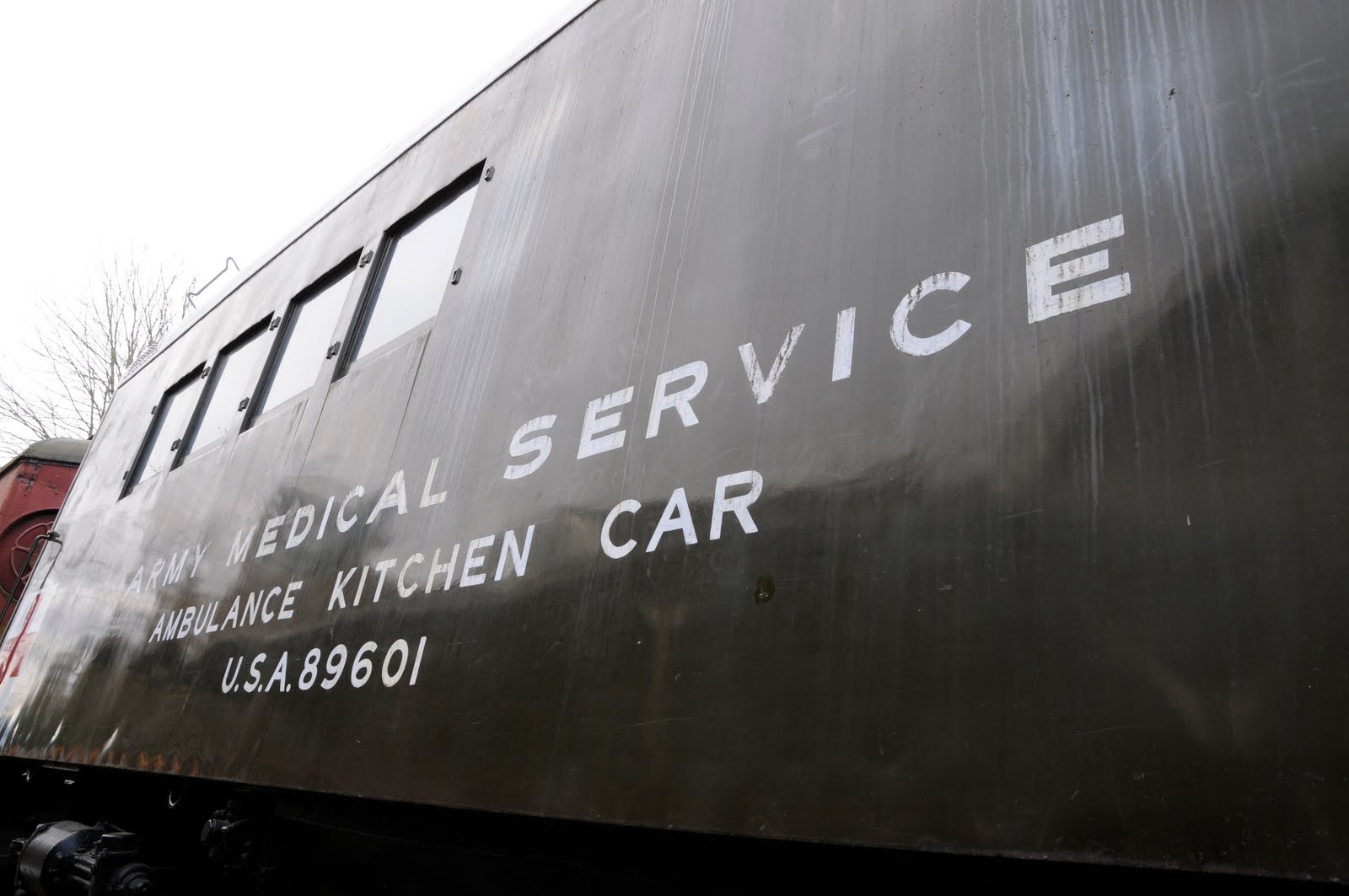
One of the most important “ingredients” for a successful event is cookie dough - enough for 22,000 cookies. Thanks to a donation of 46 cases of mix from Continental Mills of Seattle, Krusteaz® cookies will be baked and served in the Museum’s army ambulance kitchen car. Cookies are baked in the double army range fired with coal.


Cookies are produced by an efficient team of Museum Volunteers including Karen L., Kathy S., Charlsia S., Teena K., Ken L., Helga M., and Lucerne S. (Lucerne has participated in nearly every Santa Train since its inception!) and Jason P., who was camera shy. The mix the dough, load cookie sheets, tend the fire in the stoves, box the cookies for distribution during the event.

Instrumental in arranging the donation of Krusteaz cookie mix was Mike Castle of Continental Mills. Approving the contribution was Mike Merridith. Susan H. – who is the Museum’s President – contacted Continental Mills to describe the event and how the cookies will be used. Thank you Continental Mills!


The US Army Ambulance Kitchen Car 89601 was constructed in 1953 using plans refined during WW II. It was stationed at Washington’s Fort Lewis for more than twenty years awaiting a call to service that never came. Following retirement, it was purchased by Kennecott Copper near Salt Lake City to be converted to a tool car. Changes in that company’s operations saw the car surplused before it was converted; it was subsequently donated to the Northwest Railway Museum. It is a complete example of a 1953 kitchen car and features a double coal-fired army range, water raising system, ice reefers, serving and food preparation counters, and even a shower!

Santa Train is the Museum’s signature family event that was first operated in 1969 and now serves nearly 11,000 guests per year. The event features a trip by train from North Bend to Snoqualmie, a visit with Santa who gives each child a small gift, and a visit to the kitchen car for cookies, coffee and hot cocoa.

Sunday, November 7, 2010

X101 caboose caper

At the Train Shed dedication on October 2, 2010, the daughter of the late Jack Hoover of Belt, Montana announced the donation of his caboose to the Northwest Railway Museum. Christina Blackwell selected the Northwest Railway Museum to receive her father's caboose "so it can be housed inside the new Train Shed exhibit building and be accessible to the public." Initially, the caboose will be used as part of the Museum's Wellington Remembered exhibit and is typical of the type of car that could have operated through that Great Northern company town.

Caboose X101 (the first X101) was built in 1892 at St Cloud, Minnesota. A wreck-related rebuilding in 1897 and again in 1909 resulted in changes to the visual and structural characteristics of the car, but few changes have occurred since then or after retirement in 1935. Conductor Ed Shields of Great Falls retired that year too and asked the company if he could keep the caboose. They obliged him and he used a bull dozer to move the caboose 1.5 miles to his back yard. Fast forward to 1973. Jack Hoover had an opportunity to purchase the X101 and despite its then-deteriorated condition, he acquired it and moved it to his home in Belt. Years of dedicated care transformed it back to its former glory.

Receiving a donation and moving it to the Museum are significant undertakings when the object weighs 33,000 pounds and is located 650 miles from Snoqualmie. The Museum faced similar challenges when Chapel Car 5 Messenger of Peace was donated in 2007 and was able to draw on that experience to plan and execute the move of X101.


Heavy Haul Inc. of Kelso, Washington was selected to move the caboose. (They did an excellent job of transporting the chapel car and specialize in unusual moves including railroad cars.) H & H Crane Service of Great Falls, Montana lifted the caboose and trucks and placed them on the truck for shipping. In Snoqualmie, Imhoff Contractor Crane Service reassembled the caboose on the Museum's rail line. (Imhoff has been involved in a variety of Museum projects including construction of the Train Shed, Conservation and Restoration Center, Bridge 31.3 and with the chapel car move.) With completion of the move, the X101 is sitting on live rail for the first time since 1935.


Jack Hoover was a much beloved man who resided in Belt, Montana, about 20 miles from Great Falls. He was born on April 17, 1923 and lived in the area for his entire 86 years, except for 4 years of military service in WW II. He had strong interests in several fields and was renowned for his collections of guns, railroad memorabilia, western art, books and industrial architecture. Some of his firearms and western art will be perpetuated at the C.M. Russell Museum in Great Falls; his drover's coach has been preserved at the Minnesota Transportation Museum in St. Paul. A beautiful tribute to his life was detailed by Prairie Mary in her blog here. Mr. Hoover is survived by his wife Karen and daughter Christina, and by countless friends.


The Northwest Railway Museum is honored to have been selected as the recipient of caboose X101 and is incredibly grateful for the family's generosity. The caboose will be placed inside the Train Shed exhibit building in early 2011 and will be placed on public exhibit when that facility opens later in the year. It is a tribute to the late Jack Hoover that the caboose be preserved for this and future generations, and that it be used to interpret the role railroads played in the settlement and development of the Northwest.


Here is a short video of the great caboose move of 2010:


Thursday, October 28, 2010

Congressional candidates visit

This month the Northwest Railway Museum was honored to receive visits from both Congressional candidates. Early in October candidate Suzan DelBene toured the Conservation and Restoration Center. Then on October 28 Congressman Dave Reichert toured the Museum.

Reichert was in town to tour downtown Snoqualmie’s infrastructure reconstruction. That project is replacing sidewalks, burying overhead utilities, replacing street furniture, and expanding parking. A federal grant is helping fund this downtown revitalization project situated across the street from the Snoqualmie Depot.

Congressman Dave Reichert toured the Snoqualmie Depot, the Museum’s 1890-built National Register train station. Snoqualmie Mayor Matt Larson proudly highlighted the depot’s new public restrooms, an innovative partnership between the City of Snoqualmie and the Northwest Railway Museum that benefits tourists, including 90,000 Museum visitors per year. The restrooms were completed earlier this year funded by Lodging Tax dollars collected at the Salish Lodge and Spa, and represent one of the many ways Snoqualmie is supporting the museum.

After the depot tour, the Congressman climbed aboard locomotive 4012 (a 1954-built Baldwin RS4-TC) for the short trip to the Railway History Center. On the final segment of the journey, Reichert had an opportunity to student engineer. He received some instruction and eased the locomotive to a stop outside the Conservation and Restoration Center. There, he received a tour of the Train Shed and Conservation and Restoration Center.

Photos from top to bottom:
Tour of the Snoqualmie Depot. (L to R) Sue Van Gerpen, Marketing Manager; Richard R. Anderson, Executive Director; Congressman Dave Reichert; Snoqualmie Mayor Matt Larson, Jessie Cunningham, Educator.
Snoqualmie Mayor Matt Larson & Congressman Dave Reichert view the new public restrooms in the Snoqualmie Depot.
Congressman Dave Reichert operates locomotive 4012 en route to the Railway History Center.