Monday, February 25, 2013

Main Street crossing reconstruction

"We've been working on the railroad" and there is another new highway crossing to show for! 


Railroad crossings represent one of the bigger funding challenges for the Northwest Railway Museum.  With a total of 18 roadway crossings, the Museum devotes significant resources towards maintenance and reconstruction.  This latest project cost was in excess of $51,000 and replaced a double track crossing in downtown North Bend, which was required to continued operating trains into the North Bend Depot.


Concrete panels arrive and await
installation on Main Street as an
excavator sets the grade.
Main Street was last reconstructed in 1988.  Normally, a new double track crossing of that size would have cost over $100,000 and there was no funding to perform work on that scale.  Fortunately, the Museum was able to leverage several opportunities to make the project viable.

The Museum learned about a small track removal project in the City of Redmond, about 20 miles from the Museum.  There, two concrete tub crossings that were installed in 1997 were being removed to allow installation of a new sewer.  Often, used tub crossings are scrapped because they are difficult to remove without damage.  So with little commercial value, the City of Redmond was able to donate the panels to the Museum.  In the end, of the 70 panels removed, 40 were reclaimed, repaired and reused.  This “saved” the Museum over $35,000 versus the cost of new crossing tubs.
The new crossing takes shape on Main
Street in North Bend.  Concrete tubs
eliminate the use of railroad ties in the
crossing.
 
The Museum was able to secure a grant from the Washington Utilities and Transportation Commission (“WUTC”).  The WUTC is one of the agencies that provide regulatory oversight of the Museum’s railway.   They maintain a Grade Crossing Protective Fund, which awarded a $20,000 grant towards the cost of new welded rail and its installation. 

Other important project support came from the City of North Bend, which provided all the traffic control required to close the road and detour traffic, and forgave three years of user fees for the North Bend Depot for a combined benefit of over $11,000.
The crossing has been completed; it opened as soon as the
asphalt cooled.

And the Museum was able to secure some relay rail for the side track (new rail was used on the main).  As well, the Museum's dedicated volunteers were able to perform the required repairs on the used crossing panels.

The project allowed for six days of construction but it was completed in less than five.  RailWorks Track Systems, Asphalt by George, and Snoqualmie's Imhoff Contractor Crane Service performed the balance of the work. 

Thursday, January 17, 2013

quid pro quo

Pavers at east end of the
Train Shed.
In December, Spike reported here on the disposition of an object removed from the collection.  A small steam crane was moved to Ballard where it will become part of a French bistro early next summer.  As part of the disposition, the new owner of the crane provided and installed pavers for part of the Railway History Center campus.

Workers from Pavingstone Supply were on site in January 2013 to complete the installation of paving stones.  Approximately 500 square feet of decorative concrete paving stones were placed along the east and southeast portions of the sidewalk just outside the building.

Worker from Pavingstone Supply
installs pavers in front of the Train
Shed.
The pavers were called out in the original design but were not installed during the original construction.  Rapidly increasing costs lead to a cost containment program and the pavers were deleted.  A short time later, the disposal of the crane to the owner of a paving stone company presented an opportunity to get some of the pavers installed.  Something for something.


Monday, December 24, 2012

Season's Greetings

Thank you to all our Volunteers, Donors, Trustees, Supporters, Members, Benefactors, and Patrons for a wonderful and successful 2012.

A railway museum is about more than just the excitement of a train: it is education, heritage and historic preservation, community identity, the economic sustainability of a small community, and  enjoyment.  Thank you to everyone who played a part in 2012.

2013 will bring many exciting developments to the Museum: completion of the chapel car, improvements to the interpretive railway, and expanded educational programs.  We all look forward to welcoming you back to the Museum next year!

--Staff of the Northwest Railway Museum: Richard, James, Cristy, Jennifer, Jen, and Jessie. 

Friday, December 14, 2012

A 12/12/12 marriage to remember


Messenge of Peace trucks and car body married again!
Chapel car 5 Messenger of Peace has wheels again!  Messenger of Peace was married with a pair of passenger car trucks in a lengthy ceremony held on the much-coveted 12 December 2012, or 12/12/12.  The car lost its original trucks in 1949 when it was adapted for reuse as a roadside diner.  The rehabilitation work it is undergoing inside the Museum’s Conservation and Restoration Center includes elements of restoration, including the trucks.

The car body underside showing the
centerplate.

Railway car trucks are assemblies that include a frame, wheels, bearings, brakes, and a mounting plate for the car body.  For the chapel car, these trucks each have six wheels and are constructed predominantly of wood.  A blog post describing the removal process is here.
Car body centerplate and the truck
centerplate slowly come together.

Marrying trucks to a car body requires very careful alignment.  For the chapel car, 22 months of time on car stands had resulted in the car shifting slightly off center.  So the rehabilitation crew carefully nudged the car body back to the center of the tracks in a process that consumed hours.  They used a set of hydraulic jacks to undertake this work on the 60,000 lb car body.  Certainly a great deal was at stake should the car be knocked off the car stands!
Bob, Kevin and Gary roll the rear truck
under the car body.
The massive 15,000 pound trucks were rolled under the car by just three workers.  Then the car was gently lowered onto the center plate.

So 12/12/12 marks a marriage to last: the trucks and the chapel car car body.  And this is both symbolic and indicative of the final stages of this two year project to rehabilitate this national treasure.  Stay tuned for more reports about this incredible project!

Tuesday, December 11, 2012

Something old, something new

6 wheel wood, steel reinforced
passenger truck
Something old, something new, something borrowed, something . . . carbon black!

Later this month inside the Conservation and Restoration Center, the chapel car 5 Messenger of Peace will be married to its new trucks, which are special frames with wheels, bearings, and brakes.  The trucks (we think, based on castings and other details) date from circa 1901 and will get some new parts, are in a sense borrowed, and will be carbon black.  So how appropriate to now look at the origins of those trucks and how they compare to the originals.
Messenger of Peace was built by Barney and Smith of Dayton, Ohio in 1898.  The car was one of the longest cars built to that date and incorporated all the latest design advances.  It included 6 wheel trucks reinforced with steel flatbars on either side of the oak frame members.  Sadly, those original trucks were (we believe) scrapped in 1948 when the car was repurposed as a roadside diner.
The Museum has several railroad cars it has been holding to provide parts for others.  While most were originally acquired for the Collection, they were later removed either because they were redundant or because they were in very poor condition. They provide couplers, brakes, hardware, and even wood moldings to make objects in the Collection more complete.
Imhoff Crane lifts the X-127 while the
Museum's Pettibone exchanged the
trucks.

 A late nineteenth Century car called the X-127 was one such car.  It was outfitted with trucks of the same design that the chapel car was built with and they are in great shape.  They received some structural upgrades circa 1927, but are visually nearly identical to the originals.  Earlier this month, Snoqualmie’s own Imhoff Crane set up at the CRC and made quick work of the truck exchange.  They lifted the car one end at a time and replaced the original trucks with a set of shop trucks the Museum uses to move projects around.
So something old (the chapel car), something new (new center plates), something borrowed and something carbon black (black trucks from another car) will be in the marriage of chapel car 5 and its trucks.  Later, Spike will post some marriage photos along with the circa 1902 photo taken at Novinger, MO that has been used to rehabilitate the car.
Perhaps only to a curator's eye, this is a classic wood-era
passenger car truck

Saturday, December 1, 2012

Adaptive reuse

Front of steam crane
Steam crane is prepared
for shipment.
One of the great challenges facing history museums around the world is the size of their collections.  Many institutions have amassed collections that cannot be cared for with available resources.  Perhaps more troubling,even the most optimistic (but realistic) strategic plans do not project these institutions ever fully acquiring the resources needed to secure or conserve the collection, let alone conduct appropriate rehabilitation or restoration.  So what is a responsible institution to do?

The Northwest Railway Museum has offered objects that are outside its scope of collection or redundant to other museums.  Over the last 20 years, more than a dozen large objects have be sold or transferred to other institutions.  And when other museums are not interested, objects may be offered to a broader audience.
Steam crane loaded on truck
Imhoff's 65 ton conventional crane
makes quick work of lifting the
circa 1903 steam crane.
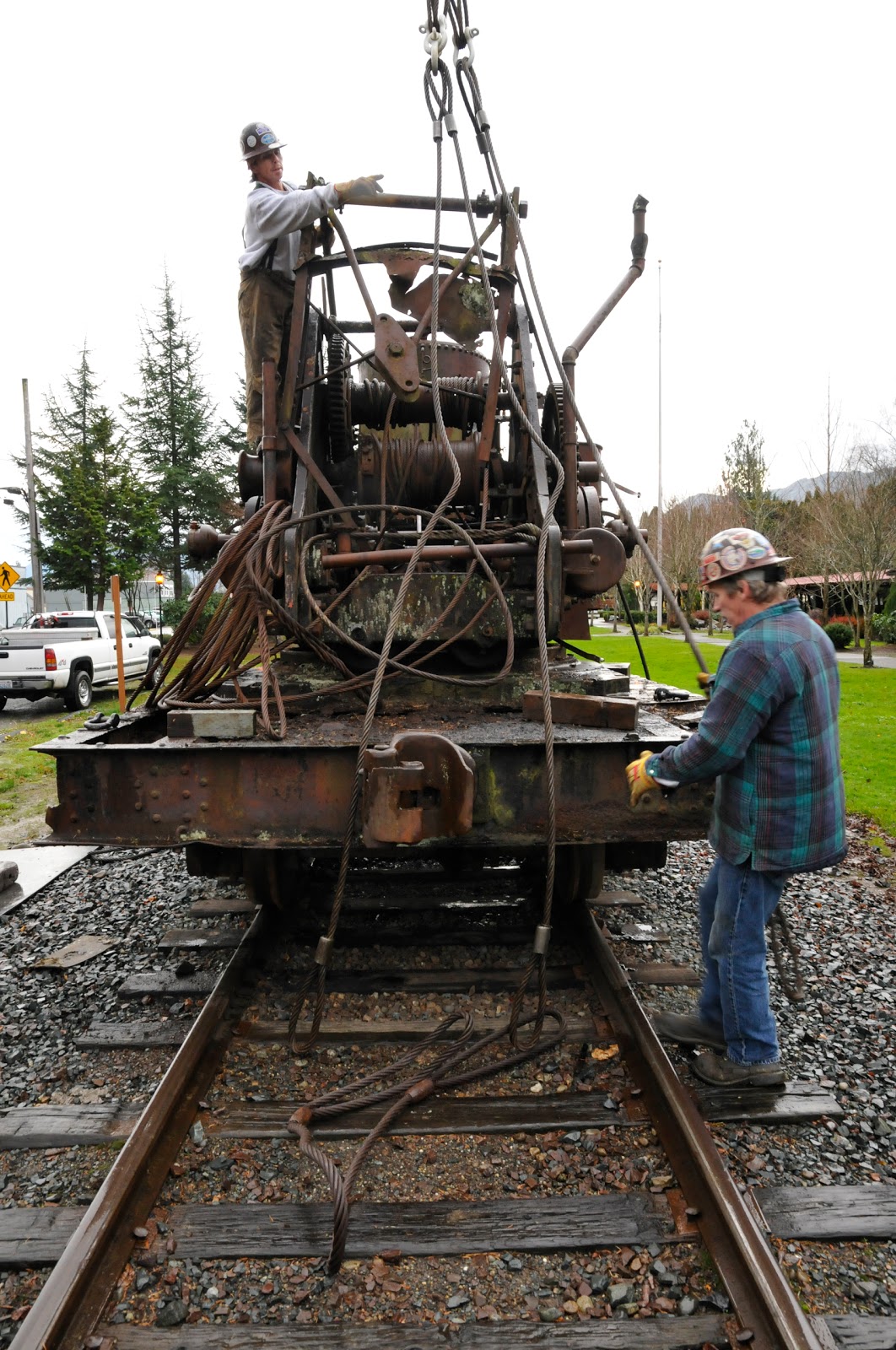
Recently a vintage steam crane was traded (more on that in a later post) to a business in Ballard, a neighborhood in the City of Seattle.  There, the crane will become the focal point in a new French bistro-themed restaurant.  Historically, the circa 1903 steam crane was used at a lumber mill in Everett, and had some other (unverifiable) contributions to history too.  Unfortunately, it was one crane too many for the Northwest Railway Museum.

Adaptive reuse is the process of retasking a building or object.  It allows something that may have outlived its usefulness and repurposes it for something else.  So an old school could become condominium housing.  An old caboose could become a cottage or office.  And a coal-fired steam crane could become the focal point of a new restaurant development where it supports an outdoor canopy.
Jon poses with steam crane.
Jon Burget poses with
his new acquisition.

Snoqualmie’s own Imhoff Crane was hired to lift the vintage crane – all 45,000 pounds of it – and Seattle’s Ballard Transfer was hired to transport it.  The move took most of a day and no doubt turned some heads on Interstate 90.
Congratulations to Jon Burget of Pavingstone Supply Inc on the acquisition of this interesting historical object for his new restaurant.  When he opens next summer, Spike will broadcast the date, time and place so you can see adaptive reuse in action! 

Wednesday, November 21, 2012

New marketing director appointed

The Northwest Railway Museum is pleased to announce the appointment of a new team member.  Jennifer Osborn has joined the Northwest Railway Museum as the new Marketing Director. She is replacing Sue VanGerpen who after serving more than six years left the Museum earlier this month to accept a position at another Valley business.

Ms. Osborn arrives at the Museum via the Snoqualmie Valley Chamber of Commerce where she performed the functions of Business Manager. She brings with her a wealth of community knowledge and connections.

Jennifer’s new responsibilities at the Museum include managing Snoqualmie Railroad Days, leading of the overall marketing effort, and community outreach.  Principally, Jennifer will be working with the Museum’s other key staff to update and implement the strategic marketing plan.  The plan will feature improved awareness for the Museum’s favorite annual events: Santa Train, Day Out With Thomas, and Snoqualmie Railroad Days.  It will also focus on building attendance throughout the year, especially for educational programming.

Ms. Osborn has a strong background in education.  Prior to working at the Chamber, she completed her Masters degree in Education, which included an internship in guidance counseling at Aviation High School in Seattle. She has also worked for the Snoqualmie Valley School District at Snoqualmie Middle School.

Jennifer was raised in Vancouver, British Columbia and always wanted to return to the Pacific Northwest. Her family has lived in the Snoqualmie Valley for the last eight years after relocating here from Carlsbad, California. Both of her daughters attend Mt. Si High School and are very active in their school community.
Jennifer is very involved in the local community.  She is a member of the Snoqualmie Valley Historical Museum Board and is a member of the Snoqualmie Valley Schools Foundation Board. The history and future of the Snoqualmie Valley are very important to her and make her a great fit for the Northwest Railway Museum.

Welcome aboard Jennifer!