Monday, June 16, 2014

Color for 218


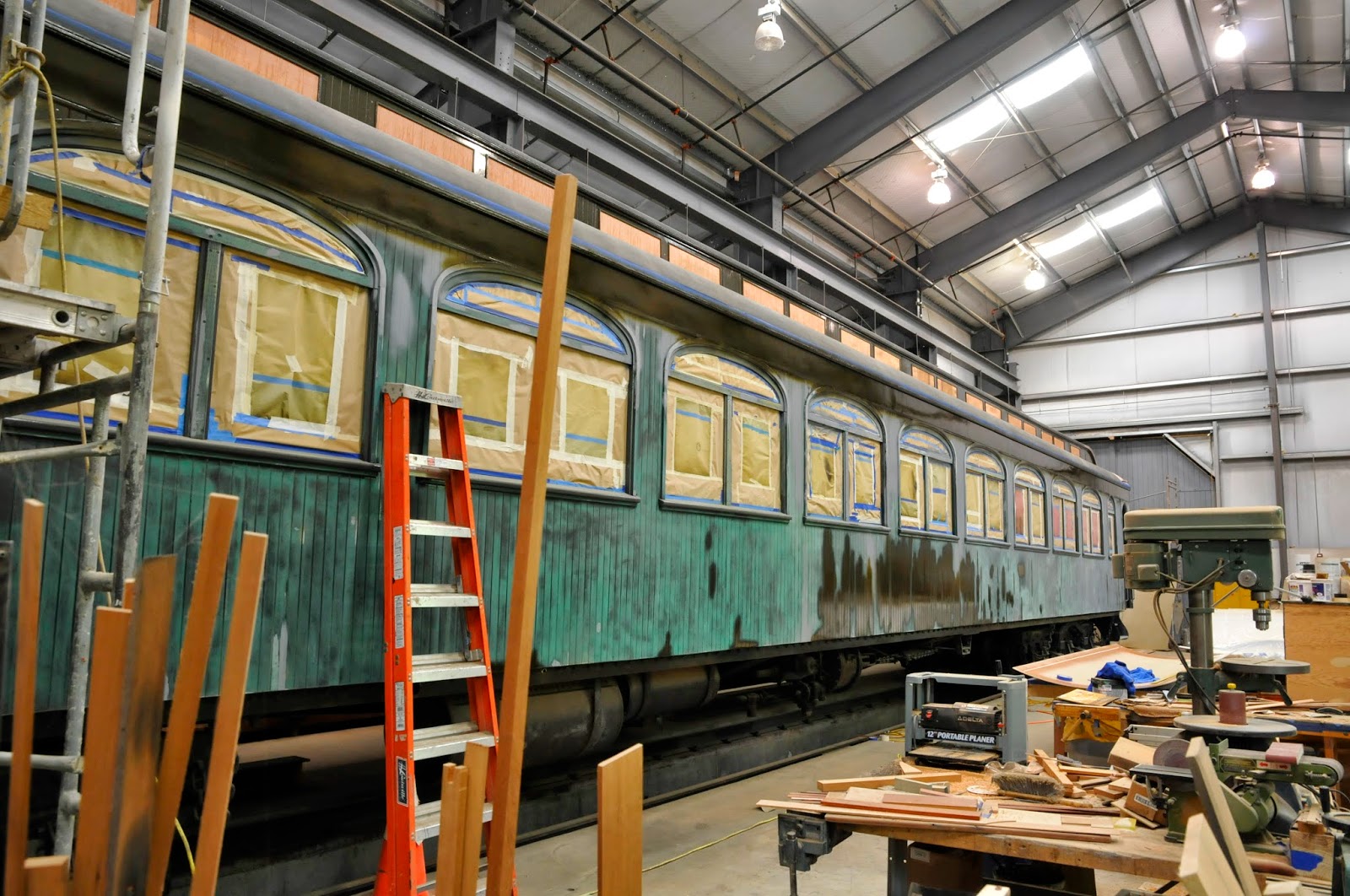
Coach 218 will be 102 years old this summer.  This Barney and Smith coach is one of the last wood coaches built for service on an American railroad.  It served the Spokane, Portland and Seattle Railway as a first class coach from 1912 through the late 1940s.

Over the last several years, coach 218 has received considerable attention from skilled volunteers and employees.  The most recent effort applied the "original" color to one side of the car.   The other side of the car will be completed in the coming weeks, but this latest effort was completed in time to debut on the annual Father's Day trains.

So what is "original" color?  It is a color matched to samples found under moldings in the vestibule. They were scanned by the paint manufacturer to create a formula for modern paint that can be mixed locally.  This dark green color was common on railroad coaches of the era and perhaps was best known as the color of most Pullman company sleeping cars.  Paint used on early 20th Century railroad coaches generally had a flat sheen and the gloss was added by applying a spirit varnish over the color coat, but that had to be re-applied each year.  The modern paint used on 218 is a two-component gloss urethane formulated for wood boats that should provide years of trouble-free service.

What is next?  Lettering.  218 was lettered "Spokane Portland and Seattle," originally in gold leaf, and later in imitation gold.  The number 218 appeared in four places, over each of the bolsters on each side of the car.

Rehabilitation of SP&S coach 218 is nearing completion after a multi-year effort incorporating 15,000 person hours and an investment of more than $250,000.  The project has been made possible in part with the generous support of 4Culture, The Snoqualmie Tribe, and the Nysether Family Foundation.

Sunday, May 25, 2014

Preschool and school train programs in 2014

May 20 marked the final day of School Train for 2014. This year the Museum hosted two full days of Preschool Train on April 29 and 30, and four days of School Train in April and May. The Preschool Train program is designed for children age 3-5. The School Train program is designed for grade 4, with a separate program for younger students and mixed-aged groups.

In 2014, 605 preschool children and adults attended the two day Preschool Train program. 631 children and adults attended the School Train program. So a total of 1236 people participated in the 6 days of educational programming this spring. In 2014 a large number of School Train participants were from small private schools, although there were attendees from the Federal Way, Renton, Lake Washington school districts. School Train is also popular with families that home school and this year was no exception.

School Train activities included a history intense grade 4 program, where students study primary source documents (census data and historic photographs) to learn about Valley life in 1890 and how the railroad changed everything here in the Pacific Northwest. Younger students and mixed-age groups were rotated thru three short activities that included Signs and Signals (all about ways we communicate with trains), a docent-led Depot tour, and a fun craft (decorate your own bandana) that doubled as a take-home. Students enjoyed coloring the bandanas while the educator enjoyed making the students first explain the historic role of bandanas on the railway. The program concluded with a 60 minute journey upon the Snoqualmie Valley Railroad, wherein students follow in the footprints of history, riding the same rails as those who traveled by train to the Snoqualmie Valley in the 1890s.

The Preschool Train program is similar, in that it includes rotation thru short age-appropriate activities followed by a 35 minute long train ride. (Preschool train is a 90 minute program whereas School Train is a 2 hour program.)
A special thanks to all the volunteer docents who helped with this educational programming, and to the running trades volunteers who operated the train!

Sunday, May 18, 2014

White glove team

The Northwest Railway Museum was honored to host a Reinforcement Crew event on May 17.  The Reinforcement Crew is a team of museum collections professionals from the Registrars Committee of the American Alliance of Museums ("AAM").  The AAM is holding their conference in Seattle this month and registrars from all over North American are visiting for this largest annual gathering of museum professionals in the world.

The Reinforcement Crew supports collections projects at small museums located in the annual conference host city. This 7th annual event selected five projects to support, including one here at the Northwest Railway Museum.   The Museum's project inventoried and boxed the collection of published material, which has been housed in the Snoqualmie Depot since the early 1980s.  This paper-based collection is being packed up and stored in preparation for its eventual relocation to the new Railway History Center library expected to open next year in Snoqualmie.  The new library will store materials in a temperature and humidity-controlled vault to help assure long term preservation.

Volunteers participating in the Northwest Railway Museum's project included Rebecca Engelhardt, Museum of Glass; Jessica Wilks, Tacoma Art Museum; Elizabeth K Mauro, Art Installation; Mell Scalzi, Museum of Arts and Design; Ariane Westin-McCaw, Nordic Heritage Museum; and Jeri Miller, Artech.  Participating from the Northwest Railway Museum were Cristy Lake, Peggy Barchi, Dennis Snook, George Houle and Spike.  Thank you to  all who participating!

During a seven hour work party, more than 120 boxes were filled with books and a detailed inventory of each box was generated and recorded.  Boxes were loaded into the Museum's coach 218, which has been undergoing rehabilitation and restoration in the Conservation and Restoration Center.  The 218 is nearly complete with a few weeks work on ceilings, some moldings and seats remaining to be completed. So it was a natural choice for transporting the library collection as it was not yet being used on the regular train, and it gave Museum staff an opportunity to evaluate the car's performance.  It also gave the visiting collections volunteers an opportunity to travel in rehabilitated coach more than 100 years old!

Monday, April 28, 2014

Give BIG to steam!

Steam at Snoqualmie Railroad Days!  That's the plan for this coming August 15 - 17 when the Santa Cruz and Portland Cement locomotive 2 will travel to Snoqualmie to operate under steam during the annual town festival.  Celebrating 125 years of excursion train service to Snoqualmie Falls, the 1909-built Porter locomotive will add considerable excitement to the working railway in the upper Snoqualmie Valley.  Your contributions during GiveBIG on Tuesday, May 6 will help make this plan a reality, but they must be made through the Museum's page on The Seattle Foundation's web site here.  Contributions up to $5,000 will be partially matched from The Seattle Foundation's stretch pool too, and may even qualify for a bonus contribution called a Golden Ticket!

GiveBIG is the annual charitable giving event organized and supported by The Seattle Foundation.  Each of more than 1,600 charities including the Northwest Railway Museum are eligible to receive contributions and their pro rata share of the stretch pool received between midnight and midnight on Tuesday, May 6, 2014.

Help bring a real, live steam locomotive to Snoqualmie Railroad Days by participating in GiveBIG on May 6!
With your GiveBIG support, Santa Cruz and Portland Cement #2 is coming to
Snoqualmie August 15 - 17.  Photo courtesy of S. Pappas.

Thursday, April 24, 2014

Celebrating 125 years of passenger trains

2014 is a big year for the Snoqualmie Valley!  This summer is the 125th anniversary of passenger train service to the valley.  On July 4, 1889 the inaugural run was a day trip from the foot of Western Avenue in Seattle to Snoqualmie Falls.  The excursion was operated by the ME Church Society over the lines of the Seattle, Lake Shore and Eastern Railway Company.  

125 years later, the Northwest Railway Museum continues the tradition of train excursions to Snoqualmie Falls. To kick off the celebration, the Museum will operate a commemorative train on July 4. Then we have something even bigger planned to celebrate.  We’re letting off a little steam (not blowing smoke!) by bringing a real, live steam locomotive to operate at the Museum during Snoqualmie Railroad Days, August 15 – 17.

Santa Cruz and Portland Cement #2,
built by H. K. Porter in 1909.   Photo
courtesy of S. Pappas.
The Santa Cruz and Portland Cement locomotive #2 will travel to Snoqualmie on a highway truck. Owner Efstathios I. Pappas will be bringing the locomotive to Snoqualmie from another museum event in California.  It will pull the Northwest Railway Museum's passenger train Friday through Sunday - watch for special train schedules that will be announced this summer.

The visit of this Porter-built steam locomotive will celebrate the continuing passenger train excursion service to Snoqualmie Falls, but it will also help the Northwest Railway Museum prepare for a steam program of its own.  The experience will "plant the seed" for a long-term, sustainable program.  Cost, however, will not be for the faint-of-heart.  Transportation of the locomotive, fuel oil and lubricants, and even water will cost thousands of dollars.  

Your support can make this a reality!  Make your contribution through GiveBIG, the annual charitable giving initiative of The Seattle Foundation and you can "stretch" at least some of your donation. All contributions up to $5,000 made on May 6 will be partially matched by The Seattle Foundation.  So plan to visit the Museum's Seattle Foundation donation page on May 6, 2014 and help make this project a reality!  
Santa Cruz and Portland Cement #2 pauses under steam. Photo courtesy 
of S. Pappas.

Friday, April 18, 2014

Crossing gate retired

One of the aspects of railroads that Spike finds particularly interesting is the longevity of many fixed assets.  Bridges, depots, and even rails are frequently in service for many decades, and in some instances for more than 100 years.  Electrical apparatus, however, are not things you often see with long service lives, but there are exceptions. 

The Museum recently retired a railroad crossing gate mechanism that was placed in service in 1953, reportedly on either the Great Northern or Northern Pacific Railway here in Washington State. It was received in a donation from the Burlington Northern in 1977 and installed on Meadowbrook Way SE in Snoqualmie.

The Griswold-built device was manufactured in Minneapolis by the precursor to today's Siemens Rail Automation.  This device is known in the industry simply as a model EM gate, and was replaced with a much newer device of the same design that was rebuilt by the Museum's signal maintainer Jon B.  Rebuilding included new wire, a new relay, repainting, new lights, new cross bucks and more.  Total financial investment was modest but an estimated 175 person hours were invested in the project.

The original device served the Museum well but the mechanism was badly worn; replacement was the only practicable option.  The newly rebuilt device will easily serve for twenty or more years thanks to the efforts of Jon and others at the Museum.

Come and see it in operation for yourself - trains operate weekends through the end of October.  Check out schedules and fares on the Museum's web site at www.trainmuseum.org

Monday, April 14, 2014

Coach 218 interior paneling

Wall paneling is cut and fit inside
coach 218.  Veneers have at least nine
coats of shellac.
Spokane, Portland and Seattle Railway coach 218 has been undergoing rehabilitation and restoration in the Museum's Conservation and Restoration Center.  Reports detailing this work have appeared in this blog for several years; the last report detailed the new floor.  Recently, crews began fitting interior paneling into the car, a tedious component of work that will take many weeks to complete. 

New and recovered mahogany veneers have been pressed onto new plywood cores using the Museum's vacuum veneer press.  Some veneers were removed from original but damaged solid core plywood.  Replacement veneers were acquired from Edensaw, a specialty hardwood supplier.  The flitches were carefully laid out and trimmed to match along each edge.  Special veneer tape was used to maintain indexing while glue and pressure was applied.
There are 43 windows in coach 218 so
there are a number of window panels.

After curing the adhesive, the veneer was colored using a 2% solution of potassium dichromate, an old but effective technique for darkening the wood and drawing out the figure.  Following a drying period, "varnish" was applied, which consists of nine or more coats of shellac. 

Shellac is a natural finish made by dissolving buttons of shellac in alcohol, and is available with semi-transparent color that ranges from clear to black.  (The buttons are made by melting the secretions of the lac bug collected from trees in India and Indonesia.)  It is the traditional interior finish used by the Barney and Smith Car Company on coach 218, but also chapel car 5 Messenger of Peace.

Coach 218 is using  a shellac variety called "ruby." which not coincidentally possesses a reddish hue.  However there can be considerable variation in the appearance of wood so the coach 218 crew has used other varieties of shellac when panels are too light or too dark.

There are many hours of effort remaining to fit all the panels but this stage represents an important and long-awaited milestone.