Friday, August 14, 2015

Steam locomotive 924 insulation removal

Locomotive 924 is a six-coupled, former Northern Pacific locomotive.  It is held in the collection of the Northwest Railway Museum and beginning in November 2014 rehabilitation work has been underway.  The objective is to return the 924 to its former glory and operate it on the Museum's railway between Snoqualmie Falls and North Bend. 

924 ready for insulation removal
Urethane foam was used to seal weak
areas until the removal project was
ready to begin.
Since the fateful day last November when the locomotive was pushed into the Conservation and Restoration Center, the boiler interior has been stripped of tubes and scale, the Form 4 engineering package begun (regulatory requirement for operating a steam locomotive), new firebox side sheets fabricated and welded in place, a new all riveted tender cistern fabricated, the tender frame rehabilitated for service, and tank installed on the frame.  However, a major hurdle for the completion of the boiler work remained the locomotive's jacketing and insulation.  In order to complete the Form 4 process, the exterior of the boiler had to be stripped for visual inspection, and the final ultrasonic thickness data collected.  

Director Anderson and
Curator Pappas wore
elaborate protective
equipment.
Preliminary testing determined that the insulating material was a form of asbestos, commonly used for locomotive boiler insulation, but now found to be harmful to human respiratory systems, causing malignant cancers, formation of plaques that inhibit lung function, and a host of other nasty, potentially life-ending conditions. Needless to say, the work of removing this material needed to be performed in a safe manner for everyone involved.  Hiring a remediation contractor is quite expensive, and it was the suggestion of volunteer Zeb Darrah to obtain the necessary training and certification to legally conduct the remediation in house.  He recommended several potential training programs, and did the majority of the preliminary fact finding for the legalities of doing this work in house. In preparation for this museum director Richard Anderson and curator Efstathios Pappas received training from Argus Pacific, a private firm that specializes in hazardous material handling training.  

Edwin from Global Asbestos
Contractors checks verifies
the entry door seal on the
containment structure.
In early August, remediation work began working with Global Asbestos Abatement, a licensed asbestos contractor.  By partnering with this firm, valuable advice and experience was available to the team, but perhaps more importantly the necessary equipment to complete the job safely and effectively.  

A double-wall containment structure
was built over locomotive 924.
Over the course of three days, the mandated double wall containment was constructed of polyethylene sheeting, and taped so as to be air tight to a minimum of -.018 inches of mercury with HEPA negative air machines running.  A three stage decontamination chamber was built and attached to the front of the enclosure, and pre-abatement samples taken so as to demonstrate a clean and safe working environment, and provide comparison for the post abatement samples.  All work conducted in the enclosure was accomplished using full face respirators with external supplied air, full coverage Tyvek suits, as well as appropriate personal protective gear such as hearing protection, gloves, etc.  

Insulation is sprayed with water prior
to removal to reduce the likelihood
that fibers will be introduced to the
atmosphere.
The removal of the jacket and insulation took approximately a day and a half to remove and safely bag for disposal.  Although the original jacket was in very poor shape, the reason for involving trained museum professionals in the actual remediation was highlighted in the data collected that will be useful as rehabilitation of the locomotive continues.  Hardware such as boiler band brackets, washout plug ferrules, and other assorted hardware was removed, cleaned and saved for reuse.  In addition, various samples of trim treatments, riveting of jacket panels, etc were also saved, and will allow the team to match the original methods of construction as closely as possible.  Illustrating how this benefits the Museum was a discovery made on the inner surface of the jacket located just beneath the hydrostatic lubricator bracket: an uncorroded patch of the original American Iron boiler jacket surface.  Samples such as these are rare because the oxide finish of both Russian and American Iron was extremely prone to corrosion and loss if not kept continuously oiled.  Curator Pappas noted the extremely oil soaked appearance of the jacket and insulation in this area due to frequent overfilling and leakage of the hydrostat over many decades of service, and was particularly mindful of the potential presence of an unadulterated sample.  

Clean boiler!
Following the removal of the material, the arduous process of cleaning all surfaces of the locomotive and containment began.  The next three days were required to assure the successful completion of the job.  The surface of the boiler was rough due to surface corrosion, and provided an ideal surface for asbestos fibers to be trapped and potentially endanger individuals working on the locomotive in the future.  To avoid this possibility, all flaky rust was removed with a chipping hammer and wire brushed while moistened to clean the surface.  More aggressive methods such as needle gunning and wire wheeling are usually not employed as these can raise the concentration of fibers in the containment to unsafe levels, even with full face mask protection.  After this step, all surfaces of the locomotive and containment were vacuumed using a HEPA vaccum cleaner, and all debris double bagged and removed from the containment.  Although this may sound like a relatively simple matter, the work in full protective gear on a hot summer day can be exhausting!

After the insulation was double bagged
and removed, the enclosure room was
cleaned and locked down. An air
sample was collected during a two
hour interval to verify that there was
no airborne fibers prior to removal of
the containment.
Once everything was cleaned, a final wash down with water was conducted over every surface.  The water was then collected below the engine, and pumped through approved water filters to remove any asbestos micro fibers.  All of the secondary inner walls of the containment were sprayed with a fixative called Lockdown, taken down, rolled, and double bagged for removal.  Then all primary surfaces were also sprayed with lockdown and clearance air samples taken.  This last step is critical to assure the safety of anyone in the shop, as once the containment is breached, any contamination will remain.  After the samples were examined by a third party local laboratory, air quality was found to be ideal, with the lowest presence of asbestos recordable!  

Although a great deal of time and effort was expended to conduct this remediation, the money saved, and opportunities for artifact care and documentation were worth the effort.  With this work completed, it is time to finish the boiler work and proceed to the running gear.  Look for more updates soon as Snoqualmie rings with the sounds of heavy boiler work again!  Until then, we hope to see you all in Snoqualmie.  

Monday, July 6, 2015

Tender tank gets wheels

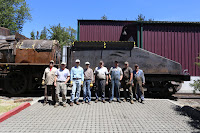
Tender tank project volunteers and staff pose with the new tank on the tender frame.A major milestone was achieved on the Northern Pacific Railway steam locomotive 924 last week: substantial completion of the new cistern (tank) for the tender.  For more than five months, a replacement tender tank has been taking shape on the floor of the Conservation and Restoration Center.  Other than a couple additional baffles and the rear coal board, all structural and seam riveting was completed such that is was time to move on to other aspects of the project.  The tender frame had already been rehabilitated and prepared for placing the tank some weeks before.  

During this phase of the project, additional research determined that this tender frame is actually far more ancient than the locomotive and tank.  The tender frame and trucks were originally built for a Northern Pacific 4-4-0 C class locomotive in the early 1880s, predating the construction of 924 by more than 15 years.  Later in 924's service life for the NP, the original frame and trucks were replaced by the running gear from one of the many 4-4-0s that were being retired in the 1910s and 1920s.  Contemplating the implications, this tender frame hardware and trucks were potentially in service prior to completion of the Northern Pacific as a transcontinental railroad!

Remachined bottom valve installed on bottom of new tank.
Before the tank could be placed on the frame, the water valves at the ends of the water legs needed to be remachined and installed in the floor of the tank.  The lack of access and upside-down nature of this work would have made it very difficult to install once the tank was in place.  The valve bodies were faced, bored, and valve seats recut using one of Museum’s large lathes.  Then the valves were fitted into position, holes drilled in the base of the tank, and mounted.  
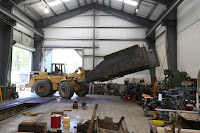
Large loader lifts new tender tank from floor in Conservation and Restoration Center.With the bottom valves in position, it was finally time to install the new tank on the tender frame.  Weber Construction is the Museum’s neighbor and is also owner of the local rock quarry.  Their repertoire of machinery includes large excavators and loaders that each can lift tens of thousands of pounds.  So Weber was hired to perform the lift and arrived Friday, June 26th with a very large loader with forks mounted on the leading edge.  The 16,000 pound tender tank was picked up from the floor, removed from the CRC and placed on the frame.  Everything fit perfectly the first time, and the total elapsed time from start to finish was just two hours!

A significant amount of work remains to be done on the tender before it is ready for service. The tank requires installation of the rear coal board, filler hatch, four small baffles, hand rails, rear headlight, additional seal welding, and interior and exterior paint.  And not to forget, large white numerals proudly displaying her number!  However, the shop floor is now open and uncluttered so that Museum forces can begin placing and powering up the new large machine tools that were acquired earlier in 2015.  This will allow work effort to slowly transition to the locomotive and its many needs.
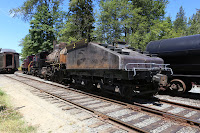
New cistern on tender frameThis achievement was made possible by the hard work and sacrifice of many museum volunteers and staff, and is a testament to the scale and quality of work that can be accomplished through teamwork.  At this time, there still remains much work to complete 924's return to operation.  However, the list just got a lot shorter!
 
 
--Special thanks to Dave Honan for taking photos of this special day, and to Stathi Pappas for providing the content of this post--


Tuesday, June 30, 2015

Steam trains return July 4 & 5!

Steam trains are returning to the Northwest Railway Museum on July 4 and 5, 2015!  The first departure is at 11:30 AM from Snoqualmie.  Tickets are $20 for adults, $18 for seniors, and $12 for children.  You can purchase tickets in advance and pickup them up at will call prior to boarding the train. There is no service charge for using the Museum's online ticketing system, and it will reserve space for you and your family!  So why wait?  Order here today!
 
Trains will be pulled by Santa Cruz Portland Cement steam locomotive 2.  There will be departures from Snoqualmie each day at 11:30 AM, 1:00 PM, 2:30 PM, and 4:00 PM.  Just a year into service after years of effort were expended restoring this early 20th Century gem, "The Chiggen" is ready to steam for the weekend. This will be the last weekend of regular trains before Thomas the Tank Engine visits Snoqualmie so come and ride the line in style, behind SCPC 2!

Tuesday, June 16, 2015

Peruvian sister city visit

The City of Snoqualmie recently formed a sister city relationship with Chaclacayo, Peru.  As part of the relationship, Snoqualmie is sending surplus firefighting equipment to that community located about 17 miles from Lima, Peru. To transport the gear from Snoqualmie to Peru, officials in both countries worked to arrange a visit from a Peruvian naval vessel. 
 
The BAP Villavisencio (FM-52) arrived at Seattle’s pier 66 on Tuesday, June 9 for five day visit, and its complement of officer cadets were bussed to area attractions as part of their ongoing education and outreach.  During the visit, approximately 50 cadets with their captain and commanders enjoyed a short excursion to Snoqualmie Falls aboard the Museum’s railway.

 
Captain Jose San Martin along with Commanders Luis Maury and Daniel Herrera rode along with locomotive engineer David Olix to Snoqualmie Falls in the cab of locomotive 4012.  So it was more than just cadets that had memorable experience.

The visit was remarkable in a number of other ways, too.  It was a rare opportunity for North Bend Mayor Ken Hearing to also ride the train.  He was escorted by Washington 5th District Representative Marine Reserve Colonel Jay Rodne, who also had a hand in helping arrange the visit.

The Museum extends special thanks to Snoqualmie Sister Cities Association President Tina McCollum for arranging the cadet's visit to the Northwest Railway Museum.


Friday, May 29, 2015

Tender work will soon be behind us

The tender tank rehabilitation and restoration work for Northern Pacific Railway 0-6-0 steam locomotive 924 is drawing to a close!  The 19th Century Rogers-built locomotive is the subject of a major collections care effort inside the Northwest Railway Museum's Conservation and Restoration Center in Snoqualmie where the first order of business is the tender and its badly deteriorated water tank.  The building of a new riveted cistern for a steam locomotive is a lot of hard work, and is not often undertaken at heritage railroads. 

Erecting major components such as sides, ends, and slope sheets can usually be accomplished quickly. In the non-museum world, a similar vessel would be put together using modern fabrication techniques such as welding, and the project would have been completed months ago.  However, in order to adhere to the Secretary of the Interior Standards for Treatment of Historic Properties, façadism is not an acceptable practice. Instead, it is critical to reuse original fabrications and components to the greatest extent practicable, and when infeasible, faithfully recreate the missing or irreparably damaged fabrications using materials and techniques consistent with the original.  So for the tender cistern, every rivet has been or will be duplicated using the technologies of the era.  For instance, each corner seam  is riveted to an angle iron on both sides of the angle with 1/2 button head rivets on a 1 1/2" pitch requiring literally thousands of precision drilled holes. 

Since the last report, the top deck of the tender tank has been fitted and installed.  Historically, for this portion of the tank, flush head "Liverpool" style rivet heads were used for the majority of the work.  This was done so that coal could be scooped from the top deck without hitting the higher "button head" style rivets.  This feature has been faithfully reproduced on the new tank. 

In addition to the structural riveting, the tank continues to receive original castings and forgings with the installation of tie down brackets and hand rails. The side coal boards were also added, giving the cistern that iconic 19th Century everted lip tender look.  Moving forward, this coal board will soon be extended and wrap completely around the rear of the top deck, and the original water hatch will be rehabilitated and installed. 

In addition, to the ongoing cistern work, the tender frame has received attention for its return to service.  This frame had been extensively rebuilt in the 1970s due to an encounter with a runaway freight car while being stored in Centralia, WA, and most of the wooden framework remains in remarkable condition.  However, aesthetically the timbers exhibited surface weathering and other effects which would not present well in the final product.  In order to rectify these issues and assure many decades of trouble free service, the surfaces have been sealed and filled using epoxy-based fillers and sanded to fill any minor cracks and surface blemishes.  (This technique was extensively applied to chapel car 5 Messenger of Peace.) The frame will be primed with epoxy-based primer Awlgrip 545) and top coated with a finish coat of black.  Once this work is completed, the tank can be installed on the frame and bolted down.  Following this step, the tender trucks will be rebuilt so as to assure like-new performance from the tender. 

The 924's tender will be completed this summer.  At that time, work will shift to the locomotive boiler, running gear, and cab.  And the 924's tender just might see some early service in support of the Museum's steam program.


Monday, May 25, 2015

A final train excursion

On Memorial Day , everyone here at the Northwest Railway Museum honors, remembers and respects all those who lives were given in the service of our Nation.  This Memorial Day, the Northwest Railway Museum had the honor of providing a last train excursion for the memory of Marine LCPL Adam James White (ret.), who passed February 14, 2015. 

LCPL AJ White spent his senior year of high school in the Puget Sound area, and graduated from Skyline High School in Sammamish.  AJ enlisted with the Marine Corps in 2008 and received a medical discharge in 2011 as a result of injuries sustained in Iraq. He passed suddenly on Feb 14, 2015 leaving his wife Jessica and 3 small children, Addison, Mackenzie and Camden.

AJ's grandfather was a railway conductor who instilled a love of trains in him.  He received a military funeral at Marion National Cemetery in Indiana, and during the service, family and friends heard a train whistle blow in the distance. His aunt Rebecca McCauley appreciated that the Museum was operating Memorial Day trains and wanted to honor AJ with a Memorial Day train ride.  She arranged for a photo montage of the Marine to be placed in the window of Spokane, Portland and Seattle Coach 218.  That 1912-built coach carried the memory of LCPL White and traveled to and from Snoqualmie Falls on the last train of the day, Monday, May 25, 2015. 

Marine, thank you for your service to a grateful Nation. To LCPL AJ White's family, our sincere condolences for your loss.

Wednesday, May 20, 2015

SCPC 2 winter work

The Santa Cruz Portland Cement steam locomotive 2 ("SCPC 2") is at present the resident steam locomotive at the Northwest Railway Museum in Snoqualmie.  It is from the personal collection of Stathi Pappas, the Museum's Curator of Collections, and is the flagship of the developing steam program introduced at the Museum last year.  While the Museum's locomotive - Northern Pacific Railway 924 - undergoes a complete rehabilitation, the SCPC 2 is leading all steam excursions and is training new engine crew.  However, like all steam locomotives, an ongoing preventative maintenance and upgrade program is essential to sustainable success.  So this past winter, the SCPC 2 received some important attention.

First of all, a little about the 2.  In 2014, SCPC 2 ran over 1,000 miles on four different railroads across the west coast, and everything relating to her rebuild (completed in 2013) performed very well.  However, a few items were not addressed in the initial project as time constraints of the west coast tour just would not allow everything to be completed before departing for California.  These were remachining the piston rods, pistons and ring grooves, new piston rings, redesigned packing, new crosshead wedges, remachining and relining the crosshead guides, and remachining the crosshead slippers. Although there was no evidence of blow by, and the bores and pistons were inspected prior to being put in service, the author decided to finish these last few items before returning the 2 to service Memorial Day weekend.

In January the author and his crew of volunteers ("Team Chiggen") stripped the cylinder saddle of covers, crossheads, guides, pistons, etc and began the process of rebuilding.  In order to assure perfect concentricity and no taper of the piston rod, the best method of machining is to rough machine to round, then use a tool post grinder to assure surface finish and concentricity.  At the same time, the team turned the ring grooves, preparatory for new rings.  
 
The specification for engines this size is for a the ring groove to be .005" over the width of the rings to assure steam tightness.   Meanwhile, new rings were purchased from Niagara Piston Ring to specific dimensions. Although Team Chiggen is more than capable of making piston rings in house, it is less expensive to source completed rings than to buy the rough material to manufacture from scratch.

At the same time, the original rod packing on the locomotive left a lot to be desired.  The author had researched going to a La France style packing similar to what the Cumbres and Toltec, and the Durango and Silverton use on their locomotives, and found a very competitively priced version available through That Steam Guy.  This owner - though not associated with the seller - is quite happy with the product.  In response to more recent steam locomotive practice, also installed were four packing elements per side based upon the South African Railway and Chinese data for multiple packing elements rather than the more familiar two. 

While piston work was underway, Team Chiggen remachined and set up the crosshead guides in order to maintain perfect alignment of the piston rod within the packing gland to prevent premature wear of the piston rod, rings, pistons, and bores.  After the guides were machined and and temporarily installed, string lines were run through the bores perfectly in alignment with the cylinder and checked against the guides to assure parallelism.  

On the left side, all was well, but the right side (shown at right) required work to bring the guides into specification with the bores, thus demonstrating the necessity of doing this type of work, even if things "look ok."  

After a little effort, the piston, rod, and ring assembly were ready to re install on the right side.  Those with keen eyes will notice the presence of double rings in each groove.  The owner decided to do this rather than two wide rings due to the overwhelming evidence to support the higher sealing abilities of multiple narrow rings over wide ones.


Now, in order to assure the piston rod is running parallel to the bores and crosshead guides, the crosshead slippers themselves must be machined and fit to assure the center line of the tapered socket is in the right place.  The accompanied photos show one of the four remachined slippers ready for installation, and the entire assembly, straight and true, with a new machined crosshead wedge to assure years of trouble free operation.  

So after all this work, there is no better way to prove if it all works than to try it.  So last Sunday was test day: Team Chiggen fired the locomotive up, and put her on the head end of the last passenger train of the day.  Rest assured that diesel is in isolation, and the Chiggen is pulling the consist up the 1.2% grade to the top of Snoqualmie Falls. Everything performed admirably and the team called the test so successful, there was a second charge up the hill just for fun!

So for all of you in the local area, come on out this Saturday through Monday (Memorial Day Weekend) and take an excursion at Northwest Railway Museum behind the new and improved SCPC 2!  Fares and times are here.  And remember, there is full summer season of steam this year, and a variety of special programs including Snoqualmie Railroad Days in August, so check out the details on the Museum's web site at www.trainmuseum.org

A special thanks to Team Chiggen: John Graddon, Adam Phillips, Zeb Darrah, Karl Klontz, Nathan Iverson, Steven Hughes, Mark Speer, Mike Donnelly, Jason Hill, CJ Vargas, Bill Gejerstad, David Wilhite, Andy Walker, Ken Liesse, Jason Sobcynski, and many others who help make this all possible!

--SCPC winter work was a guest post by Northwest Railway Museum Curator of Collections Stathi Pappas--