Monday, January 26, 2009

Museum Volunteers tour local railroad landmark

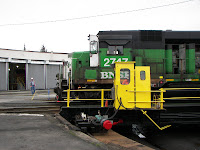
The combined contribution of over 8,000 volunteer hours recently earned four dozen Museum volunteers a rare experience. They had the opportunity to tour the Burlington Northern Santa Fe (BNSF) Railway’s Interbay Locomotive Shop and learn about the art of locomotive maintenance. The tour was organized by Justin Q., an Interbay employee, and BNSF retirees Dan O. and John H. who conducted the tour and answered questions.

The policies concerning visitors on railroad property have changed a lot in the past decade and BNSF rarely approves tours of its facilities. Interbay features an active roundhouse (built in 1929 for the Great Northern Railway), one of only two remaining in Washington State. The ability to learn Interbay’s role in supplying modern, reliable, well-maintained power coupled with a rare glimpse inside a steam-era structure made the tour a special outing.

Dave M., BNSF Interbay Shop Superintendent, approved the tour while Power Desk Foreman Wayne P. accompanied the museum visitors. After signing in, guests had a chance to look over a collection of books, photographs, rule books and pamphlets pertaining to Interbay’s history. A comprehensive safety briefing was held before the tour began; special boots and protective gear were required too.

A highlight of the tour was a ride on the 112 foot turntable. The tour included a look into the Maintenance Building, and a walk around the service tracks where locomotives are cleaned, supplied and inspected. The group toured through the entire roundhouse, getting a close look at the back shop, giant drop pit and tables, and the middle section (with its truss rod roof construction). The diesel house, where multiple level ramps allow workers access to every part of a locomotive, was next. Museum Volunteers also had a chance to look into the carbody of a 1970s vintage road locomotive called an SD40-2 to see how components are laid out.

It is noteworthy that one of the country's most successful railroads has kept the Interbay Roundhouse in service for 80 years and it remains a useful tool.

(Thanks to Ray Rhodes for this guest post.)

Friday, January 23, 2009

Boxcars for almost everything

Once upon a time, nearly everything moved in a boxcar. Grain, finished lumber, automobiles and parts, tools, house wares, clothing, aircraft parts, and nearly everything else imaginable could be found moving in a boxcar. Today, containers have replaced boxcars in most applications but a few remain in service for special applications such as newsprint and pulp. A few of the classic boxcars survive in museums including the Northwest Railway Museum.

The Museum has several great examples of typical boxcars and one of them is in the Conservation and Restoration Center for some rehabilitation work. Skilled workers of the Northern Pacific Railway built boxcar 14794 in September 1932 at their Brainerd, Minnesota shops. It has 80,000 pounds capacity and is 40 feet long; it was part of an order of 500 cars. It features composite wood and steel construction, and has a classic rolling corrugated steel door. The t & g roof is clad with interlocking sheet metal to keep the inside dry; this was a relatively new innovation in 1932. Much of the design and construction is simple but robust, which allowed it to serve the Northern Pacific Railway for an astoundingly long period - nearly 50 years!

Rehabilitation work is replacing the fascia board along the top of the car side (see old and new comparison photo to the left), and is injecting all other deteriorated wood with epoxy. Wood and steel surfaces are being prepared and coated with appropriate primer (gray Awlgrip for the wood) and top coated with an appropriately tinted boxcar red.

Thanks to Rich W. for historical data used in this post.

Wednesday, January 14, 2009

Neighbors helping neighbors

As recovery from the recent flood event proceeds, I am thrilled by the sight of people helping each other by volunteering their time and energy. Over 100 volunteers have turned out in Snoqualmie. They go door-to-door, helping residents pull out carpeting and haul furniture and water-soaked belongings to the curb for pick up. Trucks circulate through town, picking up refuse and hauling it to the corner of King Street and Railroad Ave, where heavy equipment is used to load it into dumpsters. The phone calls offering volunteer assistance and donations of household items are still pouring in. The volunteers come from church and civic groups, from the nearby communities of North Bend, Issaquah and Sammamish, from Snoqualmie itself, and even further afield from Redmond and Seattle. Not only have they already been working side by side with City of Snoqualmie staff and local residents, but even more volunteers are already signed up to help this weekend.

Volunteers and City of Snoqualmie staff have been helping pick up debris along the Museum’s right-of-way. Last Sunday, for instance, 10 community volunteers collected debris from along the track that filled more than 12 steel 55 gallon drums. In the days ahead, the Museum will continue clean up of the track, the CRC, and perform track and signal repairs. We are all so grateful for the help and support, but remain mindful of the tremendous effort and continuing need that will go on for weeks and months.

This was a flood of historic proportions. The tremendous positive response by our neighbors should also be noted. It will almost certainly allow us to recover in time for our regular trains in April.

Saturday, January 10, 2009

Damage assessment begins

Wow. Two 100 year floods in just two years. That's our reality. The Northwest Railway Museum completed the last of the flood damage repairs from the November 2006 flood in April 2008. Now new track washouts dot the Museum's railway line between a point just east of the new Conservation and Restoration Center and a point just west of the Snoqualmie Parkway. This is about 2 miles in all. (The attached image shows bridge 33 over Kimball Creek, but still partially submerged. When the flood crested, there was about 2 feet of water over the bridge deck. If you click on the image it will display a larger version. Click here to see additional photos on the web site.)

There is some really good news: there is no damage to either the Snoqualmie Depot or the Conservation and Restoration Center. The Depot did not get any water and the Conservation and Restoration Center got just a trace (less than 1/2 inch) that weeped in the cutouts for the rail. So some floor areas have to be sprayed with a bleach solution to disinfect but today the building is back in use for collection care work.

Now the bad news: there is work scheduled on the locomotives and coaches that needs to be performed inside the Conservation and Restoration Center where there is protection from wind and rain. But they are sitting in front of the depot so the track will have to be repaired before any work can take place.

Recovery will probably be slower than we all wished but we are planning to have full service restored in time for the regular season of train excursions in April. However, we can always use help so give a call or drop a note to the director Richard A. or the volunteer manager Jessie C. or the collection care manager Bill H. Please click here for their contact information.

Wednesday, January 7, 2009

Major flooding hits Snoqualmie and the Museum

A major flood is occuring in Snoqualmie. Today is 7 Jan 09 and there are near-record water flows on the Snoqualmie River that have put nearly 2 miles of track and two timber trestles under water. Unfortunately, Google's Blogspot - a free service that hosts this site - is having technical problems today and it is not possible to post photos. However we have posted some more information and several photos on the main web site here.

We will try to post updates on the web site to the extent practicable but power is now out in Snoqualmie and this is being posted using an emergency generator.

The Museum including the Snoqualmie Depot and the Conservation and Restoration Center will be closed until at least Friday afternoon.

Wednesday, December 31, 2008

Join our volunteer staff

Yes you can volunteer year ‘round!

Just because the interpretive railway and its public train excursions takes the winter off, doesn’t mean our volunteers do! Before there was a Conservation and Restoration Center (CRC), collection care had to take the winter off because of the weather, because who likes to work outdoors?! Nowadays, those projects carry on, even in the worst of what Old Man Winter throws at us. Before Christmas when night temperatures dropped to a chilly 6 degrees, it never dropped below 45 degrees in the main work area.
This winter at the CRC projects include rehabilitation of coach 218 (work underway includes installation of new floor sills, replacement window posts, and new carlins) as well as maintenance of locomotives 4012 & 4024 and coaches 213, 276 and 272. Collection Care Manager Bill Hall is at the CRC Wednesday thru Sunday. There are two ways to get involved: if you are an existing volunteer, call Bill directly at (425) 888-3054, or if you would like to become a volunteer, call or email Volunteer Manager Jessie Cunningham at (425) 888-3030 x 204 or email jessie at trainmuseum dot org. There is a brief application process.

Come spend the winter with us at the CRC and help perpetuate our railroad history!

Monday, December 29, 2008

Funding the Museum

We’re often asked how the Northwest Railway Museum is funded, and perhaps more to the point, people want to know how donor funds are “invested” in the Museum. This is a great question, particularly in light of the recent awareness of how some investor-owned businesses have been spending investor money. So here it is: unless otherwise directed by the donor, contributions are invested in new facilities and in collection care. However at this point in the Museum’s history, it is really in the facilities where donors can make the biggest difference.

The Conservation and Restoration Center is one such facility and it was completed in 2006 at a cost of $2.4 million after years of permitting and fundraising. This collection care facility is allowing the Museum to perform some truly awesome work on really important objects. Caboose 001, built by White River Lumber in 1945 is an example and is shown here in a 2008 post-rehabilitation photo. Incidentally, donor funds paid for materials and over 5,000 volunteer hours performed the rehabilitation.

The next facility will be an exhibit building to place large objects such as locomotives and coaches inside, out of the weather. This 25,000 square foot facility will revolutionize how the Museum preserves and exhibits its collection. This project is expected to cost approximately $3.7 million (exact cost will be determined in a bidding process) and $2.7 million has been pledged or received.

So how can supporters contribute? The Museum’s web site has a secure donation page here. There is also the Giving Express program through American Express that can be used to donate cash, or even membership rewards points. And you can always visit in person – the Depot Bookstore is open every day except New Years, Christmas and Thanksgiving – and speak with a real person. But you don’t have to give money to be a supporter. You can volunteer, come and participate in programs, or simply tell your friends and family about what we are doing and why you believe in it. Thank you!